
There’s something undeniably magical about watching a movie under the stars—blankets spread out on the lawn, popcorn in hand, friends gathered around as the opening credits roll. Backyard movie nights have surged in popularity, and with them, the demand for compact, portable projectors has exploded. Mini projectors, often no larger than a hardcover book, promise theater-quality entertainment at your fingertips. But are they truly capable of delivering a satisfying experience, or are they little more than overpriced gadgets that look good on paper?
The answer isn’t a simple yes or no. It depends on your expectations, setup environment, and how you plan to use the device. While some mini projectors deliver surprisingly solid performance, others fall short in brightness, clarity, and audio quality. Understanding what these devices can realistically offer—and where they cut corners—is key to deciding whether one belongs in your outdoor entertainment toolkit.
Understanding Mini Projectors: What They Are and How They Work
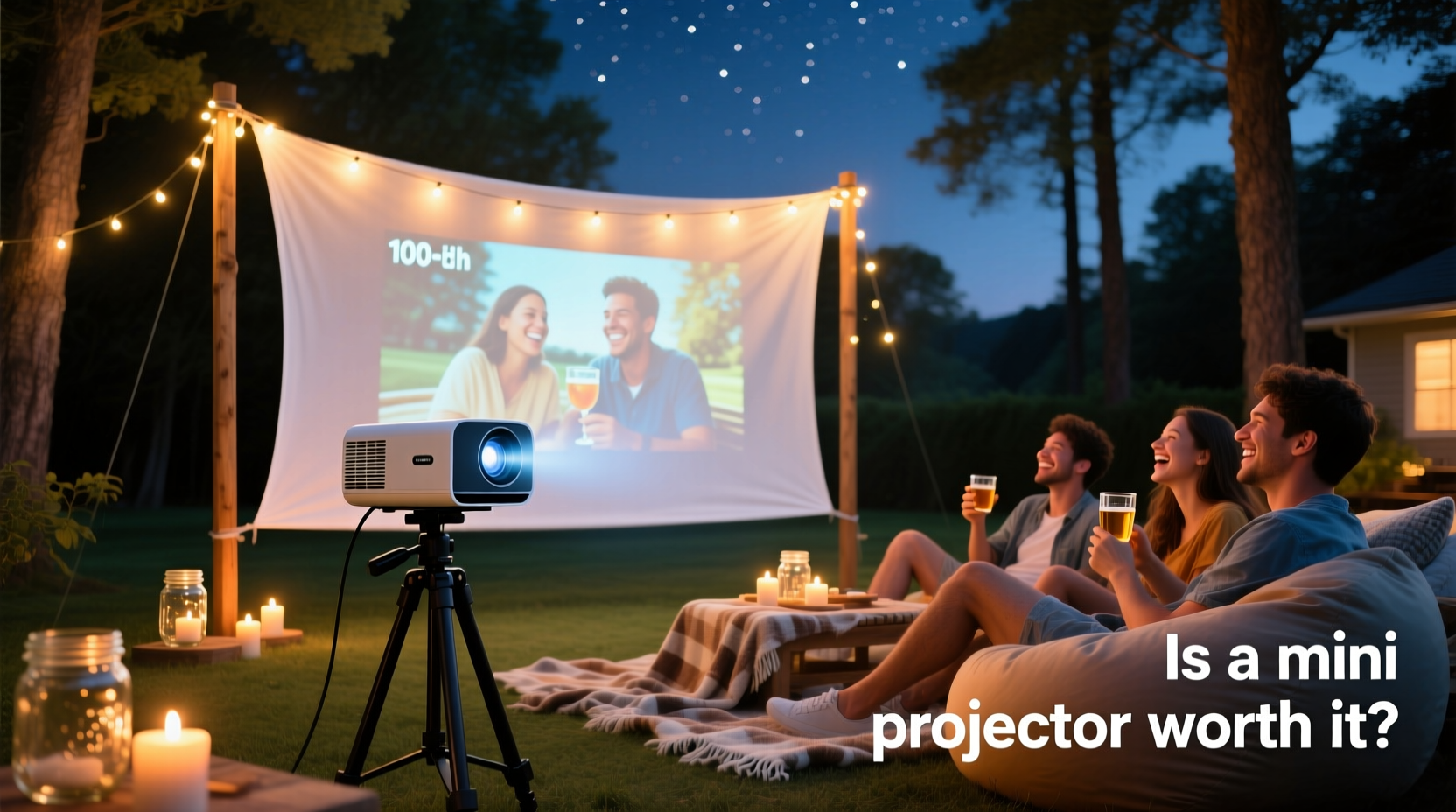
Mini projectors, also known as pocket or portable projectors, use digital light processing (DLP) or liquid crystal on silicon (LCoS) technology to project images from a source like a smartphone, laptop, or streaming stick. Unlike traditional home theater projectors, which are bulky and require permanent mounting, mini projectors prioritize portability and ease of setup.
Most models today support HDMI, USB, and wireless connectivity via Wi-Fi or Bluetooth. Some even come with built-in Android operating systems, allowing direct app access without an external device. Resolution varies widely—from 480p on budget units to native 1080p on premium models—but many advertise “4K support” through upscaling, which doesn’t equate to true 4K output.
Brightness is measured in lumens, and this is where most mini projectors struggle. While high-end home theater projectors range from 2,000 to 3,500 ANSI lumens, many mini projectors max out at 500 lumens or less. This makes them highly sensitive to ambient light, limiting their effectiveness to dark environments—ideally after full sunset.
“Mini projectors excel in convenience but compromise on core performance metrics like brightness and contrast. They’re best suited for casual, low-light viewing—not cinematic replication.” — David Lin, AV Equipment Analyst at HomeTheaterReview.com
Pros and Cons: Is the Trade-Off Worth It?
Before investing in a mini projector, it's essential to weigh its advantages against its limitations—especially when used outdoors, where environmental factors play a major role.
| Advantages | Disadvantages |
|---|---|
| Portability: Lightweight and easy to carry; ideal for spontaneous setups. | Limited Brightness: Struggles in any ambient light; requires near-total darkness. |
| Quick Setup: Most models connect in minutes with minimal cables. | Lower Resolution: Even “HD” models often fall short of full 1080p clarity. |
| Built-in Features: Many include speakers, battery power, and streaming OS. | Poor Audio Quality: Built-in speakers are tinny and lack bass; external sound needed. |
| Affordable Entry Point: Prices start under $200 for basic models. | Short Lamp Life: LED sources last longer than traditional bulbs, but still degrade over time. |
| Versatility: Can be used indoors, at campsites, or on patios. | Focusing Challenges: Manual focus wheels can be finicky; auto-focus is rare. |
The trade-offs become especially apparent during backyard use. While the idea of setting up a screen between two trees sounds idyllic, real-world conditions—like residual twilight, streetlights, or neighbor’s porch lights—can wash out the image significantly. In such cases, even a 700-lumen projector may fail to deliver a crisp picture.
Real-World Use Case: A Family Movie Night Tested
The Thompson family in Portland, Oregon, decided to test a popular mini projector—the Anker Nebula Capsule II—for their monthly backyard movie night. With two kids and frequent guest visits, they wanted a flexible solution that didn’t require permanent installation.
They purchased the $500 model, which boasts 700 ANSI lumens, 1080p resolution, Android TV, and a built-in 16W speaker. Their setup included a 100-inch pull-down screen mounted on a patio wall and a Bluetooth subwoofer for enhanced audio.
The results were mixed. On clear, moonless nights after 9 PM, the image was bright enough for comfortable viewing from 15 feet away. Color reproduction was decent, and the integrated Netflix and YouTube apps made streaming seamless. However, on evenings with partial cloud cover or early summer sunsets, the picture appeared washed out, requiring them to delay the movie by nearly an hour.
Audio from the built-in speaker filled the immediate seating area but lacked depth. Adding the subwoofer dramatically improved the experience, though it introduced another power cord and pairing step. Focus had to be manually adjusted each time due to slight shifts in projector placement.
After six months of use, they concluded the projector was “worth it for occasional fun,” but not a replacement for their indoor 4K system. “It’s not cinema-grade,” said Mark Thompson, “but it brings people together in a way our living room TV never did.”
How to Choose the Right Mini Projector for Outdoor Use
If you're considering a mini projector for backyard movies, follow this checklist to ensure you select a model that meets realistic expectations.
Essential Buying Checklist
- Minimum 700 ANSI Lumens: Avoid “lux” or “LED lumens”—insist on ANSI lumens for accurate brightness comparison.
- Native 1080p Resolution: Steer clear of “4K support” claims unless the projector has true 4K UHD chipsets.
- External Speaker Compatibility: Ensure Bluetooth or audio-out options exist; onboard sound is rarely sufficient.
- Dual-Band Wi-Fi & Streaming OS: Look for Android TV or Fire TV integration for hassle-free streaming.
- Keystone Correction: Vertical and horizontal correction helps align the image when the projector isn’t perfectly centered.
- Battery Life (if portable): At least 2.5 hours for uninterrupted playback; longer if no outlet is nearby.
- Weather Resistance Rating: While no mini projector is fully waterproof, some have better dust/moisture protection than others.
Step-by-Step Setup Guide for Optimal Results
- Choose Your Viewing Time: Schedule the movie to begin at least 30 minutes after sunset for maximum darkness.
- Select a Flat, Stable Surface: Use a tripod or sturdy table to minimize vibrations and movement.
- Set Up the Screen: A white sheet or inflatable screen works, but a fixed frame with matte finish reduces glare.
- Connect Your Source: Use an HDMI cable from a streaming stick or laptop, or cast wirelessly if supported.
- Adjust Keystone and Focus: Fine-tune until edges are sharp and the image is rectangular.
- Pair External Audio: Connect a Bluetooth speaker or soundbar for immersive sound.
- Test Before Guests Arrive: Run a short clip to confirm brightness, volume, and sync.
Frequently Asked Questions
Can I use a mini projector during early evening?
Only if ambient light is minimal. Most mini projectors perform poorly in twilight. For earlier showtimes, consider a high-brightness outdoor-rated projector (2,000+ lumens), though these are larger and more expensive.
Do I need a screen, or will a white wall work?
A wall can work in a pinch, but a dedicated projector screen enhances contrast and color accuracy. Inflatable or pull-up screens are affordable and easy to store. Avoid painted or textured walls, which distort the image.
Are mini projectors durable enough for outdoor use?
Not inherently. Most are designed for indoor environments. Dust, moisture, and temperature changes can damage internal components. Always cover the unit when not in use and avoid leaving it outside overnight.
Final Verdict: Gimmick or Genuine Value?
The question of whether a mini projector is worth it for backyard movie nights ultimately comes down to intent. If you’re seeking a plug-and-play, cinematic-grade experience rivaling a commercial theater, then no—mini projectors aren’t there yet. The physics of small optics and limited light output impose real constraints.
But if your goal is to create memorable, social experiences with minimal setup and moderate expectations, then yes—a quality mini projector can absolutely be worth it. It transforms ordinary evenings into events, encourages screen-free interaction among guests, and adds a layer of novelty that flat-panel TVs simply can’t replicate.
The key is managing expectations. Think of a mini projector not as a primary entertainment system, but as a lifestyle enhancer—an enabler of moments rather than perfection. When paired with thoughtful accessories like a good screen, quality speakers, and proper timing, even a $400 model can deliver surprising joy.
“The best tech isn’t always the most powerful—it’s the one that gets used. And mini projectors, despite their flaws, get used more often than most people expect.” — Lena Park, Tech Lifestyle Blogger at OutdoorAvenue.net
Make Your Backyard Come Alive
Backyard movie nights aren’t about specs or benchmarks—they’re about laughter under the stars, shared silence during a dramatic scene, and the collective gasp at a plot twist. A mini projector won’t replace your home theater, but it might just create memories that last far longer than any single viewing session.
If you’ve been on the fence, try renting a model first or borrowing one from a friend. See how it performs in your actual environment. You might discover that while it’s not perfect, it’s perfectly suited for the moments that matter most.




 浙公网安备
33010002000092号
浙公网安备
33010002000092号 浙B2-20120091-4
Comments
No comments yet. Why don't you start the discussion?