
For decades, the classic conical Christmas tree has dominated living rooms, lobbies, and holiday displays. But as design preferences evolve and space constraints become more common, many are turning to an alternative: the modular Christmas tree. Unlike traditional pre-lit or real trees with fixed silhouettes, modular trees are built from interchangeable sections that can be rearranged, stacked, or even spread across multiple areas. This flexibility raises a compelling question—can modular trees truly deliver better customization when it comes to shape and size?
The answer lies not just in engineering but in how people use their spaces during the holidays. Whether you're decorating a compact apartment, a sprawling atrium, or a retail storefront, the ability to tailor your tree's form can transform the entire festive atmosphere. Let’s explore the capabilities, limitations, and real-world applications of modular trees to determine if they’re the ideal choice for personalized holiday decor.
What Is a Modular Christmas Tree?
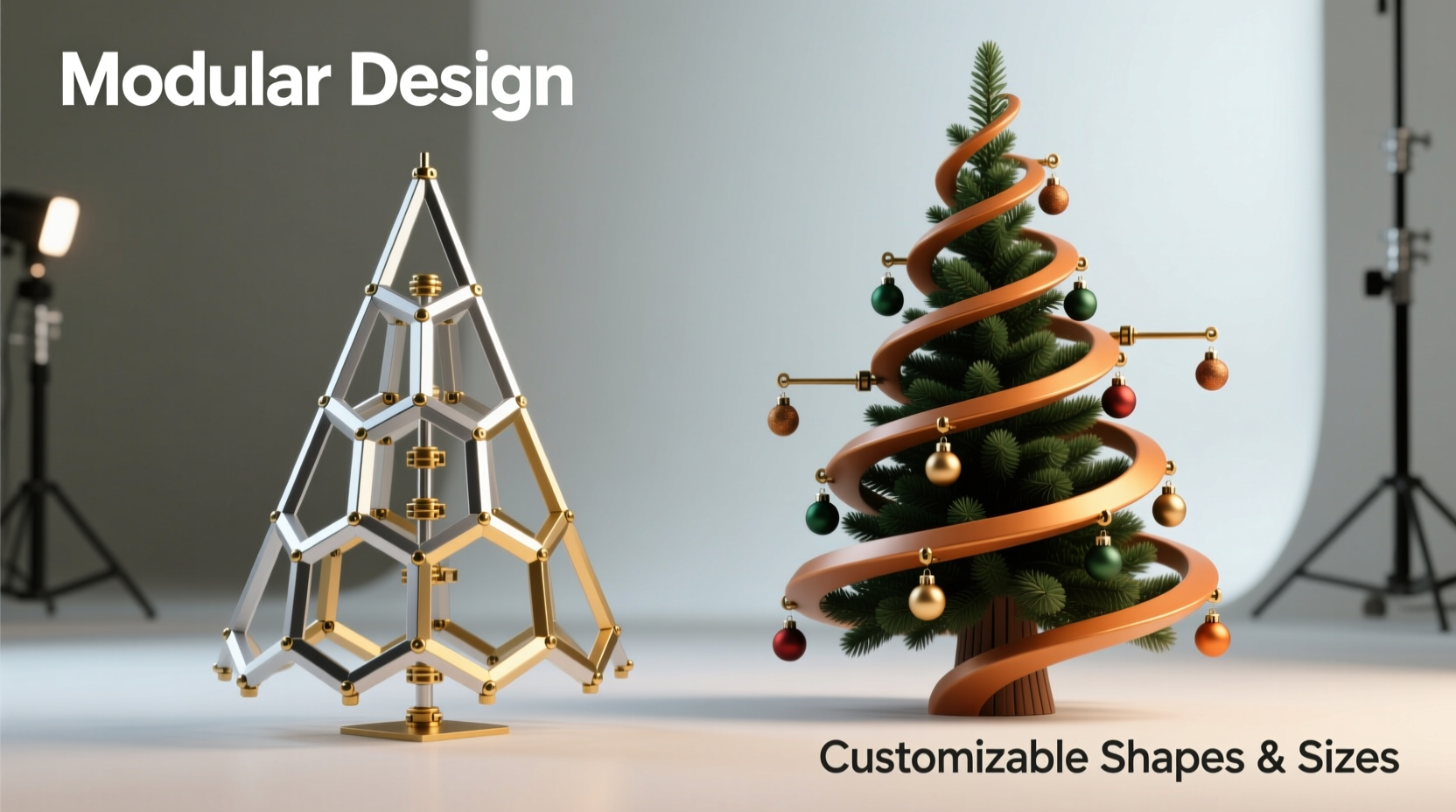
A modular Christmas tree is constructed from individual segments—typically tiers or panels—that connect vertically, horizontally, or in abstract configurations. Each section functions independently but integrates seamlessly with others through magnetic, snap-in, or bracket-based systems. These trees are often made from metal frames, plastic branches, or fabric-covered forms, designed for repeated assembly and disassembly.
Unlike traditional artificial trees that unfold into a single, predetermined cone, modular versions allow users to:
- Adjust height by adding or removing tiers
- Alter width and fullness per level
- Create non-traditional shapes (e.g., spirals, zigzags, wall murals)
- Build multi-tree installations from one kit
- Adapt to low ceilings, narrow corners, or open-plan spaces
This structural freedom makes modular trees particularly appealing to interior designers, event planners, and homeowners seeking a unique aesthetic. However, the trade-offs include higher initial cost, longer setup time, and sometimes less realism compared to premium artificial trees.
Customization Advantages of Modular Trees
The core strength of modular trees lies in their adaptability. When customization is a priority—whether due to spatial limitations or creative vision—modular systems outperform conventional trees in several key areas.
Shape Flexibility Beyond the Cone
Traditional trees follow a strict tapering profile: wide at the base, narrow at the top. While elegant, this shape doesn’t suit every environment. A modern minimalist lounge may benefit from a geometric, angular tree, while a children’s play area might thrive with a whimsical spiral or staggered tower design.
Modular trees enable these variations. For example:
- Wall-mounted trees: Panels can be arranged vertically along a wall, forming a 2D silhouette that saves floor space.
- Spiral stacks: Circular tiers offset at angles create a dynamic helix effect.
- Cluster designs: Multiple small towers grouped together mimic a forest rather than a single tree.
This versatility opens up new possibilities for themed displays in hotels, malls, or homes where novelty matters as much as tradition.
Precision Sizing for Any Space
Standard artificial trees come in fixed heights—6-foot, 7.5-foot, 9-foot—leaving gaps for rooms with 7-foot ceilings or tight stairwells. Modular trees solve this by allowing incremental adjustments. Need a 6'8\" tree? Add five standard tiers and trim the top slightly. Have a two-story foyer? Stack extra sections safely with reinforced bases.
Moreover, modular systems let you scale width independently. Some kits offer “full,” “slim,” and “feather” branch attachments per tier, enabling a tapered look without buying an entirely new tree.
Comparison: Modular vs. Traditional Trees
To assess whether modular trees are genuinely better for customization, it helps to compare them directly with traditional alternatives across critical factors.
| Feature | Modular Tree | Traditional Artificial Tree |
|---|---|---|
| Shape Options | Multiple (cone, spiral, wall art, cluster) | Limited (primarily conical) |
| Height Adjustment | Precise, per-tier control | Few increments (e.g., 6', 7.5') |
| Width Customization | Per-level adjustability | Fixed profile |
| Setup Time | Moderate to high (5–20 mins depending on complexity) | Low (2–8 mins) |
| Storage Size | Compact (flat-packed panels) | Bulky (often requires large bags) |
| Realism | Variable (often stylized) | High (especially with PE needles) |
| Price Range | $80–$400+ | $40–$300 |
While modular trees excel in customization and space efficiency, they often sacrifice some realism. Premium artificial trees use molded polyethylene (PE) branches that closely mimic real pine, spruce, or fir. In contrast, modular units frequently rely on simpler PVC or fabric foliage optimized for structure over detail.
“Modular trees aren’t about replicating nature—they’re about reimagining tradition. They give designers the freedom to treat the tree as sculpture, not just decoration.” — Lena Torres, Commercial Holiday Stylist
Real-World Application: A Retail Display Case Study
In 2023, a boutique clothing store in Portland faced a challenge: their narrow entryway couldn’t accommodate a standard 7-foot tree, yet they wanted a strong holiday presence. Instead of scaling down to a tabletop version, they opted for a modular system.
Using a 5-tier magnetic kit, the visual team created a vertical “tree wall” along the left side of the entrance. Each tier was decorated with themed ornaments reflecting seasonal collections—navy and gold for winter wear, crimson for holiday dresses. Lights were embedded in the frame, pulsing gently during evening hours.
The result?
- No floor space lost to a bulky base
- Increased customer engagement (shoppers paused to photograph the design)
- Easy disassembly and reuse in future years with updated themes
This case illustrates how modular trees solve practical problems while enhancing branding. The store didn’t just decorate—they made a statement.
Step-by-Step: Designing a Custom Modular Tree
If you're considering a modular tree for its customization potential, follow this process to ensure success:
- Assess Your Space: Measure ceiling height, floor area, and nearby furniture. Note architectural features like columns or windows that could influence placement.
- Define Your Goal: Decide whether you want a traditional shape with adjustable height, or something artistic like a spiral or wall piece.
- Select the Right Kit: Look for modular sets with flexible connectors, varied branch styles, and optional add-ons (e.g., light strips, decorative caps).
- Plan the Assembly: Lay out all pieces beforehand. Sketch a quick diagram showing how tiers will stack or align.
- Assemble and Test: Build the structure without decorations first. Check stability, balance, and visual proportions.
- Add Lights and Ornaments: Work from bottom to top. Use lightweight decor to avoid overloading upper tiers.
- Evaluate and Adjust: Step back and view from multiple angles. Remove or reposition elements that disrupt symmetry or flow.
Taking a methodical approach prevents frustration and ensures your final design matches your vision.
Common Pitfalls and How to Avoid Them
Despite their advantages, modular trees come with risks—especially for first-time users. Awareness of these issues can prevent costly mistakes.
- Overcomplicating the design: Not every space needs a spiral or asymmetrical stack. Sometimes a simple column works best.
- Ignoring weight distribution: Top-heavy builds can tip. Always anchor tall structures or use weighted bases.
- Mismatching decor style: Mixing rustic ornaments with a sleek metallic frame can look disjointed. Stick to a cohesive theme.
- Underestimating setup time: Complex arrangements take longer than expected. Schedule assembly well before guests arrive.
FAQ: Your Modular Tree Questions Answered
Can I mix modular tree parts with traditional artificial trees?
Generally, no. Modular systems use proprietary connectors and frame designs. Combining brands or types risks instability and visual mismatch. However, you can display them side by side for a curated look.
Are modular trees safe around children and pets?
Most are made from lightweight, non-toxic materials, but their geometric shapes may have exposed edges or loose connections. Always secure the structure and supervise interactions. Avoid small detachable parts if young children are present.
Do modular trees work with smart lighting?
Many newer models support LED strip integration, and some even include Bluetooth-enabled lights. Check product specs before purchase. You can also wrap compatible string lights around frames, but avoid heat-emitting bulbs near plastic components.
Checklist: Choosing the Right Modular Tree for Customization
Before buying, confirm your chosen model meets these criteria:
- ✅ Offers at least three height or shape configuration options
- ✅ Includes durable, easy-to-connect joints (magnetic or locking)
- ✅ Provides branch attachments in multiple densities (full, sparse, curved)
- ✅ Comes with integrated or compatible lighting system
- ✅ Features compact, labeled storage containers
- ✅ Has positive user reviews for stability and ease of assembly
- ✅ Matches your room’s aesthetic (modern, rustic, minimalist, etc.)
Use this checklist to filter options and invest in a system that delivers long-term value.
Conclusion: Embracing Customization Without Compromise
The rise of modular Christmas trees reflects a broader shift in holiday culture—one that values personal expression as much as tradition. While the classic evergreen silhouette will always have its place, it no longer has to be the only option.
For those constrained by space, driven by creativity, or tasked with designing impactful displays, modular trees offer unmatched flexibility in shape and size. They turn the holiday centerpiece into a canvas, inviting innovation without sacrificing festivity.
If you’ve been hesitant to step away from the standard cone, consider starting small—a single modular tier as a mantle accent, or a two-level centerpiece. Experience the ease of customization firsthand. Over time, you might find yourself looking past convention, building trees that don’t just fill a room, but define it.




 浙公网安备
33010002000092号
浙公网安备
33010002000092号 浙B2-20120091-4
Comments
No comments yet. Why don't you start the discussion?