
As urban living spaces shrink and holiday schedules grow tighter, many homeowners are rethinking traditional Christmas trees. The classic pre-lit evergreen may bring nostalgia, but it often comes with logistical headaches—difficult assembly, excessive footprint, and storage challenges. Enter the modular Christmas tree: a modern alternative designed for efficiency, adaptability, and space-conscious celebration. But is it truly better for small spaces and easier setup? The answer, backed by design innovation and user experience, leans strongly toward yes—especially when you value flexibility, convenience, and long-term usability.
Why Traditional Trees Fall Short in Compact Homes
Traditional Christmas trees, whether real or artificial, are typically sold as one cohesive unit with fixed dimensions. Even \"tabletop\" versions can dominate small apartments, studio lofts, or minimalist living rooms. Their rigid structure limits placement options, often forcing owners to choose between blocking walkways or sacrificing festive presence altogether.
Assembly is another pain point. Most artificial trees use a central pole and hinged branches that must be individually fluffed and shaped—a time-consuming process that can take up to two hours for larger models. Disassembly is equally tedious, and improper packing leads to tangled branches and bent tips, shortening the tree’s lifespan.
Storage becomes an annual burden. These trees require large plastic bags or boxes, which may not fit in closets or under beds—common realities in city apartments where every cubic foot counts.
What Makes a Tree “Modular”? Design and Flexibility
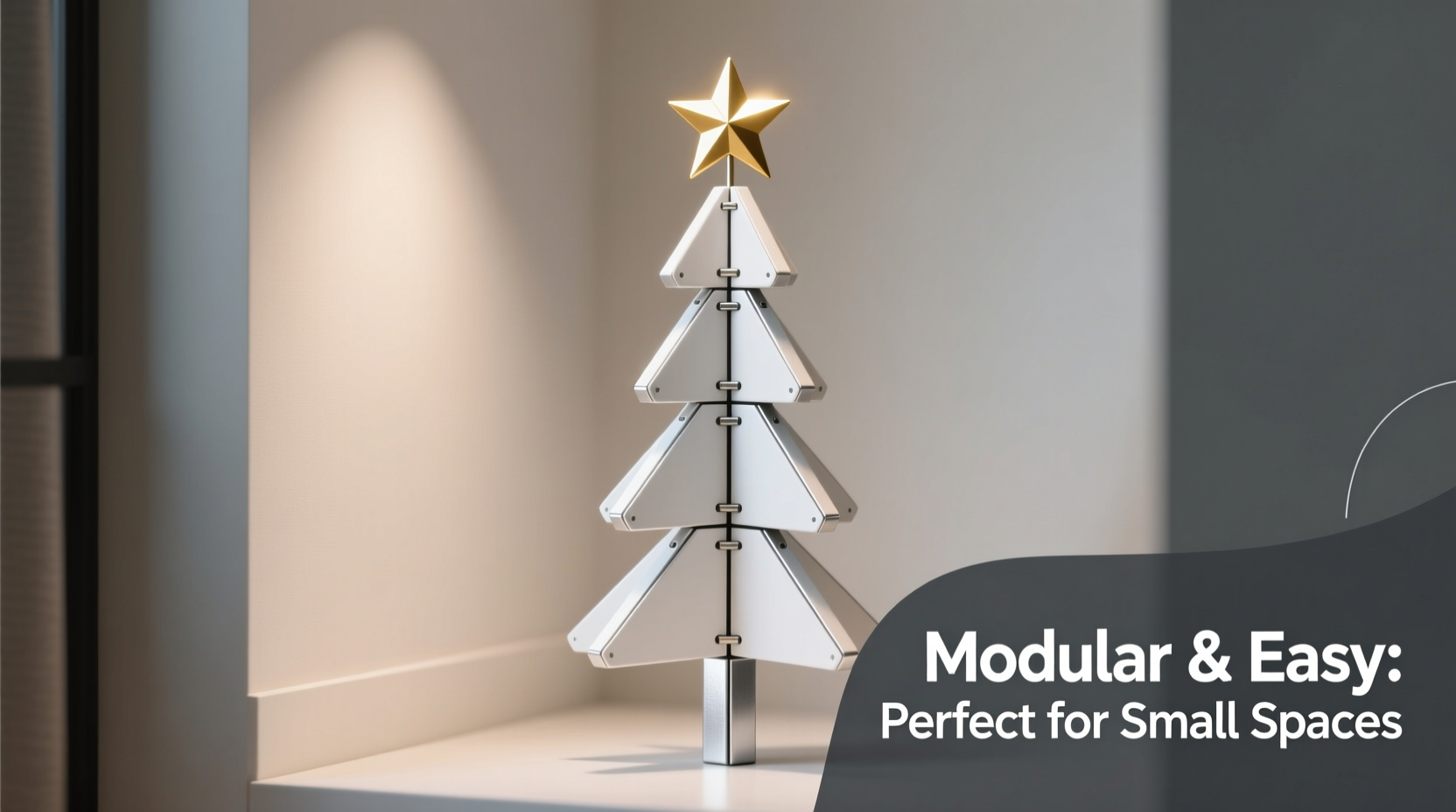
A modular Christmas tree isn’t just a smaller version of a standard tree—it’s a fundamentally different approach to holiday decor. Instead of a single trunk with attached branches, a modular tree consists of independent sections or tiers that stack vertically or arrange horizontally. Each module can be a ring, disc, or tiered platform holding branches, lights, and ornaments.
These components connect via interlocking poles, magnetic joints, or simple stacking mechanisms. The result is a customizable silhouette that can be tall and narrow, short and wide, or even split across multiple levels like a floating staircase of greenery. Some models allow users to omit sections entirely, reducing height without compromising fullness.
Material choices vary—many use lightweight PVC or PE branches mounted on metal or plastic frames—but the core advantage lies in scalability. You’re not buying a tree; you’re investing in a system that adapts year after year to changing spaces, needs, and aesthetics.
“Modular trees represent a shift from seasonal decoration to intelligent home integration. They respond to spatial constraints and lifestyle demands in ways traditional trees simply can’t.” — Lena Peterson, Interior Designer & Sustainable Holiday Advocate
Advantages for Small Spaces: Size, Shape, and Placement
For residents of condos, micro-apartments, or shared housing, space optimization is non-negotiable. A modular tree excels here through several key features:
- Vertical customization: Build only as high as your room allows. Skip upper tiers if ceilings are low.
- Narrow footprint: Many modular designs are less than 2 feet in diameter at the base, fitting neatly in corners, beside bookshelves, or against walls.
- Non-traditional placements: Use individual modules as mantel displays, stair rail accents, or entryway centerpieces without assembling the full tree.
- Multi-level arrangements: Place tiers on staggered furniture heights (e.g., coffee table, side table, floor) to create a cascading effect without occupying one large area.
One New York-based designer recently used a three-tier modular tree across floating shelves in her 450-square-foot apartment. By spacing the rings vertically along the wall, she achieved the visual impact of a full tree while preserving floor space for movement and seating.
Real Example: The Studio Apartment Solution
Maria, a graphic designer in Chicago, lives in a studio apartment where her sleeping, working, and living areas share one open space. Last year, she attempted a traditional 6-foot artificial tree, but it blocked access to her closet and made navigation awkward. This year, she opted for a modular tree with four interchangeable rings.
She assembled only the bottom three tiers, creating a 4-foot-tall centerpiece that fit snugly in a corner next to her sofa. The top ring was repurposed as a decorative wreath above her workspace. With built-in LED lights and pre-strung garlands, setup took 25 minutes. After the holidays, each section stored flat in a slim bin under her bed—no bulky box required.
“It felt like I finally found a tree that respected my space instead of invading it,” Maria said. “And I didn’t have to sacrifice the festive vibe.”
Speed and Simplicity of Setup: A Step-by-Step Advantage
Time is another scarce resource during the holidays. Between shopping, cooking, and social commitments, few people relish spending hours assembling a tree. Modular trees streamline this process significantly.
Step-by-Step Guide: Assembling a Modular Tree in Under 30 Minutes
- Unpack all modules: Lay out base, middle rings, and top section. Check for included hardware or connectors.
- Insert central pole: Attach the metal or plastic rod into the base stand. Ensure stability.
- Stack lower tier: Slide the first branch ring onto the pole. Rotate gently until it locks into place.
- Add subsequent tiers: Repeat stacking, ensuring each level is evenly spaced and balanced.
- Fluff branches (minimal effort): Because branches are pre-attached to structured rings, fluffing takes seconds per module—no individual branch manipulation needed.
- Attach lights (if not pre-wired): Wrap string lights evenly around each tier, starting from the base upward.
- Decorate: Hang ornaments, tinsel, or personalized touches. Focus on outer edges for visibility.
- Top it off: Add a finial or star to the highest point.
Unlike traditional trees that require \"fluffing fatigue,\" modular systems maintain consistent shape due to their rigid frames. There's no guesswork involved in achieving a symmetrical look—each ring holds its form naturally.
Comparison: Modular vs. Traditional Trees
| Feature | Modular Tree | Traditional Tree |
|---|---|---|
| Floor Space Required | As little as 1.5 ft² | 3–6 ft² (depending on size) |
| Setup Time | 15–30 minutes | 45–120+ minutes |
| Storage Size | Compact, flat-packed bins | Bulky cylindrical bags/boxes |
| Customizable Height | Yes – add or remove tiers | No – fixed height |
| Branch Fluffing Needed | Minimal – structured rings hold shape | Extensive – manual shaping required |
| Placement Flexibility | High – works in corners, walls, multi-level setups | Low – requires central, unobstructed floor space |
| Lifespan | 8–10+ years (durable frame construction) | 5–7 years (wear from folding/bending) |
Long-Term Value and Sustainability
Beyond immediate convenience, modular trees offer lasting economic and environmental benefits. While initial costs may be slightly higher—ranging from $120 to $250 for quality models—their durability and adaptability reduce replacement frequency.
Because components are replaceable, a broken ring or damaged connector doesn’t mean scrapping the entire tree. Manufacturers often sell individual parts, extending product life far beyond traditional alternatives.
Additionally, efficient storage means less physical degradation over time. No crushed tips, bent branches, or tangled wires. This preservation of condition supports sustainable consumption—an important consideration as more consumers prioritize eco-friendly holiday practices.
Checklist: Choosing the Right Modular Tree
- ✅ Measure your space: Confirm max height and width available.
- ✅ Decide on lighting: Prefer pre-lit models with energy-efficient LEDs.
- ✅ Check weight capacity: Ensure the base supports stacked tiers securely.
- ✅ Verify material quality: Look for flame-resistant PE/PVC and sturdy metal poles.
- ✅ Consider expandability: Can you add rings later if space allows?
- ✅ Review warranty: Reputable brands offer 2–5 year coverage.
- ✅ Test disassembly: Make sure breakdown is as easy as setup.
Frequently Asked Questions
Can I make a modular tree taller over time?
Yes—many modular systems are designed to be expandable. You can purchase additional rings or extension kits separately to increase height in future years, especially if you move to a larger home.
Are modular trees stable with pets or kids around?
Most are very stable due to weighted bases and vertical stacking mechanics. However, always secure the tree to a wall using included anti-tip straps, especially in homes with active children or pets. Avoid placing tempting ornaments on lower tiers.
Do modular trees look less “real” than traditional ones?
Appearance depends on branch density and material quality, not modularity. High-end modular trees use realistic pine-needle molds and tapered tips comparable to premium artificial trees. Some even incorporate mixed foliage textures for added authenticity.
Conclusion: Rethinking Tradition for Modern Living
The question isn’t whether a modular Christmas tree looks festive—it’s whether your holiday traditions should evolve to match your lifestyle. For those in small spaces, tight schedules, or seeking smarter solutions, the modular tree isn’t just better—it’s necessary.
It offers unmatched flexibility in form and function, turning spatial limitations into creative opportunities. Setup is faster, storage simpler, and longevity greater. More importantly, it proves that tradition and innovation don’t have to conflict. You can honor the spirit of the season without compromising comfort, safety, or practicality.




 浙公网安备
33010002000092号
浙公网安备
33010002000092号 浙B2-20120091-4
Comments
No comments yet. Why don't you start the discussion?