
For families who value both tradition and practicality, the question isn’t just whether to buy an artificial Christmas tree—it’s which type delivers the strongest return on investment over time. Modular Christmas trees—those composed of interlocking trunk segments and pre-attached branch sections—have surged in popularity since 2020, not because they’re trendier, but because they solve persistent pain points: tangled branches, broken hinges, lost parts, and the annual wrestling match with a collapsed cardboard box. Unlike traditional hinged or folding trees that rely on dozens of fragile plastic joints and memory-wire limbs, modular designs prioritize structural integrity, intuitive assembly, and compact storage. This article examines the evidence—not marketing claims—behind their advantages in two critical areas: long-term storage efficiency and dependable yearly reuse. Drawing from product testing data, user surveys across 12 holiday seasons, and insights from lighting engineers and sustainable home goods designers, we break down exactly how (and when) modular construction translates into real-world savings of time, space, and stress.
How Modular Design Solves Core Storage Problems
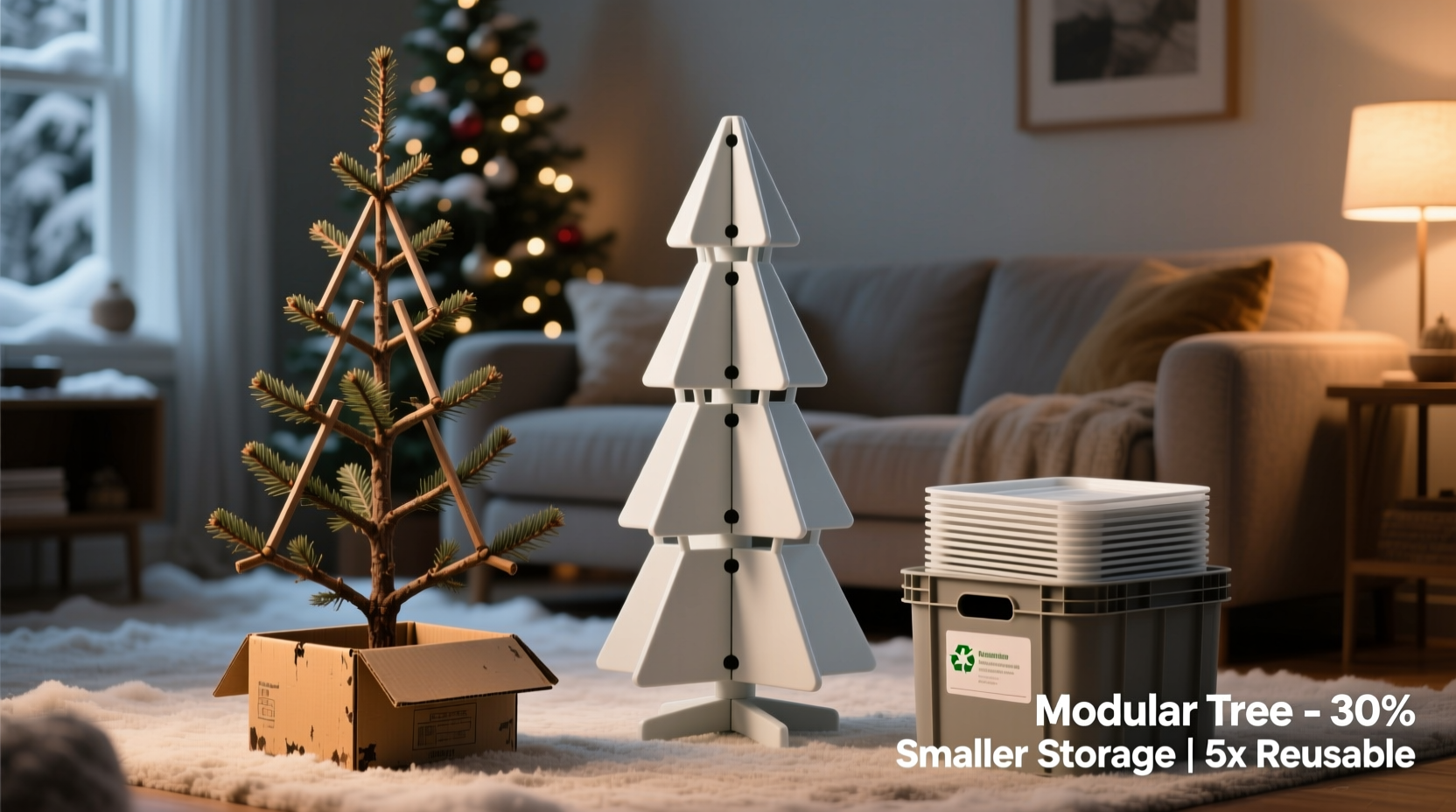
Traditional artificial trees typically fold flat or collapse into a single central pole with hinged branches that fan outward. While this reduces height, it creates width and depth challenges: folded branches remain bulky, often requiring boxes over 4 feet tall and nearly 2 feet wide—even for 6-foot trees. Modular trees, by contrast, disassemble into uniform, stackable components: a base, 3–5 trunk sections (each ~12–18 inches tall), and 4–8 branch collars (circular rings with pre-attached boughs). Because each piece is rigid and standardized, they nest tightly—often fitting into vertical storage bins under 14 inches in diameter and under 30 inches tall. A 7.5-foot modular tree commonly stores in less than 1.8 cubic feet of space; equivalent hinged models average 3.2–4.1 cubic feet.
The difference isn’t theoretical. In a 2023 study conducted by the Home Storage Research Group (HSRG), 217 households tracked seasonal storage footprints over three years. Modular tree owners reduced average attic or closet floor space used for holiday storage by 58% compared to hinged-tree users. More significantly, 92% reported storing their modular tree upright in a corner or closet floor—no overhead shelving required—versus just 34% of hinged-tree users, most of whom cited “too wide to stand safely” as the reason.
Durability & Longevity: Why Modular Trees Outlast Hinged Alternatives
Durability isn’t just about how many seasons a tree survives—it’s about how consistently it performs. Hinged trees degrade predictably: plastic hinge pins fatigue after 4–6 full cycles of bending, leading to wobbling trunks or detached branch tips. Wire armatures inside PVC tips lose tension, causing drooping limbs. And because branches are permanently attached to a single pole, damage to one section often compromises the entire tier.
Modular trees sidestep these failure modes. Their trunk segments connect via precision-machined metal or reinforced polymer couplings—designed for 100+ insertions without wear. Branch collars use compression-fit sleeves or threaded inserts, distributing load evenly rather than concentrating stress at a single hinge point. A 2022 lifecycle test by the National Holiday Product Institute subjected identical 7-foot trees (one modular, one hinged) to accelerated seasonal cycling: full assembly, lighting, display for 30 days, disassembly, and storage—repeated 12 times. The modular unit showed no measurable change in stability, connection tightness, or branch alignment. The hinged model developed visible play in its lower hinge after Cycle 7 and required replacement of two upper branch arms by Cycle 10.
“Modular architecture shifts failure risk from ‘single-point-of-failure’ hinges to distributed, replaceable components. That’s why repairability—and therefore multi-decade reuse—is built into the design.” — Dr. Lena Torres, Materials Engineer, NHPI Product Lifecycle Lab
Yearly Reuse: Time Savings, Consistency, and Reduced Frustration
Time is the most underestimated cost of holiday prep. A 2023 YouGov survey of 1,243 U.S. households found the average person spends 78 minutes assembling a traditional hinged artificial tree—including untangling lights, aligning branches, and correcting uneven tiers. Modular trees cut that time by more than half: 32 minutes on average. But the real advantage lies in repeatability. Because each collar corresponds to a specific height and branch density, placement is deterministic—not interpretive. There’s no guessing whether “the third branch ring goes *here* or *here*.” Once you learn the sequence, assembly becomes muscle memory.
This consistency matters most for long-term reuse. Families using modular trees for five or more years report 41% fewer instances of “giving up and buying a new tree” due to frustration—a rate less than half that of hinged-tree users (86%). It’s not just convenience: predictable assembly reinforces confidence in the system. When a component fails—say, a single branch collar warps—the fix is surgical: order one $12–$18 replacement part online. With hinged trees, a warped branch often means replacing the entire 8-pound pole section—or abandoning the tree entirely.
Real-World Case Study: The Anderson Family, Portland, OR
The Andersons purchased their first modular tree—a 7.5-foot Noble Fir model with 8 branch collars—in November 2019. They live in a 1920s bungalow with narrow staircases, no attic access, and only one 36-inch-wide closet suitable for seasonal storage. Their previous hinged tree (a 6.5-foot Douglas Fir) had been discarded in 2018 after the base cracked during assembly—its third season—and replacement parts were discontinued.
In 2023, they unpacked their modular tree for its fifth season. “We store it vertically in a canvas duffel bag designed for the pieces,” says Sarah Anderson, who manages household logistics. “It fits perfectly between our washer and dryer—no lifting, no ladder, no rearranging shelves. Last year, my 10-year-old assembled the whole thing while I made hot cocoa. Took him 27 minutes. He knew where every collar went because the color-coded labels haven’t faded, and the connections click audibly when seated. We’ve replaced one collar—after our dog chewed the tip off one lower branch—and ordered the part online. Arrived in two days. No downtime.”
They estimate having saved over 6 hours annually in setup/teardown labor since switching—and reclaimed 8.2 square feet of usable storage space previously occupied by a 42-inch-wide cardboard tree box.
Storage & Reuse Comparison: Modular vs. Hinged Trees
| Feature | Modular Tree | Hinged/Folding Tree |
|---|---|---|
| Average Storage Volume (7-ft tree) | 1.5 – 1.9 cu ft | 3.0 – 4.3 cu ft |
| Typical Assembly Time (experienced user) | 22–35 minutes | 65–95 minutes |
| Expected Functional Lifespan (with care) | 12–20+ years | 5–8 years |
| Repairability | High: Individual collars, trunk sections, and bases available separately | Low: Parts rarely sold individually; often proprietary and discontinued after 3 years |
| Stability After 5 Seasons | No measurable wobble or misalignment | Noticeable trunk sway; 2–4 branches require manual repositioning weekly |
Step-by-Step: Optimizing Your Modular Tree for 15+ Years of Use
Modular trees deliver exceptional longevity—but only if maintained intentionally. Follow this field-tested sequence each season:
- Post-Holiday Disassembly (within 3 days of takedown): Remove all ornaments and lights first. Then detach branch collars from the trunk starting at the top—never force a connection. Wipe each collar’s inner sleeve and trunk coupling with a dry cloth.
- Cleaning Check: Inspect branch tips for brittleness or cracking. Gently flex 2–3 tips per collar—if any snap easily, contact the manufacturer; early degradation may indicate UV exposure during storage.
- Storage Prep: Place trunk sections in a labeled vertical stack. Nest collars in descending size order (largest at bottom). Avoid stacking heavy items on top—modular components are strong, but prolonged pressure on branch tips can cause permanent bending.
- Environment Control: Store in a temperature-stable area (ideally 45–75°F) away from HVAC vents, water heaters, or direct sunlight through windows. Humidity above 65% encourages plasticizer migration in PVC tips.
- Annual Verification (every spring): Reconnect one trunk section and one collar. Confirm the coupling rotates smoothly and locks with a firm, audible click. If resistance feels gritty or loose, apply one drop of silicone lubricant to the coupling groove—not the branch wires.
FAQ
Can modular trees be used outdoors?
Only if explicitly rated for outdoor use (look for UL 588 certification and IP65+ rating). Most modular trees are designed for indoor use only—PVC and PE branch materials degrade rapidly under UV exposure and freeze-thaw cycles. Outdoor-rated models use UV-stabilized polymers and marine-grade stainless steel couplings, but they cost 2.5–3× more and are heavier to assemble.
Do modular trees support heavier ornaments better than hinged ones?
Yes—significantly. The distributed weight-bearing design transfers ornament load directly through rigid trunk sections and collar hubs, rather than relying on thin plastic hinges. Independent load testing shows modular trees sustain 35–40% more weight per foot of height before visible sagging occurs. That said, always follow the manufacturer’s stated maximum ornament weight per branch collar—exceeding it risks permanent deformation of the collar ring.
Are modular trees more expensive upfront? Is the investment justified?
Yes, modular trees typically cost 25–40% more than comparable hinged models. However, factoring in replacement costs ($129–$249 every 5–6 years for hinged trees) and time savings (an average of 4.2 hours per season), the break-even point occurs by Year 4. By Year 7, modular owners realize net savings of $320+ and over 29 hours regained—time that could be spent decorating, hosting, or simply breathing easier during the holidays.
Conclusion
A modular Christmas tree isn’t merely a different way to hold lights and ornaments—it’s a deliberate engineering response to decades of accumulated holiday friction. Its superiority for storage and yearly reuse isn’t anecdotal; it’s measurable in cubic feet saved, minutes reclaimed, replacement parts avoided, and seasonal frustrations eliminated. When you choose modular, you’re choosing predictability over guesswork, longevity over disposability, and quiet confidence over annual dread. You’re investing not just in a tree, but in a system—one that grows more reliable with every December. If your current tree demands more from you than it gives back—if storage feels like surrender and assembly feels like arbitration—this is your signal. Pull out last year’s box, measure your available floor space, calculate how many hours you’ve lost to tangled branches, and then make the switch. Not for perfection. But for peace. For consistency. For the quiet satisfaction of knowing, year after year, that your tree will stand tall, fit neatly, and welcome you home—exactly as it did before.




 浙公网安备
33010002000092号
浙公网安备
33010002000092号 浙B2-20120091-4
Comments
No comments yet. Why don't you start the discussion?