
For many families, the holiday season means hauling out boxes of ornaments, untangling strings of lights, and wrestling with a towering evergreen—real or artificial—that seems to grow more unwieldy each year. In recent years, a new contender has entered the living room: the modular Christmas tree. Marketed as a smarter, sleeker alternative to standard models, these trees promise faster setup, simpler storage, and greater design flexibility. But do they actually deliver on those promises? And are they truly easier to handle than traditional trees?
This article examines the practical realities of modular versus standard Christmas trees, focusing specifically on two key pain points: assembly and storage. Drawing from user experiences, product design principles, and expert insights, we’ll break down what makes modular trees different—and whether that difference translates into real-world convenience.
What Defines a Modular vs. Standard Christmas Tree
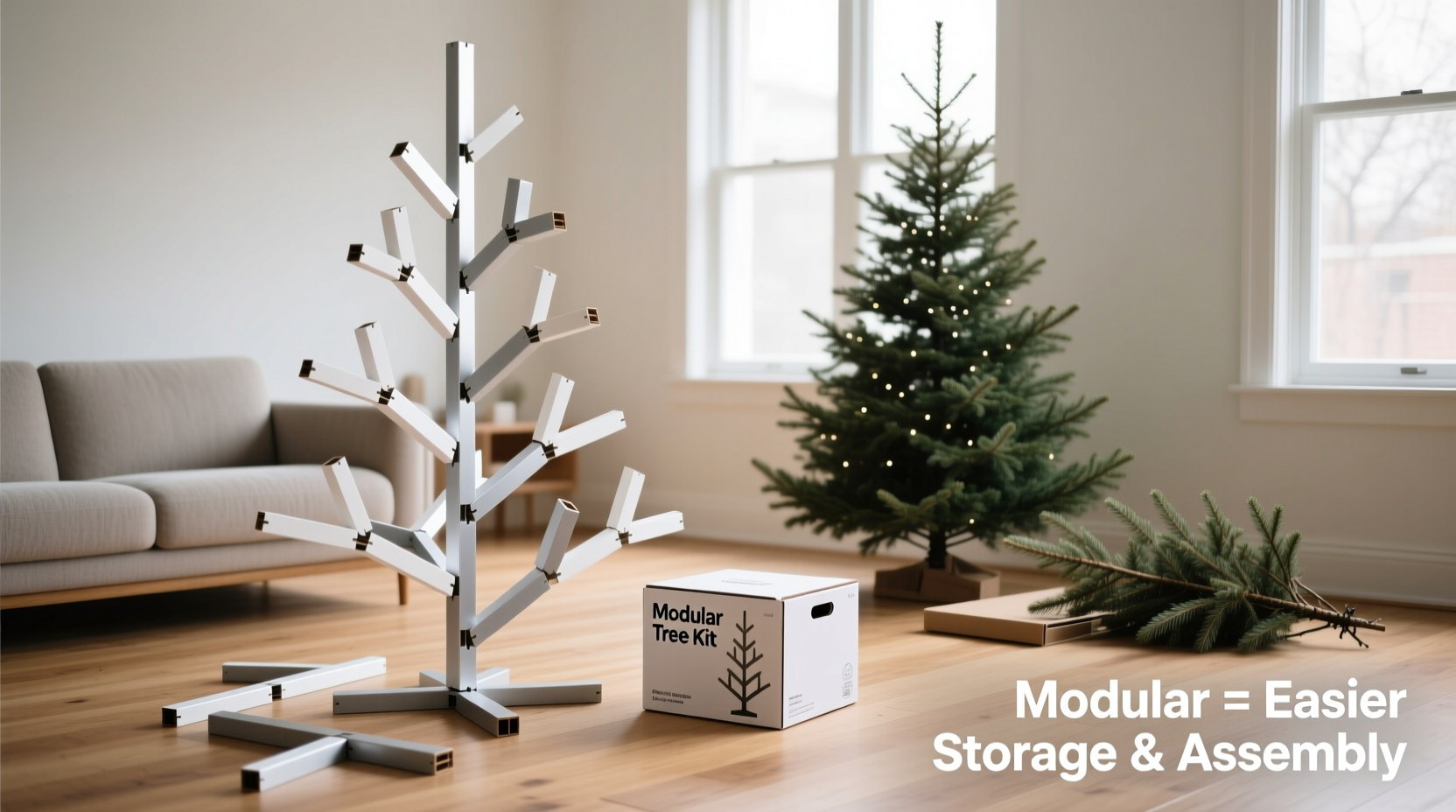
The distinction between modular and standard Christmas trees lies primarily in their construction and how they’re intended to be used over time.
A standard artificial Christmas tree typically consists of three main sections—top, middle, and bottom—that fold outward from a central pole. These sections are hinged and connected by wire or fabric, allowing them to expand like an accordion. Once assembled, branches are bent and fluffed into place. After the holidays, the tree is collapsed back into its original form and stored in one or more large cylindrical bags or boxes.
In contrast, a modular Christmas tree is composed of individual segments—often single-tiered rings or panels—that stack vertically on a central support rod. Each module is self-contained, usually pre-lit and pre-decorated, and can be added or removed independently. Some models allow users to adjust height by including fewer modules, while others let you mix colors or light patterns per section.
This fundamental difference in structure affects every aspect of ownership—from initial unboxing to long-term storage.
Assembly: Speed, Simplicity, and Stability
One of the biggest selling points of modular trees is faster, easier assembly. But how does this play out in practice?
With a standard tree, setup usually follows a predictable but labor-intensive pattern:
- Unpack the tree base and center pole.
- Lift and lock the heaviest lower section onto the pole.
- Add middle and upper sections, aligning branches carefully to avoid gaps.
- Fluff dozens (sometimes hundreds) of branch tips to achieve fullness.
- String lights—if not pre-lit—and hang ornaments.
This process often takes 45 minutes to over two hours for larger trees, especially if done alone. The weight of the bottom section alone can make alignment difficult, and misaligned branches create visible “holes” in the silhouette.
Modular trees streamline this through segmentation. Instead of unfolding heavy, interconnected arms, users stack lightweight tiers like pancakes on a dowel. Each tier is already shaped and often comes with built-in lighting and even decorative elements such as pinecones or berries.
Most modular setups take under 30 minutes, with some compact versions ready in under 10. There’s no fluffing required—just stacking and securing. Many models use magnetic connectors or twist-lock mechanisms that eliminate the need for tools.
“I used to dread setting up our old 7-foot tree—it took half a Saturday. Now I assemble my modular tree during a commercial break.” — Lisa Tran, homeowner from Portland, OR
However, stability can be a concern. Because modular trees rely on vertical stacking, they may sway more easily if bumped. Higher-end models address this with weighted bases or internal reinforcement rods, but budget versions can feel top-heavy, especially when fully decorated.
Storage: Space Efficiency and Longevity
Where modular trees truly shine is in storage. Traditional artificial trees require substantial space—a tall, rigid bag or box that rarely fits neatly into closets or under beds. Even when compressed, these containers occupy valuable square footage for 11 months of the year.
Modular trees solve this by breaking the tree into smaller, flat-packable units. Each segment stores independently in compact boxes or soft cases. This allows owners to tuck them into shelves, behind furniture, or even inside drawers. For apartment dwellers or those with limited attic or basement access, this is a game-changer.
| Feature | Standard Tree | Modular Tree |
|---|---|---|
| Storage Footprint | Large cylinder (3–4 ft tall) | Multiple small boxes (~12” x 12” each) |
| Weight per Unit | Heavier bottom section (8–15 lbs) | Lightweight modules (2–4 lbs each) |
| Setup Consistency | Branch alignment varies yearly | Consistent shape every time |
| Durability Over Time | Hinges wear out; wires loosen | Less mechanical stress per part |
| Mobility | Bulky to move; hard to carry | Easy to transport floor-to-floor |
Because each module is handled separately, there’s less risk of damaging wires or bending branches during packing. With standard trees, repeated folding can fray internal wiring or snap delicate PVC needles. Modular designs reduce this strain significantly.
Practical Considerations: Who Benefits Most?
While modular trees offer clear advantages, they aren’t ideal for everyone. Understanding your household’s needs helps determine whether the switch makes sense.
Families in small homes or urban apartments benefit most from the compact storage. If your current tree lives in the hallway or blocks access to another closet, a modular system frees up usable space without sacrificing holiday spirit.
Seniors or individuals with mobility challenges find modular trees far more manageable. Lifting a 12-pound base section off the floor can be difficult or unsafe. Modular components weigh less and can be assembled at waist height before being secured to the stand.
Renters or frequent movers appreciate the portability. Packing a standard tree into a car trunk is awkward. Modular pieces fit into SUVs, hatchbacks, or even checked luggage for holiday travel.
On the flip side, modular trees tend to have a more stylized look—often minimalist, modern, or abstract. They may not satisfy those seeking a lush, full-bodied evergreen appearance. Additionally, customization is sometimes limited; you can’t easily swap out individual branches or add extra foliage.
Step-by-Step: Setting Up a Modular Tree in Under 20 Minutes
Here’s how a typical modular tree assembly unfolds:
- Clear the area – Choose a stable, level surface near an outlet if the tree is pre-lit.
- Assemble the base – Attach legs or feet to the central pole and secure it upright.
- Begin stacking – Place the largest (bottom) module onto the pole, ensuring it clicks or locks into place.
- Add subsequent tiers – Continue stacking in order, pressing down gently until each connects securely.
- Attach the top piece – The final cap or star often includes a finial connector.
- Plug in and test lights – Confirm all sections illuminate properly.
- Minimal decoration – Add select ornaments if desired, avoiding overloading lighter modules.
No fluffing. No wire management. No guesswork. Once mastered, the entire process becomes almost ritualistic in its simplicity.
Real Example: The Nelson Family’s Switch to Modular
The Nelsons, a family of four in Denver, used a 7.5-foot pre-lit artificial tree for over a decade. Every November, setting it up meant clearing the garage, dragging out a 48-inch duffel bag, and spending most of a Sunday assembling and fluffing. Storage was equally cumbersome—their ceiling-high container blocked access to winter gear.
Last year, they switched to a six-module, 6-foot modular tree. The change was immediate. “We set it up on a Tuesday night after dinner,” said Mark Nelson. “The kids helped stack the pieces. We were done in 15 minutes, and the boxes fit neatly on a closet shelf.”
They did note one trade-off: the tree looks sleeker but less dense than their old one. However, they compensated by using a layered ornament strategy—larger decorations spaced further apart—which enhanced the modern aesthetic.
Checklist: Is a Modular Tree Right for You?
Use this checklist to evaluate whether a modular Christmas tree suits your lifestyle:
- ✅ Do you live in a small home or apartment with limited storage?
- ✅ Are you looking to reduce setup time to under 30 minutes?
- ✅ Do you or someone in your household have physical limitations?
- ✅ Do you value a clean, contemporary design over a traditional bushy look?
- ✅ Do you move frequently or take your tree to a second home?
- ❌ Do you prefer a densely branched, classic evergreen silhouette?
- ❌ Do you plan to heavily decorate with large or heavy ornaments?
If most of your answers are “yes” to the positives and “no” to the caveats, a modular tree is likely a smart upgrade.
Frequently Asked Questions
Can I mix and match modules from different brands?
No. Modular trees are brand-specific due to variations in diameter, connector types, and pole dimensions. Always use matching components from the same manufacturer.
Are modular trees more expensive than standard ones?
Generally, yes. Entry-level modular trees start around $150, with premium models reaching $400+. Standard trees can be found for as low as $60, though high-end versions also reach similar price points. The cost reflects advanced engineering, lighting integration, and durable materials.
Do modular trees last as long as traditional ones?
When properly cared for, modular trees often last longer due to reduced mechanical stress. Individual modules can sometimes be replaced if damaged, extending the life of the entire system. Avoid dropping modules and always disconnect power before disassembly.
Conclusion: A Smarter Approach to Holiday Tradition
The question isn’t whether modular Christmas trees look exactly like the firs of childhood memory—it’s whether they make the holiday experience more enjoyable, accessible, and sustainable. For many modern households, the answer is a resounding yes.
Easier assembly means more time for what matters: baking cookies, watching movies, or simply enjoying the glow of the lights without sore arms or tangled frustration. Efficient storage removes a lingering burden from the rest of the year. And the ability to customize height and style adds a creative dimension previously unavailable.
If your current tree feels more like a chore than a celebration, consider making the shift. The holidays should bring joy—not logistical headaches. A modular Christmas tree might be the upgrade that transforms your tradition from obligation to delight.




 浙公网安备
33010002000092号
浙公网安备
33010002000092号 浙B2-20120091-4
Comments
No comments yet. Why don't you start the discussion?