
When it comes to artificial trees—whether Christmas trees, display trees for events, or decorative indoor pieces—the debate between modular and one-piece designs often centers on convenience. For many consumers, ease of assembly isn’t just a minor preference—it’s a deciding factor in long-term satisfaction. A tree that takes hours to set up or requires two people to stabilize may lose its charm quickly, no matter how beautiful it looks when finished. So, is a modular tree actually easier to assemble than a one-piece design? The answer depends on several factors: user experience, storage constraints, physical space, and even frequency of use.
While both designs have their place in the market, understanding their structural differences and real-world implications can help you make a smarter choice—one that saves time, reduces frustration, and enhances seasonal enjoyment.
Understanding the Designs: Modular vs One-Piece Trees
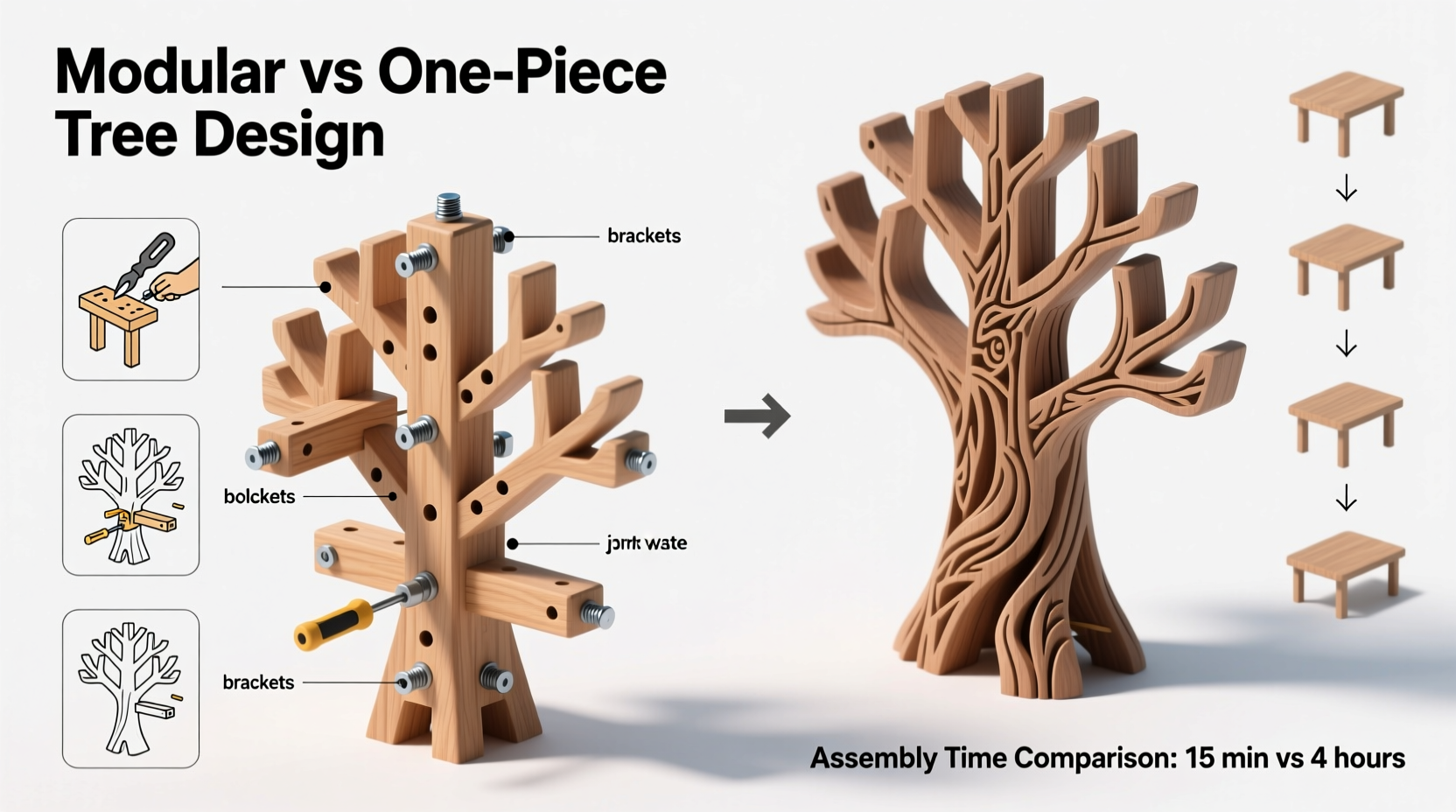
Before comparing ease of assembly, it’s essential to define what each type entails.
One-piece trees are constructed as a single unit. Once unpacked, they stand upright with minimal adjustment. Typically, these models come pre-assembled from the factory and only require fluffing of branches and securing to a base. They are commonly found in smaller sizes (under 6 feet) due to shipping and packaging limitations.
Modular trees, also known as sectional or piece-by-piece trees, are built from multiple stacked segments. Each section—usually 3 to 5—is assembled vertically and attached to the next using a central pole or locking mechanism. These are standard in larger trees (7 feet and above), where a one-piece structure would be too bulky to manufacture or transport.
The distinction might seem subtle, but it significantly affects setup time, required effort, and overall user experience.
Assembly Process Compared
To determine which design is easier, let’s break down the actual steps involved in assembling each.
One-Piece Tree Setup
- Unpack the tree from its storage bag or box.
- Lay it flat and unfold the hinged branches outward (if applicable).
- Stand the tree upright and secure it into the base.
- Fluff the branches to achieve fullness.
- Top with a tree topper if desired.
This process usually takes between 5 and 15 minutes for someone familiar with the model. There are no connectors to align, no risk of imbalance between sections, and no need for additional tools.
Modular Tree Setup
- Remove all sections and hardware from packaging.
- Assemble the center pole by connecting pole segments (if not pre-attached).
- Attach the bottom section to the base and slide the first pole segment through.
- Lift and align the next section, matching pole and branch guides.
- Repeat stacking until all sections are secured.
- Fluff each tier systematically from bottom to top.
- Add tree topper.
Depending on height and complexity, this process can take 20 to 45 minutes, especially for first-time users. Larger trees may require two people to safely lift and align upper sections without bending branches.
The added time and coordination mean modular trees inherently involve more steps—and therefore more potential points of error.
Key Factors Influencing Ease of Assembly
Ease isn’t just about speed; it’s also about accessibility, physical demand, and reliability. Several variables affect how easy either design feels in practice.
Physical Ability and Mobility
For older adults or individuals with limited mobility, lifting heavy upper sections of a modular tree can be challenging. One-piece trees eliminate vertical lifting after initial placement, making them more accessible. Modular trees, especially those over 7.5 feet, may require stepping onto stools or balancing awkward loads—a safety concern for some households.
Storage and Transportation
One-piece trees are rigid and often difficult to fit into compact storage spaces. They require tall, wide containers and careful handling to avoid bent branches. In contrast, modular trees disassemble into shorter, more manageable boxes. While they have more parts, those parts are easier to store in attics, under beds, or in closets.
Paradoxically, the very feature that makes modular trees harder to assemble—being broken into parts—also makes them easier to store long-term.
Frequency of Use
If you put up your tree once a year and take it down shortly after the holidays, the extra 20 minutes spent assembling a modular tree may be negligible. However, for event planners, retailers, or families who set up trees seasonally or multiple times a year, cumulative time adds up. In such cases, the faster setup of one-piece designs offers tangible benefits.
Tree Size and Fullness
One-piece trees rarely exceed 7.5 feet due to manufacturing and shipping constraints. If you want a dramatic 9-foot centerpiece with thick foliage, your only realistic option is a modular design. Here, “easier” must be weighed against aesthetic goals. You trade simplicity for scale.
“Sectional trees dominate the premium market not because they’re easier, but because they allow for greater realism and presence.” — Marcus Lin, Product Designer at Evergreen Home Décor
Comparison Table: Modular vs One-Piece Trees
| Feature | Modular Tree | One-Piece Tree |
|---|---|---|
| Setup Time | 20–45 minutes | 5–15 minutes |
| Number of Parts | Multiple (sections, poles, screws) | Few (tree + base) |
| Physical Effort | Moderate to high (lifting, alignment) | Low (unfolding, fluffing) |
| Storage Convenience | High (compact, stackable boxes) | Low (bulky, rigid shape) |
| Maximum Height | Up to 12+ feet | Typically under 7.5 feet |
| Suitability for Small Spaces | Yes, but complex setup | Ideal—quick and simple |
| Best For | Large homes, high ceilings, commercial use | Apartments, seniors, frequent movers |
Real-World Example: A Family’s Holiday Dilemma
The Rivera family lives in a mid-sized suburban home with an open-plan living room. For years, they used a 6.5-foot one-piece tree that set up quickly and looked festive. When their children grew older and wanted a “grand” holiday display, they upgraded to a 9-foot modular tree with lifelike foliage and built-in lights.
The first assembly took nearly an hour. Mr. Rivera struggled to align the middle section while his wife held the base steady. Two branches snapped during installation due to misalignment. Though the final look was impressive, the experience left them frustrated.
The following year, they developed a system: lay out all parts beforehand, assign roles, and use a step stool for safer access. With practice, setup dropped to 25 minutes. Still, they admitted they’d underestimated the learning curve.
Their story illustrates a key truth: modular trees aren’t inherently easier, but they become more manageable with repetition and preparation.
Step-by-Step Guide: How to Assemble a Modular Tree Efficiently
While modular trees require more effort, following a structured approach minimizes confusion and damage.
- Prepare Your Space: Clear a large area near the final location. Avoid tight corners—trees need room for branch expansion.
- Unpack All Sections: Lay them out in order: base, bottom, middle, top. Check for included hardware and instructions.
- Assemble the Pole: Connect metal or plastic pole segments fully before inserting into the base.
- Attach the Bottom Section: Slide it over the pole and lock into the base. Ensure it rotates freely and stands level.
- Stack the Next Section: Align pole openings carefully. Never force—misaligned sections cause instability.
- Secure Each Level: Some models use clips, screws, or twist locks. Confirm each connection is firm before proceeding.
- Fluff Branches Layer by Layer: Start at the bottom, working outward and upward. This prevents re-compression.
- Test Stability: Gently shake the trunk. Excessive wobbling means a section isn’t seated properly.
- Add Lights and Ornaments: If not pre-lit, string lights from top to bottom to avoid tangling.
With this method, even a complex 8-foot modular tree can be assembled confidently in under 30 minutes.
Checklist: Choosing the Right Tree for Your Needs
- ☐ Determine available ceiling height and floor space.
- ☐ Assess physical ability to lift and maneuver sections.
- ☐ Evaluate storage capacity—can you accommodate a tall, rigid case?
- ☐ Decide whether speed or size is the priority.
- ☐ Consider frequency of setup—once a year vs. recurring use.
- ☐ Check for features like pre-lit wiring, hinge branches, and weighted bases.
- ☐ Read reviews focusing on assembly difficulty and durability.
Frequently Asked Questions
Can I convert a one-piece tree into a modular one?
No. One-piece trees are structurally designed as a single unit with integrated hinges and supports. Attempting to cut or separate them will ruin the tree and create safety hazards.
Are modular trees more durable than one-piece designs?
Not necessarily. Durability depends more on material quality (e.g., PE/PP needles, wire gauge, flame-resistant coatings) than assembly style. However, modular trees may show wear at connection points over time if frequently assembled.
Do modular trees fall over more easily?
They can, if not assembled correctly. Misaligned sections or loose connections compromise stability. Always ensure each segment is securely locked and use a wide, heavy base for support—especially with tall trees.
Expert Insight: Why Design Matters Beyond Assembly
Industry professionals emphasize that the choice between modular and one-piece goes beyond initial setup.
“The real test isn’t how fast you can build the tree—it’s how well it holds up over five, ten, even fifteen seasons. Consistent assembly and proper storage matter more than the first-time experience.” — Lena Patel, Senior Editor at *Home & Holiday Magazine*
She notes that modular trees, despite their steeper learning curve, often last longer because individual sections can be replaced if damaged. A bent branch on a one-piece tree can’t be swapped out—only concealed.
Additionally, advancements in modular design—such as color-coded poles, magnetic connectors, and tool-free locks—are steadily closing the ease-of-use gap.
Conclusion: Matching Design to Lifestyle
So, is a modular tree easier to assemble than a one-piece design? Generally, no. One-piece trees win in speed, simplicity, and accessibility. They’re ideal for small spaces, quick setups, and users who prioritize convenience over grandeur.
However, modular trees offer unmatched scalability and storage flexibility. For those willing to invest a little more time upfront, they deliver a fuller, taller, and often more realistic appearance. With proper technique and organization, their assembly becomes routine—not a holiday chore.
The best choice depends not on which is universally easier, but which aligns with your living situation, physical needs, and seasonal expectations.




 浙公网安备
33010002000092号
浙公网安备
33010002000092号 浙B2-20120091-4
Comments
No comments yet. Why don't you start the discussion?