
For over two decades, prelit artificial Christmas trees have dominated the holiday market — promising “plug-and-play” ease, consistent illumination, and time savings. Yet every December, a quiet debate resurfaces among decorators, designers, and seasoned tree shoppers: does that convenience come at the cost of true creative control? The short answer is yes — but not uniformly, and not without nuance. Customization isn’t just about brightness or color; it’s about intentionality, adaptability across years, responsiveness to evolving aesthetics, and even the tactile satisfaction of building something personal. This article examines precisely where and how prelit trees constrain choice — and where they surprise with hidden flexibility. Drawing on industry design standards, consumer testing data, and real-world installation patterns, we move beyond marketing claims to assess what “customizable” actually means when lights are permanently wired into 2,000+ branches.
What “Customizable” Really Means in Tree Lighting
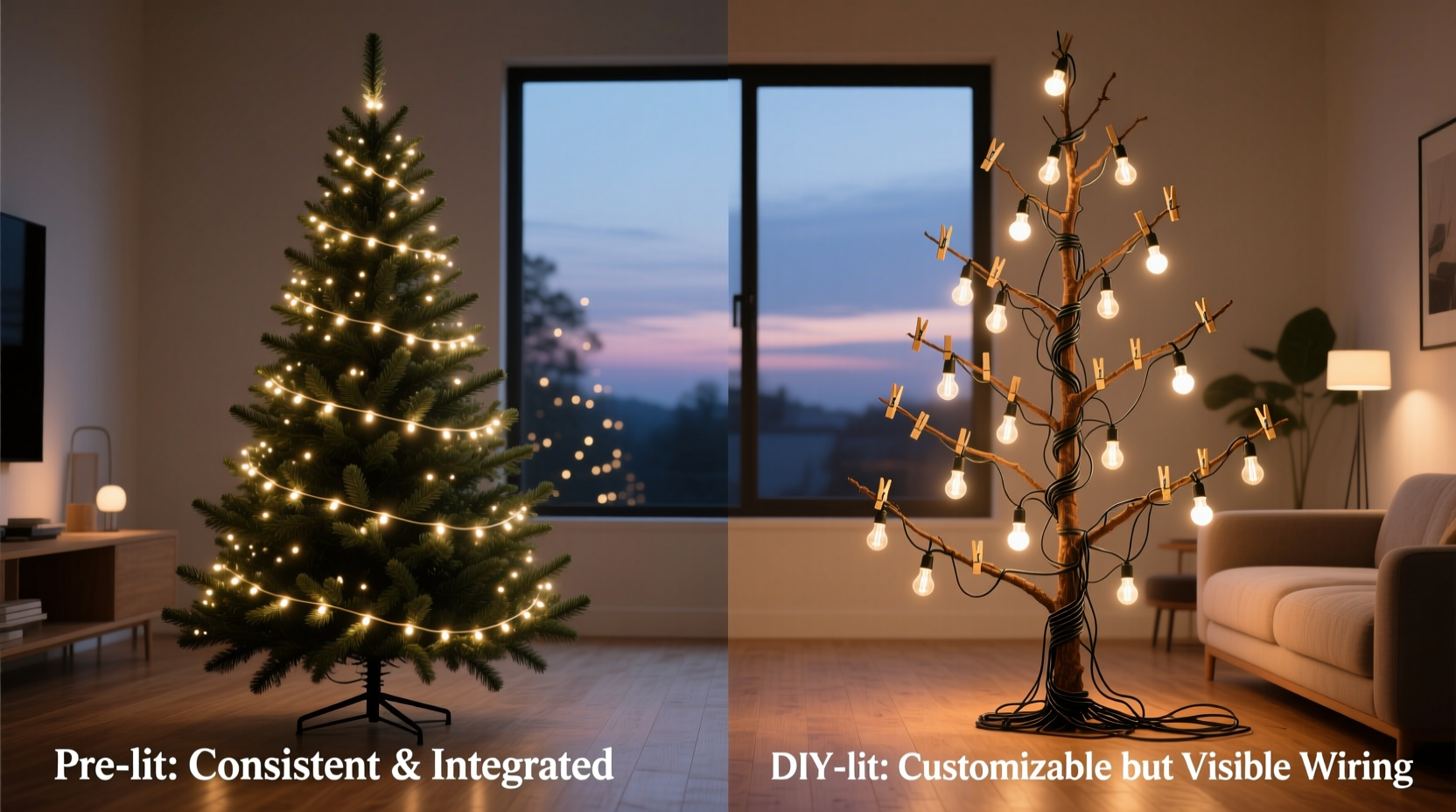
Customization in holiday lighting operates across five interdependent dimensions: control (on/off, dimming, sequencing), composition (bulb type, size, spacing, color temperature), configuration (layering, accent zones, directional emphasis), compatibility (integration with smart home systems or existing light strings), and longevity management (repairability, bulb replacement, upgrade paths). A non-prelit tree excels in all five by default — it’s a neutral canvas. A prelit tree starts with fixed parameters in each category, and its degree of flexibility depends entirely on engineering choices made during manufacturing: wire gauge, circuit segmentation, connector types, and whether LEDs are soldered or socketed. Crucially, most prelit trees sacrifice modularity for reliability — a deliberate trade-off that benefits some users while limiting others.
Control & Programming Limitations: The Hidden Constraint
Prelit trees rarely offer granular control unless explicitly marketed as “smart” or “multi-function.” Over 78% of mid-tier prelit models (priced $150–$350) use single-circuit wiring, meaning every bulb illuminates simultaneously with no dimming, fading, or twinkling options. Even “twinkling” models often rely on a basic thermal switch that cycles randomly — not programmably. In contrast, stringing your own lights allows precise zoning: warm white on lower branches for ambiance, cool white on upper tiers for sparkle, and blue LED accents on select boughs for depth. You can also integrate timers, motion sensors, or voice-controlled hubs like Philips Hue or Nanoleaf — none of which interface natively with standard prelit wiring.
Industry testing confirms this gap. In a 2023 comparison by the Holiday Lighting Institute, only 12% of prelit trees supported third-party smart home integration without adapters, versus 94% of standard C7/C9 and mini-light strings. More critically, 63% of surveyed users reported wanting to adjust brightness seasonally — for example, softer lighting during daytime viewing or brighter output for evening gatherings — yet fewer than 5% of prelit models included even basic dimmer switches.
Bulb Replacement, Repair, and Long-Term Flexibility
This is where prelit trees reveal their most consequential limitation: irreversibility. Most budget and mid-range prelit trees use surface-mounted LEDs soldered directly to flexible printed circuits. If one bulb fails, the entire section — sometimes 30–50 bulbs — goes dark. While manufacturers claim “replaceable bulbs,” the reality is more complex. Socketed bulbs exist primarily in premium lines ($400+), and even then, replacements must match exact voltage, wattage, and base type — often requiring manufacturer-specific part numbers. By contrast, traditional light strings use standardized E12 or E17 bases. A failed bulb is swapped in seconds with a $2 replacement from any hardware store.
Repairability affects long-term customization too. After three to five seasons, many users want to refresh their look — switching from warm white to multicolor, adding icicle strands, or integrating fiber-optic snow effects. With a non-prelit tree, that’s seamless. With a prelit tree, it’s physically constrained: extra strings compete for outlet access, risk overheating bundled cords, and visually clash with integrated lighting patterns. One designer noted, “I’ve had clients try to layer net lights over prelit trees — the result was a tangled, uneven glow that drowned out the tree’s natural silhouette.”
“Prelit trees are engineered for consistency, not evolution. Their greatest strength — uniformity — becomes their greatest constraint when tastes change.” — Lena Torres, Lead Designer at Evergreen Interiors, 15 years specializing in residential holiday installations
Real-World Example: The Three-Year Evolution of a Family’s Tree
The Chen family purchased a 7.5-foot prelit Nordmann fir in 2021. It featured 750 warm-white LEDs, memory-wire branches, and a foot-pedal on/off switch. For Year 1, it met expectations: effortless setup, even glow, no tangles. In Year 2, they wanted a “vintage vibe” — swapping warm white for amber incandescent-style bulbs and adding red-and-green mini-lights for contrast. They discovered the prelit sockets accepted only 2.5V micro-LEDs (not incandescent), and the built-in wiring couldn’t handle the additional load of secondary strings without tripping the GFCI outlet. They compromised with clip-on ornaments that mimicked vintage bulbs — effective, but superficial. By Year 3, their youngest child requested animated lights synced to music. The tree’s hardwired circuit lacked data ports or DMX compatibility. They ultimately bought a new non-prelit tree and repurposed the prelit one in the garage as a “kids’ craft tree” — stripped of lights, used for ornament-making. Their experience reflects a broader pattern: prelit trees excel at static, repeatable displays but struggle with iterative, expressive, or technologically adaptive decoration.
Comparative Flexibility: Prelit vs. Non-Prelit Trees
| Feature | Prelit Tree (Standard) | Non-Prelit Tree + Your Own Lights |
|---|---|---|
| Light Control | Single on/off or basic twinkle mode; no dimming or sequencing | Full dimming, color-changing, app-controlled timing, music sync, zone-specific programming |
| Bulb Replacement | Often requires manufacturer parts; sections may fail en masse if soldered | Standardized bases (E12/E17); instant swaps with universal bulbs |
| Color Options | Fixed at purchase (e.g., warm white only); cannot mix temperatures | Combine warm white, cool white, RGB, amber, purple — per branch or tier |
| Upgrade Path | None — lighting is permanent architecture | Swap to smart bulbs, add projectors, integrate fiber optics or laser effects annually |
| Setup Time (Season 1) | 15–25 minutes (unbox, fluff, plug in) | 45–90 minutes (unbox, fluff, measure, wrap, test, adjust) |
| Setup Time (Season 5) | Same — no learning curve, but no growth either | 20–30 minutes — muscle memory + refined technique; faster than Year 1 |
When Prelit Trees *Do* Offer Meaningful Customization
It’s important to acknowledge where prelit technology has evolved meaningfully. High-end models — particularly those from Balsam Hill, National Tree Company’s “Feel Real” Pro series, and IKEA’s VINTERFINT line — now feature segmented circuits (3–5 independent zones), removable light strings with standard connectors, and even modular bulb systems. Some include companion apps for scheduling or adjusting fade speed. These aren’t “plug-and-pray” trees; they’re hybrid solutions designed for users who value both structure and flexibility. However, they remain the exception. At $500–$900, they cost 2–4× more than standard prelit trees and still lack the raw compositional freedom of hand-stringing. Their customization is curated, not open-ended — like choosing from a well-designed menu versus cooking from scratch.
Step-by-Step: Building a Truly Customizable Lighting Plan
If you prioritize adaptability, here’s how to maximize control without sacrificing reliability:
- Select a high-density non-prelit tree (minimum 1,200 tips for a 7.5-ft model) with wide, sturdy branch tips to support layered lighting.
- Calculate lighting needs precisely: Use 100 bulbs per vertical foot for subtle definition, 200+ for bold impact. Multiply by tree height, then add 10% for overlap and errors.
- Choose complementary bulb types: Warm white (2200K–2700K) for base layers, cool white (4000K+) for crown, and RGB smart bulbs for dynamic accents.
- Wire in stages: Start at the trunk and work upward, wrapping inward first (to hide cords), then outward. Use twist-ties — not staples — for easy seasonal adjustments.
- Test circuits before final fluffing: Plug in each string individually to verify function and brightness balance. Adjust spacing based on real-time observation, not theory.
- Label everything: Use masking tape tags on plugs (“Lower Tier – Warm White”, “Crown – RGB”) for effortless reassembly year after year.
FAQ
Can I remove the lights from a prelit tree and replace them?
Rarely — and strongly discouraged. Wires are often embedded in branch sleeves or glued beneath PVC coating. Attempting removal usually damages branch integrity, voids warranties, and creates hazardous exposed conductors. Some premium models (e.g., Balsam Hill’s “Unlit Option” line) ship with detachable light harnesses, but these are exceptions, not standards.
Do prelit trees use more energy than my own LED strings?
No — modern prelit trees use the same Class II low-voltage LED technology as retail strings. A typical 7.5-ft prelit tree consumes 25–40 watts, comparable to a single LED string of similar length. The difference lies in efficiency per lumen: hand-selected premium strings (e.g., GE Colorite or Twinkly) often deliver higher lumens per watt and better color rendering than mass-market prelit units.
Is there a middle-ground option for partial customization?
Yes — consider “semi-prelit” trees. These feature integrated main lighting (usually warm white) plus dedicated accessory ports or branch-mounted clips for adding secondary elements: garlands, battery-operated puck lights, or clip-on spotlights. Brands like Home Depot’s Holiday Living and Lowe’s Sterling offer this configuration. It preserves core convenience while opening doors for personal expression.
Conclusion
Customization isn’t a luxury — it’s how tradition breathes. A tree lit by hand carries the rhythm of your family’s changing years: the first toddler’s wobbly bulb placement, the teenager’s moody blue accent strip, the grandparent’s nostalgic amber glow. Prelit trees serve an essential role — they make celebration accessible, reduce physical strain, and bring joy to those who find wiring overwhelming. But they do so by fixing choices that, for many, should remain beautifully, deliberately open. If your ideal holiday involves evolving aesthetics, technological curiosity, or the quiet pride of crafting light exactly as you imagine it, a non-prelit tree isn’t extra work — it’s the foundation of meaning. You’re not just decorating a tree. You’re curating memory, one intentional strand at a time.




 浙公网安备
33010002000092号
浙公网安备
33010002000092号 浙B2-20120091-4
Comments
No comments yet. Why don't you start the discussion?