
Renters navigating strict lease agreements often confront a silent dilemma: how to transform sterile, builder-grade spaces into warm, expressive homes—without risking security deposits or lease violations. Drilling holes, installing recessed lighting, swapping out fixtures, or even mounting shelves can violate clauses prohibiting “alterations” or “permanent modifications.” In this context, lighting becomes more than ambiance—it’s a legal and logistical tightrope walk. Enter the projector: not just for home theaters or presentations, but as an emerging, code-compliant tool for ambient, dynamic, and entirely reversible illumination. But is it truly better than traditional lighting solutions? The answer depends less on brightness specs and more on three interlocking realities: lease compliance, spatial flexibility, and long-term livability. This article cuts through marketing hype to assess projectors—not as gadgets, but as pragmatic, renter-first design tools.
Why Physical Lights Often Fail Renters (Legally and Logistically)
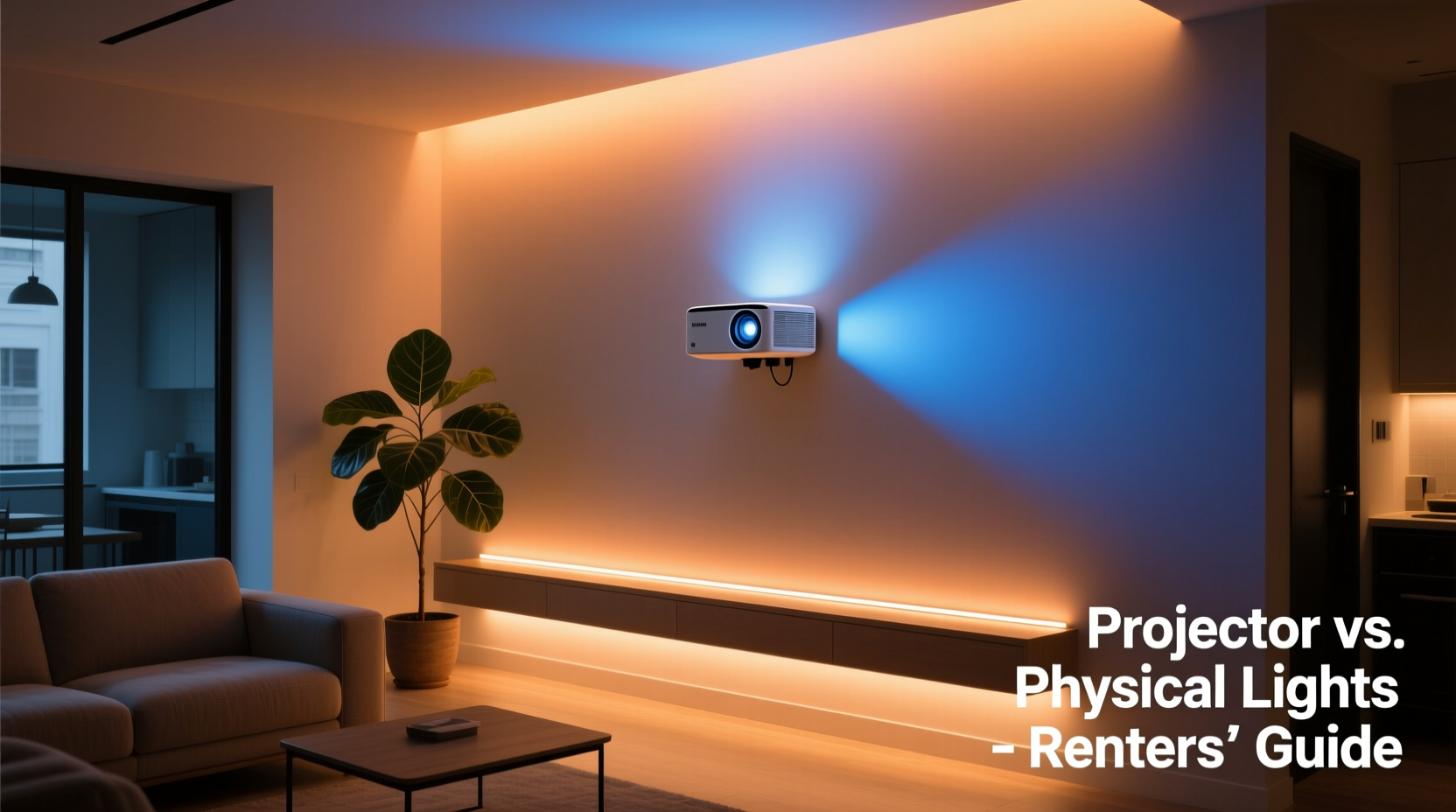
Most standard rental leases prohibit alterations that affect structural integrity, electrical systems, or surface finishes. That includes nearly every common lighting upgrade:
- Hardwired fixtures: Installing pendant lights, sconces, or track lighting typically requires opening walls, running new circuits, or modifying junction boxes—activities that almost always breach “no permanent alterations” clauses.
- Drill-required mounts: Even plug-in fixtures like swing-arm lamps or adjustable floor lamps may need wall anchors or screws for stability in high-traffic areas—creating holes that landlords classify as damage.
- Paint or finish changes: Replacing outdated ceiling roses or fixture plates often means repainting surrounding drywall or patching old screw holes—triggering obligations to restore surfaces to original condition.
- Electrical liability: Landlords frequently require licensed electricians for any work involving outlets or switches. DIY upgrades—even low-voltage LED strips—can void insurance coverage or expose tenants to liability if improperly installed.
A 2023 National Multifamily Housing Council (NMHC) survey found that 87% of professionally managed rental properties explicitly prohibit tenant-installed hardwired lighting without prior written approval—and 62% charge restoration fees for unapproved fixture swaps, averaging $189 per violation. These aren’t theoretical risks; they’re documented financial exposures.
“Landlords don’t object to beautiful lighting—they object to irreversible changes. If you can’t remove it and leave zero trace, it’s not renter-safe—even if it looks perfect.” — Maya Lin, Tenant Rights Advocate & Co-Author of Renting with Integrity
How Projectors Work as Lighting Tools (Beyond Slides and Movies)
Modern LED projectors—especially portable, short-throw, and smart models—are engineered for versatility beyond entertainment. When used intentionally for ambient lighting, they function as “light canvases”: projecting soft, diffused washes, color gradients, textured patterns, or even simulated natural light onto walls, ceilings, or floors. Unlike bulbs, they emit no heat, require no wiring, and attach to nothing. Key technical advantages include:
- No surface contact: Positioned on a shelf, desk, or tripod, they cast light from a distance—zero adhesives, screws, or brackets needed.
- Instant reversibility: Power off, pack up, and the space reverts completely—no holes, no paint mismatch, no evidence of use.
- Dynamic control: Adjust color temperature (2700K–6500K), saturation, intensity, and motion (e.g., slow cloud drift, gentle sunrise simulation) via app or remote—functions impossible with static bulbs.
- Zoned illumination: Precisely target light only where desired: a warm glow behind a sofa, a cool gradient along a hallway, or starfield patterns on a bedroom ceiling—eliminating light pollution in adjacent rooms.
This isn’t speculative. Design-forward rentals in cities like Portland, Austin, and Toronto now list “projector-ready ambient lighting” as a feature—indicating growing recognition of its functional legitimacy.
Projector vs. Physical Lights: A Renter-Centric Comparison
| Criteria | Physical Lights (Plug-in or Hardwired) | LED Projectors (Used for Ambient Lighting) |
|---|---|---|
| Lease Compliance | High risk: Hardwired = violation. Plug-in = often allowed, but mounting hardware or cord concealment may breach “no alterations” clauses. | Low risk: Zero installation required. No lease language prohibits pointing light at a wall. |
| Deposit Safety | Moderate to high exposure: Patching holes, repainting, or replacing damaged fixtures triggers deductions. | Negligible exposure: No physical change to property; no restoration needed. |
| Setup Time & Effort | Hours to days: Research, purchase, install, test, troubleshoot. May require landlord coordination for hardwired work. | Under 5 minutes: Place, focus, power on. No tools, no permits, no approvals. |
| Flexibility Across Moves | Low: Bulbs and cords move easily, but fixtures rarely do—often abandoned or sold at loss. | High: One device serves every future rental. Adapts instantly to new room sizes and layouts. |
| Ambient Customization | Limited: Fixed color temp, static output. Smart bulbs add some control—but still require hubs, apps, and compatible fixtures. | High: Real-time adjustment of hue, dimming, animation speed, pattern scale, and projection surface (wall, ceiling, fabric). |
Real-World Renter Case Study: The Brooklyn Studio Dilemma
Sophia, 29, rented a 450-square-foot studio in Williamsburg under a corporate lease with unusually strict terms: “No holes, no paint, no adhesive residue, no electrical modifications.” Her unit had two bare ceiling fixtures emitting harsh 5000K light and zero task lighting. She needed warmth for evening reading, softness for video calls, and a sense of depth in the cramped space—but couldn’t install sconces, replace bulbs with warmer LEDs (landlord-supplied only), or even hang a simple picture rail.
She tested three options over six weeks:
- Smart plug-in lamp: Required hiding a thick cord under baseboards using double-sided tape—which left faint residue on painted trim after removal. Landlord flagged it during a routine inspection.
- Clip-on LED reading light: Worked for her desk but cast harsh shadows and couldn’t soften the main living area.
- Portable LED projector (Anker Nebula Capsule 3): Mounted on a bookshelf 6 feet from the far wall. Used its “Sunset Glow” preset (2200K, slow fade) for evenings and “Cloud Drift” (soft blue-white gradient) for mornings. Added a $12 white fabric panel taped temporarily to the wall with removable poster putty—removed cleanly after three months. No lease issues. No deposit concerns. Her video call background transformed from flat glare to layered, dimensional warmth.
Sophia kept the projector for all subsequent moves—including a 3-month sublet in Seattle and a year-long lease in Nashville. “It didn’t just solve lighting,” she noted in a follow-up interview. “It solved my anxiety about leaving a mark. I stopped seeing my apartment as temporary housing and started treating it like a real home—because I finally had control I could keep.”
Practical Implementation: A 5-Step Renter’s Setup Guide
Using a projector for lighting isn’t intuitive—it requires intentional calibration. Here’s how to do it right:
- Select the right model: Prioritize LED projectors with native 1080p resolution, 300+ ANSI lumens (for daylight-usable ambient), and built-in Android TV or Chromecast. Avoid cheap “mini” projectors—they lack color accuracy and throw inconsistent light.
- Test projection surfaces: Before committing, project white light onto different walls, ceilings, and even large stretched canvas. Matte white paint yields the most uniform diffusion; avoid dark or highly textured surfaces.
- Optimize placement: Use a stable surface (not a wobbly nightstand). Elevate slightly with books if needed. Keep ventilation clear—LED projectors run cooler but still need airflow.
- Calibrate for purpose: For relaxation, use 2200K–2700K with 30–40% brightness. For task lighting near a desk, increase to 4000K and 60% brightness—but never project directly onto your eyes or computer screen.
- Integrate subtly: Hide cables with cord covers (renter-approved adhesive-free versions exist), use a neutral-colored projector casing, and turn it off when not in use—so it reads as decor, not tech clutter.
Frequently Asked Questions
Can projectors really replace overhead lights for daily use?
Yes—for ambient and mood lighting, absolutely. They won’t match the lumen output of a 100W incandescent for full-room task illumination, but modern 500-lumen projectors deliver ample, glare-free wash for lounging, dining, or winding down. Pair one with a single, well-placed plug-in floor lamp for reading, and you eliminate the need for overheads entirely.
Won’t the projector generate heat or noise in a small space?
LED projectors run significantly cooler and quieter than older lamp-based models. Top-tier portable units (e.g., XGIMI Halo+, ViewSonic M1 Mini) operate below 28 dB—quieter than a whisper—and surface temperatures rarely exceed 40°C (104°F) even after 3 hours. They’re safer and less intrusive than halogen desk lamps.
Do landlords ever object to projectors—even though they’re technically compliant?
Rarely—if you frame it correctly. Instead of saying “I’m adding lighting,” say “I’m using a portable display device for personal media and ambient light, identical to how tenants use TVs or monitors.” Emphasize zero installation and full portability. Most property managers recognize the distinction between equipment and modification.
When a Projector Isn’t the Answer (And What to Use Instead)
Projectors excel at ambiance—but they’re not universal solutions. Avoid them if:
- You need focused, directional light for cooking, detailed crafts, or makeup application (use clamp-on LED task lights instead);
- Your rental has severe light pollution concerns (e.g., shared walls with thin drywall—projector hum or light bleed may disturb neighbors);
- You live in high-humidity environments (coastal or basement units) without climate control—LED projectors are sensitive to condensation;
- Your lease explicitly bans “commercial-grade equipment” or “unlicensed electronic devices” (rare, but verify wording).
In those cases, prioritize ultra-low-risk physical alternatives: battery-powered puck lights with 3M Command Strips (designed for paint-safe removal), magnetic LED strips for metal-framed furniture, or weighted floor lamps with integrated USB charging ports—all proven to pass landlord inspections when installed and removed correctly.
Conclusion: Lighting as an Act of Renter Empowerment
Choosing lighting as a renter isn’t just about watts or kelvins—it’s about autonomy. It’s the quiet confidence of knowing your space reflects who you are, not just what the landlord provided. Projectors don’t replace every lighting need, but they redefine what’s possible within constraint. They shift the power dynamic: instead of negotiating permission to modify, you simply illuminate—responsibly, beautifully, and without compromise. That’s not a workaround. It’s a redesign of the renter experience itself. As more tenants demand flexibility, and more landlords recognize that thoughtful, non-invasive upgrades actually *increase* property appeal, projectors are evolving from novelty to necessity. Your next apartment doesn’t need to feel provisional. With the right tools—and the clarity to use them intentionally—you can build atmosphere, not just occupy space.




 浙公网安备
33010002000092号
浙公网安备
33010002000092号 浙B2-20120091-4
Comments
No comments yet. Why don't you start the discussion?