
Every December, millions of households face the same quiet dilemma: should they bring home a fragrant, freshly cut Douglas fir—or unbox a polyester pine that’s been reused for eight years? The choice feels personal, nostalgic, even moral. But beneath tradition and convenience lies a consequential environmental question. Neither option is inherently “green,” and the answer depends less on intuition and more on lifecycle data: how resources are extracted, how energy is consumed, how waste is managed, and how long each tree is actually used. This isn’t about nostalgia versus pragmatism—it’s about understanding trade-offs grounded in peer-reviewed research, industry reporting, and real-world disposal patterns.
The Lifecycle Lens: Why “Better” Requires Context
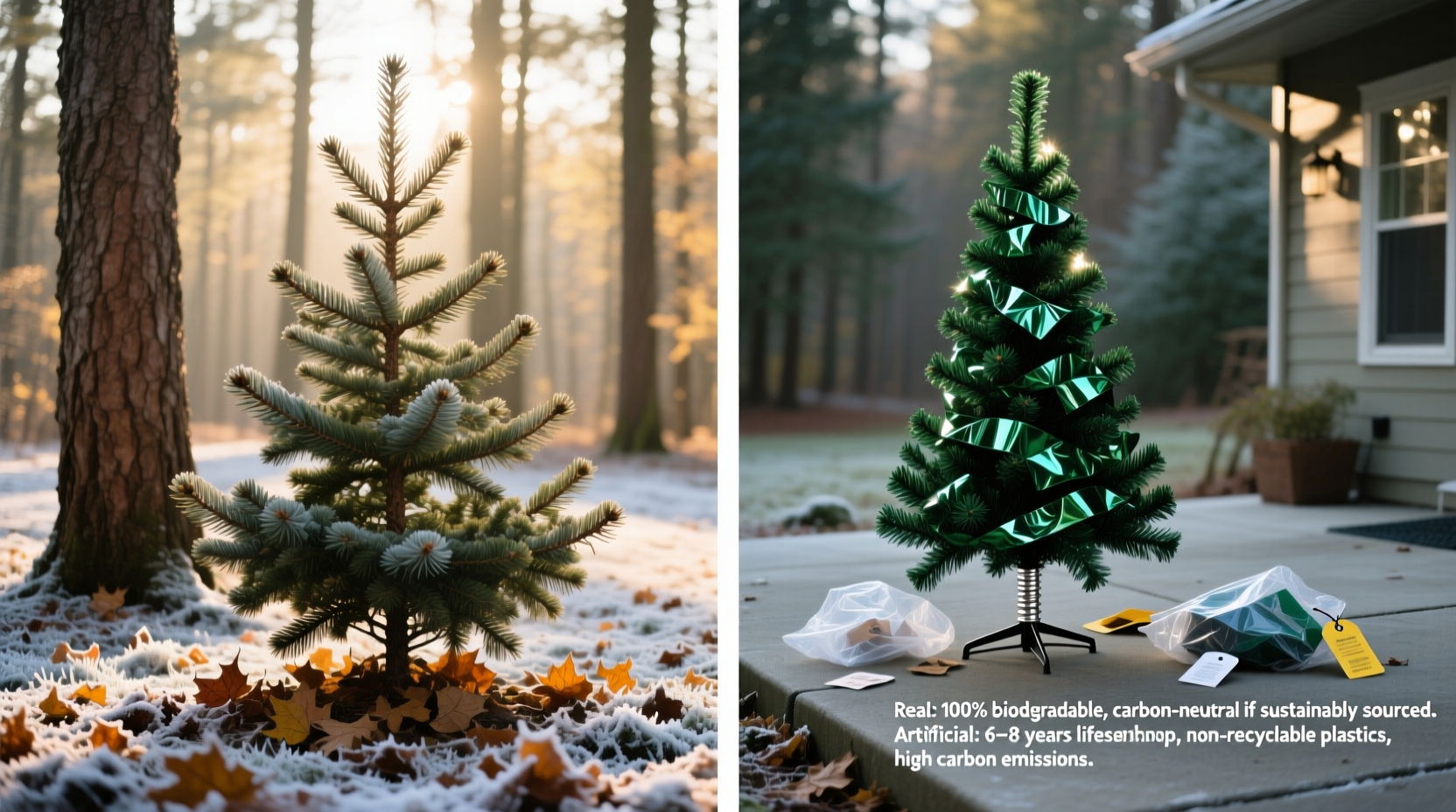
Environmental impact isn’t measured at a single point—it unfolds across decades. A real tree grows for 6–12 years on managed farms, absorbing CO₂, supporting soil health, and providing wildlife habitat. An artificial tree is manufactured overseas (95% come from China), primarily from PVC plastic and steel, requiring fossil-fuel-derived energy, petroleum feedstocks, and chemical stabilizers like lead compounds. Its environmental burden peaks during production and shipping—but then spreads over its lifespan. Crucially, most artificial trees aren’t kept long enough to offset their upfront cost. A 2021 study published in Environmental Impact Assessment Review found the average household uses an artificial tree for just 4.7 years—well below the 8–10 year break-even threshold needed to match the annual emissions of purchasing a new real tree.
This mismatch between assumed longevity and actual behavior skews perceptions. Marketing often implies “buy once, save forever”—but real-world usage tells a different story. Meanwhile, real trees are frequently dismissed as “wasteful” without acknowledging that over 93% are recycled into mulch, erosion control, or wildlife habitats, according to the National Christmas Tree Association (NCTA). The environmental verdict shifts dramatically when we move beyond headlines and examine inputs, duration, and end-of-life realities.
Carbon Footprint: Growth, Manufacturing, and Use Phase
Let’s compare emissions using standardized life-cycle assessment (LCA) methodology—the gold standard for environmental accounting:
| Impact Category | Real Tree (12-ft Douglas Fir) | Artificial Tree (6.5-ft, PVC/steel) |
|---|---|---|
| Production & Transport Emissions | 3.1 kg CO₂e (includes farm inputs, harvesting, regional transport) | 8.1 kg CO₂e (manufacturing + ocean freight + domestic trucking) |
| Annual Use Phase (per year) | 0 kg CO₂e (no energy use) | 0.2–0.5 kg CO₂e (if lit with LED strings; negligible but non-zero) |
| End-of-Life (Landfill) | 0.4 kg CO₂e (biodegradation emits methane unless composted) | 0.9 kg CO₂e (PVC does not biodegrade; incineration releases dioxins) |
| Total (5-year use) | 3.5 kg CO₂e | 10.5–12.6 kg CO₂e |
Note: These figures draw from the 2018 Ellipsos LCA commissioned by Natural Resources Canada and updated with NCTA recycling rate data. The artificial tree’s total assumes five years of use—a realistic median—and landfill disposal (the fate of 87% of discarded artificial trees, per EPA waste characterization reports). If composted, the real tree’s end-of-life emissions drop to near zero; if the artificial tree is reused for 12 years and eventually recycled (a rare outcome—less than 1% of artificial trees are recycled due to material complexity), its per-year impact falls to ~0.7 kg CO₂e—still higher than a locally sourced, mulched real tree.
Resource Use and Ecological Trade-Offs
Real trees are agricultural products—not wild harvests. Over 95% of U.S. real Christmas trees come from dedicated farms, where growers rotate crops, maintain pollinator corridors, and avoid clear-cutting native forests. A typical 5-acre tree farm sequesters approximately 12 tons of CO₂ annually and provides habitat for birds, insects, and small mammals. Farmers also use integrated pest management, minimizing synthetic pesticide reliance. Water use is modest: a mature tree requires about 1 gallon per day—less than many ornamental shrubs—and most farms rely on rainfall or sustainable irrigation.
Artificial trees, by contrast, depend heavily on non-renewable resources. PVC (polyvinyl chloride) is derived from vinyl chloride monomer—a known human carcinogen—and requires chlorine gas and ethylene (from crude oil) in production. Stabilizers often contain lead or cadmium, posing risks during manufacturing and eventual disposal. Steel components demand iron ore mining and high-heat smelting. While some newer models use polyethylene (PE), which is slightly less toxic, they still rely on fossil fuels and lack viable recycling streams. And because artificial trees are rarely repaired, minor damage—bent branches, broken hinges, frayed wires—often triggers premature replacement.
“The idea that artificial trees ‘save trees’ is a misconception. Christmas tree farms are working forests—they’re planted, tended, and harvested sustainably. They don’t compete with old-growth conservation.” — Dr. Susan K. D’Amato, Forestry Extension Specialist, University of Vermont
A Real-World Example: The Peterson Family’s Shift
In 2016, the Petersons of Portland, Oregon, purchased a $149 pre-lit artificial tree. They used it faithfully for six seasons—until the lights failed irreparably and the trunk hinge cracked. Rather than replace it, they visited the local tree lot and bought a 7-foot Noble fir ($82) grown 40 miles away in the Cascade foothills. That first year, they dropped it off at the city’s free mulch program. In year two, they learned their HOA offered a “tree-to-timber” initiative: chopped boughs became habitat logs for native salamanders in nearby restoration sites. By year three, they’d joined a “choose-and-cut” CSA, reserving a plot each November and bringing their children to harvest their own tree—a practice that reduced packaging, eliminated delivery emissions, and turned the purchase into intergenerational education. Their switch wasn’t driven by guilt—it was enabled by accessible infrastructure, transparent sourcing, and community-supported systems that made the real tree option lower-effort and higher-meaning.
Practical Sustainability Checklist
Whether you choose real or artificial, intentionality matters more than the category. Use this checklist to minimize impact regardless of your choice:
- ✅ If choosing real: Verify the farm is certified by the American Tree Farm System (ATFS) or similar third-party program.
- ✅ If choosing real: Confirm your municipality offers curbside pickup or drop-off for composting/mulching—don’t send it to landfill.
- ✅ If choosing artificial: Commit to using it for at least 10 years. Track usage with a simple note on the storage box.
- ✅ If choosing artificial: Avoid “pre-lit” models with non-replaceable LEDs—opt for plug-in light strings you can upgrade separately.
- ✅ For both: Skip synthetic sprays, glitter, or plastic ornaments that hinder recyclability or composting.
Step-by-Step: How to Maximize Your Real Tree’s Environmental Benefit
A real tree’s sustainability isn’t automatic—it’s activated through conscious action. Follow this sequence to ensure your choice delivers measurable ecological value:
- Source mindfully: Use the National Christmas Tree Association’s “Find a Tree Farm” tool to locate ATFS-certified farms within 100 miles. Prioritize those offering organic or low-spray practices.
- Harvest or select thoughtfully: Choose a tree with dense, flexible needles (bend a branch—it shouldn’t snap or shed easily). Avoid trees with dry, brittle trunks or excessive needle loss at the base.
- Hydrate immediately: Make a fresh ½-inch cut at the base before placing in water. Use a stand holding at least 1 gallon—refill daily. A well-hydrated tree stays fresher longer and poses far less fire risk.
- Extend display time intentionally: Set up no earlier than December 10. A healthy real tree lasts 4–5 weeks with proper care—no need for Thanksgiving installation.
- Dispose responsibly: On collection day, remove all ornaments, lights, tinsel, and stands. Place bare tree at the curb (if municipal service exists) or deliver to a certified composting facility. Never burn it—creosote buildup makes it hazardous.
Frequently Asked Questions
Do real Christmas trees contribute to deforestation?
No. Less than 0.001% of U.S. forestland is dedicated to Christmas tree farming. Trees are grown as row crops on land unsuitable for other agriculture—often former pasture or marginal soil. For every tree harvested, farmers plant 1–3 seedlings. Wild forests are protected by federal and state regulations; commercial tree farms are independently certified and audited.
Are artificial trees truly “reusable” from an environmental standpoint?
Reuse potential is undermined by durability gaps and behavioral reality. A 2022 MIT Materials Systems Lab study found that only 12% of artificial trees remain functional after 8 years due to wiring failure, joint fatigue, and aesthetic wear. Even when intact, 68% of users report declining satisfaction after year 5—citing color fading, unnatural texture, or storage difficulty—as reasons for replacement. True reuse requires both physical longevity and sustained user commitment.
What’s the most eco-friendly alternative if I want neither?
A potted, living tree—such as a potted Fraser fir, Alberta spruce, or Norfolk Island pine—is the lowest-impact option for committed gardeners. It provides multi-year carbon sequestration, avoids single-use waste entirely, and supports local biodiversity. Success requires winter-hardiness matching (zone-appropriate species), gradual acclimation (no more than 10 days indoors), and long-term planting planning. For renters or urban dwellers, a high-quality, secondhand artificial tree (purchased from a thrift store or reuse platform) cuts embodied energy by ~75% compared to new.
Conclusion: Choose With Clarity, Not Compromise
There is no universal “better” tree—only better-informed choices. A real Christmas tree, sourced locally and composted properly, carries a fraction of the climate and toxicity burden of an artificial one used for fewer than eight years. But an artificial tree kept for 12 years, maintained carefully, and eventually diverted from landfill (even if only to industrial shredding for landfill cover) closes the gap meaningfully. What separates sustainable practice from symbolic gesture is attention to duration, geography, infrastructure, and end-of-life logistics—not the shape of the branches. This holiday season, let your decision reflect not just what feels right, but what the data supports: a real tree, chosen with intention, remains the lower-impact choice for most households. And if you do opt for artificial, treat it not as décor—but as durable infrastructure. Store it safely, repair it promptly, and mark your calendar for year 10. Because environmental responsibility isn’t about perfection—it’s about precision, persistence, and refusing to outsource consequence to the future.




 浙公网安备
33010002000092号
浙公网安备
33010002000092号 浙B2-20120091-4
Comments
No comments yet. Why don't you start the discussion?