
When it comes to decorating for the holidays, few elements command attention like a full, lush Christmas tree. For families with larger homes or those who prefer a grander holiday centerpiece, choosing a tall or wide tree is natural. But as tree size increases, so do logistical challenges—especially when it comes to stability, placement, and visibility. One solution often marketed to homeowners is the rotating Christmas tree base. These motorized stands slowly turn the tree 360 degrees, promising even ornament distribution and effortless viewing from all angles. But is this feature truly necessary—particularly for large or heavy trees? The answer depends on several factors, including tree weight, room layout, safety concerns, and personal preference.
Understanding Rotating Tree Bases: How They Work
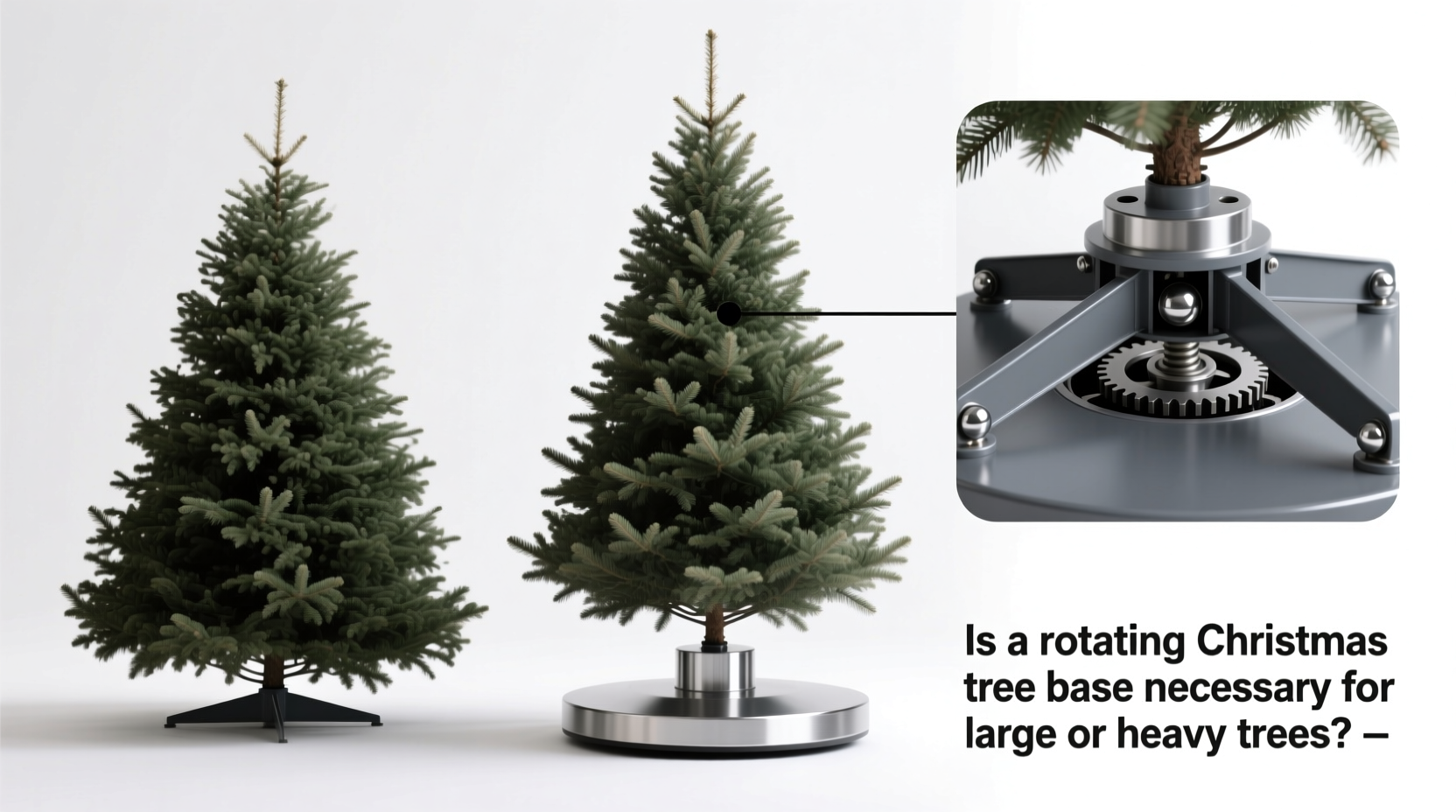
A rotating Christmas tree base is a motorized stand designed to support live or artificial trees while gently turning them in a continuous circle. Most models rotate at a speed of one full revolution every 60 to 90 seconds, slow enough to avoid disturbing ornaments but fast enough to provide dynamic visual appeal. These bases typically have weight limits ranging from 50 to over 150 pounds, making some suitable for large flocked or pre-lit artificial trees, as well as dense real evergreens like Fraser firs.
The mechanism usually includes a low-voltage motor powered by a standard outlet. Once the tree is secured in the stand’s central clamp and water reservoir (if applicable), the rotation begins with the flip of a switch. Some advanced models include remote controls, adjustable speeds, or timers.
While the novelty is appealing, the real value lies in functionality. For oversized trees that dominate a room, rotation can eliminate blind spots and reduce the need to walk around the tree to admire decorations. However, not all large trees are compatible with these systems, and improper use can lead to instability or mechanical failure.
Advantages of Using a Rotating Base for Large Trees
For heavier or taller trees, a rotating base isn’t just a luxury—it can be a practical tool that enhances both safety and aesthetics.
- Improved Visibility: Large trees often block sightlines, especially in open-concept homes. A rotating base ensures that every ornament, light strand, and decorative element gets its moment in view, eliminating the need to reposition furniture or crane your neck.
- Balanced Decoration: When decorating manually, it’s easy to favor one side of the tree, especially if access is limited. Rotation encourages decorators to step back and assess the tree from all angles, promoting more symmetrical and intentional design.
- Ease of Access During Setup: With a rotating base, you can stay in one position while the tree turns to you. This reduces physical strain during decorating, particularly helpful for individuals with mobility limitations or those working alone.
- Enhanced Safety in High-Traffic Areas: In homes with children or pets, a stationary large tree may tempt climbing or tugging. A slowly rotating tree can act as a subtle deterrent—its movement draws attention without encouraging interaction.
- Even Weight Distribution Over Time: While minimal, constant rotation may help prevent soil compaction on one side of a live tree’s root ball or reduce pressure points on carpeting beneath artificial trees.
“Rotating bases are especially useful for trees over 7 feet—they transform a static display into an engaging centerpiece.” — Daniel Reeves, Holiday Display Designer and Former Theme Park Decorator
Challenges and Limitations with Heavy or Oversized Trees
Despite their benefits, rotating bases aren’t universally suitable. When dealing with very large or heavy trees, several drawbacks must be considered.
First, **weight capacity** is a critical constraint. Many rotating stands max out at 100–125 pounds. A mature 8-foot artificial tree with built-in lights, flocking, and a metal frame can easily exceed this. Real trees, especially when water-saturated, add significant mass. Exceeding the limit risks motor burnout, uneven rotation, or even structural collapse.
Second, **floor compatibility** matters. Rotating bases require a flat, hard surface to function properly. Thick rugs, uneven hardwood, or tile grout lines can cause wobbling or stop the rotation entirely. On plush carpeting, the base may sink slightly, increasing friction and straining the motor.
Third, **stability becomes more precarious** with height. A tall tree on a rotating platform has a higher center of gravity. If not perfectly balanced during setup, it may develop a wobble that worsens over time. This is especially dangerous with top-heavy trees or those carrying heavy glass ornaments near the upper branches.
Lastly, **reliability varies by brand**. Lower-cost models may feature underpowered motors or plastic gears prone to wear. For a large tree—a significant investment in time and money—this introduces unnecessary risk.
Do’s and Don’ts for Using Rotating Bases with Heavy Trees
| Action | Recommendation |
|---|---|
| Do: Choose a base rated for at least 20% more than your tree’s weight | Ensures longevity and prevents motor strain |
| Don’t: Use on thick-pile carpet without a protective board | Can impede rotation and destabilize the tree |
| Do: Balance the tree evenly before starting rotation | Prevents wobbling and uneven wear |
| Don’t: Overload upper branches with heavy ornaments | Increases tipping risk on a moving base |
| Do: Test rotation without ornaments first | Identifies instability early |
Real-World Example: The Thompson Family’s 9-Foot Tree
The Thompsons purchased a premium 9-foot pre-lit artificial spruce for their suburban living room. Weighing approximately 110 pounds dry and over 125 with added decorations, the tree was too large for standard stands. Initially, they used a heavy-duty stationary stand, but struggled with decoration symmetry—guests could only see half the tree clearly due to furniture placement.
The following year, they invested in a commercial-grade rotating base rated for 150 pounds. After assembling the tree on a plywood sheet (to distribute weight on their engineered hardwood floors), they secured it carefully, ensuring the trunk was centered. The difference was immediate: the tree became a focal point visible from the kitchen, dining area, and entryway.
However, after two weeks, they noticed a slight grinding noise. Upon inspection, they realized one corner of the base was lifting slightly due to an imperfection in the floor. They resolved it by adding a thin rubber shim, restoring smooth operation. The experience taught them that even high-end rotating systems require precise setup—especially with large trees.
Step-by-Step Guide: Installing a Large Tree on a Rotating Base
Proper installation is crucial for safety and performance. Follow this sequence to set up a heavy tree on a rotating base:
- Inspect the Floor Surface: Ensure the area is clean, level, and free of debris. Use a carpenter’s level to check for slopes. If using on carpet, place a rigid board (e.g., 2'x2' plywood) underneath.
- Assemble the Base: Attach the motor unit and platform according to manufacturer instructions. Plug it in temporarily to confirm rotation works without obstruction.
- Prepare the Tree: If using a real tree, make a fresh cut on the trunk bottom. For artificial trees, assemble sections completely before mounting.
- Center the Trunk: Insert the trunk into the stand’s clamp, ensuring it sits vertically. Tighten screws gradually and evenly to avoid warping.
- Test Without Load: Turn on the rotation with no ornaments or lights. Watch for vibrations, wobbling, or resistance. Adjust leveling feet if available.
- Add Water (for Live Trees): Fill the reservoir and monitor daily. Avoid overfilling, which could leak into the motor housing.
- Decorate Gradually: Add lights and ornaments symmetrically. Step back frequently to observe how rotation affects visual balance.
- Final Check: Run the tree for 10 minutes unattended (within sight) to ensure consistent motion and no overheating.
Alternatives to Rotating Bases for Large Trees
If a rotating base proves impractical or too costly, several alternatives offer similar benefits:
- Turntable Platforms: Non-motorized rotating discs (like those used for pottery or retail displays) allow manual spinning. These handle heavier loads and cost less, though they require manual turning.
- Strategic Lighting: Use spotlights or LED projectors to highlight different tree sections at various times, creating dynamic visual interest without movement.
- Mirrors: Placing a large mirror opposite the tree effectively doubles visibility, allowing guests to see the “back” side without walking behind it.
- Smart Placement: Position the tree in a central location or near a corner with open sightlines. Angling it slightly can improve multi-angle viewing.
Frequently Asked Questions
Can I use a rotating base with a real Christmas tree?
Yes, but only if the base is specifically designed for live trees with water reservoirs. Ensure the motor compartment is sealed to prevent water damage. Monitor water levels daily, as dehydration increases fire risk and may affect balance.
Are rotating bases noisy?
Most modern models operate quietly, emitting a faint hum comparable to a refrigerator. Cheaper versions may produce clicking or grinding sounds, especially under load. Read user reviews focusing on noise before purchasing.
Do rotating bases increase fire hazards?
Not inherently, but any electrical device near a tree requires caution. Keep cords untangled, avoid overloading outlets, and never leave the base running unattended for long periods. Unplug when leaving home or sleeping.
Checklist: Is a Rotating Base Right for Your Large Tree?
- ✅ Tree weight is within the base’s specified limit (with margin)
- ✅ Floor surface is flat, hard, and stable
- ✅ Room layout benefits from 360-degree visibility
- ✅ Budget allows for a high-quality, durable model
- ✅ You decorate elaborately and want even visual impact
- ✅ No pets or toddlers likely to interact with moving parts
- ✅ Willingness to perform regular checks for wobbling or motor strain
Conclusion: Balancing Practicality and Presentation
A rotating Christmas tree base can elevate the holiday experience, especially when showcasing a large or heavily decorated tree. For those with spacious rooms, intricate decorations, or accessibility needs, the convenience and visual appeal are undeniable. However, necessity depends on context. If your tree exceeds weight limits, sits on uneven flooring, or resides in a low-traffic corner, a high-quality stationary stand may be safer and more reliable.
The decision ultimately hinges on balancing aesthetic goals with practical constraints. For many, the rotating base is not essential—but for others, it transforms a seasonal tradition into a mesmerizing display that captivates family and guests alike. If you choose to go rotational, invest in durability, prioritize safety, and take time with setup. The result can be a stunning centerpiece that turns—not just physically, but emotionally—into the heart of your holiday celebration.




 浙公网安备
33010002000092号
浙公网安备
33010002000092号 浙B2-20120091-4
Comments
No comments yet. Why don't you start the discussion?