
Flocked Christmas trees bring the magic of a winter wonderland into homes across the country. Their snow-dusted appearance adds elegance and nostalgia to holiday decor. But when you're dealing with a large flocked tree—often 8 feet or taller—the challenges of setup, positioning, and maintenance multiply. One solution gaining popularity is the rotating Christmas tree base. Designed to spin smoothly under the weight of a fully decorated tree, these bases promise easier viewing and simplified decorating. But are they truly worth the investment, especially for heavier, flocked models? This article explores the practical benefits, potential drawbacks, and real-world considerations to help you decide.
The Unique Challenges of Large Flocked Trees
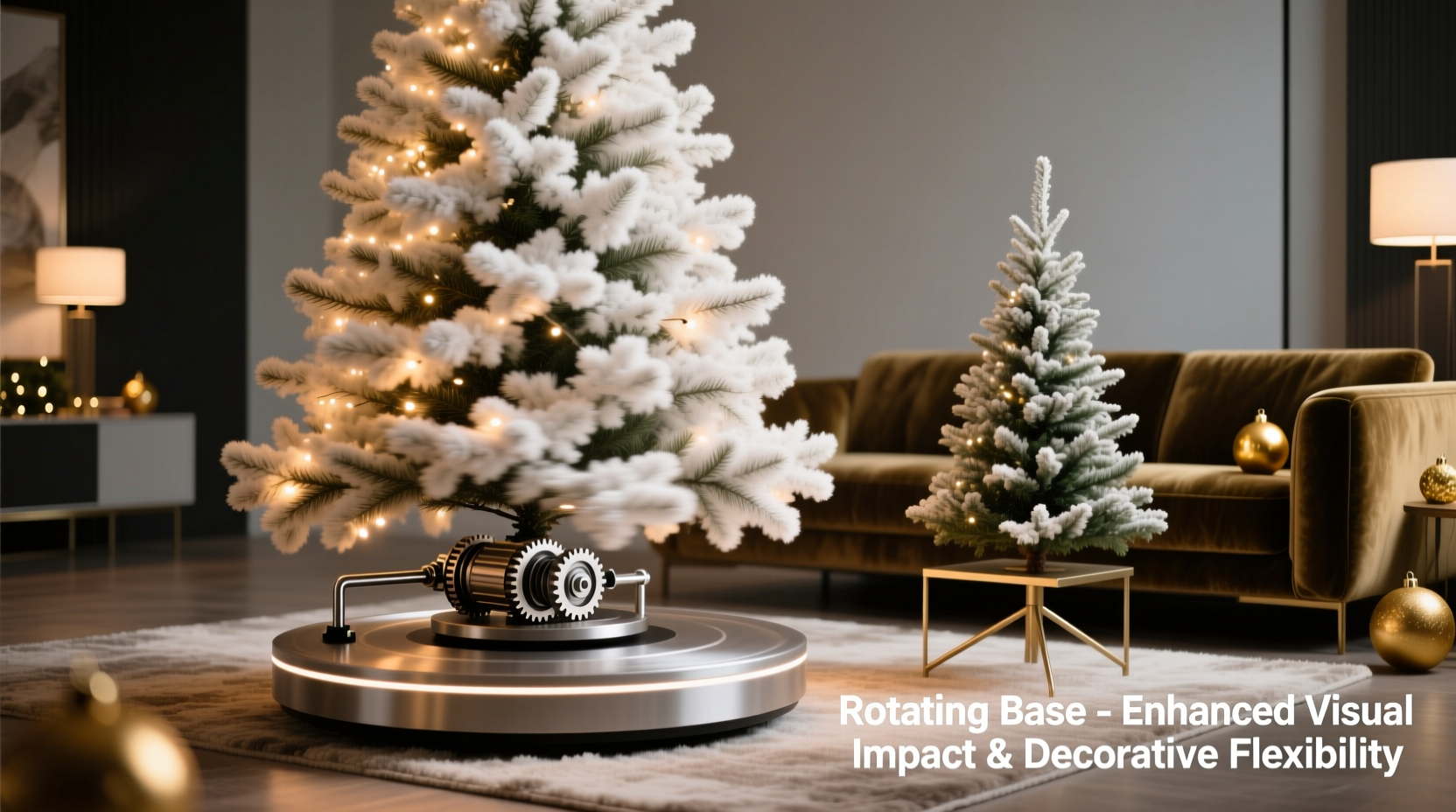
Flocked trees differ from traditional evergreens in both weight and fragility. The flocking material—typically a cellulose-based spray or powder—adds significant mass to branches and needles. A 7.5-foot pre-lit flocked tree can weigh between 60 and 90 pounds before ornaments, lights, and a stand are added. Once assembled, the total load on the base can exceed 100 pounds, depending on construction and decoration density.
Beyond weight, flocking introduces sensitivity to movement and vibration. Excessive shaking or dragging can cause the artificial \"snow\" to flake off, particularly at stress points like branch joints. This makes repositioning a fully decorated tree risky. Many homeowners find themselves needing to rotate or adjust their tree after placement only to realize how difficult and potentially damaging that process can be.
Additionally, large flocked trees are often focal points in living rooms or entryways, where visibility from multiple angles is expected. Without rotation, guests may miss intricately decorated sides, diminishing the overall impact of the display.
How Rotating Bases Work and What They Offer
A rotating Christmas tree base uses a low-friction bearing system to allow smooth 360-degree rotation. Most models support weights from 50 to over 150 pounds, making them suitable for large trees. They typically feature adjustable grips or brackets that secure the tree’s central pole, ensuring stability while permitting controlled spinning via a gentle push.
High-end models include locking mechanisms to fix the tree in place once the desired angle is achieved. Some even offer motorized rotation, allowing remote-controlled turning—an appealing option for those with mobility concerns or elaborate displays.
The primary advantages include:
- Ease of decorating: Rotate the tree incrementally while adding ornaments, ensuring even coverage without walking around.
- Better viewing: Showcase all sides of the tree during gatherings without rearranging furniture.
- Reduced physical strain: Eliminate the need to move heavy trees manually after setup.
- Safety: Minimize tripping hazards caused by dragging stands across floors.
“Rotating bases aren’t just about convenience—they’re a smart ergonomic choice, especially for older adults or anyone managing larger trees alone.” — Daniel Reeves, Home Holiday Systems Engineer
Comparing Standard vs. Rotating Bases for Flocked Trees
| Feature | Standard Tree Stand | Rotating Tree Base |
|---|---|---|
| Weight Capacity | Typically 50–75 lbs | 75–150+ lbs (varies by model) |
| Tree Adjustment After Setup | Requires lifting or dragging | Smooth rotation with minimal effort |
| Flocking Preservation | Higher risk of damage during repositioning | Lower risk due to stable, controlled movement |
| Decorating Efficiency | Requires constant walking around | Work from one position; rotate as needed |
| Cost Range | $15–$40 | $50–$150+ |
| Locking Mechanism | Rare | Common in mid-to-high-end models |
The data shows a clear trade-off: higher upfront cost for long-term gains in usability and preservation. For occasional users with small trees, a standard stand suffices. But for families investing in premium flocked trees meant to last for years, the rotating base begins to look less like a luxury and more like a protective measure.
Step-by-Step: Installing a Large Flocked Tree on a Rotating Base
Proper installation is crucial to ensure both stability and smooth operation. Follow this sequence to maximize safety and performance:
- Assemble the base on a flat surface: Ensure the floor is level and free of debris. Uneven surfaces can cause wobbling or uneven wear on the bearing.
- Secure the central pole clamp: Adjust the grip mechanism according to your tree’s pole diameter. Over-tightening can damage metal poles; under-tightening risks slippage.
- Lift the tree vertically into the base: Use two people if necessary. Avoid angling the tree, which can misalign the pole and stress the rotation mechanism.
- Test stability before decorating: Gently wiggle the trunk to check for looseness. Make micro-adjustments to the clamp if needed.
- Add water (if applicable): While most flocked trees are artificial, some rotating bases double as water reservoirs for live trees. Skip this step unless using a hybrid model.
- Begin decorating with rotation in mind: Start at the back side so you can rotate it forward as you work. Use the rotation feature every few minutes to maintain even ornament distribution.
- Lock the base once finished: If your model includes a lock, engage it after final positioning to prevent accidental spinning, especially in homes with pets or children.
Real-World Example: The Thompson Family’s Flocked Tree Upgrade
The Thompsons of Minneapolis have displayed a 9-foot flocked tree in their living room for over a decade. Three years ago, they switched to a rotating base after a frustrating season where they had to move the tree three times post-decoration—each time causing visible flock loss near the trunk.
“We spent hours perfecting the look, only to ruin part of it trying to center the tree in the room,” recalls Laura Thompson. “The second we upgraded to a rotating base, everything changed. We set it up facing the wall, decorated it slowly over two nights, and just spun it into place when done. No stress, no mess.”
Their current base, priced at $110, supports up to 120 pounds and includes a manual lock. They estimate they’ve saved at least six hours in setup time since switching, not counting reduced cleanup from fallen flock particles. “It paid for itself in sanity,” Laura says.
What Experts Say About Rotating Bases and Tree Longevity
Industry professionals increasingly recommend rotating bases—not just for convenience, but as part of a broader strategy to extend the life of high-value artificial trees.
“A rotating base reduces mechanical stress on both the tree structure and its decorative finish. For flocked trees, which are more delicate than standard PVC models, this can mean several extra years of pristine appearance.” — Marcus Lin, Senior Product Designer at Evergreen Decor Labs
According to Lin, repeated lateral pressure—such as pushing a tree stand across hardwood or tile—can warp the central pole over time, leading to instability in future seasons. A rotating base eliminates the need for such force, preserving alignment and structural integrity.
Moreover, because flocking adheres best to undisturbed surfaces, minimizing handling after application helps maintain visual quality. Rotating bases support this by allowing fine-tuning of display angle without touching the branches.
Key Considerations Before Buying a Rotating Base
Not all rotating bases are created equal. Before purchasing, evaluate the following factors to ensure compatibility and value:
- Weight rating: Confirm the base supports at least 20% more than your tree’s total loaded weight.
- Floor protection: Look for rubberized feet or non-marring pads to prevent scratches on hardwood or laminate.
- Compatibility: Ensure the clamp fits your tree’s pole diameter (most are adjustable between 0.75” and 2”).
- Locking feature: Essential for homes with active children or pets.
- Assembly complexity: Some models require tools and 15–30 minutes to set up. Opt for tool-free designs if ease matters.
- Brand reputation: Stick with brands known for durability, such as Pivotree, TreeMaster, or Noble House.
FAQ: Common Questions About Rotating Bases for Flocked Trees
Can a rotating base damage my flocked tree?
No—if used correctly. As long as the tree is securely fastened and rotated gently, there is no additional risk. In fact, it reduces the chance of damage compared to dragging or tilting a heavy stand.
Do I need a special base for a pre-lit flocked tree?
Not necessarily, but ensure the base design accommodates the power cord. Some rotating models have built-in cord management channels to prevent tangling during rotation.
Are motorized rotating bases worth the extra cost?
For most households, no. Manual rotation is sufficient and quieter. Motorized bases are best suited for commercial displays, tight spaces, or individuals with limited mobility who cannot reach the tree to spin it.
Final Checklist: Is a Rotating Base Right for You?
Use this checklist to determine if a rotating base aligns with your needs:
- ☑ Your tree is 7.5 feet or taller
- ☑ Your tree is flocked or heavily decorated
- ☑ You decorate the tree in its final location
- ☑ You value even ornament distribution and full-angle viewing
- ☑ You’ve struggled with repositioning trees in the past
- ☑ You plan to keep the same tree for 5+ years
- ☑ You’re willing to invest $60–$120 for long-term benefits
If you checked four or more, a rotating base is likely a worthwhile investment.
Conclusion: Elevate Your Holiday Display with Smarter Support
A large flocked Christmas tree is more than decor—it’s a centerpiece, a tradition, and often a family heirloom in the making. Protecting its appearance and simplifying its care shouldn’t be an afterthought. A rotating Christmas tree base offers tangible benefits: reduced physical strain, improved decorating control, better visibility, and enhanced preservation of delicate flocking.
While the initial cost exceeds that of a basic stand, the long-term value—measured in time saved, stress reduced, and tree longevity extended—makes it a smart upgrade for serious holiday decorators. When paired with careful handling and proper maintenance, a rotating base ensures your winter wonderland stays flawless from every angle.




 浙公网安备
33010002000092号
浙公网安备
33010002000092号 浙B2-20120091-4
Comments
No comments yet. Why don't you start the discussion?