
For many households, the centerpiece of holiday decor is the Christmas tree—majestic, fragrant, and often towering over living room corners. But once the tree is in place, decorating becomes a logistical challenge, especially when space is limited or the tree is tall and heavy. This is where the idea of a rotating Christmas tree base comes in. Marketed as a convenience upgrade, these motorized or manually rotated stands promise easier decorating, better visibility, and reduced physical strain. But are they truly worth it—particularly for large trees and homes with tight floor plans? The answer depends on several practical factors: tree size, room layout, user mobility, and long-term usability.
A rotating base isn’t just a novelty—it’s an engineering solution to a real problem. Instead of moving around a bulky tree to hang ornaments evenly, you stay in one spot while the tree turns toward you. For families with tall firs or spruces exceeding 8 feet, or those placing the tree in a corner near furniture or traffic paths, this feature can make setup less frustrating. However, not all rotating bases are created equal, and their value varies significantly based on use case.
The Challenge of Large Trees in Compact Spaces
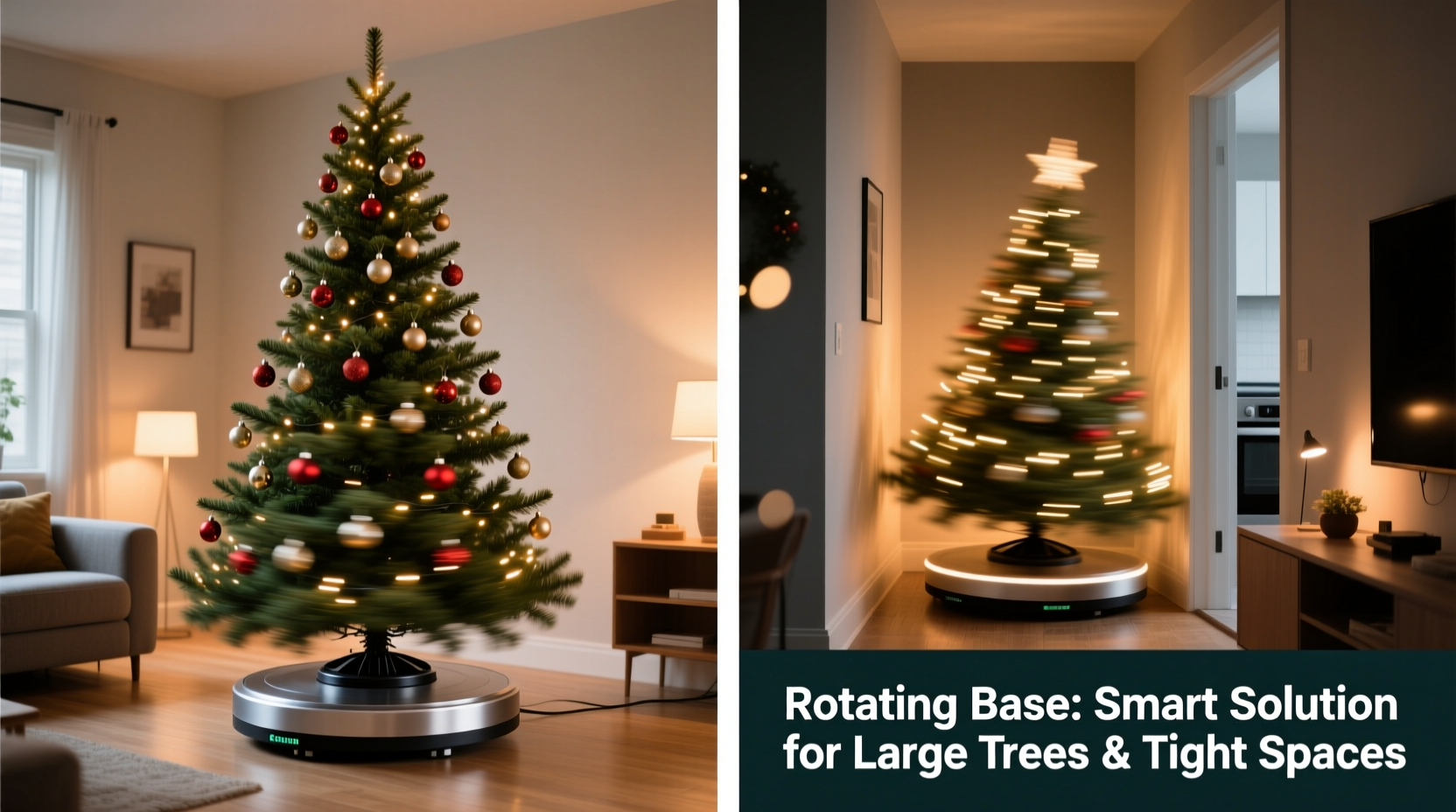
Large Christmas trees—typically defined as 7 feet and above—bring grandeur but also complications. They require sturdier stands, more water, and greater clearance for both installation and decoration. In urban apartments, split-level homes, or rooms with furniture crowding the perimeter, maneuvering around a full-sized tree can be difficult. Reaching the backside without knocking over lamps, tripping over rugs, or straining your back becomes a seasonal hazard.
In such environments, accessibility matters. A tree placed flush against a wall or nestled into a corner may look elegant, but decorating the hidden sides forces awkward stretching or repositioning. This is where rotation could offer tangible benefits. By enabling 360-degree access from a single vantage point, a rotating base reduces movement and increases precision during ornament placement.
How Rotating Bases Work: Mechanics and Types
Rotating tree bases come in two primary types: manual and motorized.
- Manual rotating bases rely on hand-cranking or direct pushing to turn the tree. These are typically more affordable and mechanically simpler, using ball bearings or low-friction platforms to enable smooth rotation. While effective, they require consistent effort, especially with heavier trees.
- Motorized rotating bases include a small electric motor that slowly rotates the tree at a preset speed, often controllable via remote or switch. These models provide hands-free operation and are ideal for display purposes, allowing guests to view all angles without intervention.
Both types must support the tree's weight and trunk diameter. Most high-capacity rotating stands handle up to 12-foot trees weighing over 150 pounds, provided the trunk is centered and the stand is level. The mechanism usually sits beneath a standard tree stand reservoir, integrating water retention with rotational capability.
However, performance depends heavily on build quality. Lower-end models may wobble under load or bind after a few rotations. Higher-end versions use sealed bearings and reinforced frames to maintain stability. As one home improvement specialist notes:
“Rotation only works if the base remains stable. A wobbly motorized stand under a 9-foot spruce isn’t just ineffective—it’s a safety risk.” — Daniel Reeves, Holiday Display Engineer, HomeFlex Innovations
Pros and Cons: Is It Worth the Investment?
To determine whether a rotating base adds real value, consider the following comparison of advantages and limitations.
| Advantages | Disadvantages |
|---|---|
| Reduces physical strain during decorating, especially for elderly or mobility-limited individuals | Higher cost compared to standard stands (typically $80–$200 vs. $30–$60) |
| Enables even ornament distribution without walking around the tree | Requires open floor space around the base to allow full rotation |
| Motorized versions enhance visual appeal with slow-turning displays | Electric models need nearby power access; extension cords create tripping hazards |
| Helps position tree perfectly within tight alignment constraints (e.g., centered under a mantel) | Potential mechanical failure or noise from motors, particularly in budget models |
| Simplifies light stringing by allowing controlled rotation during wrapping | Not all large trees rotate smoothly—dense branches may catch on walls or furniture |
The trade-offs become clearer when evaluating specific scenarios. For example, a family with a 9-foot Fraser fir in a narrow living room might find the ability to fine-tune positioning invaluable. Conversely, someone with a spacious great room and no physical limitations may see little benefit beyond novelty.
Real-World Example: The Urban Apartment Dilemma
Consider Sarah Lin, a resident of a Chicago high-rise with a 700-square-foot apartment. Each year, she opts for a 7.5-foot noble fir—a decision driven by tradition, not space optimization. Her living area opens directly into the kitchen, leaving minimal clearance behind the sofa where the tree must go. Last year, she purchased a mid-range motorized rotating base after struggling to decorate the rear side without pulling the entire setup forward.
“I spent 20 minutes just trying to reach the back with tinsel,” she recalls. “My partner had to hold the tree steady while I leaned over the couch. It felt dangerous.” After switching to a rotating base, she reported a dramatic improvement. “I stood in one spot, used the remote to inch the tree around, and decorated each quadrant slowly. It took half the time and zero acrobatics.”
However, she noted drawbacks: the motor emitted a faint hum, and the power cord ran across a walkway. She mitigated this by routing it under a rug and using a cord cover. Additionally, she discovered that fully lit garlands sometimes snagged on nearby shelves during rotation, requiring careful spacing.
Sarah’s experience illustrates a key insight: rotating bases excel in constrained environments but demand thoughtful setup. The convenience is real—but so are the spatial and electrical considerations.
Step-by-Step Guide: Choosing and Using a Rotating Base
If you're considering a rotating base for a large tree in a tight space, follow this sequence to ensure optimal results:
- Measure Your Space: Confirm there’s at least 2–3 inches of clearance between the tree’s widest branch and surrounding walls, furniture, or door swings. Rotation requires full circular motion.
- Assess Tree Weight and Height: Check manufacturer specs for maximum load. Oversizing the base by 20% ensures stability. For trees over 8 feet, choose a model rated for at least 150 lbs.
- Determine Power Access: Locate the nearest outlet. If none is nearby, plan for a low-profile extension cord or consider a battery-powered motorized option (rare but available).
- Assemble Before Loading: Set up the base on a hard, level surface. Test rotation manually before inserting the tree to verify smooth operation.
- Center the Tree Carefully: Insert the trunk into the stand’s clamp mechanism, ensuring it’s vertical. An off-center tree will wobble or bind during rotation.
- Perform a Dry Spin: Rotate the empty stand 360 degrees to confirm no obstructions. Mark any problem zones with tape.
- Add Water and Begin Decorating: Once secured, begin hanging ornaments starting from one viewpoint, rotating incrementally as needed. Use the remote or crank in small increments for precision.
- Monitor Daily: Check water levels daily and inspect the base for unusual noises or resistance. Clean any sap buildup around moving parts after the season.
Checklist: Is a Rotating Base Right for You?
Answer the following questions to determine if investing in a rotating base makes sense for your situation:
- ☑ Is your tree 7 feet or taller?
- ☑ Do you have less than 18 inches of clearance behind or beside the tree?
- ☑ Are you or a household member dealing with back pain, joint issues, or limited mobility?
- ☑ Do you frequently struggle to decorate the backside of the tree evenly?
- ☑ Is the tree located near high-traffic areas where repeated circling poses a hazard?
- ☑ Can you safely route a power cord to the base if using a motorized model?
- ☑ Are you willing to pay a premium for long-term convenience and reduced physical strain?
If you answered “yes” to three or more, a rotating base is likely a worthwhile investment. If most answers are “no,” a sturdy traditional stand may suffice.
Frequently Asked Questions
Can I use a rotating base with an artificial tree?
Yes, most rotating bases are compatible with both real and artificial trees. Ensure the central pole of the artificial tree fits securely in the stand’s clamp mechanism. Some pre-lit artificial trees have thick metal poles that may require an adapter or larger-diameter stand.
Do rotating bases require maintenance?
Minimal maintenance is required. After the holiday season, clean the platform, dry thoroughly, and store indoors to prevent rust. Lubricate moving parts annually with silicone spray. Inspect cords and motors for wear before reuse.
Will a rotating base keep my real tree fresher longer?
Not directly. While many rotating bases include water reservoirs similar to standard stands, the rotation feature itself doesn’t impact hydration. Freshness depends on daily watering, avoiding heat sources, and initial cut quality. However, easier access may encourage more frequent water checks.
Final Considerations and Long-Term Value
The decision to invest in a rotating Christmas tree base ultimately hinges on lifestyle needs rather than holiday trends. For those managing large trees in compact or challenging spaces, the functional benefits—reduced physical strain, improved decoration control, and enhanced safety—can justify the higher price tag. Over multiple seasons, the time saved and discomfort avoided add up.
That said, it’s not a universal upgrade. Homes with open layouts, shorter trees, or users without mobility concerns may find the added complexity unnecessary. Additionally, poor placement or inadequate clearance can render even the best rotating base ineffective—or worse, hazardous.
When chosen wisely and used correctly, a rotating base transforms a cumbersome annual task into a smoother, safer experience. It’s less about luxury and more about ergonomic design meeting real-world constraints. As holiday traditions evolve, tools that prioritize comfort and accessibility are increasingly valuable—not just for convenience, but for inclusivity.
Conclusion
A rotating Christmas tree base isn’t essential for every home, but for those navigating the challenges of large trees and tight spaces, it can be a game-changer. From reducing back strain to enabling precise decoration, the right model delivers measurable benefits that last through the season—and for years to come. Evaluate your space, consider your needs, and choose a high-quality base that matches your tree’s size and your room’s layout. With proper setup, what seems like a small upgrade can make your holiday preparation significantly more enjoyable.




 浙公网安备
33010002000092号
浙公网安备
33010002000092号 浙B2-20120091-4
Comments
No comments yet. Why don't you start the discussion?