
For city dwellers and apartment residents, the holiday season brings joy—and logistical challenges. One of the most pressing: where to put a Christmas tree without sacrificing precious floor space or blocking foot traffic. As living spaces shrink and urban rentals prioritize minimalism, traditional setups often fall short. Enter the rotating Christmas tree base: a simple mechanical solution promising 360-degree access and easier decorating. But is it truly worth investing in for someone living in a compact studio or a one-bedroom flat? The answer depends on how you use your space, what kind of tree you have, and what you value most during the holidays.
While a rotating base may seem like a minor upgrade, its impact on functionality, aesthetics, and convenience can be significant—especially when every square foot counts. This article explores the practicality of rotating bases in tight environments, evaluates their pros and cons, and provides actionable guidance for those considering this seasonal enhancement.
How Rotating Bases Work and Why They Matter
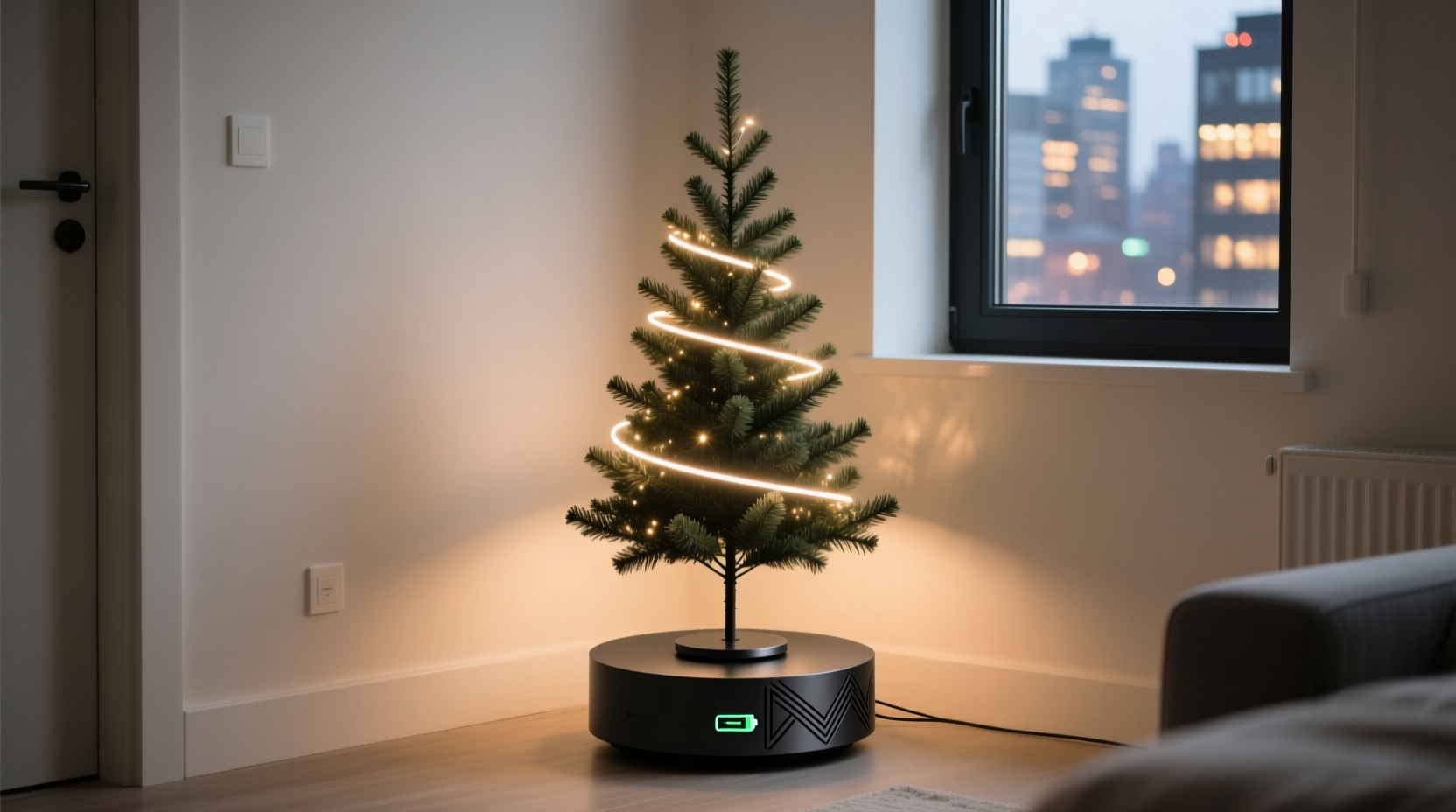
A rotating Christmas tree base functions like a lazy Susan—allowing the entire tree to spin smoothly with minimal effort. Most models are designed to support artificial trees ranging from 5 to 9 feet tall, though smaller versions exist for tabletop or mini trees. The mechanism typically involves a weighted platform with ball bearings or low-friction joints that let users turn the tree by simply nudging a branch.
In larger homes, rotation might be a novelty—a way to show off all sides of an elaborately decorated tree. But in small spaces, the benefit shifts from aesthetic to functional. When walls are close and furniture is arranged tightly, accessing the backside of a tree can mean climbing over couches, squeezing behind dressers, or leaving decorations uneven. A rotating base eliminates that struggle, enabling full visibility and access without rearranging the room.
Moreover, many modern rotating bases come with built-in water reservoirs for real trees, though these are less common in ultra-compact models. For artificial trees—which dominate small-space setups due to storage efficiency—the focus is purely on stability and rotation smoothness.
Solving Space Constraints with Smart Rotation
In a tiny apartment, every piece of furniture must serve multiple purposes. A Christmas tree is no exception. It should enhance the atmosphere without becoming an obstacle. Rotating bases help achieve this balance by reducing the need for physical movement around the tree.
Consider a typical studio layout: the living area doubles as a bedroom, kitchen, and dining space. Placing a tree in the corner near the entrance might seem ideal, but once assembled, reaching the far side could require walking halfway across the room—or worse, dragging a chair through a cluttered floor. With a rotating base, you decorate from one fixed position, turning the tree incrementally until every angle is covered.
This also improves safety. In cramped quarters, stepping over cords, tripping on ornaments, or bumping into unstable trees is more likely. By minimizing foot traffic around the tree, rotation reduces accident risks. It also allows for better cord management—lights and plug positions can be optimized before locking the tree into its preferred viewing angle.
Another overlooked advantage is symmetry. Without rotation, people tend to decorate the “front” more thoroughly, leading to a lopsided appearance when viewed from other angles. In open-plan micro-apartments, where sightlines cross multiple zones, this imbalance becomes obvious. A rotating base encourages even decoration, resulting in a more polished display.
“Rotation isn’t just about convenience—it’s about design integrity. In small spaces, visual harmony matters more because there’s no place to hide imperfections.” — Lena Torres, Interior Stylist & Urban Living Consultant
Comparison: Standard vs. Rotating Base in Compact Setups
| Feature | Standard Tree Stand | Rotating Tree Base |
|---|---|---|
| Space Required for Access | Full clearance around tree needed | Access from one side only |
| Ease of Decorating | Requires moving around tree; risk of missed spots | Spin-and-decorate method ensures full coverage |
| Footprint Efficiency | Same footprint, but demands surrounding space | Same footprint, maximizes usable space |
| Stability | Generally stable if secured properly | Often heavier base; improved weight distribution |
| Cost | $10–$25 | $30–$70 |
| Best For | Large rooms, infrequent decorators | Small apartments, detail-oriented decorators |
Real-Life Example: Decorating a 400-Square-Foot Studio
Maria, a graphic designer in Brooklyn, lives in a 400-square-foot loft-style studio where her bed, desk, and kitchenette are all within arm’s reach of each other. Every year, she struggled with her 6.5-foot artificial tree, which she placed in a corner beside her sofa. She’d spend hours hanging ornaments, only to realize—after stepping back—that the left side was sparse and underlit. To fix it, she had to move a floor lamp, shift a basket of blankets, and crawl behind the couch.
Last year, she invested in a slim rotating base designed for artificial trees. Setup took five minutes. Once assembled, she anchored the tree, plugged in the lights, and began decorating from her standing position in front of the sofa. After finishing one quadrant, she gave the tree a gentle push and continued. Within 45 minutes, the tree was fully adorned, symmetrical, and perfectly lit—all without relocating a single piece of furniture.
“It changed everything,” Maria said. “I used to dread decorating because it felt like obstacle course training. Now it’s actually relaxing. I can enjoy music, sip cocoa, and just turn the tree as I go.”
Her experience highlights a broader truth: in micro-living environments, tools that reduce friction aren’t luxuries—they’re necessities. The rotating base didn’t add space, but it made better use of what she already had.
Step-by-Step: Choosing and Using a Rotating Base in a Small Apartment
- Measure Your Available Floor Space: Before buying anything, confirm the exact location where the tree will stand. Ensure there’s enough room for the base diameter (usually 18–24 inches) and that nearby furniture won’t obstruct rotation.
- Determine Tree Type and Size: Match the base capacity to your tree. Most rotating stands support up to 50–75 lbs and trees up to 8 feet. For tabletop trees (under 4 feet), look for mini rotating platforms.
- Select a Low-Profile Model: Prioritize bases with a slim design that sits close to the ground. Avoid bulky reservoirs unless using a live tree.
- Assemble Before Positioning: Put the base together and attach the tree trunk rod in an open area. Once secure, move the entire unit to its final spot to avoid dragging a loaded tree.
- Test Rotation Early: Spin the tree gently before adding decorations to ensure smooth movement. Adjust leveling screws if wobbling occurs.
- Decorate in Sections: Divide the tree into four quadrants. Decorate one, rotate 90 degrees, repeat. This ensures even ornament distribution.
- Final Placement Lock (if available): Some models include a lock to prevent accidental spinning after setup. Use it once decorating is complete, especially if pets or children are present.
Common Misconceptions About Rotating Bases
Despite their utility, rotating bases are sometimes dismissed as gimmicks. Let’s address a few myths:
- Myth: They’re too expensive for occasional use. While pricier than basic stands, most quality rotating bases last 5–10 years with care. Amortized over time, the cost is minimal—often less than $10 per season.
- Myth: They’re noisy or wobbly. Lower-end models may squeak or tilt, but reputable brands use sealed bearings and reinforced frames. Read reviews and opt for metal-over-plastic construction.
- Myth: Only useful for large trees. In fact, smaller trees benefit more—because they’re often placed closer to walkways, rotation prevents constant bumping and misalignment.
Frequently Asked Questions
Can I use a rotating base with a real tree?
Yes, but only if the base includes a water reservoir and is rated for fresh-cut trees. Many rotating stands are designed exclusively for artificial trees with central poles. Check product specifications carefully. For real trees in small spaces, consider a potted living tree instead—it’s more sustainable and eliminates water concerns indoors.
Do rotating bases work on carpet?
Most do, especially on low-pile carpet. However, thick shag rugs may impede smooth rotation. If you have deep carpeting, place a rigid board (like plywood) under the base to create a stable surface. Alternatively, choose a model with wide, flat feet designed for soft flooring.
Are they safe with pets and kids?
Generally yes, but supervision is advised. Curious hands or paws can cause unintended spinning, potentially knocking over nearby items. Use the rotation lock feature when not actively adjusting the tree. Also, secure electrical cords out of reach to prevent tugging hazards.
Checklist: Is a Rotating Base Right for Your Apartment?
Before purchasing, ask yourself the following:
- ✅ Do I have less than 3 feet of clearance around my desired tree location?
- ✅ Do I frequently miss decorating parts of the tree’s backside?
- ✅ Is my primary living space under 600 square feet?
- ✅ Do I value symmetry and even lighting in my holiday decor?
- ✅ Am I willing to invest $30–$70 for long-term convenience?
- ✅ Do I reuse the same artificial tree annually?
If you answered “yes” to three or more, a rotating base is likely a worthwhile investment.
Conclusion: Elevate Your Holiday Experience in Tight Quarters
The question isn’t whether a rotating Christmas tree base transforms your apartment into a mansion—it doesn’t. But it does transform how you interact with the space you have. For small-space dwellers, convenience, efficiency, and thoughtful design aren’t optional extras; they’re essential components of livable comfort.
A rotating base offers more than just spin—it offers control, accessibility, and peace of mind. It turns a cumbersome annual ritual into a seamless, enjoyable process. Whether you’re draping garlands, arranging heirloom ornaments, or simply showing off your handiwork to guests via video call, the ability to view and adjust your tree from any angle enhances both function and festivity.
If you’ve hesitated because it seemed unnecessary or overengineered, reconsider in the context of your actual living conditions. In a world where square footage comes at a premium, smart solutions matter. And sometimes, the smallest upgrade—a smooth-turning base—can make the biggest difference.




 浙公网安备
33010002000092号
浙公网安备
33010002000092号 浙B2-20120091-4
Comments
No comments yet. Why don't you start the discussion?