
For many urban dwellers and those living in compact homes, the holiday season brings both joy and logistical challenges. One of the most cherished traditions—displaying a Christmas tree—can quickly become complicated when square footage is limited. In recent years, rotating Christmas tree bases have gained popularity as a convenient alternative to traditional stands. But for those with tight living rooms, hallways, or studio apartments, the real question remains: is a rotating Christmas tree base worth it?
The answer isn’t a simple yes or no. It depends on your space constraints, lifestyle, tree size, and how you use your holiday decor. Let’s explore the practical advantages and potential drawbacks of using a rotating base in small environments, backed by real-world considerations and expert insight.
How Rotating Tree Bases Work
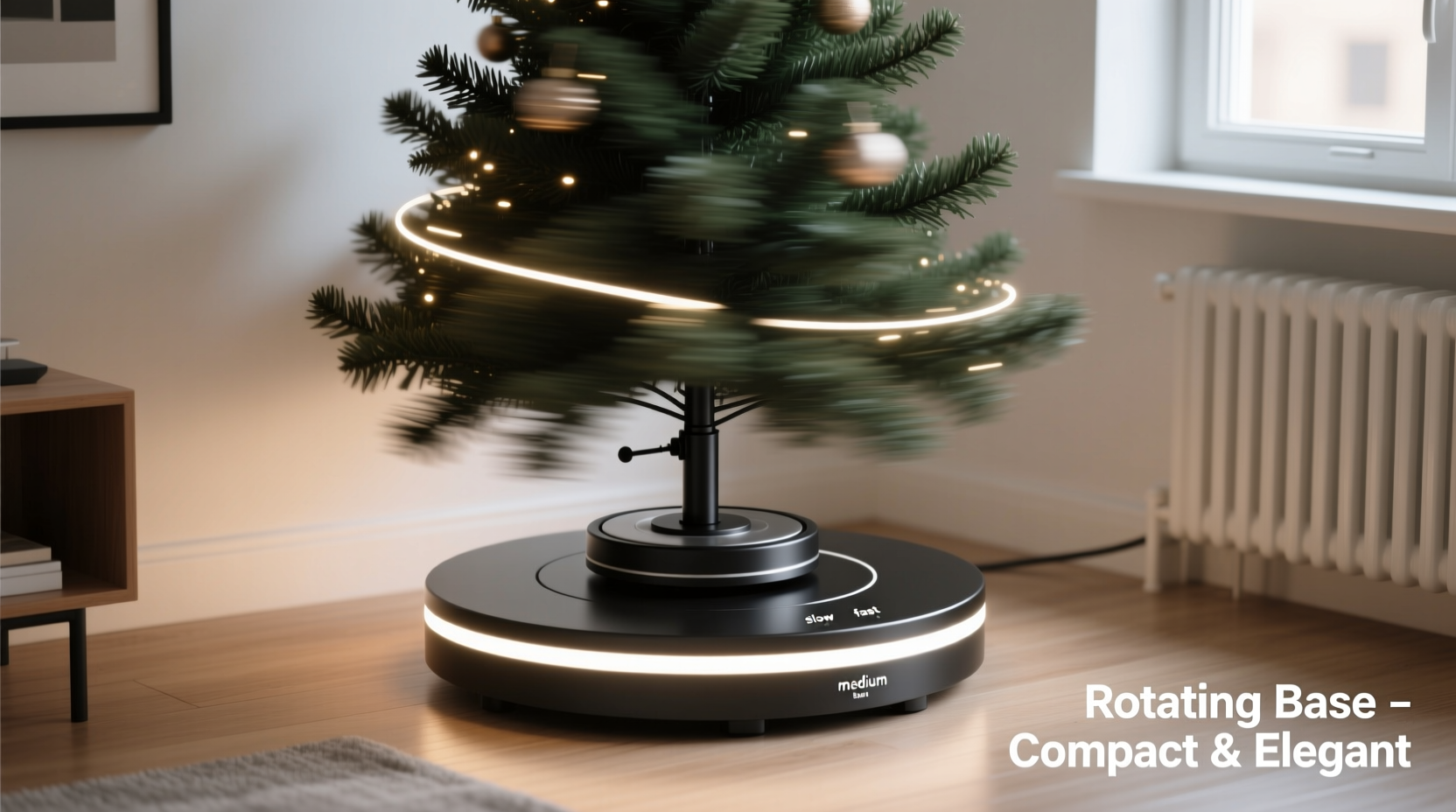
A rotating Christmas tree base functions like a lazy Susan—designed to spin smoothly under the weight of a tree. Most models are motorized, powered by batteries or USB, and allow you to rotate the tree with minimal effort. Some high-end versions offer remote control operation or app integration for automatic rotation cycles.
These bases typically support trees up to 7 or 8 feet tall, depending on the model, and are engineered to distribute weight evenly while minimizing floor pressure. The mechanism is usually housed in a low-profile disc that fits neatly beneath the trunk, making it less obtrusive than bulkier traditional stands.
In larger homes, rotation is often about convenience—viewing ornaments from all angles without walking around the tree. But in smaller spaces, the value proposition shifts toward spatial efficiency and visual impact.
Space-Saving Advantages in Compact Homes
When every inch counts, furniture placement and decor mobility become critical. A rotating base can actually enhance spatial perception in a small room. Instead of needing a full 360-degree walkway around the tree, you only need enough space for one viewing angle—the tree comes to you.
This means you can place the tree flush against a wall, in a corner, or even between two pieces of furniture without sacrificing visibility. For studio apartments or open-plan lofts, this flexibility allows you to reclaim valuable floor space while still enjoying a fully decorated centerpiece.
Additionally, rotating bases reduce the temptation to overcrowd the tree with decorations on all sides. Since you can turn it, you’re more likely to focus on quality over quantity, curating a minimalist yet impactful display—a design principle well-suited to small-space aesthetics.
Real Example: Apartment Living in Chicago
Take Sarah Kim, a graphic designer living in a 550-square-foot Chicago apartment. Last year, she opted for a 6-foot pre-lit tree on a rotating base after struggling to fit a standard stand into her living area. “I used to put the tree in front of the window, blocking light and making the room feel cramped,” she says. “Now, I tuck it into the corner behind the couch. With the rotation feature, I don’t even need to get up to see the back side. It saves space and looks intentional.”
Her experience highlights a growing trend: rotating bases aren’t just a luxury—they’re becoming a functional necessity for modern urban celebrations.
“Small-space decorating is all about illusion and movement. A rotating tree creates dynamic visual interest without requiring extra room.” — Lena Torres, Interior Designer & Small Space Specialist
Key Considerations Before Buying
While the benefits are clear, not every rotating base is suitable for tight quarters. Here are the top factors to evaluate before investing:
- Weight capacity: Ensure the base supports your tree’s weight, including water (if live) and heavy ornaments.
- Noise level: Some motors emit a faint hum. In quiet studios or bedrooms, this could be disruptive.
- Floor protection: Look for non-slip pads and scratch-resistant materials, especially on hardwood or laminate.
- Power source: Battery-powered models offer portability; USB-rechargeable ones reduce waste but require access to an outlet.
- Rotation speed: Adjustable speeds let you control how fast the tree turns—ideal for photography or children’s enjoyment.
Do’s and Don’ts for Tiny Spaces
| Do | Don’t |
|---|---|
| Measure your available footprint before purchasing | Place the tree where rotation could interfere with foot traffic |
| Use LED lights to minimize heat and energy use | Overload the tree with heavy handmade ornaments |
| Opt for a slim-profile, low-height base | Ignore assembly instructions—misalignment can damage the motor |
| Test rotation before decorating fully | Place near curtains or flammable materials that could brush against lights |
Step-by-Step Guide: Installing a Rotating Base in a Small Room
Proper installation ensures safety, stability, and smooth operation. Follow these steps to maximize effectiveness in limited space:
- Clear the area: Remove nearby furniture or rugs that might obstruct rotation or cause imbalance.
- Assemble the base: Attach the motor unit and platform according to manufacturer instructions. Double-check alignment.
- Position strategically: Place the base in your chosen corner or against a wall, ensuring at least 2–3 inches of clearance on the rotating side.
- Add the tree: Lift the tree straight down onto the center peg. Avoid tilting, which can strain the mechanism.
- Secure the trunk: Use the built-in clamps or screws to stabilize the trunk. Even slight wobbling can disrupt rotation.
- Test rotation: Turn on the base without decorations first. Confirm smooth, quiet spinning.
- Decorate mindfully: Start with lights, then add ornaments evenly. Avoid placing heavy items only on one side.
- Final check: Rotate the tree slowly while observing for cable tangles, balance issues, or floor contact.
This process takes about 30–45 minutes but pays off in long-term usability. Once set up, maintenance is minimal—just occasional dusting and battery checks.
Cost vs. Value Analysis
Rotating bases range from $40 for basic models to over $120 for smart-enabled versions. Compared to standard stands ($15–$30), they represent a significant upfront investment. So, is the added cost justified in a small space?
Consider the long-term value:
- Durability: High-quality rotating bases last 5–10 years with proper care, amortizing the cost over multiple seasons.
- Reusability: Unlike disposable stands, most rotating units work with artificial trees year after year.
- Time savings: No need to rearrange furniture or move the tree to view all sides—especially helpful for those with mobility limitations.
- Enhanced enjoyment: Families report higher engagement, especially with children who love watching the tree spin.
In tiny spaces where functionality and multi-use features are prized, the premium price begins to make sense. You're not just buying a stand—you're investing in smarter spatial design.
Checklist: Is a Rotating Base Right for Your Small Space?
- ✅ Do you lack 360-degree clearance around your ideal tree location?
- ✅ Are you using an artificial tree under 8 feet tall?
- ✅ Would you prefer to place the tree against a wall or in a corner?
- ✅ Do you want to reduce clutter and create a focal point without dominating the room?
- ✅ Can you access a power outlet or are you okay with battery replacements?
- ✅ Are you willing to invest in a longer-lasting solution rather than a seasonal disposable stand?
If you answered yes to most of these, a rotating base is likely a worthwhile upgrade.
Frequently Asked Questions
Can I use a rotating base with a real Christmas tree?
Yes, but with caveats. Live trees absorb water and gain weight over time, so ensure the base has sufficient load capacity (usually 50+ lbs). Also, check that the water reservoir doesn’t interfere with the rotation mechanism. Most manufacturers design rotating bases for artificial trees, so verify compatibility before purchase.
Will the rotation tangle my Christmas lights?
Not if installed correctly. Always wrap lights vertically or diagonally—not horizontally—around the tree. Horizontal strands are more likely to twist and tangle during rotation. Using pre-lit artificial trees eliminates this issue entirely.
Are rotating bases safe for pets and kids?
Generally, yes. Most models rotate slowly (one full turn every 60–90 seconds) and stop automatically if obstructed. However, supervise young children and pets initially. Avoid placing fragile ornaments at low heights where paws or hands might reach during rotation.
Conclusion: Making the Most of Minimal Space
In the context of shrinking urban footprints and rising demand for multifunctional decor, the rotating Christmas tree base emerges not as a gimmick, but as a thoughtful innovation. For tiny spaces, its ability to deliver full visual access without demanding extra room transforms it from a novelty into a necessity.
It encourages smarter decorating habits, reduces spatial stress, and adds a touch of magic to holiday gatherings—all within the confines of a modest apartment. When chosen wisely and installed properly, a rotating base doesn’t just hold your tree; it enhances your entire holiday experience.




 浙公网安备
33010002000092号
浙公网安备
33010002000092号 浙B2-20120091-4
Comments
No comments yet. Why don't you start the discussion?