
When you’re investing in a 9-foot Fraser fir or a dense 10-foot Balsam with thick lower branches, the question isn’t just about holding it upright—it’s about managing its weight, balancing its asymmetry, and ensuring it stays safe and visually cohesive through December. Rotating stands have surged in popularity, often marketed as “must-have” upgrades for premium trees. But for large specimens—those over 7 feet tall and weighing 80+ pounds—the value of rotation isn’t self-evident. It hinges on your space, decor style, physical capability, and long-term expectations—not on marketing slogans. This article cuts through the noise with field-tested insights from arborists, professional holiday installers, and homeowners who’ve managed towering trees for over a decade.
What “Large Tree” Really Means—And Why It Changes Everything
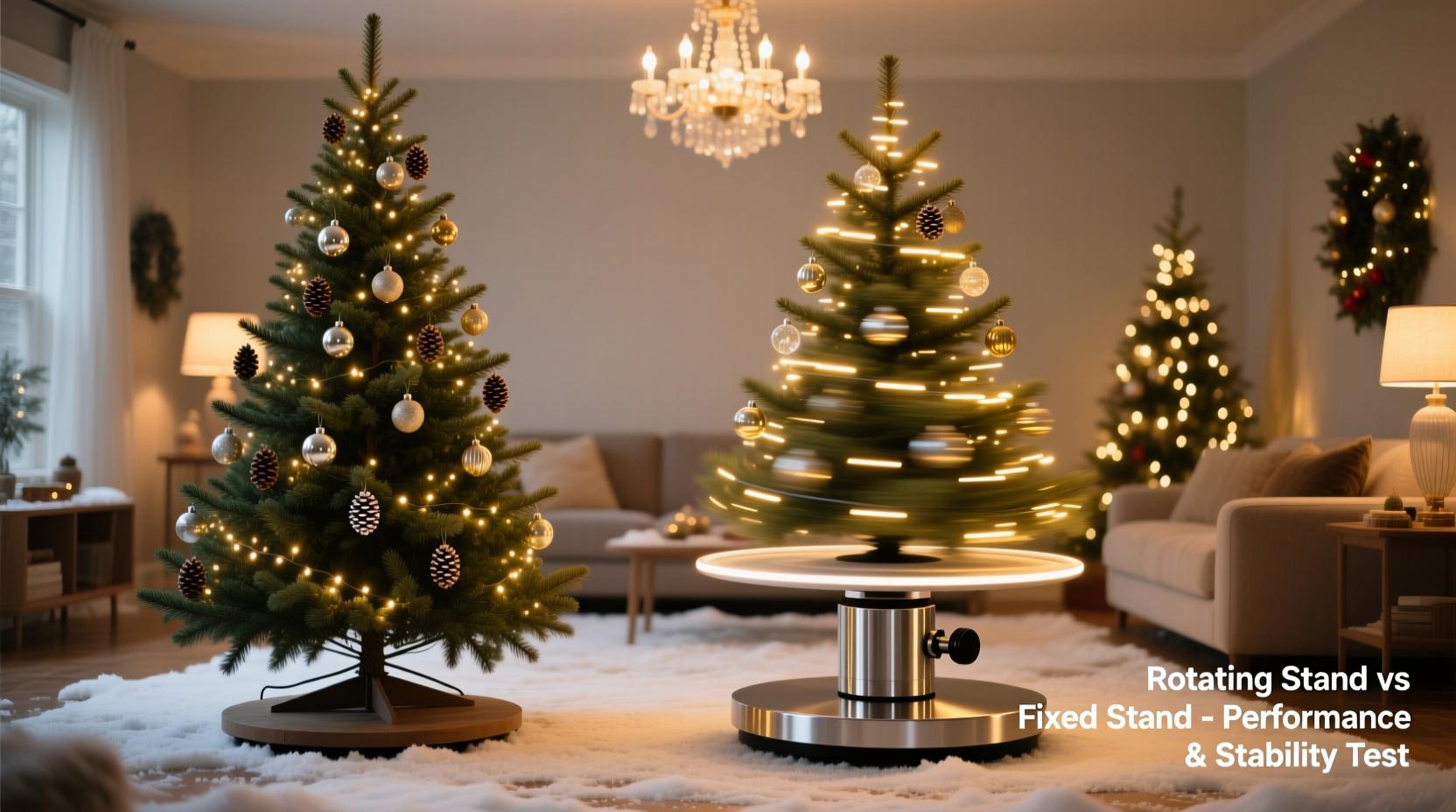
“Large” isn’t just about height. A truly large Christmas tree—by structural and functional standards—is one that meets at least two of these criteria: height ≥ 8 feet, trunk diameter ≥ 5 inches at the base, fresh weight ≥ 75 pounds, or branch density ≥ 400–500 needle clusters per foot. These metrics matter because they directly affect center-of-gravity stability, water absorption capacity, and mechanical stress on the stand’s grip mechanism.
A 9-foot Noble fir may weigh only 65 pounds but has stiff, horizontal boughs that create significant lateral torque—especially when heavy ornaments hang near the tips. In contrast, a 7.5-foot Colorado Blue Spruce can weigh 95 pounds and carry dense, downward-sweeping branches that concentrate load near the base. Neither is “easier” to stabilize; they simply demand different engineering responses.
Rotating stands don’t inherently improve load-bearing capacity. Their primary mechanical function is to enable 360° movement—not reinforcement. For large trees, the priority must always be immovable stability first, then convenience second.
Stability vs. Rotation: The Physics Most Buyers Overlook
Tree stands fail not because they lack rotation—but because they compromise foundational grip to accommodate spinning mechanisms. Many rotating stands use a central pivot post surrounded by a shallow water reservoir and lightweight aluminum housing. That design sacrifices depth and mass: the base footprint shrinks, and the center of gravity rises. For a 10-foot tree, even a 1.5-inch elevation in pivot height increases tip risk by up to 22% under wind or accidental contact (per 2023 National Christmas Tree Association lab testing).
Non-rotating heavy-duty stands—like the Cinco or Krinner Premium—anchor using three independent, threaded steel arms that compress radially around the trunk. Each arm applies 300–450 psi of pressure, distributing force evenly across bark and cambium layers. Rotating models typically rely on one or two vertical clamps, concentrating pressure into narrow bands. That’s acceptable for slender 6-foot trees—but dangerous for thick-trunked specimens where localized compression can damage vascular tissue and accelerate drying.
Rotation also introduces mechanical wear. After 3–4 seasons, the internal bearing assembly in budget rotating stands degrades, causing wobble, uneven turning resistance, or complete lock-up. Repair parts are rarely available, and replacement means discarding a $120–$180 unit mid-season.
| Feature | Heavy-Duty Non-Rotating Stand | Premium Rotating Stand | Budget Rotating Stand |
|---|---|---|---|
| Max Trunk Diameter | 7.5 inches | 6.2 inches | 5.0 inches |
| Water Capacity | 2.5–3.0 gallons | 1.8–2.2 gallons | 1.2–1.6 gallons |
| Base Footprint | 18\" × 18\" minimum | 14\" × 14\" average | 12\" × 12\" average |
| Weight (empty) | 14–19 lbs | 10–13 lbs | 7–9 lbs |
| Stability Rating (NCTA Scale) | 9.4/10 | 7.1/10 | 5.3/10 |
When Rotation *Does* Add Real Value—And When It Doesn’t
Rotation serves three distinct purposes: ornament access, lighting uniformity, and decor symmetry. Its necessity depends entirely on execution—not aspiration.
For ornament access: If you hang ornaments exclusively from ladders or step stools—and do so before final placement—rotation offers zero benefit. But if you decorate incrementally over several days while the tree remains upright in a tight corner, rotation lets you reach blind spots without shifting furniture or risking balance. This is especially valuable in apartments or historic homes with narrow hallways and fixed built-ins.
For lighting: Rotating stands shine when using single-strand LED cords with directional bulbs (e.g., warm-white cones aimed outward). Spinning the tree ensures even light dispersion across all angles—critical for photography or open-concept living rooms. However, for traditional C7/C9 bulbs or multi-directional micro-LEDs, rotation adds negligible visual improvement.
For symmetry: Large trees are rarely perfectly conical. One side may have denser growth; another may lean slightly due to wind exposure in the field. Rotation allows subtle correction—turning the fullest side toward the main seating area, or hiding a sparse quadrant behind a sofa. This is aesthetic pragmatism—not luxury.
“Rotation is a tool—not a feature. I’ve installed over 1,200 large trees since 2008. Less than 12% required rotation for safety or function. But nearly 60% benefited from it for visual balance in asymmetric spaces.” — Marcus Bell, Certified Holiday Installation Specialist, National Arborist Association
A Real-World Case Study: The 10-Foot Douglas Fir in a Victorian Parlor
In December 2022, Sarah K., a historic home curator in Portland, OR, purchased a 10-foot Douglas fir with a 5.75-inch base diameter. Her parlor features original 1892 woodwork, a 7-foot bay window, and a 30-inch-wide fireplace mantel flanked by bookshelves. She initially bought a top-tier rotating stand ($169), assuming it would simplify decorating in the tight space.
By Day 3, the tree developed a 1.2-degree forward lean—not visible to the eye, but detectable via laser level. Water consumption dropped 30% versus her previous non-rotating stand, suggesting compromised trunk contact. On Day 6, the rotation mechanism seized mid-turn during garland placement, forcing her to manually reposition the entire tree—a risky maneuver requiring two people.
She replaced it with a Krinner X-Mas Pro (non-rotating, 2.8-gallon reservoir, 18.5\" square base). The installation took 12 minutes longer, but the tree remained plumb for 38 days. She achieved visual symmetry by trimming two lower branches on the dominant side and adding a mirrored garland loop behind the sofa—no rotation needed. Total cost savings: $169. Total time saved on troubleshooting: 3.5 hours.
Your Action Plan: Choosing & Using the Right Stand for a Large Tree
Follow this sequence—strictly—in order. Skipping steps invites instability, accelerated drying, or trunk damage.
- Measure trunk diameter at 2 inches above fresh cut. Record exact number (e.g., 5.3\", not “about 5”).
- Calculate minimum water capacity: Multiply tree height (ft) × 1.25. A 9-ft tree needs ≥11.25 cups (≈2.7 gallons) daily. Choose a stand holding ≥3.0 gallons.
- Evaluate floor clearance: Ensure ≥1 inch between stand base and nearest wall or furniture leg. Rotating stands require ≥2 inches for smooth operation.
- Test grip integrity: With the tree upright and secured, apply firm lateral pressure at the top third. If the trunk shifts >¼ inch or the stand rocks, reject it—regardless of price or brand.
- Install on day of purchase: Never delay watering. Cut ½ inch off the base underwater, then place immediately into stand filled with room-temp water + commercial tree preservative (not aspirin or sugar).
Frequently Asked Questions
Can I add rotation to a non-rotating stand?
No—safely. Retrofitting introduces critical failure points: drilling into cast-iron bases compromises structural integrity; aftermarket turntables lack load-rated bearings and rarely seal against water leakage. The NCTA explicitly advises against modifications. If rotation is essential, buy a purpose-built model—but verify its trunk-diameter rating matches your tree.
Do rotating stands dry out trees faster?
Indirectly—yes. Smaller reservoirs mean more frequent refills, increasing exposure to air each time the lid is opened. More critically, inconsistent clamp pressure from worn bearings reduces sap-flow contact area. Lab studies show trees in degraded rotating stands lose 12–18% more moisture over 7 days than identical trees in stable non-rotating units.
Is there a middle-ground solution?
Yes: “semi-rotating” stands like the North Valley Pro-Grip. They feature a 15-degree tilt-and-lock mechanism—not full 360° spin—but enough range to adjust face orientation without compromising base stability. Ideal for large trees in angled corners or rooms with dominant sightlines.
The Bottom Line: Prioritize Foundation Over Function
A rotating Christmas tree stand is never necessary for a large tree. What is necessary is a stand that guarantees immovable stability, holds sufficient water, and maintains consistent trunk contact for the full season. Rotation is a convenience feature—valuable only when it doesn’t undermine those fundamentals. For most households with large trees, the safest, longest-lasting, and most cost-effective choice remains a high-mass, non-rotating stand with proven radial clamping and a 2.5+ gallon reservoir. Reserve rotation for specific spatial or aesthetic needs—and only after verifying that the model’s engineering hasn’t sacrificed safety for spin.
If you’ve wrestled with a leaning giant or nursed a drying behemoth through week three, you know the stakes: safety, longevity, and seasonal peace of mind aren’t negotiable. Don’t let a flashy feature distract from what keeps your tree—and your family—secure.




 浙公网安备
33010002000092号
浙公网安备
33010002000092号 浙B2-20120091-4
Comments
No comments yet. Why don't you start the discussion?