
As holiday traditions evolve, so do the tools we use to make them easier. One innovation that has gained popularity in recent years is the rotating Christmas tree stand—a motorized or manual base that allows your tree to spin 360 degrees with minimal effort. While this feature sounds appealing, especially during decorating season, many homeowners with larger trees (8 feet and above) wonder: is it truly worth the investment?
The answer isn’t straightforward. For some families, a rotating stand simplifies decoration and display; for others, it introduces mechanical complexity, higher costs, and potential instability. This article dives deep into the practicality, safety, and long-term value of rotating stands specifically for large trees, helping you make an informed decision based on size, space, usage, and budget.
How Rotating Tree Stands Work
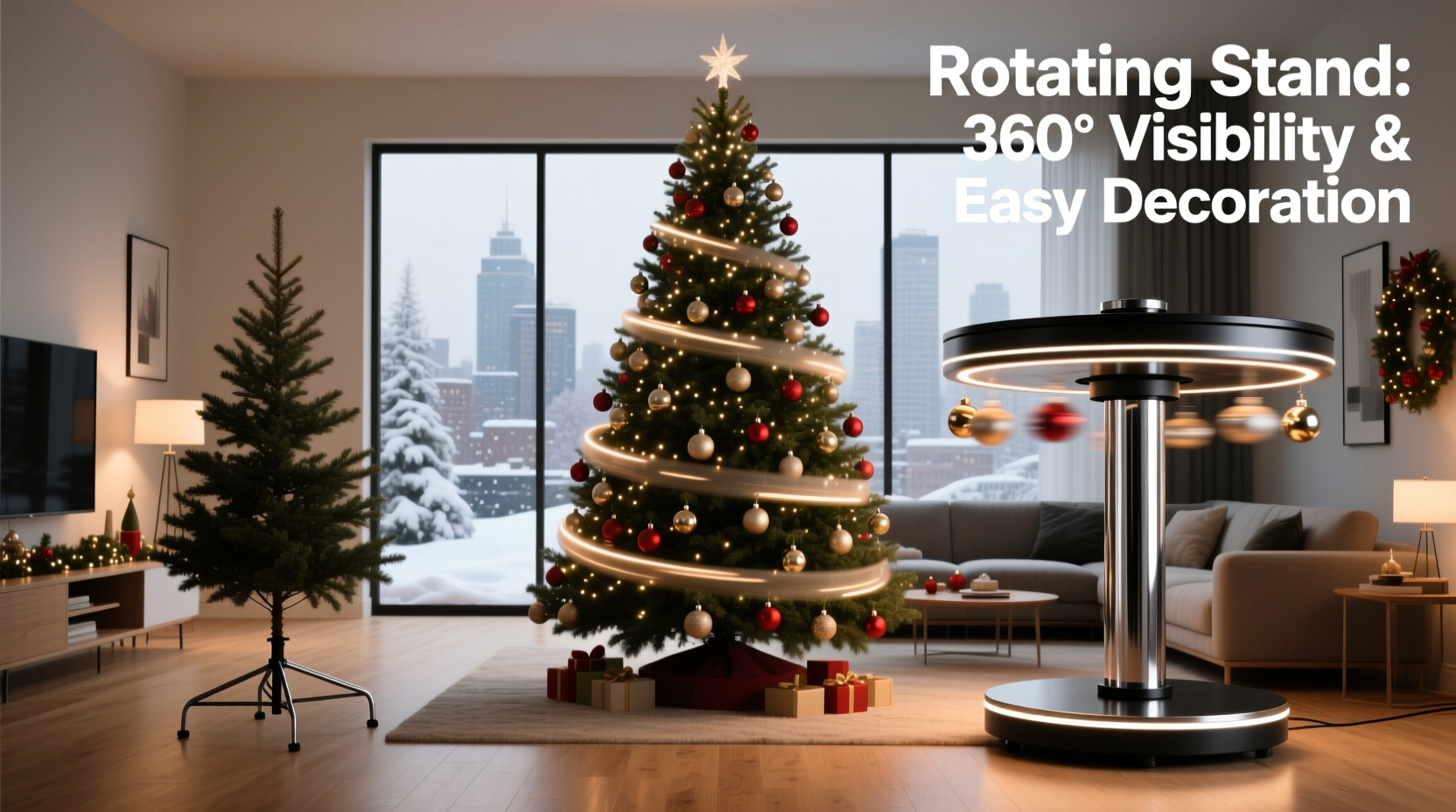
Rotating Christmas tree stands use either a manual crank or an electric motor to rotate the tree base smoothly. Most models are designed to support standard tree sizes, but high-capacity versions claim to handle trees up to 12 feet tall and trunks up to 7 inches in diameter. The rotation mechanism typically sits between the tree trunk and the floor, using ball bearings or low-friction rollers to enable smooth spinning.
When activated—either by hand or via remote control—the entire tree rotates slowly, usually completing one full turn in 45 seconds to two minutes. This slow motion is intended to allow even light distribution from ornaments and lights and to simplify viewing from all angles without walking around the tree.
For large trees, however, the added weight and height increase torque and stress on the mechanism. A fully grown Fraser fir or Noble fir can weigh over 100 pounds before decorations, and once adorned with hundreds of ornaments, lights, and a star, total weight may exceed 150 pounds. Not all rotating bases are built to handle such loads reliably.
Pros and Cons for Large Trees
The appeal of a rotating stand grows with tree size—after all, circling a towering evergreen to adjust tinsel or plug in lights becomes a chore. But convenience must be weighed against durability, cost, and setup complexity.
Advantages
- Easier decorating: Rotate the tree instead of walking around it, reducing strain and improving access to all sides.
- Better ornament visibility: Guests can enjoy the full display without needing to move furniture or reposition themselves.
- Even lighting exposure: Some users report more balanced light reflection, especially with fiber-optic or reflective ornaments.
- Novelty and conversation starter: The gentle spin adds a whimsical touch that children and guests often enjoy.
Drawbacks
- Stability concerns: Tall trees have a higher center of gravity. Any wobble in the rotating mechanism increases tipping risk.
- Limited weight capacity: Many rotating stands max out at 75–100 lbs, insufficient for mature trees with dense foliage.
- Mechanical failure: Motors can burn out, gears jam, or power cords become tripping hazards.
- Higher cost: Quality rotating stands range from $80 to $200, compared to $20–$40 for standard stands.
- Floor damage risk: Continuous rotation may scratch hardwood or scratch-resistant flooring unless protected.
“While rotating stands offer undeniable convenience, I caution families with trees over 9 feet to prioritize stability over automation. A tipped tree can cause injury and significant property damage.” — Daniel Reeves, Home Safety Consultant & Holiday Display Specialist
Comparing Stand Types: Standard vs. Rotating
| Feature | Standard Tree Stand | Rotating Tree Stand |
|---|---|---|
| Average Price | $20 – $40 | $80 – $200 |
| Max Tree Height Supported | Up to 12+ ft (varies) | Typically 8–10 ft |
| Weight Capacity | 75 – 150+ lbs | 50 – 100 lbs (some up to 120) |
| Water Reservoir Size | 1–2 gallons (standard) | Often smaller due to mechanism space |
| Setup Time | 10–15 minutes | 15–25 minutes (alignment critical) |
| Durability (Seasons of Use) | 5–10+ years | 2–5 years (motor wear) |
| Safety Rating (Consumer Reports) | High (proven track record) | Moderate (caution for large trees) |
The data shows a clear trade-off: rotating stands sacrifice reservoir size, weight tolerance, and longevity for motion convenience. For large trees, where hydration and stability are paramount, these compromises matter significantly.
Real-World Example: The Thompson Family’s 10-Foot Spruce
The Thompsons in suburban Minnesota purchased a 10-foot Colorado blue spruce each year, traditionally secured in a heavy-duty metal stand. In 2022, they upgraded to a premium electric rotating stand advertised for “large trees up to 12 feet.”
Installation went smoothly, though aligning the trunk perfectly over the motor hub took nearly 30 minutes. The tree held steady initially, but after three weeks—and with over 300 ornaments and dual light strands—the base began emitting a faint grinding noise. By Christmas Eve, the rotation stopped completely. Worse, the central bolt had loosened slightly, causing a half-inch wobble.
They powered off the unit and manually rotated the tree for final adjustments. After the holidays, they reverted to their old stand, citing reliability concerns. “It looked impressive at first,” said Mark Thompson, “but knowing it could tip with our kids running nearby made us nervous. Next year, we’re sticking with what works.”
This scenario is not uncommon. Consumer reviews across major retailers show a pattern: rotating stands perform well with medium-sized trees (7–8 ft), but user satisfaction drops sharply beyond that threshold.
Step-by-Step: Choosing the Right Stand for a Large Tree
If you're considering a rotating option for a large tree, follow this process to ensure safety and functionality:
- Measure your tree’s trunk diameter at the base. Most stands require a minimum of 3 inches and max out at 6–7 inches. Measure accurately with a tape measure.
- Weigh your tree (or estimate). Ask your tree lot for average weights by species and height. Add 10–20 lbs for expected decorations.
- Check clearance and ceiling height. Ensure there's at least 6 inches between the top of the tree and the ceiling, especially if the stand raises the base slightly.
- Review stand specifications critically. Look for independent lab testing, weight certifications, and tilt-resistance features. Avoid generic brands without verified ratings.
- Test rotation on a flat, level surface. Uneven floors amplify instability. If your living room has any slope, reconsider motorized rotation.
- Monitor daily for the first week. Check for wobbling, unusual noises, or shifting position. Place a level against the trunk to detect lean.
- Secure as backup. Even with a rotating stand, use discreet guy wires anchored to walls if the tree exceeds 9 feet, especially in homes with pets or active children.
When a Rotating Stand Makes Sense
Despite the risks, rotating stands can be worthwhile in specific situations:
- Display-focused setups: Homes using the tree as a centerpiece in open-concept spaces benefit from 360-degree visibility.
- Accessibility needs: Individuals with mobility limitations find rotation far easier than walking around a large tree.
- Smaller large trees: An 8.5-foot tree with a slim profile and lightweight ornaments may fall within safe operating limits.
- Commercial or rental use: Event planners or Airbnb hosts may justify the cost for visual impact and guest experience.
In these cases, investing in a top-tier model from reputable brands like Best Choice Products, Gorilla Rack, or Reality Plus—with reinforced frames and overload protection—can deliver reliable performance.
FAQ: Rotating Stands and Large Trees
Can I retrofit a rotating base onto my existing stand?
No. Rotating mechanisms are integrated into the stand’s core design. Retrofit kits are not commercially available or safe for large trees due to balance and load risks.
Do rotating stands require maintenance?
Yes. Dust buildup in the gear system can impair function. Wipe the base monthly and store it disassembled in a dry place. Lubricate moving parts only if specified by the manufacturer.
Are battery-powered rotating stands safe?
Most are AC-powered for consistent torque. Battery models exist but often lack the power for sustained rotation of heavy trees and may stop mid-cycle.
Final Checklist Before Buying
- ✅ Tree height under 10 feet?
- ✅ Trunk diameter within stand specs?
- ✅ Total weight (tree + decor) below max limit?
- ✅ Floor is level and scratch-resistant?
- ✅ Stand has tilt-alert or anti-tip feature?
- ✅ Water reservoir holds at least 1 gallon?
- ✅ Backup anchoring plan in place?
Conclusion: Balancing Innovation and Practicality
A rotating Christmas tree stand offers undeniable charm and convenience, particularly during the decorating phase. For large trees, however, the engineering challenges of weight, balance, and durability cannot be overlooked. While some high-end models perform admirably, the majority of rotating stands are better suited for medium-sized trees in controlled environments.
If your priority is safety, hydration, and long-term reliability—especially with a towering evergreen—opting for a sturdy, non-rotating stand with a large water reservoir remains the wisest choice. Reserve the rotating upgrade for smaller display trees, artificial models, or future years when your family tradition scales down.
That said, if you proceed with a rotating stand, do so with eyes open: verify specs, monitor stability, and never compromise on securing your tree. The holidays should be joyful, not hazardous.




 浙公网安备
33010002000092号
浙公网安备
33010002000092号 浙B2-20120091-4
Comments
No comments yet. Why don't you start the discussion?