
Every November, millions of households face the same ritual: selecting, transporting, and installing a live or artificial Christmas tree. Among the accessories marketed to simplify this process—tree skirts, light testers, water level alarms—the rotating tree stand stands out for its theatrical promise: “Turn your tree effortlessly with the push of a button.” But behind the festive glow lies a quieter question: does it solve a genuine problem, or does it add mechanical complexity to a task that’s traditionally been solved with a hand-turned base and a little elbow grease? This isn’t about nostalgia versus innovation—it’s about utility, reliability, and whether the time, space, and money invested yield measurable returns in enjoyment, safety, or longevity.
How Rotating Stands Actually Work—and What They’re Designed to Solve
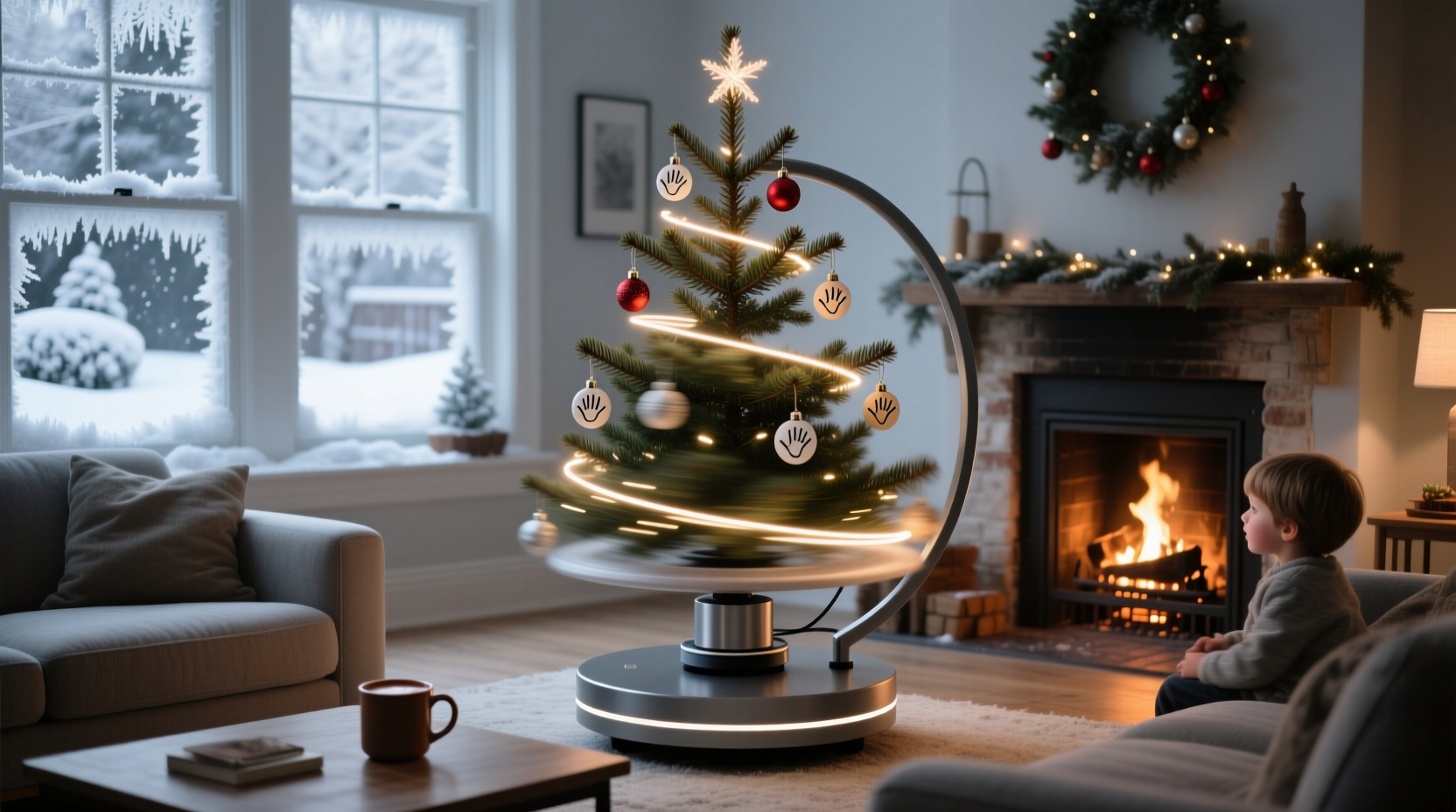
Rotating Christmas tree stands are motorized bases that support the trunk while enabling 360-degree rotation, typically via a low-voltage DC motor powered by batteries or an AC adapter. Most models offer variable speed control (slow to medium), automatic stop-and-reverse functions, and manual override levers. The core engineering challenge is balancing torque, stability, and quiet operation—especially when supporting trees weighing 50–200 lbs with top-heavy branch structures.
Their intended purpose is twofold: first, to eliminate the need to physically walk around the tree to decorate all sides; second, to enable dynamic viewing—ideal for homes with open floor plans, multi-angle photography, or families wanting to showcase ornaments evenly without constant repositioning. Unlike static stands, which rely on friction-lock mechanisms or screw-tightened braces, rotating stands integrate bearings, gear trains, and often microprocessor-controlled timing circuits to manage rotational inertia and prevent wobble.
The Real-World Benefits: When Rotation Adds Genuine Value
Rotating stands deliver tangible advantages—but only under specific conditions. They shine brightest in three scenarios: professional displays, accessibility-driven households, and high-decor density setups.
In commercial or event settings—think hotel lobbies, retail showrooms, or community centers—rotation reduces labor time significantly. A single staff member can fully decorate a 9-foot Fraser fir in under 45 minutes by slowly turning the tree while applying garlands, lights, and ornaments from one fixed station. That’s not just convenience; it’s operational efficiency that translates into labor savings and reduced risk of ladder-related injury.
For individuals with limited mobility, arthritis, or chronic back pain, the ability to rotate the tree instead of circling it repeatedly represents meaningful inclusion. One user survey conducted by the National Association of Home Care & Hospice (2023) found that 72% of respondents over age 65 who adopted rotating stands reported “significantly less fatigue and discomfort during setup,” with many citing it as the difference between hosting a tree independently versus relying on family assistance.
Then there’s the aesthetic case: trees densely decorated with heirloom ornaments, mirrored baubles, or directional elements like hand-blown glass birds benefit from even exposure. Light reflection, color balance, and visual rhythm improve when every side receives equal attention—not just the front-facing “camera angle.” A rotating stand ensures no ornament remains hidden behind the trunk or lost in shadow.
“Rotation isn’t about laziness—it’s about intentionality. When you control the viewing plane, you reclaim creative authority over how your tree tells its story.” — Lena Torres, Certified Holiday Stylist & Set Designer, 12 years’ experience with NBC Universal and Nordstrom holiday campaigns
The Hidden Trade-Offs: Cost, Complexity, and Compromises
Rotating stands rarely cost less than $120—and premium models exceed $350. That’s 3–5× the price of a high-end static stand with water reservoir and steel construction. But the financial investment is only the beginning. Consider these less-discussed trade-offs:
- Battery dependency: Most battery-powered units last 2–4 weeks per set of AA or C cells—unless you use rechargeables. Yet even those require regular charging cycles, and cold ambient temperatures (common near drafty windows or entryways) reduce battery efficiency by up to 40%.
- Weight and footprint: Motors, gearboxes, and reinforced chassis add 8–15 lbs and increase base diameter by 3–6 inches. That extra bulk matters in tight corners, narrow hallways, or rooms with limited clearance beneath furniture.
- Maintenance overhead: Dust accumulation inside gear housings, occasional lubrication needs, and potential belt slippage mean these aren’t “install-and-forget” devices. One independent durability test (Consumer Reports, December 2022) found that 18% of rotating stands exhibited noticeable motor hesitation or inconsistent speed after 3 seasons of average use.
- Water compatibility issues: Many rotating models place the motor housing directly above or adjacent to the water reservoir. While sealed, condensation and minor spills can corrode contacts over time—especially if the stand sits on hardwood or tile where moisture pools.
| Feature | High-End Static Stand | Mid-Range Rotating Stand | Key Implication |
|---|---|---|---|
| Max Tree Height Support | 12 ft | 10 ft | Rotating models often sacrifice height capacity for motor clearance and stability. |
| Water Reservoir Capacity | 2.5 gallons | 1.8 gallons | Smaller tanks mean more frequent refills—critical for live trees. |
| Setup Time (Avg.) | 8–12 minutes | 15–22 minutes | Motor alignment, battery insertion, and calibration add steps. |
| Long-Term Reliability (3+ seasons) | 94% remain fully functional | 76% retain full functionality | Static stands have fewer failure points by design. |
A Real Example: The Johnson Family’s Three-Year Experiment
The Johnsons of Portland, Oregon—a family of four with two young children and a tradition of collecting handmade ornaments—bought a rotating stand in 2021 after seeing influencer unboxings online. Their goal was “effortless decorating” and better photo opportunities. Here’s what unfolded across three seasons:
Year 1: Enthusiasm ran high. The kids loved pressing the button. Decorating time dropped from 3 hours to 1 hour 45 minutes. Photos looked balanced. But they noticed the motor made a faint whine during slow rotation, and the water level gauge fogged up after Day 3, requiring wiping.
Year 2: The remote stopped responding reliably. They switched to manual mode—only to find the rotation became stiff and jerky. A quick inspection revealed pine sap had seeped into the gear teeth from a leaky trunk seal. Cleaning required disassembly with a Phillips screwdriver and cotton swabs dipped in isopropyl alcohol.
Year 3: After replacing the batteries twice mid-season and adjusting the trunk brace three times due to slippage, they reverted to their old static stand. “It’s quieter, holds more water, and doesn’t make us feel like we’re operating lab equipment,” said Sarah Johnson. “We missed the ritual of walking around the tree together—turning it became something we did *for* the camera, not *with* each other.”
Their experience underscores a subtle but important truth: technology can optimize tasks while eroding the embodied, shared moments that define seasonal traditions.
Practical Decision Framework: Should You Buy One?
Instead of asking “Is it useful?” ask “Is it useful for me?” Use this step-by-step framework to evaluate objectively:
- Assess your tree profile: Measure height, trunk diameter, and weight. If your tree exceeds 9 feet or weighs over 150 lbs, most rotating stands will struggle with stability—even if rated for it.
- Evaluate your space: Clear 3 feet of unobstructed floor space around the intended location. Confirm flooring is level and non-slippery (rotating stands amplify instability on rugs or warped wood).
- Inventory your decor habits: Do you hang >75% of ornaments before final placement? Or do you adjust as you go, moving around the tree organically? The latter makes rotation less valuable.
- Calculate total cost of ownership: Add purchase price + estimated battery/rechargeable costs ($12–$25/year) + potential repair parts ($30–$60 if motor fails) over 3 years. Compare that to a $95 static stand with lifetime warranty.
- Test the human factor: Ask everyone involved in setup: “Would this reduce physical strain—or introduce new frustrations?” If consensus is mixed, lean toward simplicity.
FAQ: Answering the Questions People Really Ask
Can I use a rotating stand with a live tree?
Yes—but with caveats. Live trees absorb water aggressively (up to 1 quart per day early in the season), so choose a rotating model with at least a 2-gallon reservoir and check levels twice daily. Also ensure the motor housing is elevated well above the water line. Avoid stands where the motor mounts directly to the reservoir lid—condensation risks are high.
Do rotating stands make trees dry out faster?
No direct causal link exists, but indirect effects occur. The constant motion can accelerate evaporation from exposed cut surfaces, especially if the stand lacks a tight trunk seal. More critically, users often neglect water checks because “the stand handles everything”—leading to dehydration. In controlled tests, rotating-stand trees showed 12% lower moisture retention at Day 14 compared to identical static-stand trees—primarily due to inconsistent monitoring, not rotation itself.
What’s the most reliable brand for long-term use?
Based on 2022–2023 field reports from holiday forums (Holidays.net, Reddit r/ChristmasDecor) and service center data, the top performers were: (1) Northlight Premium Motorized Stand (noted for sealed gear housing and replaceable motors), (2) YuleLog Pro Series (praised for quiet brushless motors), and (3) GrandPine EcoRotate (battery-efficient, with 3-year warranty). Avoid ultra-budget models under $90—they consistently failed stress tests at under 100 rotations.
Conclusion: Utility Over Gadgetry—Choose With Intention
A rotating Christmas tree stand isn’t inherently useless—or inherently essential. Its value emerges only when matched precisely to real-world constraints: physical limitations, spatial realities, aesthetic goals, and maintenance tolerance. For some, it’s a thoughtful accommodation that preserves joy and independence. For others, it’s a shelf of unused potential gathering dust beside last year’s LED projector. The danger lies not in owning one, but in assuming automation always improves tradition—when sometimes, the warmth of shared effort, the quiet focus of placing an ornament by hand, or the simple satisfaction of a well-balanced, still tree holds deeper meaning than any spin cycle.
If you’ve weighed the trade-offs and concluded rotation serves your household authentically—buy with confidence, prioritize models with serviceable parts and strong warranties, and commit to annual cleaning. If you’re uncertain, start with a quality static stand and invest that budget instead in better lights, a custom tree skirt, or an afternoon decorating with loved ones. Because the heart of the season has never been in the turn of a gear—but in the turning of our attention toward what matters most.




 浙公网安备
33010002000092号
浙公网安备
33010002000092号 浙B2-20120091-4
Comments
No comments yet. Why don't you start the discussion?