
For many families, the centerpiece of holiday decor is a lush, full Christmas tree towering in the living room. As trees grow larger—especially those exceeding 7 feet or with dense foliage—the challenge of positioning, decorating, and viewing them from all angles becomes more complex. Enter the rotating Christmas tree stand: a mechanical base designed to spin your tree with minimal effort. But is it truly worth the investment for large or full trees? The answer depends on several factors including convenience, safety, tree size, and long-term use.
Rotating stands have evolved from novelty items into functional solutions marketed toward homeowners with spacious homes and substantial trees. While they promise effortless viewing and easier decorating, they also come with trade-offs in cost, weight capacity, and installation complexity. This article examines the real-world benefits and limitations of rotating stands, particularly when used with large or full-bodied trees, so you can decide if this upgrade aligns with your holiday needs.
The Appeal of Rotation: Why People Choose These Stands
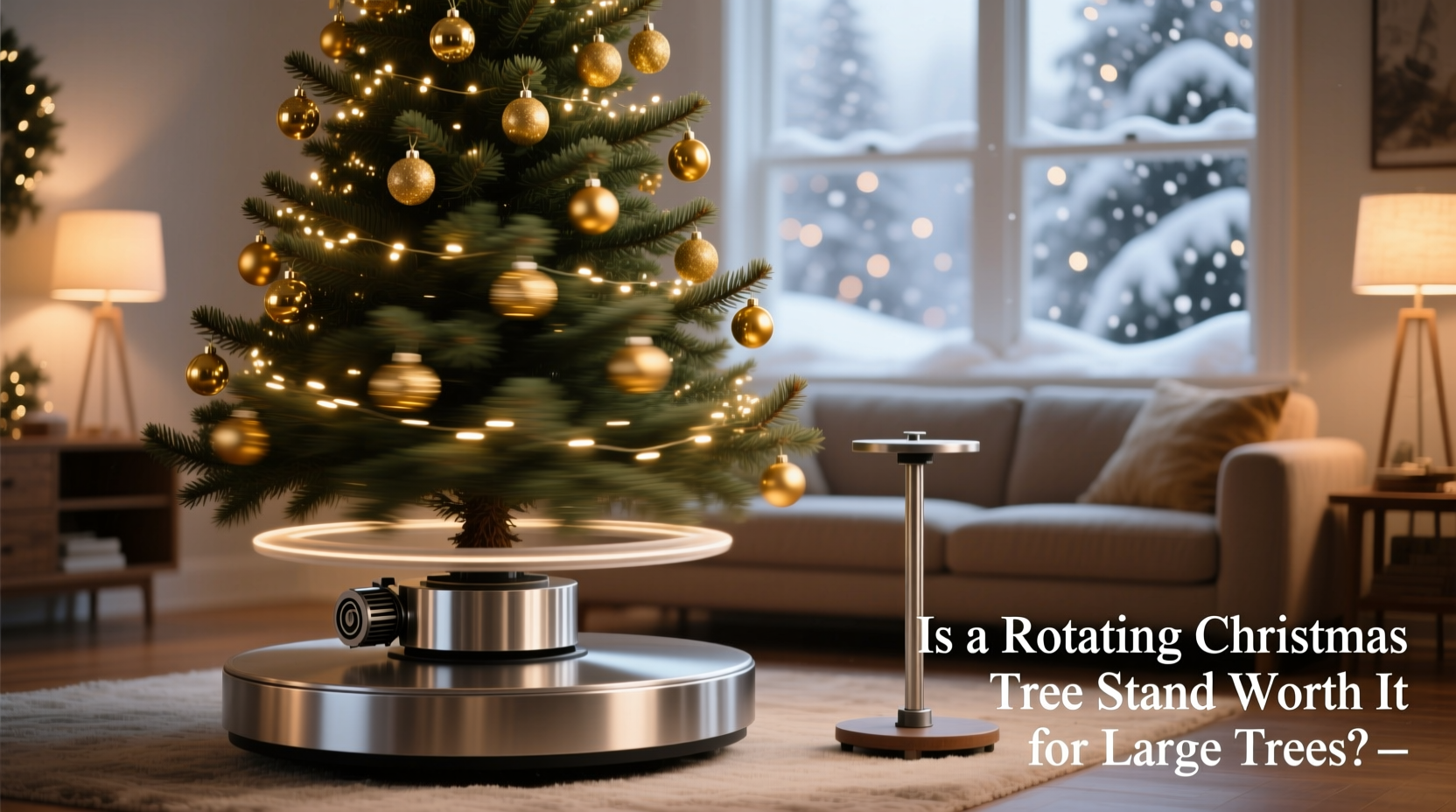
A traditional tree stand holds the trunk firmly in place, requiring anyone who wants to view or decorate the backside of the tree to walk around it. With a full Fraser fir or spruce that spans over 8 feet tall and has thick branching, reaching certain sides during decoration can be awkward—especially in tight spaces. A rotating stand eliminates this by allowing the tree to turn smoothly beneath a fixed base.
The mechanism typically involves a ball-bearing platform or gear-driven rotation system that supports hundreds of pounds. Once installed, users can gently push the trunk or use a pull cord (on some models) to rotate the entire tree 360 degrees. This makes it possible to stay in one spot while adjusting ornaments, lights, or garlands across all sides.
Beyond convenience, there’s an aesthetic benefit. When guests gather, the ability to slowly rotate the tree ensures everyone gets a full view without needing to reposition furniture or crane their necks. Some high-end models even include motorized rotation, offering a “display mode” that turns the tree at set intervals like a holiday exhibit.
Stability vs. Size: Can Rotating Stands Handle Large Trees?
One of the most critical considerations is whether a rotating stand can securely support a large or heavy tree. Not all rotating bases are created equal—some are rated only up to 7 feet or 150 pounds, which may not suffice for mature firs or pines commonly chosen for grand displays.
High-capacity rotating stands exist, with top-tier models supporting trees up to 12 feet tall and weighing over 250 pounds. These often feature reinforced steel frames, wider footprints, and multi-point stabilization systems. However, they also tend to be heavier themselves, sometimes exceeding 30 pounds before the tree is even added.
The physics of rotation introduces additional stress. A stationary stand distributes weight evenly through clamps and water reservoirs. In contrast, a rotating model must balance rotational torque with vertical load. If the center of gravity shifts too far—due to uneven limb distribution or heavy ornament clusters—the tree may wobble or tilt during movement.
Manufacturers address this with features like locking mechanisms, anti-tip brackets, and low-center designs. Still, user reviews consistently note that proper centering during installation is crucial. Even a slight misalignment can cause dragging, uneven spinning, or strain on the mechanism.
“With a full 9-foot balsam, the difference between a standard and rotating stand was night and day—but only after we centered it perfectly. One inch off, and the rotation stuttered.” — Daniel Reeves, Home Decor Enthusiast and DIY Blogger
Comparison: Rotating vs. Traditional Tree Stands for Large Trees
| Feature | Rotating Stand | Traditional Stand |
|---|---|---|
| Tree Height Capacity | Up to 12 ft (premium models) | Up to 10+ ft (varies by model) |
| Weight Support | 150–275 lbs (high-end models) | 100–200 lbs (standard) |
| Water Reservoir | Typically 1–2 gallons | 1–3 gallons (often larger) |
| Setup Complexity | Moderate to high (alignment critical) | Low to moderate |
| Rotation Ease | Smooth with ball bearings or gears | No rotation |
| Price Range | $80–$250 | $20–$80 |
| Footprint Stability | Wider base needed; risk of tipping if overloaded | Narrower but generally more stable |
As shown above, rotating stands often sacrifice some water capacity and absolute stability for functionality. They’re engineered more intricately, which increases cost and demands precision during setup. For smaller trees, the trade-off might not justify the expense. But for large, full trees in open rooms where viewing angles matter, the advantages become more compelling.
Step-by-Step Guide: Installing a Rotating Stand for a Large Tree
Proper installation is essential to ensure both smooth rotation and safety. Follow these steps carefully when using a rotating stand with a large or dense tree:
- Unpack and inspect the stand – Check for damaged parts, especially the bearing plate or rotation gears. Ensure all screws and stabilizing legs are included.
- Position the stand in its final location – Due to weight and size, avoid moving the tree once mounted. Place it where the tree will remain throughout the season.
- Cut the trunk flat and square – A level cut ensures even pressure distribution and prevents wobbling. Use a handsaw or trunk cutter for precision.
- Center the tree in the stand – Insert the trunk through the clamp mechanism. Adjust until the tree stands straight and the base rotates freely without catching.
- Tighten the bolts gradually and evenly – Alternate between opposing screws to maintain alignment. Over-tightening can crack the trunk or distort the base.
- Fill the reservoir and test rotation – Add water first, then gently rotate the tree by hand. Listen for grinding or resistance. Unlock any brake mechanisms if applicable.
- Wait 1–2 hours before decorating – Let the tree settle and check for any lean developing over time. Make micro-adjustments if needed.
Skipping any of these steps—especially centering and leveling—can lead to poor performance. Many return complaints stem not from defective products, but from rushed installations with oversized or unbalanced trees.
Real Example: The Thompson Family’s 10-Foot Spruce
The Thompsons in Minneapolis have displayed a 10-foot white spruce in their cathedral-ceiling living room for 15 years. Traditionally, decorating required two people—one in front, one behind—passing ornaments back and forth. Last year, they invested in a premium rotating stand rated for 275 pounds and 12-foot trees.
Initial setup took nearly 45 minutes due to careful alignment, but once secured, the tree rotated smoothly with a light push. During decoration, one person remained seated nearby, rotating the tree incrementally to access each section. Their young grandson delighted in turning the tree like a carousel during visits.
However, they noticed the water reservoir held half a gallon less than their old stand, necessitating refills every other day. They also had to avoid clustering heavy heirloom ornaments on one side to prevent imbalance. Despite these minor adjustments, they called it “the best upgrade we’ve made in years.”
When a Rotating Stand Is (and Isn’t) Worth It
Despite their appeal, rotating stands aren’t universally beneficial. Consider the following checklist to determine if one suits your situation.
✅ Do consider a rotating stand if:
- You have a tree taller than 7.5 feet or with very full branching.
- Your living space limits walking behind the tree (e.g., near walls or furniture).
- You decorate solo or with limited help.
- You value display quality and enjoy showing off all sides of the tree.
- You plan to reuse the stand for multiple seasons.
❌ Avoid rotating stands if:
- Your tree exceeds the manufacturer’s height or weight rating.
- You have pets or small children who might bump or spin the tree unsupervised.
- You prioritize maximum water capacity over rotation.
- You’re on a tight budget—quality rotating stands start at nearly four times the price of basic ones.
- You store your tree in a compact space; rotating stands are bulkier to pack away.
“Rotating stands are fantastic for presentation, but they’re not foolproof. I recommend them only when the tree and room dynamics justify the investment.” — Laura Mendez, Interior Stylist and Holiday Design Consultant
Frequently Asked Questions
Can a rotating stand damage my tree trunk?
Not if used correctly. High-quality stands use padded clamps that distribute pressure without cutting into the wood. However, overtightening the bolts can compress the trunk and restrict water uptake. Always follow manufacturer torque guidelines and check moisture levels regularly.
Do motorized rotating stands exist?
Yes, though they’re less common. Some luxury models include quiet electric motors that rotate the tree automatically at intervals (e.g., every 30 seconds). These are ideal for display settings but require access to power and are significantly more expensive—often over $300. Manual rotation remains the standard for home use.
Are replacement parts available for rotating mechanisms?
Limited availability. Most manufacturers don’t sell individual bearings or gears separately. If the rotation mechanism fails, you may need to replace the entire stand. Look for brands offering warranties of at least 3 years to protect your investment.
Final Verdict: Is It Worth the Investment?
For owners of large or full Christmas trees, a rotating stand can be a game-changer—but only under the right conditions. If you value ease of decoration, consistent visibility, and a polished presentation, and your tree falls within the stand’s specifications, the upgrade is likely worthwhile. Premium models offer reliable performance and durability across multiple seasons, justifying their higher upfront cost.
Yet, it’s not a one-size-fits-all solution. The added complexity, reduced water capacity, and sensitivity to alignment mean that improper use can lead to frustration. Pet owners, those with very large trees, or budget-conscious shoppers may find better value in a high-quality traditional stand paired with smart placement.
In the end, the decision hinges on how you interact with your tree. If it’s a functional backdrop, rotation adds little value. But if it’s a focal point of celebration, craftsmanship, and family tradition, then the ability to showcase every angle—with a simple turn—might just make the holidays feel a little more magical.




 浙公网安备
33010002000092号
浙公网安备
33010002000092号 浙B2-20120091-4
Comments
No comments yet. Why don't you start the discussion?