
Every year, millions of households wrestle with the same holiday challenge: getting the Christmas tree perfectly centered, securely anchored, and evenly visible from all angles. For families with larger, fuller, or naturally top-heavy trees, this task becomes even more demanding. Enter the rotating Christmas tree stand — a modern solution promising effortless positioning and enhanced stability. But is it truly worth upgrading, especially when dealing with heavier trees that weigh 50 pounds or more?
The short answer: often, yes — but only if your priorities include convenience, long-term usability, and reducing physical strain during setup. The full picture, however, involves trade-offs in cost, compatibility, and installation complexity. This article dives deep into the mechanics, advantages, and limitations of rotating stands for heavy trees, helping you make an informed decision before your next holiday season.
How Rotating Tree Stands Work
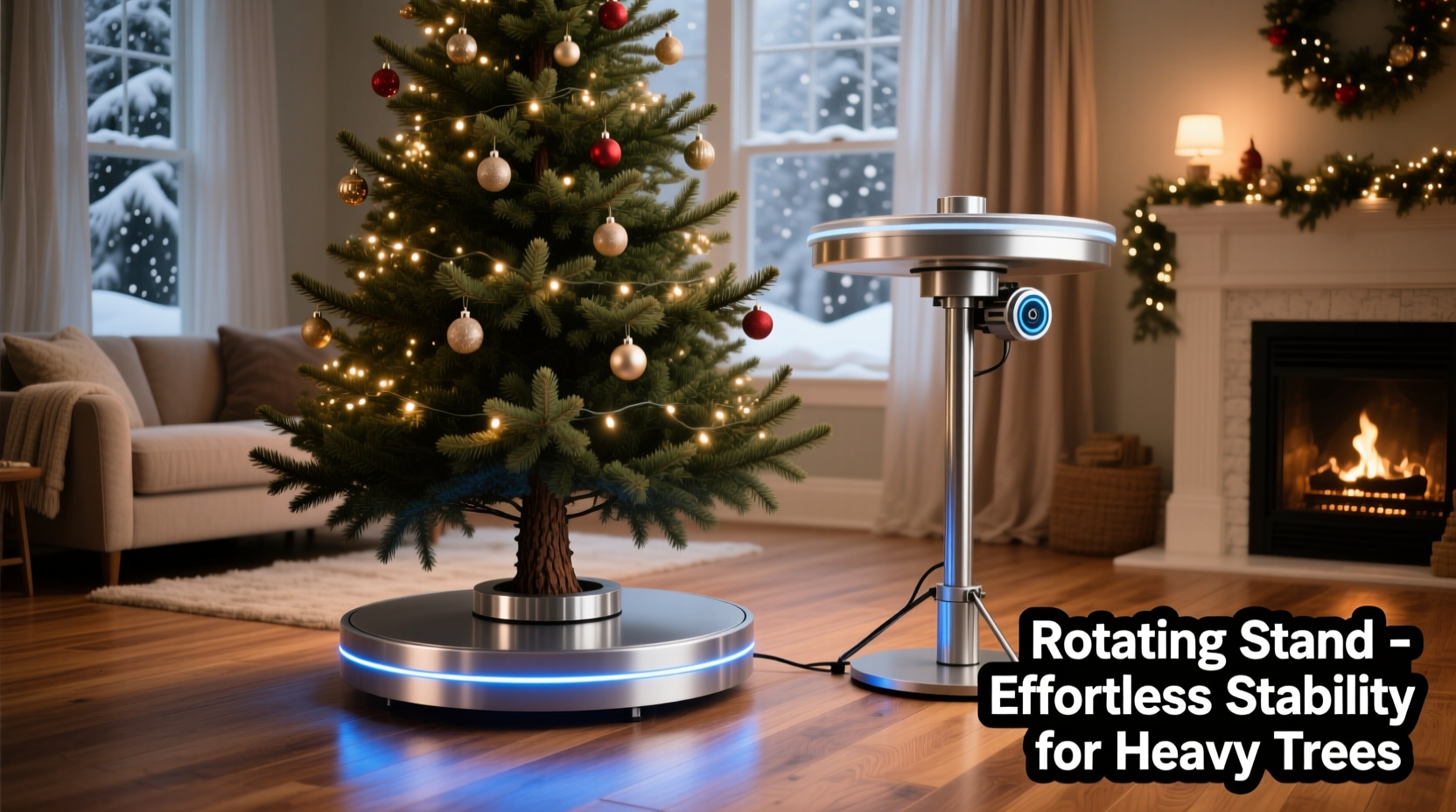
Traditional tree stands rely on a central bolt or screw mechanism to clamp the tree trunk in place. Once positioned, the tree remains fixed unless manually repositioned — which often means dragging the entire base across the floor, risking water spills and branch damage.
In contrast, rotating tree stands incorporate a dual-mechanism design:
- Stabilization System: A central screw or lever tightens against the trunk, just like traditional models, ensuring the tree doesn’t wobble or tip.
- Rotation Mechanism: A bearing or turntable system beneath the base allows the entire tree and stand to rotate smoothly with minimal effort — sometimes with just one finger.
This separation of functions — stabilization vs. rotation — is key. The tree stays firmly secured while being able to pivot 360 degrees. High-end models use ball bearings or reinforced polymer rings to reduce friction and support weight without degradation over time.
Benefits of Rotating Stands for Heavy Trees
Heavier trees — typically firs, spruces, or pines over 7 feet tall — present unique challenges. Their weight makes manual repositioning difficult, increases the risk of tipping, and complicates decorating symmetry. A rotating stand addresses several of these pain points directly.
Effortless Viewing and Decorating
With a heavy tree, stepping back to assess ornament placement often requires moving furniture or walking around crowded rooms. A rotating stand eliminates this by bringing every angle of the tree to you. This is especially useful when hanging delicate ornaments or adjusting lights on dense branches.
One user reported spending nearly two hours decorating a 9-foot Fraser fir, constantly shifting position and bending awkwardly. After switching to a rotating stand, the same process took 70 minutes — with significantly less physical strain.
Improved Weight Distribution and Stability
Many premium rotating stands are engineered specifically for heavier loads. Models like the Tree Ride Pro or Gorilla Rack support up to 1,000 pounds of dynamic weight (including water and decorations), far exceeding standard stands rated for 50–60 pounds.
These stands often feature wider bases, reinforced steel frames, and multi-point clamping systems that grip the trunk at multiple angles, distributing pressure more evenly. This reduces the chance of trunk splitting or slippage — common issues with oversized trees in basic stands.
“Rotating stands designed for heavy trees aren’t just about convenience — they’re about safety. A properly supported 8-foot tree can exert significant torque when bumped. A stable, rotating base prevents accidents.” — Daniel Meeks, Arborist and Holiday Safety Consultant
Reduced Floor Damage and Furniture Adjustment
Manually turning a 70-pound tree on a hardwood or tile floor often results in scratches, gouges, or displaced rugs. With a rotating mechanism, the tree pivots in place, eliminating drag. This is particularly valuable in homes with open-concept layouts where the tree occupies a central visual space.
When a Rotating Stand Might Not Be Worth It
Despite their advantages, rotating stands aren’t universally ideal. Several factors can diminish their value proposition, especially for budget-conscious or space-limited households.
Higher Upfront Cost
A quality rotating stand typically costs between $80 and $200, compared to $20–$40 for a standard stand. While this is a one-time investment, it may not justify the benefit for those who:
- Use smaller trees (under 7 feet)
- Only decorate for a short period (e.g., two weeks)
- Have limited storage space for bulky equipment
If you only need basic support and don’t mind occasional repositioning, the added cost may not translate into meaningful improvement.
Limited Compatibility with Irregular Trunks
Some natural trees have crooked, split, or off-center trunks — common in wild-cut or older-growth specimens. Rotating stands require a relatively straight trunk to function properly. If the center of gravity is too far off-axis, rotation can cause wobbling or binding, even if the tree is otherwise secure.
Additionally, certain rotating models have strict diameter limits. While most accommodate trunks from 1.5” to 5”, some high-precision models narrow this range, potentially excluding very thick or oddly shaped bases.
Comparison: Traditional vs. Rotating Stands for Heavy Trees
| Feature | Traditional Stand | Rotating Stand |
|---|---|---|
| Max Weight Capacity | 40–60 lbs | 150–1000 lbs |
| Ease of Rotation | Manual lifting/dragging required | Smooth 360° turn with light touch |
| Setup Complexity | Simple, 5–10 minutes | Moderate, 10–20 minutes |
| Price Range | $15–$40 | $80–$200 |
| Floor Protection | Low — dragging causes scratches | High — rotates in place |
| Ideal Tree Height | Under 7 feet | 7 feet and above |
Real-World Example: The Johnson Family Upgrade
The Johnsons in Denver, Colorado, have used a 9-foot Balsam fir for Christmas for over a decade. Their previous metal stand held the tree upright but made decorating frustrating — every adjustment meant pushing the entire base, spilling water, and risking imbalance.
Last year, they invested in a $140 rotating stand with a 750-pound capacity. Setup took 18 minutes — slightly longer than before — but once stabilized, the tree rotated smoothly. Their 8-year-old daughter could now spin the tree safely to see her favorite ornaments. Decorating time dropped by 35%, and they avoided rearranging their living room furniture.
“It paid for itself in reduced stress,” said Mark Johnson. “We’re not young anymore, and not having to shove a 70-pound tree across the floor is a game-changer.”
Step-by-Step Guide: Installing a Rotating Stand for a Heavy Tree
Proper installation is critical to ensure both stability and smooth rotation. Follow these steps for optimal performance:
- Prepare the Base: Assemble the stand according to instructions. Ensure the rotation ring or bearing is clean and unobstructed.
- Cut the Trunk Flat: Re-cut the bottom of the trunk at a straight 90-degree angle. An uneven cut will prevent proper seating and cause wobbling.
- Position the Tree: Lift the tree straight down into the stand. Avoid angling it, as this can damage internal mechanisms.
- Secure the Clamps: Tighten the main screw or levers gradually and evenly. Over-tightening can crack the trunk; under-tightening leads to instability.
- Test Rotation: Gently rotate the tree by hand. It should turn smoothly without resistance or wobble. If it binds, check for debris or misalignment.
- Add Water: Fill the reservoir immediately. Monitor levels daily — heavy trees consume more water.
- Final Check: Apply slight lateral pressure to test stability. No movement should occur outside of rotation.
Frequently Asked Questions
Can I use a rotating stand with an artificial tree?
Yes — and many users prefer them for large artificial trees. Since these trees are reused annually, the long-term convenience of rotation adds up. Just ensure the pole diameter matches the stand’s specifications.
Do rotating stands require maintenance?
Minimal maintenance is needed. After the season, drain all water, dry thoroughly, and wipe the rotation ring with a silicone-based lubricant to prevent rust and ensure smooth operation next year.
Will a rotating stand prevent my tree from tipping?
Not inherently. While many rotating stands are sturdier, tipping prevention depends on proper weighting, correct tightening, and placement away from foot traffic. Always anchor the tree to a wall if you have pets or small children.
Checklist: Is a Rotating Stand Right for You?
Answer these questions to determine if the upgrade makes sense:
- ✅ Do you use a tree taller than 7 feet?
- ✅ Does your tree weigh more than 50 pounds fully watered?
- ✅ Do you struggle with decorating due to poor viewing angles?
- ✅ Have you damaged flooring by moving the tree manually?
- ✅ Are you looking for a long-term investment (3+ years of use)?
- ✅ Is your trunk relatively straight and undamaged?
If you answered “yes” to three or more, a rotating stand is likely a worthwhile upgrade.
Conclusion: Making the Decision That Fits Your Home
A rotating Christmas tree stand isn’t just a luxury — for owners of heavier trees, it can be a practical necessity. The ability to rotate a massive evergreen effortlessly transforms decorating from a chore into a shared family experience. It reduces physical strain, protects your floors, and enhances display symmetry without constant readjustment.
While the upfront cost is higher, the long-term benefits in convenience, safety, and enjoyment often outweigh the price difference — especially if you plan to reuse the stand for multiple seasons. Like upgrading from a manual to electric tool, the investment pays off in saved time and reduced frustration.




 浙公网安备
33010002000092号
浙公网安备
33010002000092号 浙B2-20120091-4
Comments
No comments yet. Why don't you start the discussion?