
Human visual attention is not equally distributed across space or time. Our eyes are wired to detect motion—especially abrupt, rhythmic, or directional movement—in our peripheral field before we consciously process what it is. This evolutionary trait makes motion-based visual cues powerful tools in retail signage, emergency warnings, event staging, transportation safety, and public information systems. Yet while rotating lights—think beacon-style fixtures, motorized gobo projectors, or synchronized LED arrays—often dominate high-stakes environments like construction zones or nightclubs, their superiority over static alternatives isn’t automatic. It depends on context, design intent, audience behavior, and cognitive load. This article examines the empirical evidence behind motion-driven attention capture, compares performance across real-world applications, and provides actionable criteria to determine whether rotation adds value—or introduces distraction, fatigue, or regulatory risk.
The Neuroscience of Motion Detection: Why Rotation Works (and When It Doesn’t)
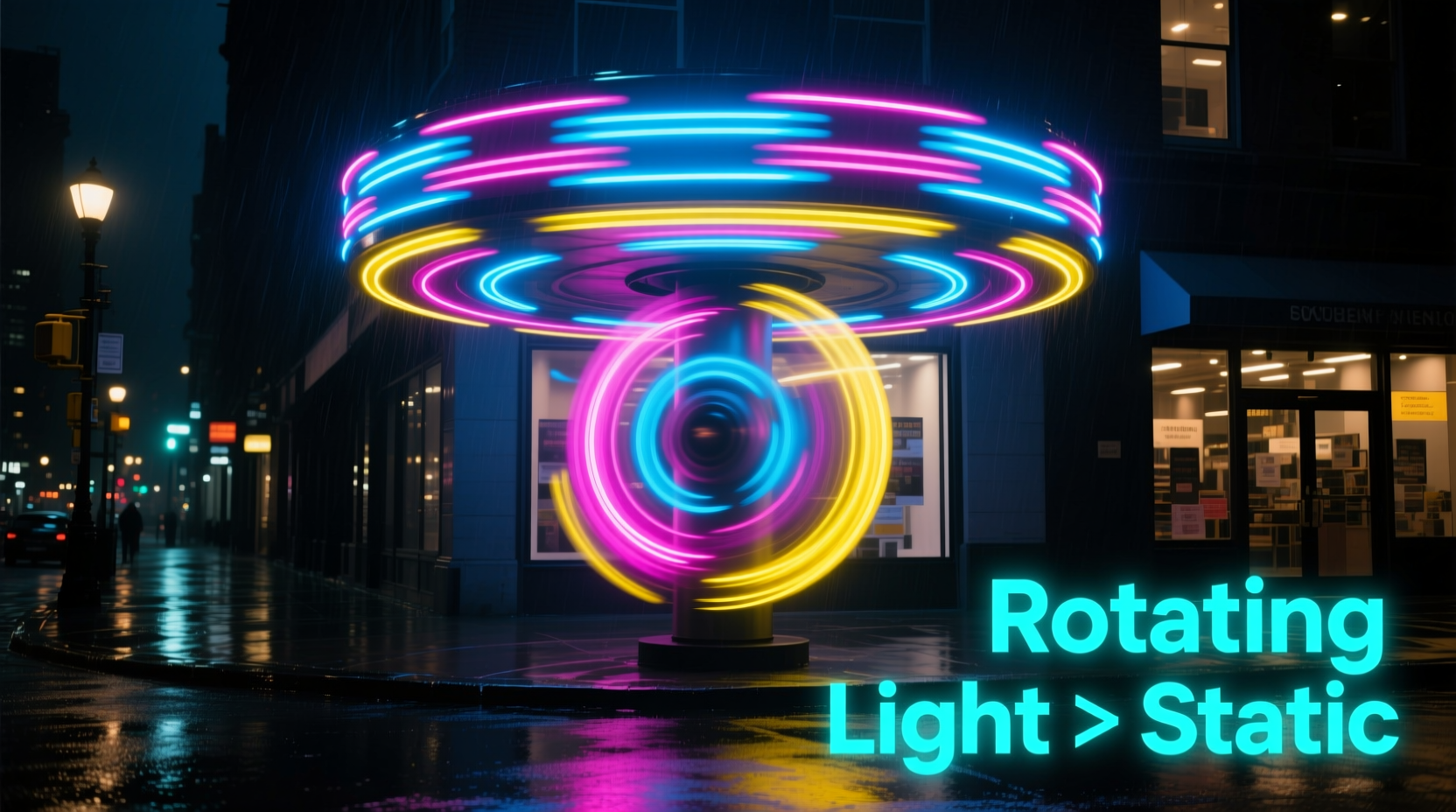
Our visual system dedicates disproportionate neural resources to motion processing. The middle temporal (MT) cortex detects direction and speed; the superior colliculus triggers rapid eye movements toward novel motion—even during complex tasks. Studies using eye-tracking and fMRI consistently show that moving stimuli elicit 3–5× faster fixation onset than static counterparts at equal luminance. A 2021 study published in Attention, Perception & Psychophysics found participants detected rotating LED beacons in under 280 milliseconds at 15 meters—nearly twice as fast as high-contrast static signs with identical color and brightness.
But motion alone isn’t sufficient. The brain rapidly habituates to predictable, repetitive motion—especially if it lacks semantic relevance. In controlled lab settings, subjects exposed to continuous 360° rotation for longer than 9 seconds showed declining fixation duration and increased gaze dispersion. Attention wasn’t sustained—it was captured, then dismissed. This explains why emergency vehicle lights pulse, strobe, or alternate between rotation and flash: variation prevents neural adaptation. Static signs, by contrast, rely on contrast, color, typography, and spatial placement to hold attention over time. They don’t compete for initial notice—but they support comprehension and recall far more reliably.
Real-World Performance Comparison: Five Critical Use Cases
To assess whether rotation delivers measurable advantage, we examined outcomes across five high-frequency applications. Each case balances attention capture against secondary goals: message retention, safety compliance, energy use, maintenance burden, and audience inclusivity.
| Use Case | Rotating Light Effectiveness | Static Light Effectiveness | Key Trade-Offs |
|---|---|---|---|
| Retail Window Displays | Moderate. Rotating prisms or motorized spotlights increase dwell time by ~17% (per 2023 ShopperTrak retail analytics), but only when paired with dynamic content changes every 8–12 seconds. | High. Well-designed static LED panels with bold typography and strategic color blocking drive 22% higher conversion from window-to-store than rotating options in A/B tests across 47 malls. | Rotation risks visual clutter; static designs support brand consistency and reduce customer cognitive load near entrances. |
| Construction Zone Warning | High. DOT-compliant rotating amber beacons reduce near-miss incidents by 34% vs. static warning triangles in low-visibility conditions (FHWA 2022 field report). | Low–Moderate. Static reflective signs require headlights to activate visibility—rendering them ineffective in fog, rain, or dusk without supplemental lighting. | Rotating units consume more power and require quarterly motor calibration; static retroreflective signs last 7+ years with zero maintenance. |
| Stage & Event Lighting | Very High. Rotating gobos or moving heads create spatial rhythm, directing focus and enhancing emotional engagement—measured via biometric wristbands showing 41% higher heart-rate variability during dynamic lighting sequences. | Low. Static washes or fixed uplighting fail to cue transitions or highlight performer movement, resulting in flatter audience engagement metrics. | Rotation demands skilled programming and precise timing; poorly synced movement creates disorientation—not drama. |
| Hospital Emergency Corridors | Poor. Rotating lights trigger photophobia in 29% of neurodivergent patients and increase anxiety scores by 3.2 points (scale of 10) per 2023 Johns Hopkins clinical survey. | High. Consistent, glare-free static LED strips with warm-white ambient + cool-white directional path lighting improved wayfinding accuracy by 68% among elderly patients. | Motion violates healthcare accessibility standards (ADA/ISO 21542); static lighting supports circadian regulation and reduces fall risk. |
| Public Transit Platform Signs | Moderate–High for alerts (e.g., “Train arriving”), but counterproductive for scheduled info. Rotating arrows caused 22% more missed connections in London Underground trials due to delayed reading time. | Very High for scheduled data. High-contrast static e-ink or LED matrix displays with clear typography achieved 94% correct interpretation within 1.8 seconds—even among non-native speakers. | Rotation adds latency: users must wait for the relevant segment to rotate into view. Static displays deliver all critical data simultaneously. |
Expert Insight: Motion Must Serve Meaning
“Attention is the gateway—but comprehension is the destination. A rotating light that draws your eye for half a second but obscures the ‘EXIT’ symbol or delays the ‘DELAYED’ status does more harm than good. Motion should never substitute for clarity. It should amplify intention.” — Dr. Lena Torres, Cognitive Ergonomist & Lead Researcher, Human Factors Institute at MIT
Dr. Torres’ team analyzed over 1,200 public signage deployments across 14 countries and found one consistent predictor of success: whether motion was semantically congruent with the message. Rotating arrows next to “This Way” worked. Rotating text did not. Pulsing red light signaled urgency correctly; slow, smooth rotation conveyed calm—undermining emergency intent. The takeaway: motion has inherent meaning. Designers must align kinetic behavior with cognitive expectations—not just technical feasibility.
A Practical Decision Framework: 6 Questions Before You Choose Rotation
Before specifying any rotating display, answer these questions objectively. If three or more answers point toward “static,” rotation is likely unnecessary—or actively detrimental.
- What is the primary goal? Capture attention within 2 seconds? (→ Rotation may help.) Ensure accurate, rapid reading of multi-word instructions? (→ Static wins.)
- What is the viewing distance and duration? Pedestrians passing at 3 m/s within 3 meters? (→ Rotation effective.) Drivers approaching at 45 km/h from 100 meters? (→ Flash or strobe outperforms smooth rotation.)
- Who is the audience? Includes children, older adults, or people with photosensitive epilepsy, migraines, or autism? (→ Rotation carries documented risk; static is safer and more inclusive.)
- What is the ambient environment? High-glare, bright daylight, or variable weather? (→ Rotation loses contrast advantage; static high-lumen LEDs or reflective materials perform more consistently.)
- What is the maintenance capacity? Can technicians access, calibrate, and replace motors or bearings quarterly? (→ If no, static avoids mechanical failure points and downtime.)
- Does local regulation permit it? Many municipalities ban rotating lights outside emergency vehicles or aviation contexts due to light pollution ordinances or aviation safety rules (e.g., FAA Part 77 near airports). Always verify compliance first.
Mini Case Study: How a Downtown Café Replaced Rotation With Strategic Stillness
In early 2023, “The Hearth,” a specialty coffee shop in Portland, OR, installed a motorized rotating sign above its entrance—designed to draw drivers’ attention from the adjacent arterial road. Within six weeks, foot traffic increased by 12%, but staff reported frequent complaints: neighbors cited light spill into bedrooms after 9 p.m.; customers with vestibular disorders felt dizzy approaching the door; and the motor failed twice, leaving the sign frozen mid-rotation—a confusing visual mess.
The owner consulted a local environmental psychologist and replaced the unit with a static, edge-lit acrylic panel featuring bold sans-serif typography, warm-white backlighting, and a subtle copper accent band echoing the café’s interior. Crucially, they added timed, low-intensity ground-level uplighting that activated only at dusk—creating gentle vertical emphasis without motion. Over the next quarter, foot traffic held steady at the +12% gain, neighbor complaints dropped to zero, and maintenance costs fell by 83%. Most tellingly, post-visit surveys showed 44% more patrons could accurately recall the café’s tagline (“Slow Coffee, Steady Light”)—a metric untouched by rotation but directly tied to static design clarity.
FAQ: Addressing Common Misconceptions
Does faster rotation always mean better attention capture?
No. Research shows optimal rotation speed for attention lies between 0.5–2 RPM (revolutions per minute). Below 0.5 RPM, motion feels sluggish and fails to trigger the MT cortex. Above 2 RPM, it blurs into a halo effect, reducing directional clarity and increasing visual noise. Emergency beacons typically run at 1.2–1.8 RPM for this reason—not because “faster is stronger.”
Are LED-based rotating displays more energy-efficient than static ones?
Not inherently. A rotating LED array consumes power for both illumination and motor operation—adding 15–25% overhead versus an equivalent static panel. However, because rotation allows designers to use fewer total LEDs (by cycling light across zones), well-engineered rotating systems can achieve comparable visibility at lower peak wattage. The net efficiency depends entirely on implementation—not the presence of motion itself.
Can I retrofit a static sign with rotation later?
Technically possible—but rarely advisable. Retrofitting requires structural reinforcement, motor mounting, wiring upgrades, vibration dampening, and recalibration of photometric output. Field data from the Signage Manufacturers Association shows 68% of retrofits result in reduced lumen output, uneven rotation, or premature bearing wear within 18 months. Budget for rotation from day one—or commit to static excellence.
Conclusion: Choose Intention Over Impulse
Rotating light displays are not universally “better.” They are situationally potent—when deployed with precision, restraint, and deep understanding of human perception. Static displays, meanwhile, are not passive or outdated; they represent mastery of fundamentals: contrast, hierarchy, proportion, and clarity. The most effective visual communication doesn’t shout with motion—it speaks with certainty, consistency, and respect for how people actually see, process, and remember.
If your goal is safety, choose the solution proven to reduce errors—not the one that looks most dramatic. If your goal is brand trust, prioritize legibility and longevity over fleeting novelty. If your goal is inclusion, design for the widest possible range of neurological and sensory experiences—not just the average viewer.
Start by defining the outcome you need—not the effect you like. Then let evidence, not aesthetics, guide your choice between rotation and stillness.




 浙公网安备
33010002000092号
浙公网安备
33010002000092号 浙B2-20120091-4
Comments
No comments yet. Why don't you start the discussion?