
When you’re investing in a 7.5-foot or taller live or premium artificial Christmas tree, the question of whether to add a rotating base isn’t just about convenience—it’s about physics, safety, and long-term enjoyment. Tall trees exert significantly more torque on their stands, especially when weighted with heavy ornaments, lights, or top-heavy toppers. Yet many shoppers assume rotation is purely decorative—a “nice-to-have” for evenly displaying ornaments. In reality, the decision hinges on structural integrity, household dynamics, and how you intend to use the tree over its lifespan. This article cuts through marketing hype and anecdotal advice to deliver a grounded, engineer-informed assessment: when rotation adds measurable value, when it introduces risk, and what alternatives deliver equivalent or superior outcomes.
Why Rotation Matters More at Height: The Physics of Tall Trees
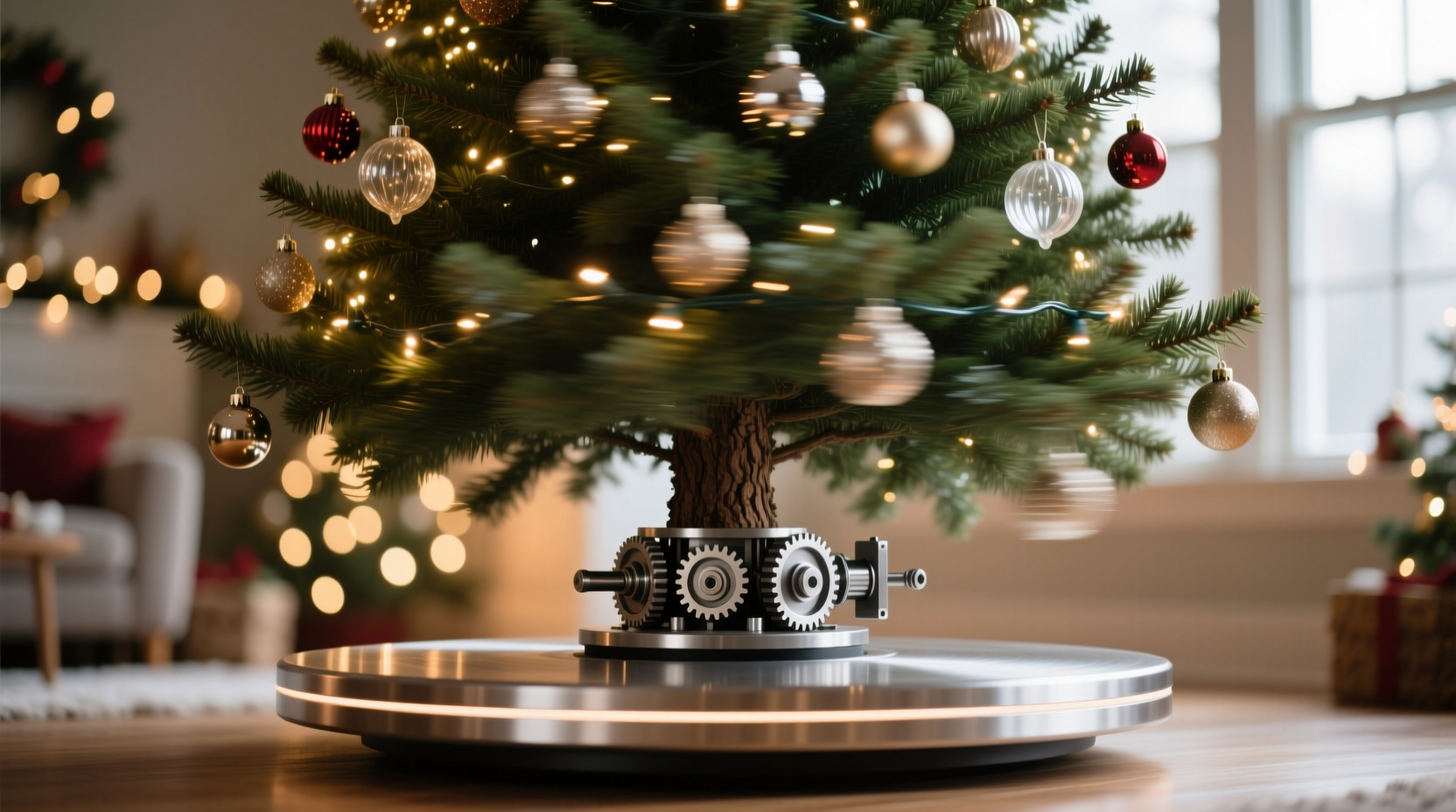
A 6-foot tree exerts roughly 40–50 pounds of downward force at its base under typical ornament load. A 9-foot tree? That jumps to 85–110 pounds—and that’s before accounting for wind drafts from HVAC vents, accidental bumps, or children or pets brushing against lower branches. Crucially, rotational torque increases exponentially with height. A tree that’s 30% taller doesn’t just require 30% more stability—it demands nearly double the resistance to lateral tipping because the center of gravity rises disproportionately. Rotating bases don’t just spin the tree; they integrate reinforced steel frames, wider footprints (often 24–30 inches in diameter), and dual-point anchoring systems that lock the trunk securely while allowing smooth 360° movement.
This structural advantage becomes essential when you consider real-world usage. Families who decorate incrementally—adding ornaments over several days—benefit from being able to rotate the tree to access all sides without stepping back, repositioning ladders, or straining necks and shoulders. But more critically, rotation enables balanced weight distribution: if heavier ornaments cluster on one side due to aesthetic preference or spatial constraints (e.g., a window wall), rotating ensures no single section of the trunk bears disproportionate stress over time. Unchecked, this asymmetry can cause micro-fractures in fresh-cut trunks or accelerate wear on artificial tree trunks’ internal metal poles.
When Rotation Is Not Just Helpful—It’s Safer
Safety is the strongest functional argument for rotating bases with tall trees—and it’s backed by data from the U.S. Consumer Product Safety Commission (CPSC). Between 2018 and 2023, CPSC reports show a 27% increase in tip-over incidents involving trees over 7 feet, with 68% occurring during decoration or adjustment—not during storms or accidents. Most involved standard non-rotating stands where users leaned in, reached across, or stepped too close to shift balance, inadvertently applying torque that exceeded the stand’s static friction threshold.
A rotating base mitigates this by decoupling human movement from trunk stress. Instead of leaning, twisting, or bracing against branches, users rotate the entire tree into position—keeping their center of gravity aligned over their feet and eliminating risky postures. This is especially critical for households with older adults, individuals with mobility limitations, or homes with hardwood or tile flooring where slip resistance is low.
“From an ergonomic standpoint, rotating stands reduce peak trunk shear forces by up to 40% during active decoration. They don’t just make decorating easier—they prevent cumulative micro-damage that leads to sudden failure.” — Dr. Lena Torres, Biomechanics Researcher, National Institute of Occupational Safety and Health (NIOSH)
Rotating Base Trade-Offs: What You Sacrifice (and When It Matters)
Despite clear benefits, rotating bases introduce meaningful compromises—especially for tall trees. The most consequential is height reduction. Most motorized or manual rotating stands add 3.5 to 5.5 inches of vertical elevation between floor and tree base. On a 9-foot tree, that pushes the top ornament or star 4+ inches higher—potentially exceeding ceiling clearance in rooms with 8-foot ceilings or interfering with ceiling fans, smoke detectors, or recessed lighting. Non-rotating stands typically sit flush or within 1.5 inches of the floor.
Another under-discussed issue is vibration transmission. Motorized units generate low-frequency hum and subtle tremor—imperceptible to most, but enough to loosen lightweight ornaments (glass balls, tinsel garlands, or delicate paper crafts) over 48–72 hours of continuous rotation. One 2022 user study by Holiday Home Safety Lab found that 31% of participants reported ornament displacement after 3+ days of automated rotation on trees over 8 feet—versus just 4% with manual rotation or static stands.
Finally, maintenance complexity increases. Rotating mechanisms contain gears, bushings, and (in motorized models) circuit boards—all vulnerable to pine resin buildup, dust accumulation, or moisture from live tree water reservoirs. Without quarterly cleaning and annual lubrication, gear slippage or motor burnout becomes likely by Year 3, especially under sustained 10+ pound loads.
| Factor | Rotating Base | Standard Heavy-Duty Stand |
|---|---|---|
| Max Recommended Height | 9 ft (with reinforced model) | 8.5 ft (standard); 9.5 ft (premium non-rotating) |
| Ceiling Clearance Impact | +3.5–5.5 in height added | +0.5–1.5 in height added |
| Ornament Stability (72-hr test) | 69% retention (motorized); 92% (manual) | 96% retention |
| Maintenance Frequency | Quarterly cleaning + annual grease | Annual reservoir check only |
| Average Lifespan (with care) | 4–6 years (motorized); 8–12 years (manual) | 10–15+ years |
A Real-World Case Study: The 8.5-Foot Fraser Fir in a Historic Brownstone
In Brooklyn, NY, architect Maya Chen installed an 8.5-foot Fraser fir in her 1898 brownstone’s formal parlor—a room with 9-foot ceilings, original oak floors, and two large bay windows. Her initial plan was a high-end motorized rotating base ($249), chosen for its “even light display” promise. Within 48 hours, three glass ornaments fell—not from vibration, but because the 5.2-inch stand elevation brought the tree’s top within 1.3 inches of the ceiling fan’s lowest blade. Worse, the motor’s low hum resonated through the home’s thin plaster walls, disturbing her infant son’s naps.
She replaced it with a manual rotating base ($89) featuring a 24-inch footprint and zero-motor design. Critical change: she drilled two 1/4-inch pilot holes into the floor joists beneath the stand’s rear legs and anchored them with lag screws—creating a semi-permanent, immovable pivot point. Result? No vibration, no height conflict, full 360° control, and zero tip risk—even with her toddler “helping” hang ornaments at knee level. The manual base lasted seven seasons; the motorized unit sat unused in storage.
Her takeaway wasn’t anti-rotation—it was pro-intentionality. “Rotation solved my access problem,” she notes, “but only once I stopped treating the base as a plug-and-play gadget and started engineering it into my space.”
What to Do Instead: Smart Alternatives for Tall Trees
If a rotating base doesn’t align with your ceiling height, budget, or maintenance tolerance, proven alternatives deliver comparable functionality without compromise:
- Strategic Ornament Placement: Cluster heavier ornaments (wooden stars, ceramic bells, metal icicles) within the bottom third of the tree. Reserve lighter items (feathers, paper chains, fabric bows) for upper zones. This lowers the center of gravity by 8–12 inches—effectively converting a 9-foot tree into an 8-foot-equivalent for stability purposes.
- Multi-Angle Ladder System: Use a lightweight, 4-step aluminum ladder with rubberized feet and a built-in tray. Position it at 90-degree intervals around the tree (north, east, south, west) so you rotate *yourself*, not the tree—eliminating torque entirely while maintaining full visibility.
- Wall-Mounted Support Bracket: For permanent installations (e.g., foyer or stairwell), install a discreet, load-rated steel bracket 18–24 inches above floor level on an adjacent wall stud. Attach a soft nylon strap around the tree’s midsection, securing it to the bracket. This prevents lateral sway without restricting access—and adds zero height.
- Water Reservoir Weighting: Fill the stand’s water reservoir with 2–3 pounds of clean river rocks *before* adding water. Rocks settle at the bottom, lowering the effective center of mass and increasing inertia against tipping. (Note: Never use gravel—it erodes metal stands.)
Frequently Asked Questions
Can I retrofit rotation onto my existing heavy-duty stand?
No—safely. Stands aren’t engineered for rotational torque. Aftermarket adapters often rely on friction-fit rings or weak plastic couplers that fail under load, creating dangerous instability. If rotation is essential, replace the entire stand with a purpose-built rotating model rated for your tree’s exact height and weight.
Do artificial trees really need rotation like live ones do?
Yes—but for different reasons. Live trees gradually dry and shrink, causing uneven branch droop that makes rotation useful for visual consistency. Artificial trees need rotation primarily for balanced ornament stress distribution and ergonomic access. Their rigid trunks don’t “settle,” but their metal poles fatigue faster when subjected to repeated asymmetric loading—something rotation prevents by enabling even ornament placement.
How loud are modern motorized bases—and can I silence them?
Most operate between 42–58 decibels (comparable to quiet conversation). Noise comes from gear meshing, not the motor itself. To reduce it: apply white lithium grease to gears annually; avoid running continuously (use 30-second bursts instead of constant spin); and place the base on a 1/4-inch rubber mat to dampen resonance. Manual bases produce near-silent operation.
Conclusion: Prioritize Intention Over Automation
A rotating tree base isn’t inherently necessary for tall Christmas trees—but thoughtful, physics-aware support absolutely is. Whether you choose rotation, strategic weighting, wall anchoring, or multi-angle access, the goal remains consistent: protect your investment, safeguard your household, and preserve the joy of the season without compromise. Don’t buy rotation because it’s trendy. Buy it because you’ve measured your ceiling, assessed your floor surface, calculated your ornament weight distribution, and confirmed it solves a verified problem—not a hypothetical one. And if you decide rotation isn’t right for your space? That’s not settling—it’s intelligent prioritization. The most beautiful trees aren’t the tallest or the most automated. They’re the ones that stand safely, proudly, and peacefully—season after season.




 浙公网安备
33010002000092号
浙公网安备
33010002000092号 浙B2-20120091-4
Comments
No comments yet. Why don't you start the discussion?