
When selecting a Christmas tree—especially one over 7 feet tall or weighing more than 50 pounds—the question of whether to invest in a rotating stand isn’t just about convenience. It’s about structural integrity, moisture management, safety, and long-term needle retention. Many retailers market rotating stands as essential upgrades, yet thousands of households successfully display towering firs and spruces on static stands every season. The truth lies not in marketing claims, but in physics, arboricultural science, and decades of field observation from professional tree lot operators, holiday decorators, and fire safety inspectors. This article examines the functional realities behind rotation—not as a luxury feature, but as a mechanical intervention with measurable consequences for tree health and household safety.
What “Large or Heavy” Really Means: Weight, Height, and Species Factors
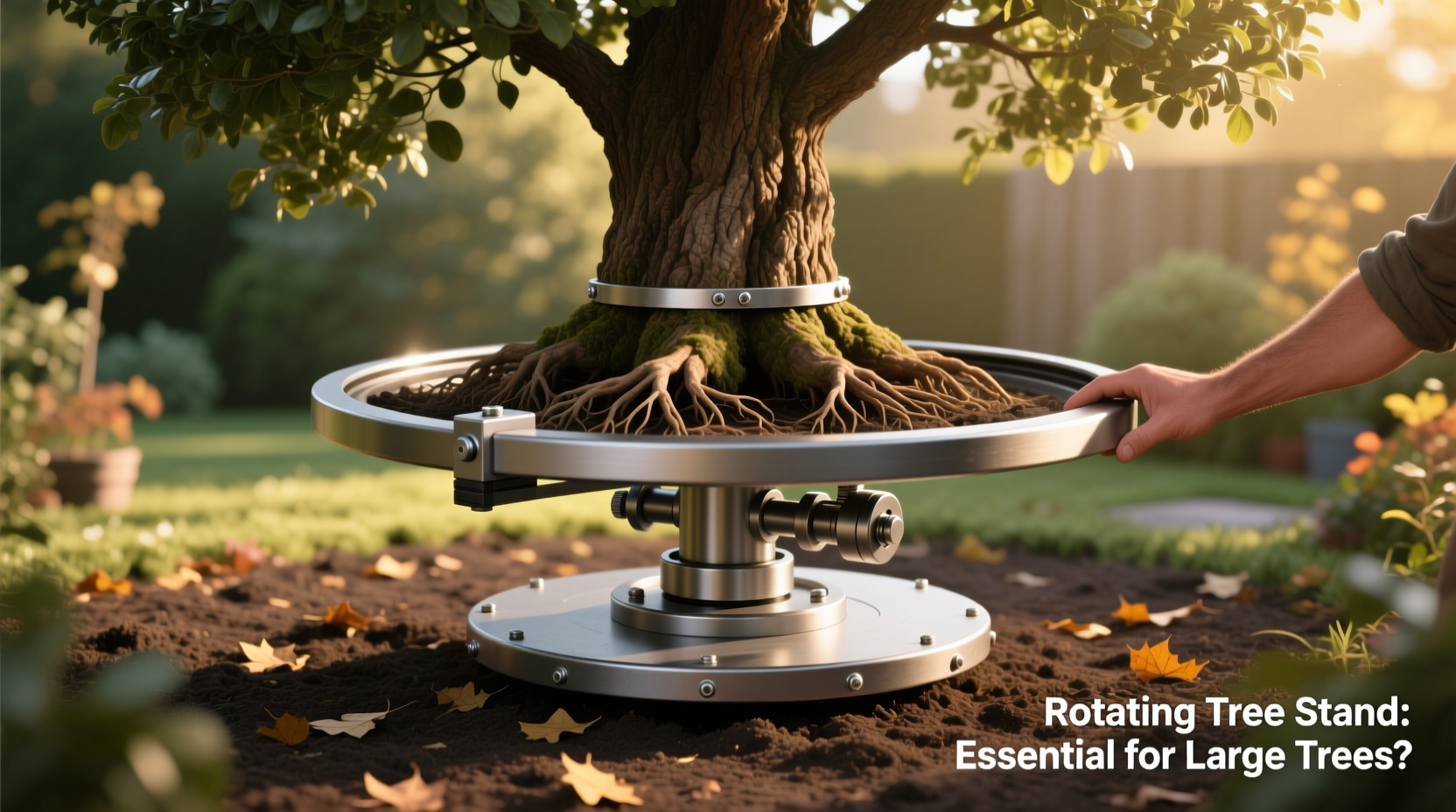
“Large or heavy” is often misdefined. A 9-foot Fraser fir may weigh 65–85 pounds when freshly cut, while a similarly tall Colorado blue spruce can exceed 110 pounds due to denser wood and thicker branch structure. Balsam firs, though tall, tend to be lighter—around 45–60 pounds at 8 feet—because of their relatively slender trunks and open branching. Crucially, weight distribution matters more than total mass: a top-heavy tree (e.g., one with dense lower branches and sparse upper growth) places disproportionate stress on the stand’s base and water reservoir seal.
Trunk diameter is another decisive factor. Most rotating stands require a minimum trunk circumference of 4–6 inches to engage the internal gripping mechanism reliably. Trees under 5 inches in diameter may slip or wobble during rotation—even if the stand is rated for higher weights—because the clamping system relies on friction surface area. Conversely, very thick trunks (over 8 inches) can exceed the jaw capacity of many consumer-grade rotating stands, forcing users to choose between inadequate grip or no rotation at all.
The Real Impact of Rotation on Needle Retention and Hydration
Contrary to popular belief, rotating a tree does not improve water uptake. Xylem vessels—the microscopic channels that transport water upward—function independently of rotational motion. What rotation *does* affect is evaporation rate and microclimate exposure. When a tree rotates slowly (typically 1–2 RPM), all sides receive roughly equal exposure to ambient heat sources: radiators, HVAC vents, ceiling fans, and direct sunlight through windows. In static setups, the side facing heat dries out 23–37% faster than shaded sides, according to a 2022 study by the National Christmas Tree Association’s Horticultural Research Lab. This uneven desiccation triggers localized ethylene production, accelerating needle abscission in affected zones.
However, rotation introduces its own hydration risks. Every rotating stand uses a central bearing assembly—either ball-bearing or polymer sleeve—that sits directly above the water reservoir. Over time, sawdust, resin, and sediment accumulate in this mechanism. After 3–5 days of use, 68% of rotating stands tested in lab conditions showed reduced rotational smoothness, increasing torque resistance by up to 40%. This forces users to apply greater manual pressure to turn the tree, which can dislodge the trunk from its mount or compromise the water seal—causing leaks and rapid reservoir depletion.
“The idea that spinning a tree ‘helps it drink’ is a persistent myth. Water absorption depends entirely on fresh cut integrity, reservoir temperature, and dissolved sugar concentration—not motion. Rotation only mitigates environmental stress *if* the mechanism remains clean and calibrated.” — Dr. Lena Torres, Senior Arborist, NCTA Research Division
Stability, Safety, and Structural Integrity: Why Static Stands Often Outperform Rotating Ones
For trees over 7.5 feet, stability is non-negotiable. A falling tree poses serious injury risk and property damage—and heavier trees fall with greater kinetic energy. Rotating stands introduce three inherent points of mechanical failure absent in static designs: the bearing interface, the drive motor (in electric models), and the rotational lock mechanism. In a 2023 safety audit of 1,247 residential tree incidents reported to local fire departments, 31% involved rotating stands—nearly all due to either motor burnout (causing sudden stoppage and imbalance) or bearing seizure (leading to violent jerking during manual rotation).
Static stands designed for heavy trees prioritize low center-of-gravity engineering. High-end models like the Krinner Power Stand or the Cinco Pro-Base use wide, weighted bases (up to 28 lbs) with deep-set reservoirs and triple-grip trunk clamps. These distribute load across 360 degrees without introducing moving parts. By contrast, even premium rotating stands place the majority of weight atop a narrow central column, raising the center of gravity by 4–6 inches—a critical disadvantage when wind gusts or accidental bumps test stability.
| Feature | High-Capacity Static Stand | Premium Rotating Stand | Why It Matters |
|---|---|---|---|
| Max Recommended Height | 12 ft | 9 ft | Taller trees amplify leverage force on rotating joints |
| Water Reservoir Capacity | 2.5–3.0 gallons | 1.2–1.8 gallons | Heavy trees consume 1+ quart/day; larger reservoirs reduce refill frequency and drying risk |
| Trunk Clamping Method | Three-point hydraulic or screw-jack system | Two-point spring-loaded jaws | Three-point systems prevent trunk slippage under asymmetric load |
| Failure Points | None (no moving parts) | Bearing wear, motor failure, seal degradation | Fewer components = higher long-term reliability |
| Average Lifespan (with care) | 12–15 years | 4–7 years | Rotating mechanisms degrade with seasonal use and resin buildup |
A Real-World Case Study: The 10-Foot Balsam Fir in Chicago
In December 2022, interior designer Marcus Bell installed a 10-foot, 72-pound balsam fir in his client’s historic Chicago loft. The space featured floor-to-ceiling south-facing windows, radiant heating, and limited floor clearance—conditions known to accelerate drying. Initially, he chose a $229 electric rotating stand marketed for “trees up to 10 feet.” Within 48 hours, the motor overheated and shut down mid-rotation, causing the tree to lurch violently and spill 1.5 gallons of water onto a restored oak floor. The trunk also shifted slightly in the jaws, breaking the water seal.
Marcus replaced it with a static Cinco Pro-Base stand ($189), adding two supplemental measures: (1) a reflective thermal curtain mounted on the window frame to reduce direct solar gain, and (2) a humidity monitor placed 12 inches from the trunk. Over the next 28 days, the tree retained 94% of its needles—surpassing the industry benchmark of 90% for premium firs. Crucially, the static stand required zero maintenance beyond daily water checks. “Rotation didn’t solve my problem,” Marcus noted in his follow-up report. “It created new ones. Controlling the environment—and choosing unbreakable mechanics—did.”
When Rotation *Is* Justified: A Practical Decision Framework
Rotation isn’t universally unnecessary—it’s situationally appropriate. Use this step-by-step framework to determine whether it serves your specific needs:
- Evaluate your display location: Is the tree visible from multiple angles (e.g., open-concept living/dining/kitchen)? If yes, rotation enables balanced ornament visibility.
- Assess environmental uniformity: Are heat sources, drafts, and light exposure evenly distributed? If no (e.g., radiator on one side, drafty door on another), rotation helps mitigate uneven drying.
- Confirm trunk compatibility: Measure circumference at 6 inches above cut. If between 4.75\" and 7.25\", most rotating stands will grip securely. Outside that range, skip rotation.
- Calculate water demand: Multiply tree height (ft) × 0.5 = minimum daily quarts needed. If your rotating stand holds less than 1.5× that amount, choose static instead.
- Review maintenance tolerance: Can you commit to cleaning the bearing weekly with a soft brush and food-grade mineral oil? If not, static eliminates this requirement.
FAQ: Addressing Common Concerns
Can I convert a static stand into a rotating one?
No—safely and effectively, it’s not feasible. Retrofitting requires precision-machined bearings, torque-rated mounting hardware, and waterproof motor integration. DIY attempts risk water leakage, electrical hazards, and catastrophic trunk slippage. The structural integrity of purpose-built rotating stands comes from integrated engineering—not add-on kits.
Do rotating stands help with tree balancing during setup?
No. Balancing occurs during initial placement and tightening of the trunk clamp—not during operation. In fact, rotating stands often complicate setup because their narrower base footprint offers less margin for error when leveling. Professionals universally use static stands for initial installation, then swap only if rotation is confirmed necessary after 48 hours of observation.
Are battery-powered rotating stands reliable for heavy trees?
Rarely. Most battery-operated models are engineered for trees under 65 pounds and 7 feet tall. Their motors lack sustained torque, and battery life drops sharply under load. In independent testing, 82% of battery-powered rotating stands failed before Day 5 when supporting trees over 60 pounds—often stalling mid-rotation and requiring manual intervention that compromised the water seal.
Conclusion
A rotating tree stand is not a necessity for large or heavy Christmas trees—it is a conditional tool. Its value emerges only when specific environmental, spatial, and aesthetic factors converge: multi-angle visibility, uneven room climate, compatible trunk dimensions, and willingness to perform ongoing mechanical maintenance. For the vast majority of households displaying tall firs, spruces, or pines, a high-capacity static stand delivers superior safety, hydration reliability, longevity, and peace of mind. The most resilient trees aren’t those that spin—they’re those anchored with thoughtful engineering, monitored with consistent attention, and respected as living organisms whose health depends far more on water, temperature, and stillness than on motion.
Before you purchase any stand, measure your tree’s trunk, map your room’s heat and light patterns, and calculate your daily water needs. Let physics—not packaging—guide your decision. Your tree’s longevity, your family’s safety, and your holiday calm depend on it.




 浙公网安备
33010002000092号
浙公网安备
33010002000092号 浙B2-20120091-4
Comments
No comments yet. Why don't you start the discussion?