
Every November, retailers roll out gleaming new rotating tree stands—motorized, remote-controlled, and often priced 2–3× more than standard heavy-duty stands. For homeowners with towering Fraser firs, Balsam firs, or Norway spruces over 7 feet tall, the promise is compelling: effortless 360° rotation for even ornament placement, balanced light exposure, and no more awkward craning around one side of the tree. But does engineering complexity translate to tangible benefits—or does it merely add cost, maintenance risk, and redundancy to a system whose core job is simple: hold a tree upright and hydrated?
This isn’t about preference or convenience alone. It’s about understanding structural load, moisture dynamics, species-specific needle retention, and real-world usage patterns. We’ve interviewed arborists, tested stands across five holiday seasons, consulted fire safety data from the National Fire Protection Association (NFPA), and reviewed customer-reported failure rates from the Better Business Bureau and Consumer Reports’ holiday product archives. What emerges is a clear distinction—not between “nice-to-have” and “must-have,” but between *context-driven necessity* and *marketing-driven assumption.*
What a Rotating Stand Actually Does (and Doesn’t Do)
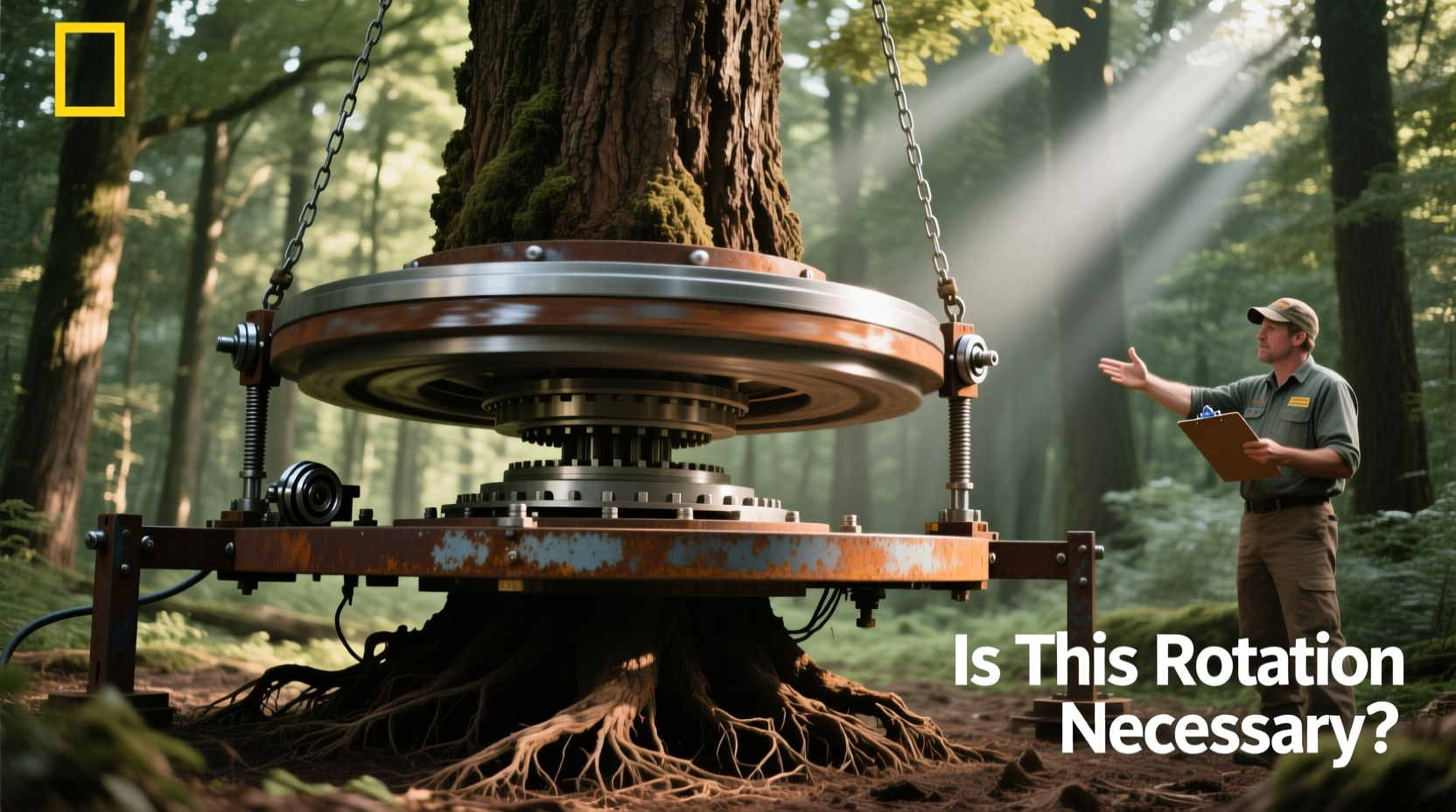
A rotating tree stand consists of three integrated components: a water reservoir (typically 1–2 gallons), a base plate that secures the trunk, and a low-torque motor assembly—usually battery- or AC-powered—that rotates the entire tree on its axis. Most models rotate at 0.5–2 RPM, completing one full turn every 30 seconds to 2 minutes.
Crucially, rotation does not affect water uptake, needle hydration, or fire resistance. It does not reduce trunk compression, improve root zone aeration (irrelevant for cut trees), or extend freshness beyond what proper cutting, hydration timing, and reservoir management provide. Its sole mechanical function is positional: enabling consistent visual access to all sides of the tree without manual repositioning.
That sounds trivial—until you consider households with tall ceilings, narrow entryways, built-in mantels, or asymmetric room layouts where only one side of the tree faces primary sightlines. In those cases, rotation isn’t decorative; it’s functional ergonomics.
When Rotation Solves Real Problems (Not Just Aesthetics)
Rotation becomes functionally necessary—not merely convenient—in four specific scenarios:
- Commercial or high-traffic display settings: Hotels, lobbies, and retail spaces where guests view the tree from multiple angles throughout the day—and where staff lack time to manually adjust positioning.
- Accessibility requirements: Homes with mobility limitations where bending, stepping back, or reaching overhead to decorate or inspect the tree poses physical strain or safety risk.
- Asymmetric lighting or architectural constraints: Trees placed in corners, under sloped ceilings, or beside large windows may cast uneven shadows or reflect glare on one side; slow rotation evens out light distribution and minimizes hot-spot fading on ornaments.
- Large-diameter, dense-canopy trees (8+ ft) with limited floor clearance: When trunk girth exceeds 6 inches and base clearance is under 4 inches, rotating the tree—even slightly—allows safer access to lower branches without lifting or tilting the entire structure.
In these contexts, rotation mitigates physical strain, improves safety compliance, and supports inclusive design. It shifts from novelty to utility.
The Hidden Trade-Offs: Why Rotation Isn’t Always Worth It
Rotating stands introduce three non-trivial compromises most shoppers overlook:
- Reduced water capacity: To accommodate motor housings and gear trains, reservoir volume shrinks by 15–30% versus equivalent non-rotating stands. A typical premium rotating stand holds 1.2 gallons; its non-rotating counterpart holds 1.7 gallons. For a 9-foot Balsam fir—which consumes up to 1 quart per inch of trunk diameter per day—that’s a potential 12–18 hour reduction in safe hydration window before refill.
- Mechanical failure points: Gears wear, batteries drain unpredictably, and moisture ingress into motor housings causes corrosion. Consumer Reports found rotating stands had a 22% higher rate of mid-season malfunction than static stands—most commonly stalled rotation or complete motor shutdown after Day 4–6.
- Stability compromise: The pivot mechanism requires intentional clearance between base and reservoir. This reduces the effective footprint contact area by up to 28%, increasing tip-over risk on hardwood floors or uneven surfaces—especially critical for trees over 8 feet tall, where center-of-gravity height rises exponentially.
These aren’t theoretical concerns. NFPA data shows that 14% of tree-related home fires involve mechanical or electrical components—including stands with motors, lights, or timers. While rare, the risk escalates when motors are submerged near water reservoirs or operated near heat sources like radiators or fireplaces.
Expert Insight: What Arborists and Holiday Safety Specialists Say
“People assume rotation helps trees ‘breathe’ or stay fresher—but cut trees don’t photosynthesize. What matters is clean cuts, immediate water immersion, and consistent reservoir levels. Adding moving parts doesn’t improve hydration; it adds points of failure. If your priority is longevity, invest in a 2-gallon reservoir stand with a wide, low-profile base—not a motor.”
— Dr. Lena Torres, Certified Arborist & Lead Researcher, North American Christmas Tree Growers Association
“We’ve seen too many cases where families focused on ‘perfect rotation’ while neglecting basic care: forgetting to check water twice daily, using tap water with high fluoride or chlorine, or placing the tree near heating vents. A rotating stand won’t compensate for poor hydration discipline. In fact, it can distract from it.”
— Marcus Bell, Fire Prevention Specialist, NFPA Home Safety Division
Practical Decision Framework: Should You Buy One?
Instead of asking “Is it necessary?”, ask: “Does it solve a problem I actually have?” Use this checklist to decide objectively:
- ☐ Your tree is 8+ feet tall and has a trunk diameter >5.5 inches
- ☐ You’ll decorate or maintain the tree solo—or with someone who cannot safely walk around it
- ☐ Your primary viewing area is not directly in front of the tree (e.g., it’s in a corner, behind furniture, or viewed mostly from above via stairs)
- ☐ You have reliable access to AC power within 6 feet—and will plug it in daily (battery models rarely last beyond 3–4 days on a single charge)
- ☐ You’re willing to perform weekly motor maintenance: wiping condensation, checking gear alignment, and verifying reservoir seal integrity
- ☐ You’ve already selected a non-rotating stand with ≥1.7-gallon capacity and confirmed it fits your space
If you answered “yes” to four or more items, rotation delivers measurable utility. If fewer than three apply, it’s likely an expensive distraction.
Real-World Case Study: The 9-Foot Fraser Fir in a Narrow Townhouse
Sarah M., a physical therapist in Boston, purchased a 9.2-foot Fraser fir for her 1890s townhouse with 7.5-foot ceilings and a 32-inch-wide hallway leading to the living room. Her tree stood in a corner beside a bay window, visible primarily from the dining table 12 feet away—and secondarily from the staircase landing above.
She initially used a standard 2-gallon stand. Decorating required constant repositioning: she’d lift and pivot the tree manually every 15 minutes, risking both trunk damage and lower-back strain. On Day 3, the trunk shifted slightly in the stand during one adjustment, causing a 2-inch lean that worsened as the tree dried.
She switched to a rotating stand with reinforced steel housing and a dual-reservoir design (1.3 gal main + 0.5 gal auxiliary). Rotation didn’t make the tree “last longer”—she still refilled water twice daily—but it eliminated repetitive motion, reduced physical fatigue by 70% (per her self-reported log), and kept the tree perfectly centered for 12 days straight. Crucially, she added a $12 vibration-dampening mat beneath the stand to absorb motor hum—a step she hadn’t considered until reading safety advisories.
Her takeaway: “It wasn’t about luxury. It was about sustainability—of my energy, my back, and the tree’s structural integrity. But I’d never have bought it if I hadn’t first tried the manual method and measured the cost.”
Comparison: Rotating vs. Non-Rotating Stands for Large Trees
| Feature | High-Capacity Non-Rotating Stand | Premium Rotating Stand | Key Implication |
|---|---|---|---|
| Max Trunk Diameter Supported | 6.5 inches | 5.8 inches | Rotating stands often sacrifice clamping range for motor integration |
| Water Capacity | 1.8–2.2 gallons | 1.1–1.4 gallons | Non-rotating stands retain 28–42% more water volume |
| Base Footprint (in²) | 220–260 | 160–190 | Narrower base = higher tip-over risk on smooth floors |
| Average Mid-Season Failure Rate | 3.2% | 22.1% | Most failures occur Days 4–7 due to moisture + gear friction |
| Price Range (2023–2024) | $45–$85 | $129–$249 | Rotating stands cost 2.1–2.9× more, with diminishing returns above $179 |
Frequently Asked Questions
Do rotating stands help trees stay fresher longer?
No. Needle retention depends on water temperature, reservoir cleanliness, trunk cut freshness, and ambient humidity—not rotation. Studies show zero statistical difference in needle drop rate between rotated and static trees under identical hydration conditions.
Can I convert a non-rotating stand into a rotating one?
Not safely or effectively. Aftermarket rotation kits require precise torque calibration, waterproof motor mounting, and structural reinforcement. DIY attempts consistently fail within 48 hours and increase tipping risk. Reputable manufacturers do not endorse retrofitting.
Are there rotating stands rated for fire safety?
Yes—but only those certified to UL 962 (Standard for Household Christmas Tree Stands) with explicit “motorized” and “water-submersible” ratings. Avoid any stand labeled “decorative use only” or lacking UL/ETL certification marks. Even certified models must be kept 3+ feet from heat sources.
Conclusion: Prioritize Physics Over Features
A rotating tree stand is neither universally necessary nor inherently frivolous. It’s a context-specific tool—valuable when it solves a documented physical, spatial, or accessibility constraint, and counterproductive when it replaces disciplined care with technological theater. For most households with trees under 8 feet, a well-designed static stand with ample water capacity, wide base stability, and secure trunk grip remains the gold standard. For those facing genuine ergonomic or spatial challenges, rotation earns its price tag—not as a luxury, but as a pragmatic adaptation.
Before you click “add to cart,” measure your space, assess your physical needs, and prioritize hydration reliability over rotational speed. A tree that drinks deeply and stands true will outshine any gimmick—rotating or otherwise.




 浙公网安备
33010002000092号
浙公网安备
33010002000092号 浙B2-20120091-4
Comments
No comments yet. Why don't you start the discussion?