
For decades, the Christmas tree has been a quiet anchor of tradition: pine-scented, needle-dropping, lit with warm light and hung with ornaments that tell family stories. Then came the scent diffuser tree—a sleek, artificial evergreen embedded with ultrasonic misters, essential oil reservoirs, and programmable timers. It promises year-round fragrance without sap, no vacuuming, and zero fire hazard from real candles. But does it deepen the holiday experience—or dilute it? This isn’t just about novelty. It’s about how we engage our senses during ritual moments, what authenticity means in an age of engineered convenience, and whether scent—powerful as it is—can carry the weight of memory when divorced from its traditional context.
The Sensory Science Behind the Appeal
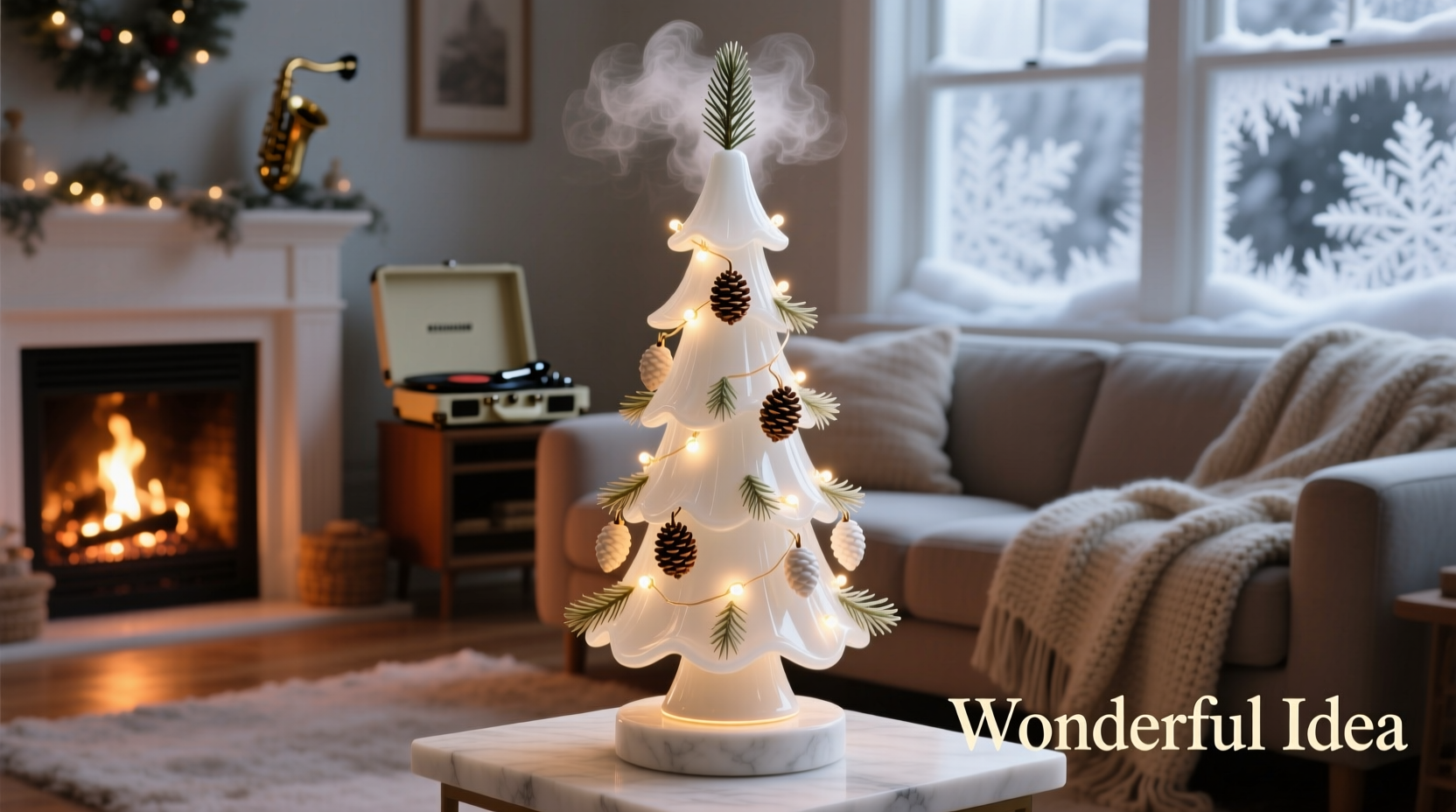
Our sense of smell is neurologically wired to emotion and long-term memory more directly than any other sense. The olfactory bulb sits adjacent to the amygdala and hippocampus—the brain’s emotional processing and memory-encoding centers. That’s why the sharp green tang of crushed balsam fir needles can instantly transport someone back to childhood mornings, or why cinnamon-vanilla blends evoke kitchen warmth and anticipation. A scent diffuser tree taps into this biology deliberately: it doesn’t wait for you to inhale a passing whiff—it saturates your environment with curated holiday notes on demand.
But not all “Christmas scents” are created equal. Real conifers release over 200 volatile organic compounds (VOCs), including α-pinene, limonene, and camphene—molecules that contribute to their crisp, resinous, slightly medicinal character. Most commercial diffuser oils simplify this complexity into three-note accords: top (citrus or mint), middle (pine or clove), base (vanilla or sandalwood). The result is often *familiar*, but rarely *identical*. As Dr. Lena Torres, olfactory neuroscientist at the Monell Chemical Senses Center, explains:
“Fragrance is associative—not absolute. A diffuser tree won’t replicate the biochemical signature of a Fraser fir, but if it reliably triggers your personal ‘Christmas’ neural pathway, it functions just as effectively. What matters isn’t botanical fidelity—it’s consistency of cue.” — Dr. Lena Torres, Olfactory Neuroscientist, Monell Chemical Senses Center
This distinction is critical. A scent diffuser tree isn’t competing with nature on botany; it’s competing on reliability, control, and accessibility—especially for those with allergies, limited space, or mobility challenges that make handling a real tree impractical.
Weird or Wonderful? A Balanced Comparison
Labeling the concept “weird” or “wonderful” misses the nuance. Its value depends entirely on user priorities, lifestyle constraints, and expectations. Below is a side-by-side assessment grounded in real-world use cases—not marketing claims.
| Factor | Scent Diffuser Tree | Traditional Real Tree | Traditional Artificial Tree |
|---|---|---|---|
| Fragrance Control | ✅ Precise intensity, duration, and scent rotation (e.g., pine → gingerbread → frankincense) | ❌ Natural scent fades in 7–10 days; strongest only when freshly cut | ❌ None unless supplemented externally (sprays, sachets) |
| Allergen Impact | ✅ No pollen, mold spores, or sap—ideal for asthma or tree allergies | ❌ High allergen load; common trigger for seasonal rhinitis | ✅ Low allergen risk (but dust accumulation possible) |
| Maintenance Burden | ✅ No watering, no needle cleanup, no disposal logistics | ❌ Daily watering, daily vacuuming, post-holiday hauling | ✅ Minimal upkeep—dusting only |
| Sensory Authenticity | ❌ Lacks tactile feedback (crunch of needles, sticky sap), visual texture (natural asymmetry), and ambient sounds (rustling in draft) | ✅ Full multisensory immersion: scent, touch, sound, sight | ❌ Visual realism varies; zero natural scent or texture |
| Long-Term Value | ⚠️ $180–$450 upfront; reservoirs and oils cost $12–$28/month; lifespan ~3–5 years | ✅ $75–$150/year; biodegradable; supports sustainable farms | ✅ $120–$350 one-time; lasts 10+ years with care |
The data reveals a clear pattern: diffuser trees excel in *control* and *accessibility*, but sacrifice *embodied authenticity*. They’re not replacements—they’re alternatives designed for specific needs.
A Real-World Case Study: The Urban Apartment Holiday
In Portland, Oregon, Maya R., a physical therapist with severe seasonal allergies and a 420-square-foot studio apartment, tried real trees for five consecutive years. Each December brought sneezing fits, itchy eyes, and sleepless nights—despite air purifiers and frequent vacuuming. Her landlord prohibited live trees due to fire code concerns in the building’s older wiring. In 2023, she purchased a 6-foot scent diffuser tree with Bluetooth scheduling and a “Forest Hearth” oil blend (balsam, cedarwood, and smoked amber).
“The first night, I set it to diffuse at 30% intensity from 4–9 p.m. I didn’t cry—but I did pause mid-unwrapping a gift and say out loud, ‘This smells like my grandmother’s porch in 1998.’ Not exactly the same, but close enough to unlock the feeling. I don’t miss the mess. I don’t miss the anxiety. And for the first time in eight years, I hosted Christmas Eve dinner without needing my inhaler on standby.”
Maya’s experience underscores a key truth: “wonderful” isn’t universal—it’s contextual. For her, the diffuser tree wasn’t a compromise. It was the only viable path to participating in a tradition that had become physically exclusionary.
Practical Tips for Getting It Right (If You Go the Diffuser Route)
Not all scent diffuser trees deliver equal results. Poorly designed units disperse mist unevenly, overheat oils (degrading their aromatic compounds), or emit weak, chemical-tinted vapors. Avoid disappointment with these field-tested guidelines:
- Choose ultrasonic over heat-based diffusion: Heat alters molecular structure, flattening top notes and amplifying harshness. Ultrasonic models preserve delicate terpenes for truer scent profiles.
- Position strategically: Place the tree away from HVAC vents, windows, and direct sunlight. Cold drafts scatter mist; heat accelerates evaporation. Ideal placement is central, at breathing height (4–5 feet), with 3 feet of clearance on all sides.
- Rotate scents weekly: Olfactory fatigue sets in after ~20 minutes of continuous exposure. Program intermittent cycles (e.g., 15 min on / 45 min off) and switch blends every 7 days to maintain perceptual freshness.
- Clean the reservoir weekly: Mineral buildup from tap water clogs misters. Use distilled water + 1 tsp white vinegar per fill; rinse thoroughly before refilling.
- Layer—not replace—tradition: Pair the diffuser tree with tactile elements: real pinecones in a bowl, cinnamon stick garlands, or a small wooden nativity set. This restores multisensory grounding missing from pure diffusion.
What Experts Say About Ritual & Replacement
Design anthropologists have long studied how objects mediate ritual. When a symbol loses its functional roots—like a tree that no longer grows, sheds, or requires care—does it retain cultural weight? Dr. Arjun Mehta, who studies material culture at the University of Michigan, observes a generational shift:
“We’re moving from ‘ritual as obligation’ to ‘ritual as intention.’ Younger households aren’t rejecting tradition—they’re curating it. If a diffuser tree lets someone light candles safely, host relatives comfortably, or breathe deeply while decorating, it’s not erasing meaning. It’s reallocating effort toward presence—not maintenance.” — Dr. Arjun Mehta, Cultural Anthropologist, University of Michigan
That perspective reframes the debate. It’s not about purity tests (“Is it *really* Christmas?”) but about alignment: Does this object serve your values, constraints, and desired emotional outcome? A tree that enables joy without sacrifice isn’t lesser—it’s adaptive. And adaptation, history shows, is how traditions survive.
Your Scent Strategy: A 4-Step Decision Framework
Before purchasing—or dismissing—a scent diffuser tree, walk through this evidence-based decision sequence:
- Diagnose Your Primary Constraint: Is it allergies? Space limitations? Physical mobility? Fire safety rules? Time scarcity? Identify the *one non-negotiable barrier* a real or traditional artificial tree creates for you.
- Define Your Sensory Priority: Rank these in order of importance: (a) authentic pine/citrus aroma, (b) tactile interaction (touching branches, hanging ornaments), (c) visual realism, (d) ease of setup/cleanup, (e) fragrance variety and control. If (a) ranks #1 *and* you have no constraints, a real tree likely serves you best.
- Test Before You Invest: Buy a standalone ultrasonic diffuser ($25–$40) and three holiday oil blends. Run them for 3 evenings in your main living space. Note: Does the scent feel immersive or thin? Do you notice headaches or throat irritation? Does it evoke calm or distraction?
- Evaluate the Full Lifecycle Cost: Calculate 3-year ownership: device + 36 months of oils ($15 avg./month = $540). Compare to 3 years of real trees ($120 avg. = $360) or one high-quality artificial tree ($280). Factor in your time value—e.g., 12 hours/year cleaning needles = $180 if you value time at $15/hour.
FAQ: Addressing Common Concerns
Will a scent diffuser tree trigger my asthma or sensitivities?
Most medical allergists report fewer reactions to diffuser trees than real ones—but individual responses vary. Start with low-intensity diffusion (15 min/hour) using single-note oils (e.g., pure balsam fir, not “Christmas Spice” blends with cinnamon bark oil, which is a known irritant). Monitor symptoms for 72 hours before increasing usage. Always consult your pulmonologist if you use daily controller medications.
Can I use it year-round—or is it just for Christmas?
Yes—and many users do. The hardware functions identically for any seasonal or wellness-focused blend: eucalyptus-rosemary for spring focus, lemongrass-lavender for summer calm, or frankincense-myrrh for autumn grounding. Just ensure oils are changed between seasons to prevent olfactory blending (e.g., pine + citrus can create an oddly medicinal note).
Does it really “feel” like Christmas without the mess and imperfection?
It feels like a different kind of Christmas—one centered on serenity, control, and inclusive participation. Users consistently describe it as “calmer,” “more intentional,” and “less frantic.” If your ideal holiday involves unhurried moments, shared laughter without allergy meds nearby, and decorations that stay pristine, then yes—it delivers a deeply resonant version of the season. It simply asks you to redefine what “feels like Christmas” means for your life, right now.
Conclusion: Choose Meaning Over Mimicry
A scent diffuser Christmas tree isn’t weird. It isn’t wonderful in some absolute, universal sense. It’s a thoughtful response to real human needs in a complex world—where health, space, time, and accessibility shape what rituals are possible. Dismissing it as “inauthentic” ignores how deeply scent anchors memory, and praising it uncritically overlooks the irreplaceable richness of natural texture and impermanence. The most meaningful holiday choices aren’t about choosing the “most traditional” option—they’re about selecting the one that allows your values, your body, and your people to show up fully.
If you’ve hesitated because you worried it might feel hollow—try it with intention. Pair it with handwritten cards, carols sung off-key, and cookies baked from scratch. If you’ve embraced it but feel a quiet pang of doubt—honor that too. Tradition isn’t static. It breathes. It adapts. And sometimes, the most faithful thing we can do is let it evolve—thoughtfully, respectfully, and with full attention to what the season is truly meant to deliver: presence, connection, and peace.




 浙公网安备
33010002000092号
浙公网安备
33010002000092号 浙B2-20120091-4
Comments
No comments yet. Why don't you start the discussion?