
Each December, thousands of households welcome the ritual of lighting a new candle from a beautifully packaged advent calendar—24 tiny vessels of fragrance, flame, and festive anticipation. But as the glow multiplies, so do quiet concerns: Is lighting a candle every single day truly safe? Can repeated exposure to fragrance compounds or combustion byproducts accumulate in indoor air? What about children, pets, or people with asthma? The answer isn’t a simple yes or no—it hinges on material quality, usage habits, ventilation, and awareness. This article cuts through seasonal marketing hype to deliver evidence-based, practical guidance grounded in fire safety standards, toxicology research, and real-world incident data.
Understanding the Dual Risks: Fire Safety and Indoor Air Quality
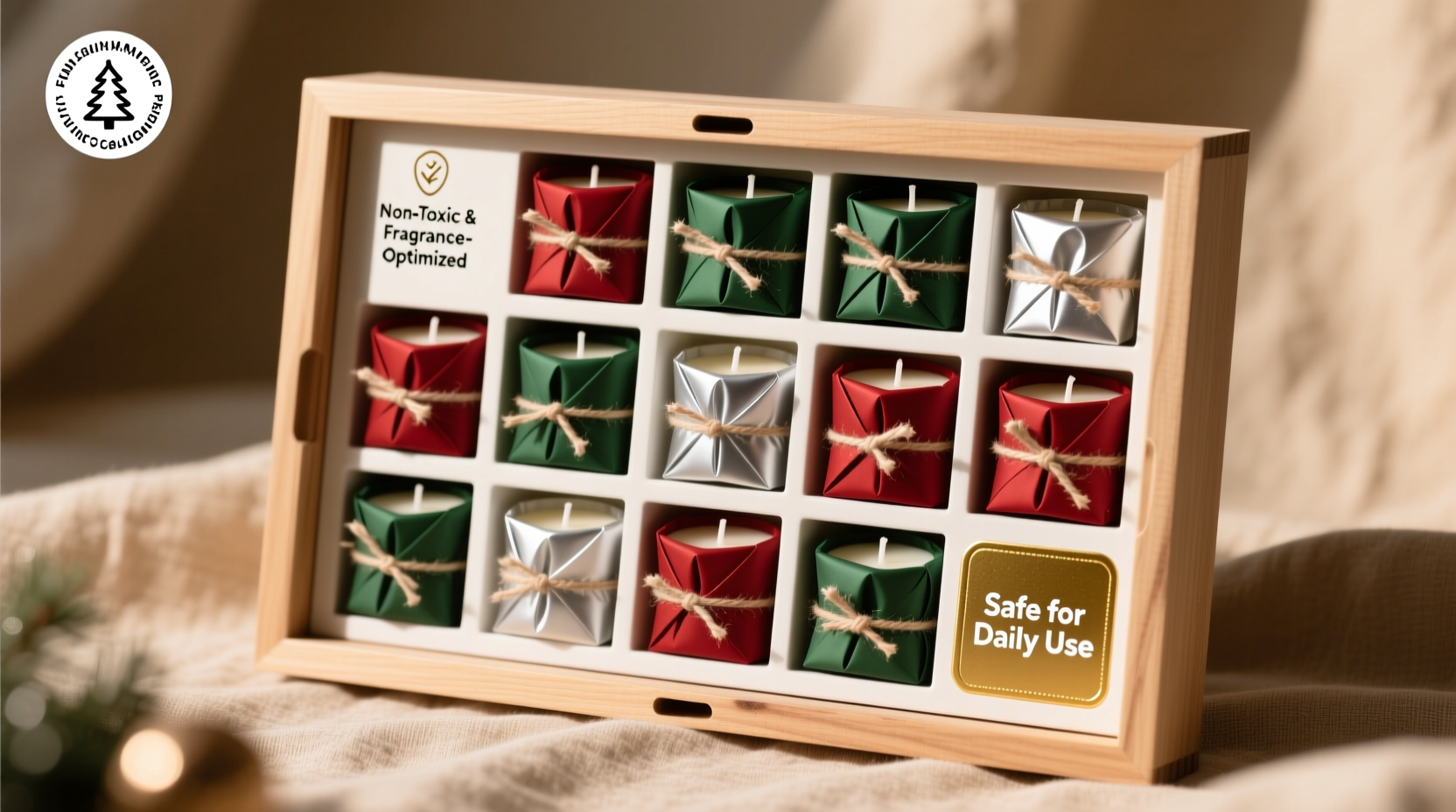
Candle-related hazards fall into two primary categories: acute physical danger (fire, burns, tipping) and chronic environmental exposure (volatile organic compounds, particulate matter, allergens). A 2023 U.S. Consumer Product Safety Commission (CPSC) analysis found that candles caused an estimated 7,100 home fires annually—nearly 20% of all residential fire ignitions—and 85% of those occurred when candles were left unattended or placed near combustibles. Meanwhile, indoor air quality studies from the EPA and the European Environment Agency confirm that burning paraffin-based candles—even in short durations—releases measurable levels of benzene, toluene, formaldehyde, and ultrafine particles (UFPs), which can penetrate deep into lung tissue and trigger respiratory inflammation.
Advent calendars compound these risks not because they’re inherently dangerous, but because they normalize daily candle ignition without reinforcing safety discipline. Unlike a single centerpiece candle lit occasionally, a 24-day calendar encourages habitual use—often in bedrooms, living rooms, or hallways where airflow is limited and supervision may lapse. The small size of most advent candles (typically 0.5–1.2 oz wax volume) creates a false sense of security: their compact wicks burn hotter relative to surface area, increasing the likelihood of overheating containers or igniting nearby decor like pine garlands or gift wrap.
What Makes One Advent Calendar Safer Than Another?
Not all scented candle advent calendars are created equal. Safety begins at the ingredient and manufacturing level. Below is a comparative breakdown of critical factors consumers should evaluate before purchase:
| Feature | Safer Choice | Riskier Choice | Why It Matters |
|---|---|---|---|
| Wax Base | 100% soy, coconut, or beeswax (non-GMO, pesticide-free) | Paraffin or paraffin-blend wax | Paraffin is a petroleum byproduct; combustion emits known carcinogens (e.g., benzene) at significantly higher concentrations than plant-based waxes. Soy and coconut waxes burn cooler and cleaner, with up to 80% less soot. |
| Wick Type | Lead-free cotton or wood wicks (certified ASTM F2842 compliant) | Unmarked or “cotton-core” wicks with hidden metal cores (especially zinc or tin) | Lead wicks have been banned in the U.S. since 2003—but non-lead metal wicks still emit trace metals when burned. Wood wicks produce gentler flames and less flicker-induced soot. |
| Fragrance Source | Phthalate-free, IFRA-compliant essential oil blends or natural isolates | Synthetic fragrance oils containing diethyl phthalate (DEP), limonene, or linalool without disclosure | Phthalates are endocrine disruptors linked to developmental effects; limonene oxidizes in air to form formaldehyde. IFRA (International Fragrance Association) sets exposure thresholds based on toxicological review. |
| Container & Design | Sturdy ceramic, heat-resistant glass, or thick tin with stable base and minimum ½\" rim height | Thin glass, flimsy metal tins, or plastic-encased candles | Thin containers crack under thermal stress; plastic melts or off-gasses toxins. A high rim prevents wax pooling and wick submersion failure. |
| Testing & Certification | ASTM F2417 (standard for candle fire safety), California Proposition 65 compliant, third-party lab reports available | No safety certifications listed; vague claims like “clean-burning” or “eco-friendly” without substantiation | ASTM F2417 mandates flame-height limits, stability testing, and labeling requirements. Prop 65 compliance signals transparency about known carcinogens or reproductive toxins. |
A Real-World Scenario: How One Family Adjusted Their Routine
In December 2022, Maya R., a pediatric occupational therapist in Portland, OR, bought a popular lavender-vanilla candle advent calendar for her two young children. By Day 9, her 5-year-old developed persistent nighttime coughing and nasal congestion. Her 8-year-old complained of headaches after spending time in the living room where the candles were lit each evening. Concerned, Maya contacted her local county health department, which referred her to an indoor air quality specialist. Using a portable VOC meter, the specialist measured airborne formaldehyde levels spiking from 0.03 ppm (baseline) to 0.18 ppm within 30 minutes of lighting the candle—well above the WHO’s 30-minute exposure guideline of 0.1 ppm.
The specialist reviewed the product’s ingredient list (found online via batch code) and discovered it used a paraffin-soy blend with synthetic fragrance containing limonene and DEP. They also observed that the candles were being lit directly beneath a wooden shelf holding dried eucalyptus and cinnamon sticks—creating a secondary source of volatile emissions. With guidance, Maya switched to a certified soy-wax calendar with essential oil fragrance, relocated candle use to a well-ventilated sunroom, enforced strict 90-minute maximum burn times, and introduced a HEPA + activated carbon air purifier. Within 10 days, both children’s symptoms resolved. “I didn’t realize how much cumulative exposure mattered,” she shared. “It wasn’t one candle—it was 24 candles, in the same space, with no air exchange.”
Step-by-Step: Building a Safer Daily Candle Ritual
Lighting a candle daily doesn’t have to mean compromising safety. Follow this evidence-informed sequence—designed around human behavior, physics, and air dynamics—to minimize risk while preserving tradition:
- Pre-light Prep (Day Before): Trim every wick to ¼ inch using dedicated wick trimmers—not scissors. This prevents mushrooming, reduces soot, and ensures even melting.
- Location Check (Before Lighting): Place the candle on a non-flammable, level surface at least 12 inches from curtains, upholstery, books, or holiday greenery. Avoid drafty areas (e.g., near HVAC vents or open windows), which cause erratic burning.
- Ignition Protocol: Light with a long-reach lighter or match. Never use another burning candle. Wait 30 seconds for the initial flame to stabilize before walking away.
- Active Monitoring Window: Stay in the room for the first 15 minutes. Watch for tunneling, excessive smoke, or flame height exceeding 2 inches. If any occur, extinguish immediately and discontinue use of that candle.
- Timed Burn Limit: Set a visible timer for 90 minutes. Do not exceed this—even if wax remains. Longer burns increase container temperature and VOC emission rates exponentially.
- Safe Extinguishing: Use a candle snuffer or wick dipper. Never blow—this disperses hot wax and aerosolizes unburned fragrance compounds into the air.
- Post-Burn Ventilation: Open a window or door for 5–10 minutes after extinguishing to flush residual VOCs and particulates. Run an air purifier with activated carbon during and for 30 minutes after burning.
“Daily candle use isn’t unsafe by default—but it demands intentionality. The greatest risk isn’t the candle itself; it’s the assumption that ‘small’ means ‘harmless.’ A 1-ounce candle releases the same class of pollutants as a larger one—just over a shorter timeframe and with less thermal inertia to buffer emissions.” — Dr. Lena Cho, Environmental Health Scientist, Harvard T.H. Chan School of Public Health
FAQ: Addressing Common Concerns
Can I reuse the same advent calendar next year?
No. Advent calendar candles are designed for single-season use. Wax degrades over time—especially when exposed to light, heat, or humidity—altering burn characteristics and increasing sooting or flare-up potential. Wicks oxidize and become harder to ignite cleanly. Most manufacturers explicitly state “for single-use only” in safety documentation. Reusing poses measurable fire and air quality risks.
Are “natural” or “organic” candles automatically safer?
Not necessarily. The term “natural” is unregulated in fragrance and candle labeling. A candle labeled “organic lavender” may still contain synthetic solvents, undisclosed fixatives, or paraffin wax. Always verify the wax base (look for “100% soy” or “coconut wax”), check for IFRA certification, and request full ingredient disclosure from the brand. Transparency—not marketing language—is the true indicator of safety.
My child has asthma—should we skip the candle calendar entirely?
Proceed with extreme caution—and consider alternatives. The American Lung Association advises people with asthma or COPD to avoid all forms of indoor combustion, including candles, incense, and fireplaces. Even low-emission candles release fine particles that can trigger bronchoconstriction. Safer options include LED tea lights in decorative holders, fragrance diffusers with timed release (using pure essential oils, not synthetic fragrances), or scent-free rituals like reading a story or placing a new ornament. If you choose to use candles, restrict them to a single, well-ventilated room never occupied by the child—and never during sleep hours.
Conclusion: Safety Is a Practice, Not a Product Feature
A scented candle advent calendar can be part of a joyful, meaningful December—but its safety depends entirely on how it’s integrated into your home’s rhythms and routines. There is no universal “safe” product, only safer choices made daily: choosing certified clean-burning waxes, enforcing strict burn limits, prioritizing ventilation over ambiance, and treating each flame with the respect due to a controlled combustion event. This isn’t about eliminating tradition—it’s about honoring it with awareness. When you light that first candle on December 1st, do so knowing you’ve selected materials thoughtfully, prepared your space deliberately, and committed to presence over habit. That intention transforms ritual into responsibility—and warmth into genuine well-being.




 浙公网安备
33010002000092号
浙公网安备
33010002000092号 浙B2-20120091-4
Comments
No comments yet. Why don't you start the discussion?