
As urban living spaces shrink and minimalist holiday aesthetics grow in popularity, the way we decorate for Christmas is evolving. One of the most visible changes is in how we choose our Christmas trees. For many city dwellers, apartment residents, or families with limited floor space, the traditional towering evergreen simply doesn’t fit—literally. Enter the spiral Christmas tree: a compact, space-conscious alternative that’s gaining traction during the holiday season. But is it truly better than a vertical tree when space is tight? The answer depends on design, function, and personal priorities.
This article examines the practical differences between spiral and vertical Christmas trees, focusing on spatial efficiency, visual impact, ease of setup, decoration potential, and long-term usability. Whether you're furnishing a studio apartment or rethinking your family’s decor strategy, understanding these nuances can help you make a smarter, more satisfying choice.
Spatial Efficiency: How Each Tree Uses Floor Space
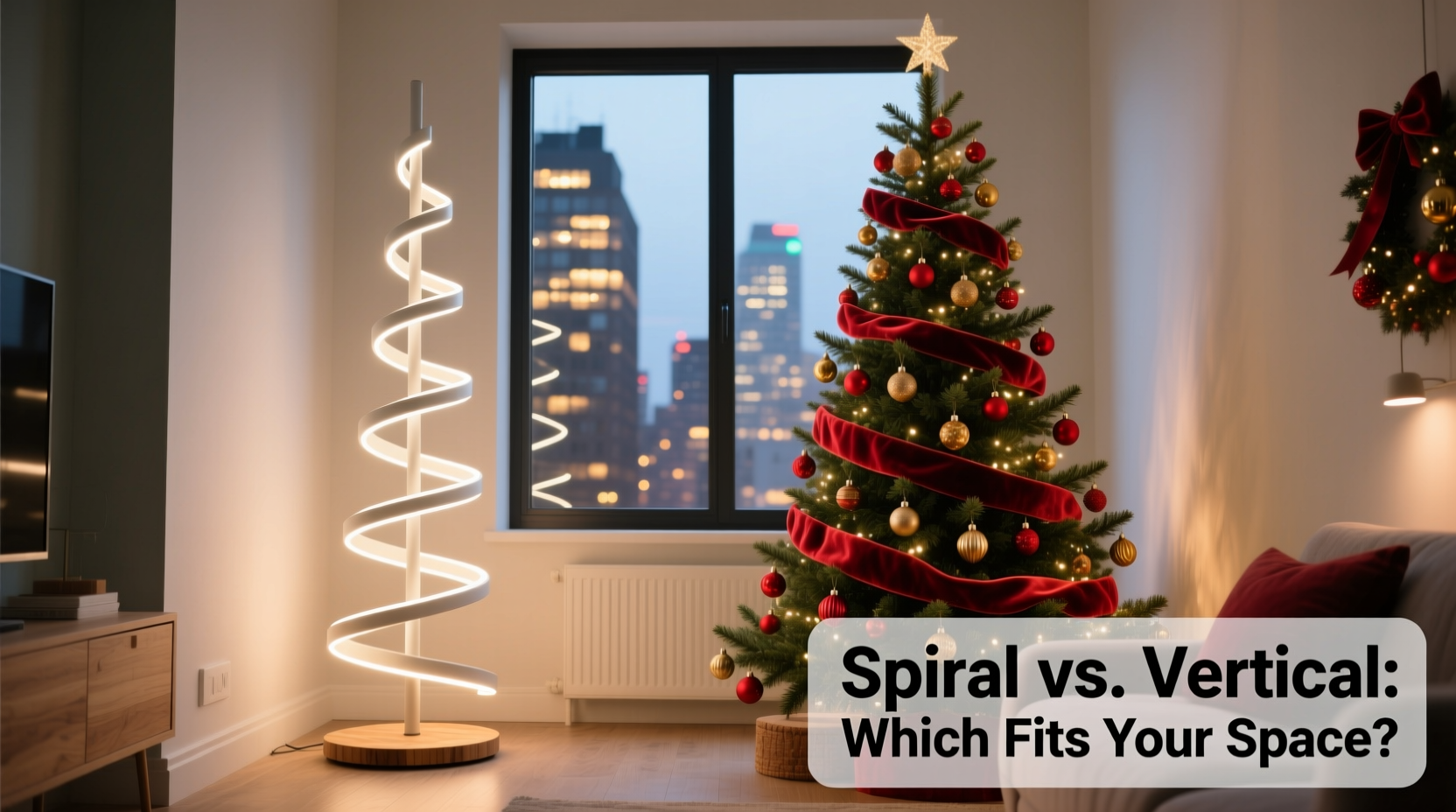
The primary advantage of any compact tree lies in its footprint. Vertical trees, even when narrow, tend to occupy a circular base area ranging from 2 to 4 feet in diameter. In contrast, spiral trees are designed with a helical shape that wraps around a central pole, drastically reducing their horizontal spread. Most spiral models range from 18 to 30 inches in width, making them ideal for corners, hallways, or beside furniture where every inch counts.
A spiral tree’s vertical rise is also more controlled. While it may reach similar heights (typically 5 to 7 feet), its growth pattern follows a corkscrew path rather than expanding outward. This allows it to maintain height without sacrificing floor space. For example, a 6-foot spiral tree might use only 20% of the floor area required by a standard 6-foot vertical tree with full branches.
Design & Aesthetics: Form vs. Tradition
Traditionalists may find the spiral tree’s modern silhouette unconventional. Unlike the lush, layered look of a Fraser fir or pre-lit vertical artificial tree, spiral designs emphasize symmetry and minimalism. Lights and ornaments are typically strung along the spiral wireframe, creating a glowing helix effect that resembles a DNA strand or festive tornado.
While this aesthetic appeals to contemporary tastes, it diverges from the cozy, abundant feel many associate with Christmas. However, that doesn’t mean charm is lost. Spiral trees often shine in modern lofts, minimalist homes, or offices where bold design statements are welcome. They also work well as accent pieces in larger rooms, complementing—not replacing—a main tree.
Vertical trees, on the other hand, offer familiar proportions and greater surface area for ornamentation. You can hang dozens of heirloom decorations, tuck in plush animals, or drape garlands generously. Their depth allows for layering, giving the illusion of abundance even in modest sizes.
“The spiral tree isn’t about replicating tradition—it’s about reimagining it within spatial constraints.” — Lena Peterson, Interior Stylist & Holiday Design Consultant
Comparison Table: Spiral vs. Vertical Trees for Small Spaces
| Feature | Spiral Tree | Vertical Tree |
|---|---|---|
| Footprint | Narrow (18–30 in) | Wider (36–48 in) |
| Height Range | 5–7 ft | 4–8 ft |
| Decoration Capacity | Limited (linear placement) | High (multi-layered) |
| Setup Time | Fast (5–10 min) | Moderate (15–30 min) |
| Storage Size | Compact (often disassembles flat) | Larger (requires bulky box) |
| Best For | Small apartments, modern decor, low-decorating households | Families, traditional settings, heavy ornamentation |
Real-Life Example: A Studio Apartment Transformation
Maria, a graphic designer living in a 450-square-foot Brooklyn studio, faced the same dilemma each December: where to put a tree without blocking her workspace or sofa? Her previous attempts with a 5-foot vertical tree left her tripping over branches and avoiding the living area entirely. Last year, she opted for a 6-foot LED-lit spiral tree mounted in the corner behind her desk.
The result was transformative. The spiral design drew the eye upward, creating a sense of height in the low-ceilinged unit. She wrapped micro-lights around the frame and added just six minimalist glass orbs at intervals. The tree became a sculptural centerpiece rather than an obstacle. “I didn’t miss the clutter,” she said. “It felt more intentional, like the holidays were curated, not crammed in.”
Maria’s experience reflects a growing trend: smaller spaces don’t require sacrificing celebration—they demand smarter design choices.
Practical Considerations: Setup, Storage, and Safety
One of the underrated benefits of spiral trees is their simplicity. Most models consist of a single center pole and a wire spiral armature that either clips or screws into place. Assembly rarely requires tools and takes under ten minutes. Many are also lightweight—some under 10 pounds—making them easy to move or adjust.
In contrast, vertical artificial trees involve multiple sections, branch unfolding, fluffing, and alignment. Even “easy” models can take 20–30 minutes to set up properly, especially if you’re aiming for a full, natural look. Disassembly and storage are equally time-consuming, with branches needing careful compression to fit back into often ill-fitting boxes.
Spiral trees usually break down into two or three parts and store flat, saving valuable closet or under-bed space. Some even come with carrying bags. This makes them ideal for renters or those who travel during the holidays and want to pack their tree easily.
Step-by-Step Guide: Choosing the Right Tree for Your Space
- Measure your available floor space. Use a tape measure to determine width, depth, and ceiling clearance. Note nearby furniture or walkways.
- Define your decorating goals. Are you planning a full ornament display, or do you prefer a subtle glow with few accents?
- Evaluate lighting needs. Spiral trees often integrate LEDs directly into the frame. Decide if built-in lights are preferable to stringing your own.
- Consider long-term storage. If closet space is limited, prioritize collapsible or flat-pack designs.
- Test stability. Ensure the base is weighted enough to prevent tipping, especially in homes with pets or children.
- Review assembly instructions. Check customer reviews for feedback on setup difficulty and durability.
- Budget accordingly. Spiral trees range from $50 to $150; vertical trees vary widely based on size and realism.
When a Spiral Tree Isn’t the Answer
Despite their advantages, spiral trees aren’t universally superior. Families with young children or pet owners may find the linear ornament placement less safe—decorations hang at predictable intervals, making them easier to grab. There’s also less room for creativity in styling. You can’t tuck a stuffed reindeer behind a branch or hide presents beneath dense foliage.
Additionally, people who enjoy the ritual of decorating—the scent of pine (real or artificial), the music, the hot cocoa—may find the spiral tree too sparse to deliver that emotional payoff. It’s efficient, but not immersive.
If your holiday joy comes from abundance, nostalgia, or shared traditions, a compact vertical tree might still be the better fit—even in a small space. Many manufacturers now offer “slim” or “pencil” vertical trees as narrow as 20 inches wide, blending tradition with space efficiency.
Frequently Asked Questions
Can I use regular Christmas ornaments on a spiral tree?
Yes, but sparingly. Most spiral trees have designated hooks or loops spaced several inches apart. Large or heavy ornaments may throw off balance or block the visual flow. Opt for lightweight, spherical, or cylindrical ornaments that follow the spiral rhythm.
Are spiral trees only for artificial setups?
Virtually all spiral trees are artificial due to structural requirements. Real trees lack the flexibility and durability needed to form and maintain a spiral shape safely. However, some crafters create temporary spiral displays using bent branches or wreath segments—but these are decorative accents, not full replacements.
Do spiral trees come pre-lit?
Most do. Integrated LED lighting is common because it enhances the spiral effect and eliminates tangled cords. Look for models with replaceable bulbs or shatterproof LEDs for longevity. Some feature color-changing modes or remote controls for added convenience.
Checklist: Is a Spiral Tree Right for You?
- ✅ Do you live in an apartment, dorm, or small home?
- ✅ Is floor space limited near entrances, sofas, or dining areas?
- ✅ Do you prefer modern, minimalist, or artistic decor?
- ✅ Are you short on time for setup and storage?
- ✅ Do you use few or delicate ornaments?
- ✅ Do you value portability and compact storage?
- ✅ Are you open to a non-traditional holiday look?
If you answered “yes” to most of these, a spiral tree could be an excellent fit. If not, consider a slim vertical alternative that honors tradition while respecting space limits.
Final Thoughts: Function Meets Festivity
The question isn’t whether spiral trees are inherently better than vertical ones—it’s whether they better serve the needs of specific environments. In small spaces, efficiency, safety, and visual harmony matter more than sheer volume. A spiral tree excels in these areas by offering a vertical presence without horizontal sprawl.
That said, the “best” tree is the one that fits your life—not just your square footage. For some, that means a towering spruce covered in decades-old ornaments. For others, it’s a sleek helix of light in the corner, quietly marking the season with elegance and restraint.
Ultimately, both designs reflect the spirit of adaptation that defines modern living. As homes get smaller and lifestyles faster, our traditions evolve—not out of compromise, but out of intentionality.




 浙公网安备
33010002000092号
浙公网安备
33010002000092号 浙B2-20120091-4
Comments
No comments yet. Why don't you start the discussion?