
Lighting is one of the most transformative elements in visual storytelling. Whether you're shooting a portrait, filming a scene, or photographing a product, how light moves across your subject defines depth, mood, and dimension. Among the many techniques used to sculpt form with illumination, three directional approaches stand out: vertical, horizontal, and the increasingly popular spiral light wrap. While traditional vertical and horizontal lighting have long been industry standards, the spiral method introduces a dynamic alternative that mimics natural, multidirectional ambient light. But is it actually better? The answer depends on context, intent, and execution.
Understanding Directional Lighting Basics
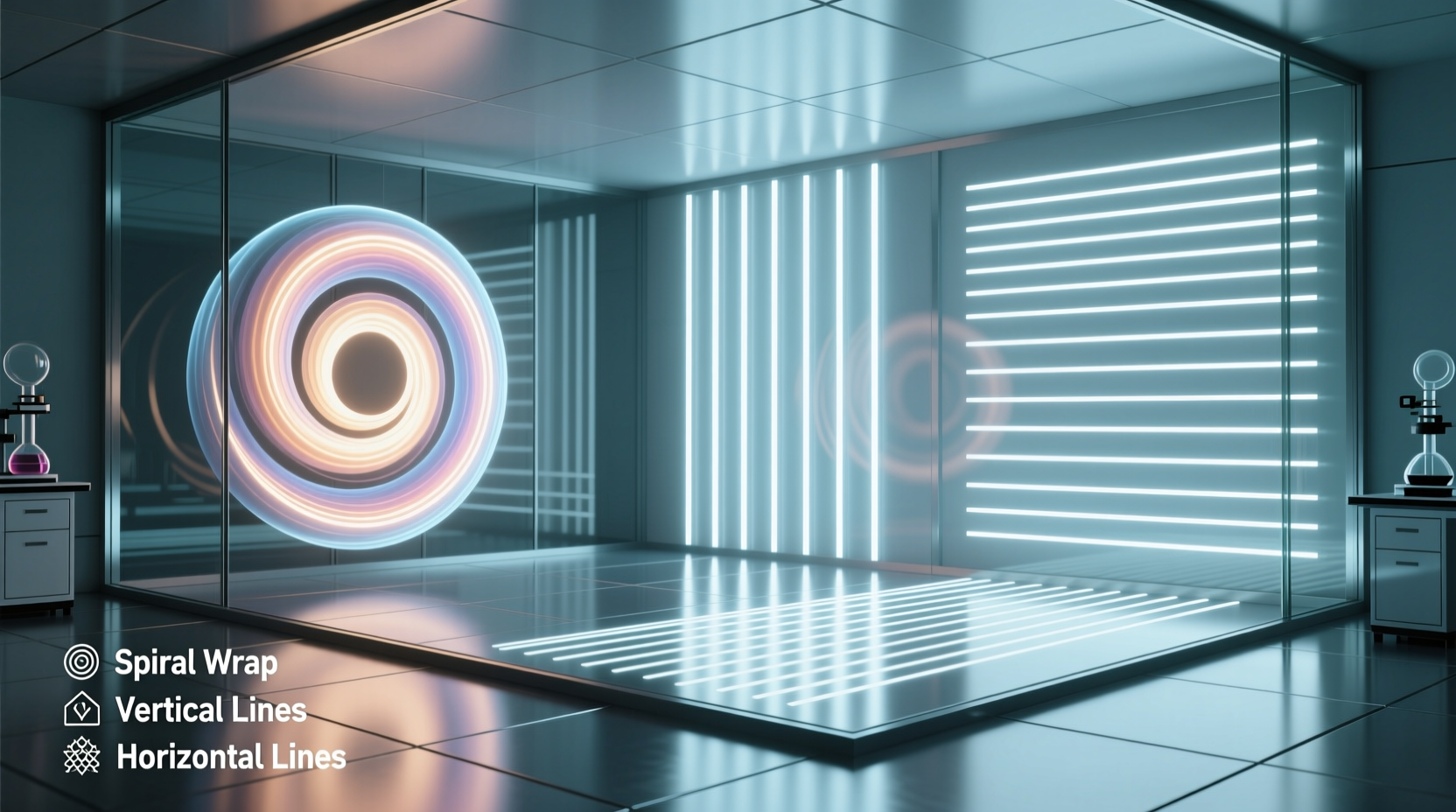
Before evaluating the spiral light wrap, it’s essential to understand what vertical and horizontal lighting entail—and why they’ve dominated studios for decades.
Vertical lighting involves placing lights above or below the subject, creating strong top-down or underlighting effects. This method emphasizes facial structure, especially in dramatic portraiture. Think of classic noir films where light falls sharply from above, casting deep shadows under the eyes and cheekbones.
Horizontal lighting, typically achieved with key lights placed at eye level to the left or right, produces more balanced illumination. It’s widely used in commercial photography and interviews because it reveals texture without extreme contrast. However, it can flatten features if not paired with fill or rim lighting.
In both cases, the direction is static—light comes from one primary axis. The spiral light wrap technique, by contrast, uses multiple continuous sources arranged in a circular or helical pattern around the subject. This creates a sweeping, fluid gradient of light that appears to \"wrap\" around forms, minimizing harsh shadows while preserving contour definition.
“Directional control is no longer enough. Modern visuals demand dimensional continuity—light that flows like air around a face.” — Lena Torres, Cinematic Lighting Director, ASC
How the Spiral Light Wrap Works
The spiral light wrap isn’t just about adding more lights; it’s about rethinking how light interacts with space. Instead of positioning fixtures at fixed points (left, right, top), practitioners use a curved softbox array, LED panels mounted on arcs, or motorized rigs that rotate slowly during exposure. The result is a seamless transition of highlights and midtones that simulate the diffused glow of overcast daylight or interior environments with reflective surfaces.
This technique leverages the principle of angular integration: by exposing the subject to light from dozens of incremental angles, every surface receives some degree of illumination. Shadows aren't eliminated—they're softened and stretched into gradients, allowing details to remain visible even in recessed areas like jawlines or collarbones.
Equipment and Setup Requirements
- A circular or arc-shaped lighting rig (e.g., spiral tube LEDs, C-stand-mounted strips)
- Diffusion materials (silk, grids, or softboxes) to smooth transitions
- Precise control over intensity and color temperature across all segments
- Optional: motorized rotation system for time-lapse or motion blur effects
Unlike vertical or horizontal methods—which often require only two or three lights—the spiral setup demands greater technical coordination. Each segment must be calibrated so brightness doesn’t spike at certain angles, which could create unwanted hotspots.
Comparative Analysis: Spiral vs. Vertical vs. Horizontal
To assess performance objectively, we evaluated all three techniques across five critical criteria: shadow control, dimensionality, skin rendering, versatility, and setup complexity.
| Criteria | Spiral Light Wrap | Vertical Lighting | Horizontal Lighting |
|---|---|---|---|
| Shadow Control | Excellent – gradual falloff, minimal hard edges | Fair – creates sharp contrasts; useful for drama | Moderate – side shadows can obscure detail |
| Dimensionality | Superior – full 360° tonal variation enhances roundness | Good – strong top-to-bottom modeling | Limited – flattens front-facing planes |
| Skin Rendering | Exceptional – evens out texture without losing pores or character | Poor – exaggerates wrinkles when overhead | Acceptable – shows blemishes but lacks refinement |
| Versatility | Moderate – best for close-ups, beauty shots, still life | High – effective in theater, fashion editorials | Very High – standard in broadcast, corporate video |
| Setup Complexity | High – requires calibration and space | Low – simple placement, minimal gear | Low to Moderate – easy to balance key and fill |
The data shows that spiral lighting excels in aesthetic quality but lags in practicality. It’s not a replacement for traditional methods—it's an enhancement for specific applications where visual richness outweighs logistical constraints.
When to Use Each Technique: A Practical Guide
Choosing between spiral, vertical, and horizontal lighting should align with creative goals, not trends. Here’s a step-by-step decision framework:
- Define the purpose: Are you capturing emotion, information, or artistry? Emotional portraits benefit from spiral wrapping; informational interviews work better with horizontal clarity.
- Assess the subject: Delicate textures (skin, fabric, glass) respond well to spiral gradients. Bold silhouettes or architectural subjects may prefer the starkness of vertical light.
- Evaluate environment: Studio settings allow for complex spiral rigs. On-location shoots often favor portable horizontal kits.
- Consider post-production needs: Spiral lighting reduces the need for shadow recovery in editing, saving time in color grading.
- Budget time and resources: If turnaround is tight, default to proven horizontal setups unless the project demands premium finish.
Mini Case Study: Beauty Campaign Shoot
A luxury skincare brand commissioned a high-end campaign featuring diverse models under age 40. The creative director wanted flawless skin visibility without appearing retouched. The team tested three lighting styles on the same model under identical camera settings (50mm, f/4, ISO 100).
- Horizontal lighting: Revealed uneven tone on the left cheek due to abrupt shadow fall-off.
- Vertical lighting: Caused unflattering nose shadows and emphasized forehead lines.
- Spiral light wrap: Produced a luminous, even glow. Fine hairs along the hairline were illuminated naturally, and pores remained visible but not prominent.
The final selection was unanimously the spiral version. Retouchers confirmed it required 70% less digital correction than the others. Though setup took 45 minutes longer, the overall production timeline improved due to fewer reshoots.
Expert Recommendations and Common Pitfalls
While the spiral technique offers undeniable benefits, misuse can lead to flatness or overexposure. Seasoned professionals emphasize precision:
“The danger with spiral wrapping is losing contrast entirely. You still need a dominant angle—even within a gradient, there should be a perceived ‘source’.” — Marcus Lin, Commercial Photographer & Educator
Common mistakes include:
- Using too many bright segments without dimming outer arcs
- Neglecting background separation, causing subjects to blend into backdrops
- Ignoring color consistency—LEDs from different batches can vary in CCT
- Over-relying on automation without manual fine-tuning
Experts recommend starting with a hybrid approach: build a foundation with horizontal lighting, then add a partial spiral element (like a quarter-arc above and behind) to introduce wraparound softness without sacrificing directionality.
Checklist: Implementing Spiral Light Wrap Successfully
- Confirm studio space allows for circular rig installation
- Use tunable-white LEDs to maintain uniform color temperature
- Test gradient flow with a neutral gray sphere before shooting
- Adjust intensity so no single point exceeds 1.5 stops brighter than adjacent zones
- Monitor background exposure separately to preserve depth
- Shoot test frames and review histograms for highlight clipping
- Have a fallback plan using conventional lighting if timing becomes critical
Frequently Asked Questions
Can I achieve a spiral light wrap effect with software instead?
While AI-powered relighting tools (such as those in Adobe Photoshop or Capture One) can simulate wraparound lighting, they cannot replicate true optical gradients. Digital enhancements often produce unnatural halos or smudging. Real spiral lighting captures micro-contrast and specular detail that algorithms struggle to invent convincingly.
Is spiral lighting suitable for group shots?
It can be, but with limitations. As subject count increases, maintaining consistent wrap becomes difficult unless individuals are tightly grouped and facing the same direction. For groups, a modified horizontal setup with broad diffusion usually delivers more predictable results.
Does this technique work outdoors?
Rarely in pure form. Natural sunlight is inherently directional. However, reflectors arranged in a semi-circle or bounce arrays on drones can partially mimic spiral behavior. These setups are experimental and require advanced coordination.
Conclusion: Matching Technique to Vision
The spiral light wrap technique isn’t universally “better” than vertical or horizontal lighting—but it represents a significant evolution in how we think about illumination. Its strength lies in its ability to render organic forms with unparalleled smoothness and realism, making it ideal for beauty, product, and fine-art photography. Yet, its complexity and resource demands mean it won’t replace simpler methods anytime soon.
Vertical lighting remains unmatched for theatrical impact. Horizontal lighting continues to dominate broadcast and documentary work for its reliability and speed. The spiral technique occupies a niche: the premium tier of visual production where nuance matters as much as clarity.
The best choice isn’t determined by trend, but by intention. Master all three. Know when to reach for each. And remember: light isn’t just about visibility—it’s about feeling, memory, and perception. How you shape it shapes how your audience sees the world.




 浙公网安备
33010002000092号
浙公网安备
33010002000092号 浙B2-20120091-4
Comments
No comments yet. Why don't you start the discussion?