
Sedentary office work has long been linked to poor posture, chronic back pain, and reduced mobility. As awareness grows, standing desks have surged in popularity—marketed as a solution to slouching, spinal strain, and the health hazards of prolonged sitting. But is switching to a standing desk truly beneficial for posture, or is it merely discomfort repackaged as wellness? The answer isn’t binary. While standing desks can support better alignment and reduce certain risks, they also introduce new challenges if used improperly. Understanding the biomechanics, ergonomics, and behavioral habits involved is essential to determine whether a standing desk improves your posture—or simply shifts the problem.
The Posture Problem with Sitting
For decades, office workers have logged eight or more hours daily in seated positions, often hunched over keyboards with necks tilted forward—a posture colloquially known as \"tech neck.\" This sustained position places excessive load on the cervical spine, weakens core stabilizers, and shortens hip flexors. Over time, these imbalances contribute to kyphosis (rounded upper back), anterior pelvic tilt, and disc degeneration.
A 2018 study published in the Journal of Physical Therapy Science found that individuals who sit for more than six hours a day exhibit significantly higher rates of lumbar lordosis and forward head posture compared to those with active routines. The issue isn't just sitting—it's static sitting. Remaining motionless prevents postural muscles from engaging dynamically, leading to neuromuscular fatigue and compensatory movement patterns.
“Prolonged sitting doesn’t just weaken muscles—it reprograms how your body moves and stabilizes itself.” — Dr. Lena Patel, Biomechanics Researcher at McGill University
Standing Desks: A Postural Upgrade?
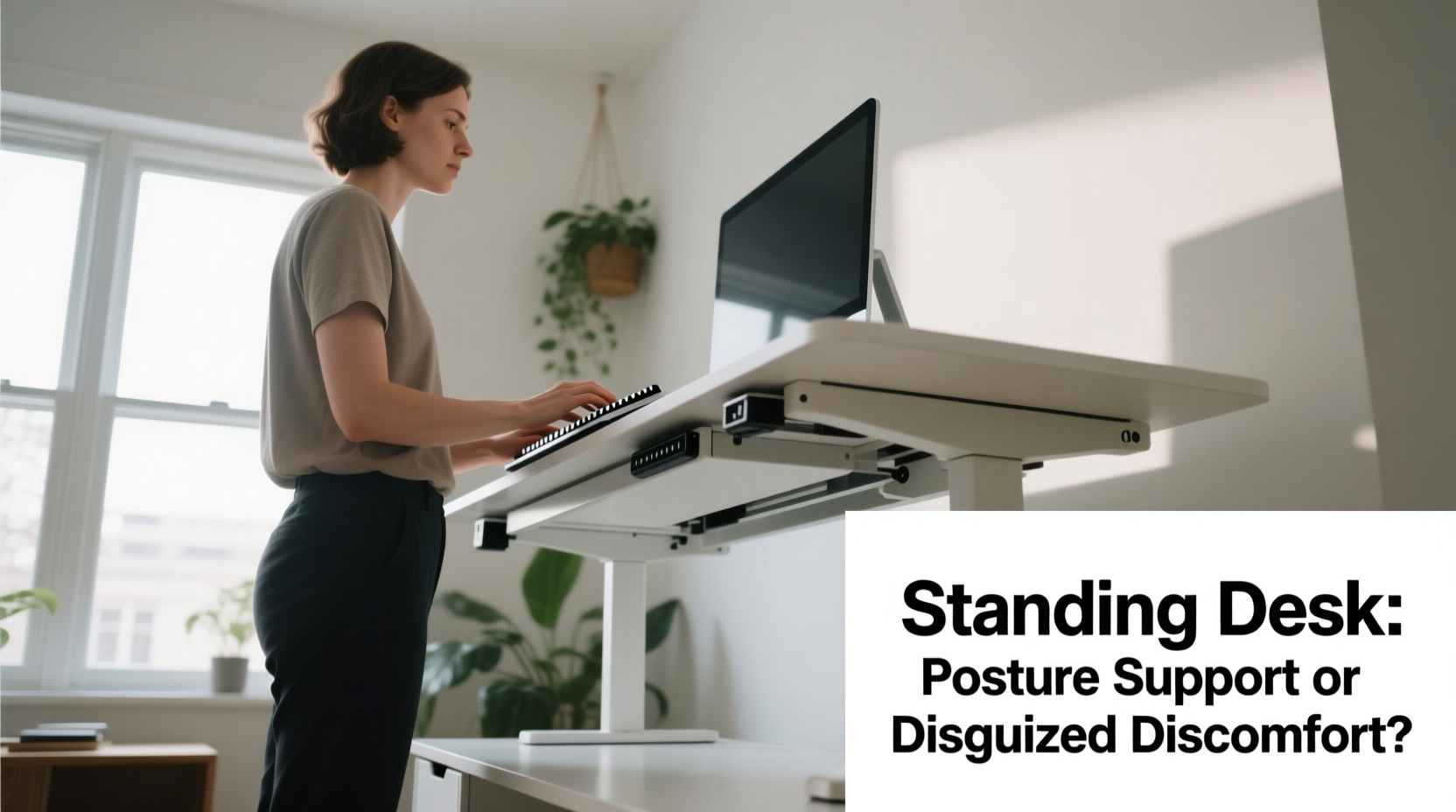
Standing desks aim to disrupt sedentary behavior by encouraging upright work. In theory, standing engages core muscles, promotes neutral spine alignment, and reduces pressure on intervertebral discs. When set up correctly, a standing workstation can help users maintain a more anatomically sound posture: ears aligned over shoulders, shoulders over hips, and hips over ankles.
However, research reveals mixed outcomes. A 2020 meta-analysis in Ergonomics concluded that while standing desks reduce lower back pain and improve self-reported comfort over time, they do not automatically correct poor posture. In fact, many users simply transfer bad habits from sitting to standing—leaning on one leg, locking knees, or craning their neck toward monitors.
The real benefit lies in movement variability. Alternating between sitting and standing throughout the day encourages dynamic postural control, reducing tissue stress and improving circulation. It’s not standing alone that helps—it’s the reduction of immobility.
Common Standing Desk Mistakes That Harm Posture
Many people adopt standing desks without adjusting their setup or behavior, inadvertently creating new sources of strain. Here are frequent errors that undermine postural health:
- Incorrect monitor height: If screens are too low, users tilt their heads forward, increasing cervical load.
- Poor footwear: Standing barefoot or in unsupportive shoes increases foot and lower back fatigue.
- Static standing: Remaining rigidly upright for hours leads to venous pooling and muscle fatigue.
- One-sided weight distribution: Leaning on one hip promotes pelvic asymmetry and scoliotic tendencies.
- Lack of anti-fatigue mat: Hard surfaces increase joint stress and encourage shifting into compensatory stances.
These issues illustrate why some users report that standing desks feel like “uncomfortable in disguise”—not because standing is inherently flawed, but because implementation often is.
Optimizing Your Standing Desk for Posture: A Step-by-Step Guide
To genuinely support better posture, a standing desk must be part of a holistic ergonomic strategy. Follow this sequence to maximize benefits and minimize strain:
- Adjust desk height: Set the work surface so your elbows rest at 90 degrees when typing, with forearms parallel to the floor.
- Align your monitor: Position the top of the screen at or slightly below eye level, about an arm’s length away.
- Stand with neutral alignment: Distribute weight evenly across both feet, engage your core lightly, and keep shoulders relaxed.
- Use an anti-fatigue mat: These mats encourage micro-movements that enhance circulation and reduce static load.
- Alternate every 30–60 minutes: Begin with 15-minute standing intervals, gradually increasing duration as tolerance builds.
Introduce subtle movement: Shift weight, perform calf raises, or use a small balance pad to activate stabilizing muscles.
Consistency matters more than duration. Even brief standing breaks interrupt harmful sitting patterns and stimulate postural awareness.
Comparison: Sitting vs. Standing Desk Ergonomics
| Factor | Traditional Sitting Desk | Properly Used Standing Desk |
|---|---|---|
| Spinal Load | High on lumbar discs due to seated compression | Reduced disc pressure; more even load distribution |
| Hip Flexor Tension | Increased from prolonged shortening | Reduced; maintains natural hip extension |
| Core Engagement | Minimal unless actively bracing | Naturally higher due to balance demands |
| Circulation | Slowed in legs; risk of deep vein thrombosis | Improved blood flow; reduced pooling |
| Risk of Overuse | Lower back, neck, shoulders | Feet, knees, lower legs (if static) |
| Movement Variability | Low without conscious effort | Higher potential with intentional transitions |
This comparison shows that neither sitting nor standing is universally superior. The key is integration—using both positions strategically throughout the day.
Real-World Example: Sarah’s Transition to a Standing Desk
Sarah, a 34-year-old graphic designer, switched to a standing desk after experiencing persistent mid-back pain and numbness in her right hand. Initially enthusiastic, she stood for three hours straight each morning. Within two weeks, she developed plantar fasciitis and shin splints. Discouraged, she nearly abandoned the desk—until she consulted an ergonomic specialist.
The specialist identified several issues: her monitor was too low, forcing her to look down; she wore flat sneakers instead of supportive shoes; and she wasn’t taking seated breaks. After adjusting her setup, adding a gel mat, and adopting a 30-minute sit-stand rotation, Sarah noticed improvements within ten days. Her back pain decreased, her energy levels rose, and she became more aware of her posture throughout the day.
Her experience underscores a crucial point: success with a standing desk depends on proper implementation, not just intention.
Expert Recommendations for Sustainable Posture Improvement
Posture isn’t fixed by furniture alone—it’s shaped by daily habits, muscle conditioning, and environmental design. Experts emphasize a multi-pronged approach:
- Dynamic workstations: Use height-adjustable desks that allow seamless transitions between sitting and standing.
- Postural cues: Set reminders to check alignment every hour—shoulders back? Head centered? Feet grounded?
- Strengthening exercises: Incorporate planks, glute bridges, and scapular retractions to build postural resilience.
- Footwear and flooring: Wear supportive shoes and stand on cushioned mats to reduce joint impact.
“The goal isn’t to stand all day—it’s to move more and sit less. Movement is the best posture corrector we have.” — Dr. Marcus Tran, Occupational Health Physician
Checklist: Is Your Standing Desk Actually Helping Your Posture?
Use this checklist to evaluate your current setup and habits:
- ✅ Monitor top is at or slightly below eye level
- ✅ Elbows form 90-degree angles when typing
- ✅ Wrists remain neutral, not bent upward or downward
- ✅ Weight is evenly distributed on both feet
- ✅ You’re using an anti-fatigue mat
- ✅ You alternate between sitting and standing every 30–60 minutes
- ✅ You wear supportive footwear while standing
- ✅ You avoid locking your knees or leaning to one side
- ✅ You take short walks or stretch during longer work blocks
- ✅ You’ve noticed reduced stiffness or pain since starting
If fewer than seven items apply, your standing desk may be contributing to discomfort rather than correcting posture. Reassess and adjust accordingly.
Frequently Asked Questions
Can standing desks fix rounded shoulders?
Not automatically. Rounded shoulders stem from muscle imbalances—tight chest muscles and weak upper back muscles. While standing with proper alignment can reduce the tendency to slump, lasting correction requires targeted stretching and strengthening. A standing desk supports better positioning but should be paired with exercises like rows, face pulls, and thoracic extensions.
How long should I stand at my desk each day?
There’s no universal ideal, but research suggests alternating between sitting and standing every 30 to 60 minutes is effective. Start with 15–30 minutes of standing per hour and adjust based on comfort. Total daily standing time should generally not exceed two hours continuously. Listen to your body: fatigue, dizziness, or foot pain means it’s time to sit.
Are standing desks worth it for posture improvement?
Yes—if used correctly. Standing desks offer meaningful benefits when integrated into an active work routine. They reduce sedentary time, encourage postural awareness, and decrease spinal compression. However, they are tools, not cures. Without attention to ergonomics, movement, and muscle strength, they may simply replace one form of discomfort with another.
Conclusion: Beyond the Hype—A Balanced Approach to Posture
The question isn’t whether standing desks are better for posture, but how they’re used. Unmodified, they can lead to new forms of strain. Implemented thoughtfully, they become catalysts for healthier work habits. The truth is, no single desk configuration guarantees perfect posture. What does work is variety—shifting positions, moving frequently, and staying mindful of alignment.
Instead of viewing a standing desk as a magic fix, treat it as part of a broader strategy: strengthen your postural muscles, optimize your workspace, and prioritize movement over stillness. When used wisely, a standing desk isn’t uncomfortable in disguise—it’s a prompt to move better, breathe deeper, and work smarter.




 浙公网安备
33010002000092号
浙公网安备
33010002000092号 浙B2-20120091-4
Comments
No comments yet. Why don't you start the discussion?