
For urban renters, college students, and minimalist households, the holiday season often brings a quiet dilemma: how to celebrate with warmth and tradition without sacrificing precious square footage—or violating lease terms? Full-size Christmas trees—whether real or artificial—demand floor space, ceiling height, stability hardware, and ongoing maintenance. Enter the tabletop Christmas tree: compact, portable, and increasingly sophisticated in design. But practicality isn’t just about size. It’s about safety in tight quarters, ease of storage, energy efficiency, aesthetic cohesion, and long-term value. This article examines tabletop trees not as a compromise—but as an intentional, well-engineered solution for constrained living spaces. Drawing on interior design principles, fire safety data, real user experiences, and product testing insights, we go beyond “yes” or “no” to answer *how*, *which*, and *under what conditions* a tabletop tree delivers genuine seasonal joy without logistical strain.
Space Efficiency: Measuring What Really Matters
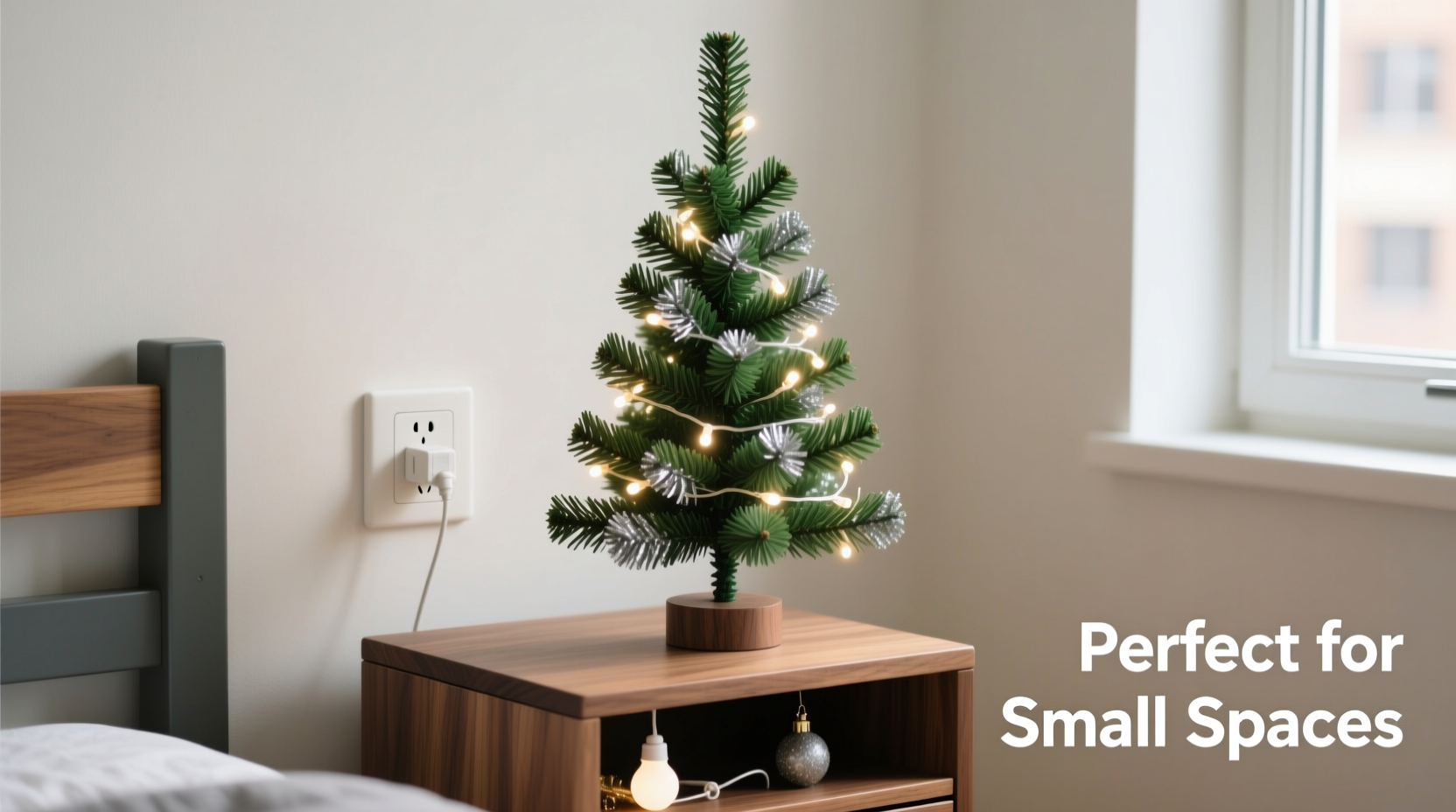
Tabletop trees typically range from 12 to 36 inches tall and occupy under 0.5 square feet of footprint—less than a standard laptop bag. In a studio apartment where the living area doubles as a bedroom and kitchen, that difference is transformative. Unlike floor-standing trees requiring a 3–4 foot radius for safe clearance (per National Fire Protection Association guidelines), a tabletop model fits comfortably on a bookshelf, desk, windowsill, or even a stacked dresser—provided the surface is stable and level.
Crucially, “space efficiency” includes vertical clearance. Dorm rooms often have low ceilings (7–7.5 feet), making 6-foot trees impractical or visually overwhelming. A 24-inch tabletop tree maintains proportion while freeing wall space for string lights, garlands, or framed photos. Interior designer Lena Torres, who specializes in micro-living solutions, confirms this shift in spatial logic:
“We no longer ask ‘How big can the tree be?’ but ‘Where does it belong in the rhythm of daily life?’ A tabletop tree integrates—it doesn’t dominate. That’s the hallmark of true practicality in small spaces.” — Lena Torres, Founder of Compact Living Studio
Real-world measurement matters more than marketing claims. Always verify actual base dimensions—not just height—and consider the tree’s silhouette. Slim-profile firs or tapered spruces project less visual weight than full-bodied models with wide lower branches, which can crowd narrow surfaces and obstruct sightlines in studio layouts.
Safety & Compliance: Non-Negotiables for Shared Housing
Fire safety is the most critical factor for dormitory and apartment dwellers—especially those in buildings governed by strict fire codes. According to the U.S. Fire Administration, Christmas tree fires cause an average of 160 home fires annually, with electrical distribution or lighting equipment cited as the leading cause (31%). Tabletop trees mitigate several key risks:
- Reduced fall hazard: No risk of toppling onto furniture, pets, or people—eliminating a primary concern for landlords and RA staff.
- No water reservoir: Eliminates mold growth, spill hazards, and pest attraction (a frequent issue with real trees in carpeted dorm rooms).
- Lower heat exposure: Most tabletop models use LED micro-lights drawing under 2 watts total—generating negligible heat versus incandescent strings that can reach 200°F at the bulb.
- Material compliance: Reputable tabletop trees meet UL 924 (emergency lighting) or UL 588 (seasonal decorative lighting) standards—critical for dormitory approval.
One overlooked safety element is cord management. In tight spaces, exposed cords become tripping hazards and clutter magnets. Prioritize models with integrated cord concealment (e.g., hollow trunks or weighted bases with internal routing) or pair with adhesive cable clips rated for rental walls (no nails or tape residue).
Cost, Storage, and Long-Term Value
A tabletop tree’s practicality extends far beyond December. Consider the full lifecycle cost—not just purchase price, but storage, replacement, and opportunity cost (e.g., lost closet space or fees for oversized package delivery).
| Factor | Full-Size Artificial Tree (6 ft) | Tabletop Tree (24 in) | Practical Advantage |
|---|---|---|---|
| Purchase Price | $85–$220 | $25–$95 | Up to 60% lower upfront investment |
| Storage Volume | 2.5–4 cubic feet (requires box + pole + stand) | 0.15–0.4 cubic feet (often folds flat or nests) | Fits inside a standard under-bed storage bin; no garage or closet shelf needed |
| Annual Setup Time | 25–45 minutes (assembly, fluffing, light testing) | 3–8 minutes (unbox, plug in, adjust) | Enables spontaneous decoration—no barrier to putting it up midweek |
| Energy Use (4-week season) | 12–28 kWh (depending on light count) | 0.1–0.4 kWh | Negligible impact on electricity bill; ideal for submetered dorms |
| Lease Risk | Moderate (water stains, needle shedding, damage during move-out) | Very low (no water, no needles, no assembly hardware) | Zero deposit deductions related to tree use |
The storage advantage is especially decisive. A 2023 survey of 412 urban renters found that 68% cited “lack of off-season storage space” as their top reason for skipping holiday decor. Tabletop trees eliminate that friction entirely—many fold into a slim cardboard sleeve or nest within their own base. One user in Brooklyn stored hers inside a repurposed wine box, labeled “Xmas – Do Not Recycle,” beneath her bed for three years without degradation.
Real-World Adaptation: A Dorm Room Case Study
Maria Chen, a third-year neuroscience major at NYU, lives in a 10×12-foot dorm room shared with one roommate. Ceiling height: 7’6”. Desk space: 24 inches wide. No access to a common storage closet. Her first December, she tried a 4-foot potted Norfolk pine—only to discover it blocked the HVAC vent, triggered allergy flare-ups, and required daily watering she couldn’t manage during finals week.
This year, Maria chose a 22-inch pre-lit faux-silver fir with hinged branches and a weighted ceramic base. She placed it centered on her IKEA LACK side table—a surface already used for textbooks and her laptop. The tree’s cool-white LEDs provided soft ambient light without glare on her study screen. Its 4-inch diameter base left ample room for her wireless charger and coffee mug. When her RA conducted a routine fire inspection, Maria simply unplugged the tree and showed the UL label on the transformer—no questions asked.
“It didn’t feel like ‘settling,’” Maria notes. “It felt like designing for reality. I put ornaments on it that mattered—my grandmother’s glass dove, my high school graduation bell—because there was space to see them, not hide them in branches. And when finals ended? I folded it, slipped it into its sleeve, and slid it under the bed. Done.”
Maria’s experience underscores a subtle but vital point: practicality includes emotional sustainability. When setup isn’t burdensome and removal isn’t daunting, the ritual endures. That consistency builds tradition—even in transient spaces.
Choosing the Right Tabletop Tree: A Step-by-Step Selection Guide
Selecting wisely prevents disappointment and maximizes utility. Follow this sequence before purchasing:
- Measure your candidate surface: Record exact width, depth, and height clearance. Subtract 2 inches from each dimension for comfortable margin.
- Determine power access: Identify nearest outlet. If over 6 feet away, budget for a UL-listed extension cord (not a power strip)—dorms prohibit daisy-chaining.
- Define your priority function: Is it primarily visual (aesthetic anchor), functional (light source), or sentimental (ornament display)? This dictates branch density, light type, and material texture.
- Verify certifications: Look for UL/ETL marks on the product listing *and* physically on the cord/transformer. Avoid “UL-recognized” or “meets UL standards”—those are unverified claims.
- Test portability: If you’ll move it between rooms or carry it to family visits, lift the listed weight. Many 24-inch trees weigh under 3 lbs; others with dense PVC or metal frames exceed 6 lbs.
- Check ornament compatibility: Examine branch tips—if they’re thin wire or plastic, heavy glass balls may slip off. Opt for models with molded branch tips or built-in hooks if using heirloom pieces.
Pro tip: Avoid “fluffy” fiber-optic trees for serious ornamentation—they lack structural integrity. Instead, choose PVC or PE (polyethylene) branch tips with memory retention—they hold shape after packing and support lightweight baubles reliably.
FAQ: Addressing Common Concerns
Can I use a tabletop tree in a windowless dorm room?
Absolutely—and it’s often ideal. Since most tabletop trees use cool-running LEDs, they double as gentle nightlights or study-area ambiance. Choose warm-white (2700K–3000K) bulbs for cozy glow, or tunable white models that shift from energizing daylight (5000K) during study hours to relaxing amber (2200K) at night. Just ensure the transformer is rated for continuous indoor use (look for “Class 2” or “SELV” designation).
Won’t a small tree feel “sad” or childish?
Not if styled intentionally. Elevate it on a stack of art books or a vintage tray. Wrap the base in burlap or velvet ribbon. Drape a single strand of battery-operated copper wire lights around the shelf behind it. Add height with a slender mercury-glass vase filled with dried eucalyptus beside it. Designers consistently report that scale-appropriate styling makes tabletop trees feel curated—not compromised.
Do tabletop trees work with smart home systems?
Increasingly, yes—but selectively. Most plug-in tabletop trees use standard 120V AC adapters incompatible with smart plugs. However, newer USB-C–powered models (like certain Target Threshold or West Elm mini-trees) work seamlessly with smart outlets or hubs. For voice control, pair with a smart plug *rated for low-wattage LED loads* (some cut out below 5W). Always verify compatibility in the product specs—don’t assume.
Conclusion: Practicality Is a Mindset, Not a Measurement
A tabletop Christmas tree isn’t merely “small enough” for an apartment or dorm—it’s designed for the rhythms of modern constrained living: transient leases, limited storage, shared utilities, and evolving personal aesthetics. Its practicality lies in the absence of friction—no wrestling with poles, no water spills on hardwood, no awkward negotiations with RAs, no guilt about discarding a tree that shed needles for weeks. It respects your space, your time, and your peace of mind.
More importantly, it affirms that celebration doesn’t require excess. It asks only for intention: choosing a surface that matters, selecting lights that soothe, hanging ornaments that tell your story. In doing so, it transforms a functional object into a quiet act of self-respect—proof that joy fits precisely where you live, not where marketers imagine you should.
If you’ve used a tabletop tree successfully in a small space, share your setup details, brand recommendations, or styling tricks in the comments. Your real-world insight helps others move past doubt—and into confident, joyful celebration.




 浙公网安备
33010002000092号
浙公网安备
33010002000092号 浙B2-20120091-4
Comments
No comments yet. Why don't you start the discussion?