
When it comes to holiday decorating, few decisions carry as much emotional weight as choosing the right Christmas tree. For many, the tree is not just a centerpiece—it’s a canvas for memories, family traditions, and creative expression. One of the most important aspects of that expression is ornament display. As more homeowners explore alternative tree styles, the tiered Christmas tree has emerged as a compelling option. But does it actually offer more room for ornaments than a traditional conical (standard) tree? The answer depends on how you define \"more\"—and what kind of display experience you're aiming for.
Understanding Tiered vs. Standard Tree Structures
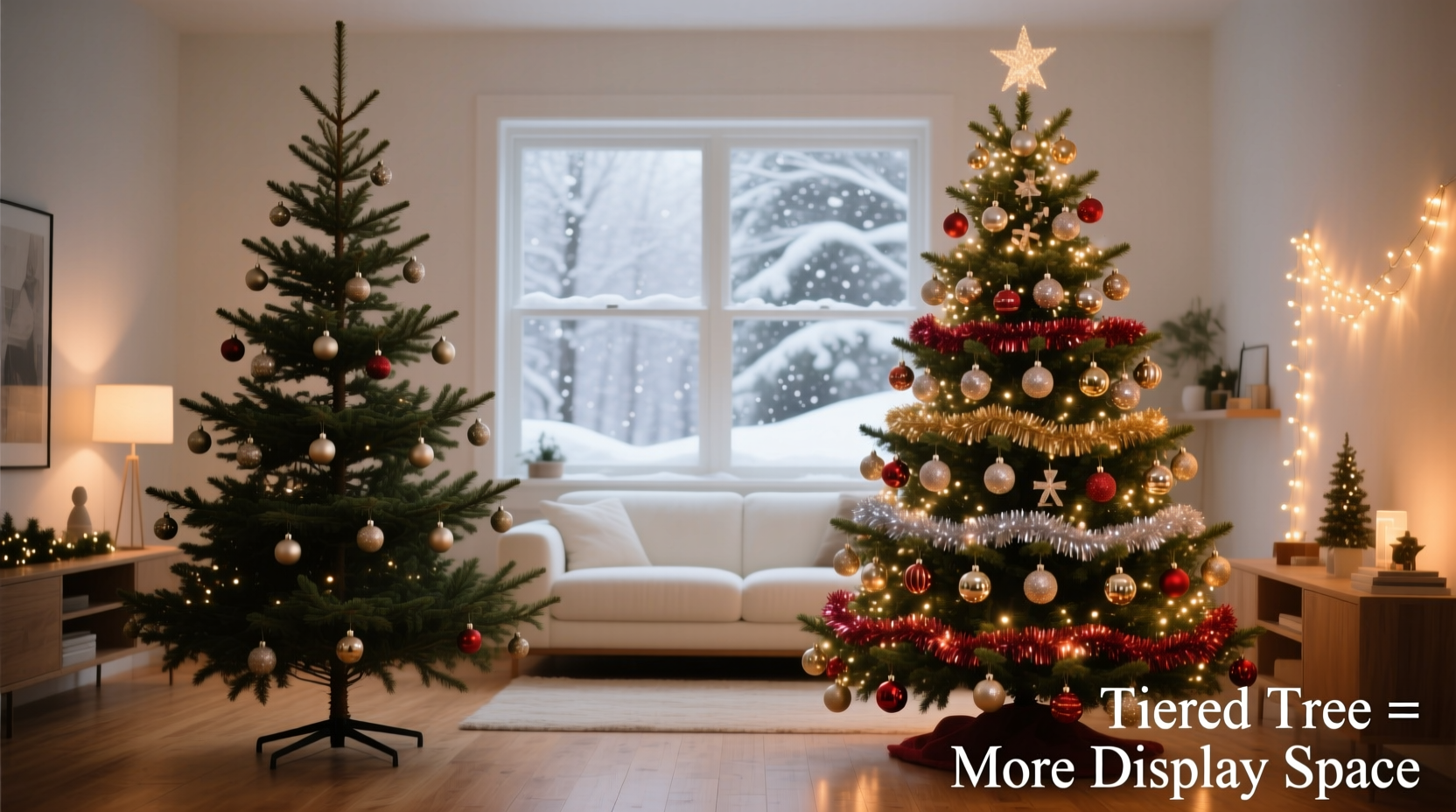
A standard Christmas tree follows the classic evergreen silhouette: a broad base tapering to a pointed top. Whether real or artificial, these trees are designed to mimic nature, with dense branches radiating outward from a central trunk. Ornament placement tends to be three-dimensional but often favors the outer surfaces, with deeper layers hidden from view.
In contrast, a tiered Christmas tree—also known as a stepped or shelf-style tree—is structured in horizontal levels, resembling a wedding cake or stacked cones. Each tier is separated by open space, creating distinct platforms for decoration. These trees are almost always artificial and are frequently used in modern, minimalist, or space-conscious settings.
The structural difference is key. While a standard tree maximizes vertical volume, a tiered tree emphasizes horizontal accessibility. This shift in geometry changes how ornaments are displayed, viewed, and interacted with.
Ornament Capacity: Surface Area vs. Accessibility
At first glance, a standard tree appears to offer more space. A full 7-foot Fraser fir can have hundreds of branch tips, each capable of holding an ornament. However, much of this space is functionally inaccessible. Ornaments placed deep within the interior are obscured, and lower branches may be blocked by presents or furniture.
Tiered trees compensate for reduced overall volume with superior organization. Because each level operates like a decorative shelf, every ornament is intentionally placed and clearly visible. There’s no \"backside\" to the tree—viewers can walk around it and see everything at once. This makes tiered trees ideal for showcasing collectible or heirloom ornaments where presentation matters more than quantity.
Consider this: a 6-foot standard tree might hold 150 ornaments, but only 60–70 may be easily seen from common viewing angles. A tiered tree of similar height might only accommodate 80 ornaments, but nearly all will be on full display. In practical terms, the tiered design doesn’t increase capacity—it optimizes it.
Expert Insight: Visibility Over Volume
“With tiered trees, you’re trading density for clarity. It’s not about how many ornaments you can hang—it’s about how many people can appreciate them.” — Lydia Monroe, Interior Designer & Holiday Stylist
Comparative Analysis: Tiered vs. Standard Trees
| Feature | Tiered Tree | Standard Tree |
|---|---|---|
| Total Ornament Capacity | Moderate (60–100) | High (100–200+) |
| Visible Ornament Percentage | 90–100% | 40–60% |
| Accessibility for Decorating | Excellent (open tiers) | Fair (dense branching) |
| Footprint Efficiency | High (narrow base) | Low (wide base) |
| Suitability for Large Ornaments | Excellent (stable shelves) | Limited (branch strength varies) |
| Ideal For | Showcasing special ornaments, small spaces, themed displays | Traditional decor, high-volume ornament collections, family heirlooms |
This comparison reveals that while standard trees win in raw capacity, tiered trees excel in strategic display. If your collection includes fragile, large, or narratively significant ornaments, the tiered format ensures they’re not lost in the foliage.
Real-World Example: The Collector’s Dilemma
Sarah Bennett, a longtime Christmas ornament collector from Portland, Oregon, faced a challenge every holiday season: her 180-piece collection overwhelmed her 7.5-foot artificial tree. While she could technically fit all her ornaments, many were buried in the center or blocked by lights and garland. Guests rarely saw the pieces that mattered most—handmade ornaments from her children, vintage glass baubles from Europe, and a delicate porcelain angel from her grandmother.
In 2022, she switched to a four-tiered tree, reducing her displayed ornaments to 75 carefully curated pieces. The result was transformative. “For the first time, people actually stopped and looked,” she said. “They noticed details. They asked about stories behind the ornaments. It felt more personal, more intentional.”
Though she stored the rest of her collection, Sarah now rotates themes annually—one year focused on travel, another on childhood memories. The tiered structure made thematic storytelling possible in a way her standard tree never allowed.
Step-by-Step: Optimizing Ornament Display on a Tiered Tree
If you’re considering a tiered tree—or already own one—follow this sequence to maximize its decorative potential:
- Assess your ornament collection. Sort by size, fragility, and significance. Identify which pieces deserve center-stage visibility.
- Choose a tree with proportional spacing. Tiers should be wide enough to support your largest ornaments and spaced at least 8–12 inches apart for visual breathing room.
- Start from the bottom up. Place heavier or larger ornaments on lower tiers for stability and balance.
- Distribute color and texture evenly. Avoid clustering similar items. Alternate shapes and finishes to maintain visual interest across levels.
- Incorporate lighting strategically. String battery-operated fairy lights along tier edges or place small LED spotlights beneath each level to highlight featured ornaments.
- Add non-ornament elements. Mini wreaths, pinecones, or folded family photos in tiny frames can enhance storytelling without overcrowding.
- Walk around the tree. View it from all angles to ensure even coverage and eliminate blind spots.
This method prioritizes curation over clutter, turning ornament display into an art form rather than a storage solution.
Common Misconceptions About Tiered Trees
Despite their advantages, tiered trees are sometimes dismissed as “less festive” or “too modern.” Some believe they lack the warmth of traditional trees. Others assume they’re only suitable for small apartments or minimalist homes. These assumptions overlook the versatility of the design.
Tiered trees can be decorated in any style—rustic, glam, vintage, or whimsical. With proper lighting and thoughtful ornament selection, they evoke the same joy and nostalgia as standard trees. The key is embracing the format’s strengths: clarity, symmetry, and narrative potential.
Another misconception is that tiered trees are inherently smaller. While many are compact, full-size models up to 8 feet tall are available. These offer multiple large tiers, capable of supporting dozens of medium-to-large ornaments while maintaining elegance.
FAQ: Your Tiered Tree Questions Answered
Can I use heavy ornaments on a tiered tree?
Yes, but check weight limits per tier. Most tiered trees have reinforced shelves designed for moderate loads (up to 1–2 lbs per level). Avoid placing extremely heavy items on upper tiers to prevent imbalance.
Do tiered trees work for families with young children?
They can be ideal. The open design reduces the risk of broken ornaments falling into dense branches, and lower tiers can be reserved for child-safe, interactive decorations. Consider letting kids decorate one entire tier themselves.
Are tiered trees harder to store than standard trees?
Generally, no. Many tiered trees disassemble into flat or compact components. Because they lack sprawling branches, they often require less storage volume than full-bodied standard trees. Just ensure you keep tiers separated to avoid scratches.
Final Checklist: Choosing the Right Tree for Your Ornament Goals
- ☐ Do you prioritize ornament visibility over total quantity?
- ☐ Do you have a curated collection with sentimental or artistic value?
- ☐ Is your space limited or do you want a focal point that doesn’t dominate the room?
- ☐ Do you enjoy rotating themes or telling a story through decor?
- ☐ Are you willing to curate rather than fill?
If you answered “yes” to most of these, a tiered tree may be the superior choice—not because it holds more ornaments, but because it lets each one matter.
Conclusion: Rethinking What “More” Means
The question isn’t simply whether a tiered Christmas tree holds more ornaments than a standard one—it’s whether it helps you display them better. In a world where holiday stress often stems from excess, the tiered tree offers a refreshing alternative: less clutter, more meaning. It invites intentionality, encourages storytelling, and ensures that no ornament is ever forgotten behind a wall of branches.
For those with expansive collections, a hybrid approach might work best: use a standard tree for general decoration and a smaller tiered tree as a dedicated showcase for prized pieces. This way, you honor both abundance and individuality.




 浙公网安备
33010002000092号
浙公网安备
33010002000092号 浙B2-20120091-4
Comments
No comments yet. Why don't you start the discussion?