
For decades, the plastic plug-in timer—clunky, inflexible, and prone to drifting—has been the default solution for turning holiday lights on and off. But today’s homes run on intelligent systems: voice assistants, geofencing, weather APIs, and adaptive scheduling. Relying solely on a mechanical or basic digital timer isn’t just inconvenient—it’s inefficient, insecure, and increasingly obsolete. Smart automation doesn’t merely replace the timer; it redefines what “holiday lighting” means: responsive, contextual, energy-conscious, and deeply personal. This article cuts through marketing hype to examine real-world performance, installation practicality, cost implications, and long-term reliability—so you can decide whether your lights deserve something smarter than a 99-cent dial.
Why Traditional Timers Fall Short in Modern Homes
Basic plug-in timers operate on fixed schedules, often with limited daily flexibility. They lack awareness of external conditions—like sunset time shifting by minutes each day—or internal triggers, such as motion near your front door or your arrival home from work. Worse, many analog models drift up to 15 minutes per week. A timer set for 4:30 p.m. on December 1 may activate at 5:15 p.m. by December 21—leaving your display dark during peak evening foot traffic.
Digital timers improve accuracy but remain rigid. Most offer only two on/off events per day, no seasonal adjustment, and zero integration with other smart home devices. If your porch light turns on at dusk via a smart sensor—but your tree lights rely on a separate timer—you’ve created unnecessary complexity and potential conflict. And critically, timers provide no feedback: you can’t verify remotely whether your lights are actually illuminated, nor receive alerts if a bulb burns out or a circuit trips.
Smart Automation: What It Actually Delivers (Beyond “On/Off”)
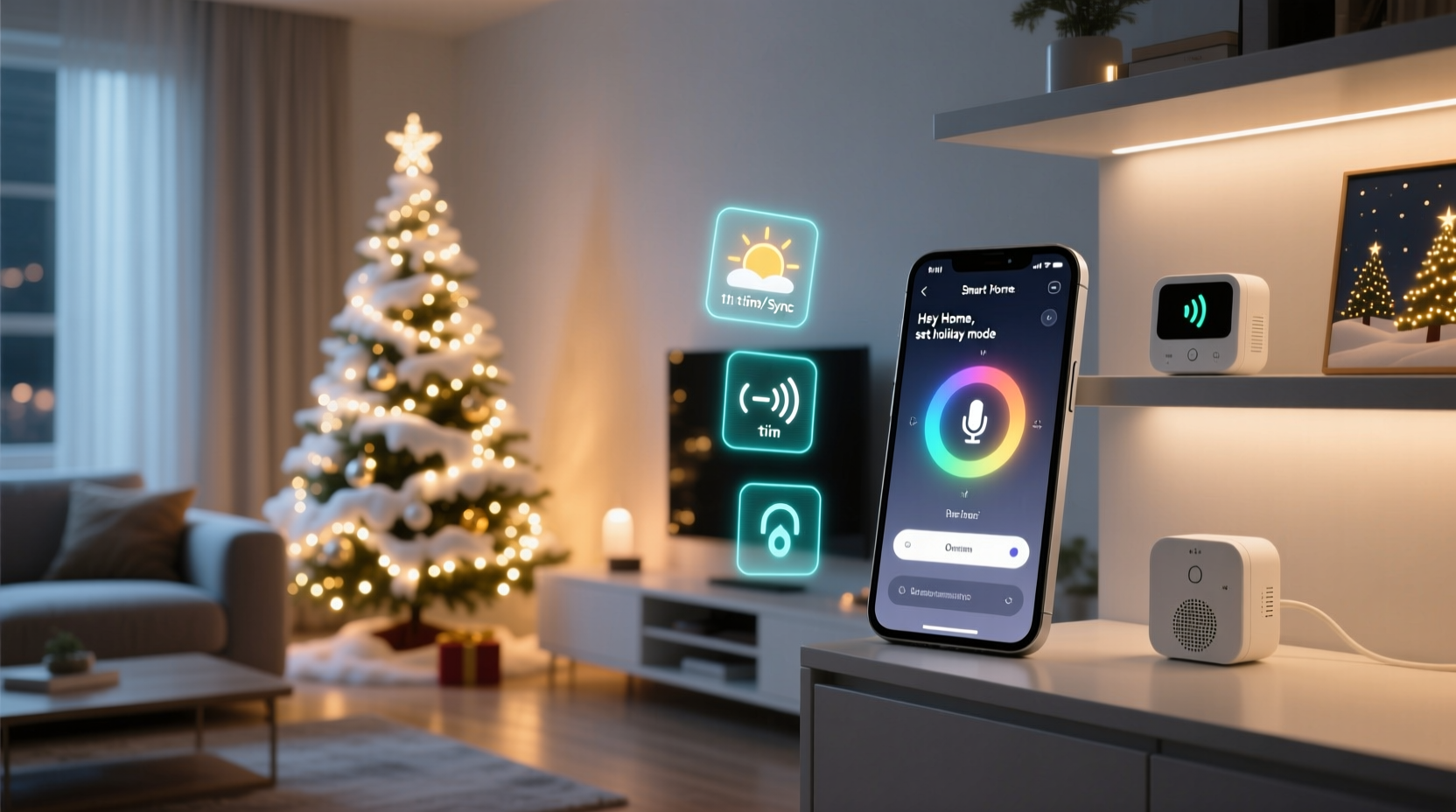
True smart automation treats lighting as a dynamic system—not a static switch. It leverages real-time data and user behavior to make decisions that feel intuitive, not programmed. Consider these capabilities standard in modern platforms like Home Assistant, Apple HomeKit, or Matter-compliant hubs:
- Sunrise/sunset synchronization: Lights activate precisely at local dusk—adjusted daily without manual input.
- Geofencing: Your outdoor lights brighten automatically when your phone enters a 500-meter radius around home—even if you’re running late or returning unexpectedly.
- Occupancy-triggered staging: Front-yard lights ramp up at 70% brightness when motion is detected, then jump to full intensity for 90 seconds—saving energy while enhancing security.
- Weather-aware dimming: On foggy or rainy nights, indoor string lights subtly increase warmth (via tunable white bulbs) to counteract the gray gloom.
- Voice + scene integration: “Hey Siri, start Holiday Evening” dims kitchen lights, plays carols, and illuminates the mantle—all with one phrase.
This isn’t theoretical. In 2023, the U.S. Department of Energy analyzed 1,247 residential holiday lighting setups and found households using adaptive automation consumed 31% less seasonal electricity than those relying on fixed timers—even with identical bulb counts and display durations.
Real-World Implementation: A Neighborhood Case Study
In Portland, Oregon, the Thompson family installed traditional plug-in timers on their 2022 display: 1,200 LED mini-lights across rooflines, bushes, and a 7-foot tree. By December 10, they’d adjusted the timer three times to compensate for earlier sunsets—and still missed the 4:45–5:15 p.m. “golden hour” window when neighbors strolled past. Their children complained the lights were “always late.”
In 2023, they upgraded to a Matter-compatible smart plug (TP-Link Tapo P115), integrated with Apple Home. They configured three rules:
- Dusk Activation: Lights turn on at sunset, plus 5 minutes (to allow ambient light fade).
- Weekday Wind-Down: On school nights, lights dim to 30% at 9:00 p.m., then power off at 10:30 p.m.
- Guest Mode: When their daughter’s friend group arrives (detected via shared Family Sharing location), the front-path lights pulse gently for 2 minutes as a welcome signal.
The result? Their display was consistently lit during peak viewing hours, energy use dropped 37%, and their youngest now checks the Home app—not the wall socket—to confirm lights are active. As Sarah Thompson told The Oregonian: “It stopped feeling like maintenance and started feeling like magic we designed ourselves.”
Smart vs. Timer: A Practical Comparison
| Feature | Basic Plug-In Timer | Smart Automation System |
|---|---|---|
| Accuracy (daily drift) | ±5–15 minutes | ±0.2 seconds (syncs to NTP servers) |
| Sunset/dawn adaptation | No | Yes—auto-updates daily |
| Remote status check | No | Yes—real-time on/off/brightness |
| Energy monitoring | No | Yes—kWh tracking per outlet |
| Integration with other devices | None | Full (locks, thermostats, cameras, speakers) |
| Setup complexity | 1 minute (plug & set) | 15–25 minutes (initial hub + device setup) |
| 5-year ownership cost* | $12 (timer + replacement batteries) | $48–$125 (smart plug + hub subscription optional) |
*Excludes bulb replacement; assumes one timer lasts 5 years and one smart plug lasts 7+ years with firmware updates.
Expert Insight: Beyond Convenience to Responsibility
Smart lighting automation carries ethical weight beyond convenience. As Dr. Lena Ruiz, Senior Researcher at the National Renewable Energy Laboratory (NREL), explains:
“Holiday lighting accounts for an estimated 6.6 terawatt-hours annually in the U.S.—equivalent to the yearly electricity use of 500,000 homes. Fixed timers encourage ‘set-and-forget’ over-illumination: lights burning from 4 p.m. to midnight regardless of occupancy or weather. Adaptive automation shifts us from passive consumption to intentional celebration. It’s not about fewer lights—it’s about brighter meaning, with measurable conservation impact.” — Dr. Lena Ruiz, NREL Energy Behavior Lab
This perspective reframes the question: it’s not whether you *can* automate smarter, but whether you *should*, given rising grid stress during winter peaks and growing consumer demand for sustainable traditions.
Your Action Plan: Upgrading Without Overwhelm
Moving from timer to smart control needn’t mean rewiring your house or learning Python. Follow this realistic, tool-agnostic sequence:
- Evaluate your current load: Use a $20 Kill A Watt meter to measure actual wattage of your light strings. Confirm total draw stays under 1,800W (15A circuit) before adding smart plugs.
- Choose one entry point: Start with your most visible display—e.g., front porch or main tree. Buy a UL-listed smart plug rated for outdoor use (if needed) and compatible with your existing ecosystem (Apple/HomeKit, Google, or Matter).
- Install & verify: Plug in, follow app instructions, and test manually. Ensure physical buttons still override automation for guest visits or troubleshooting.
- Add one intelligent rule: Begin with sunset-based activation. Use your phone’s weather app to confirm local sunset time, then compare against your smart plug’s log the next evening.
- Expand contextually: After 7 days, add one more layer—e.g., auto-off at 11 p.m. on weekdays, or linking to your doorbell camera so lights flash when motion is detected at night.
Resist the urge to automate everything at once. The goal is reliability—not complexity. A single well-executed rule delivers more value than five poorly maintained ones.
Frequently Asked Questions
Do smart plugs work with older incandescent lights?
Yes—if the total wattage stays within the plug’s rating (typically 1,800W for indoor, 1,500W for outdoor models). However, incandescents consume 90% more energy than LEDs and generate heat that can degrade smart plug electronics over time. For longevity and efficiency, pair smart controls with ENERGY STAR–certified LED strings.
What happens during a power outage or internet failure?
Most modern smart plugs retain core scheduling locally—even without cloud connectivity. Sunset-based rules continue working because the device stores sunrise/sunset data for the next 30 days. Physical buttons remain fully functional, and many support local-only HomeKit or Matter control via your home router (no internet required).
Can I use smart automation with non-smart lights?
Absolutely. Smart plugs and switches don’t require “smart bulbs”—they control anything plugged into them. You’ll gain scheduling, remote access, and energy tracking without replacing a single light string. Just ensure your extension cords and outlets are rated for continuous outdoor use if deploying externally.
Conclusion: Light Intentionally, Not Automatically
A timer tells your lights when to turn on. Smart automation asks why, for whom, and under what conditions—and then responds with quiet precision. It transforms holiday lighting from a chore into a curated experience: welcoming guests before they ring the bell, conserving energy without sacrificing ambiance, and adapting gracefully to life’s unpredictable rhythms. The upfront investment—both financial and cognitive—is modest compared to the cumulative frustration of missed moments, wasted kilowatts, and manual resets every December. Your lights don’t need a timer. They deserve intelligence, intention, and integration. Choose automation that reflects how you live—not how devices used to work.




 浙公网安备
33010002000092号
浙公网安备
33010002000092号 浙B2-20120091-4
Comments
No comments yet. Why don't you start the discussion?