
Maintaining oral hygiene isn’t just about brushing your teeth—it’s about what happens between them. Flossing is a critical step in removing plaque and food debris from areas your toothbrush can’t reach. For decades, traditional string floss has been the gold standard. But in recent years, water flossers have surged in popularity, promising a gentler, more effective alternative. So, are they really better? And what do dentists actually think?
This article dives into clinical research, real-world use cases, and professional dental insights to answer whether a water flosser is truly worth switching to over conventional string floss.
How Traditional String Floss Works
Traditional flossing involves sliding a thin thread of nylon or PTFE between each tooth to dislodge plaque and trapped particles. When done correctly, it disrupts bacterial colonies along the gumline and prevents tartar buildup. The American Dental Association (ADA) recommends flossing at least once daily as part of a complete oral care routine.
The effectiveness of string floss depends heavily on technique. Proper flossing requires wrapping the floss around each tooth in a C-shape and gently moving it below the gumline. However, many people either skip this step entirely or perform it incorrectly—using a sawing motion that irritates gums without removing plaque effectively.
The Rise of Water Flossers: How They Work
A water flosser, also known as an oral irrigator, uses a stream of pulsating water to flush out debris and bacteria from between teeth and below the gumline. Devices like Waterpik, Philips Sonicare AirFloss, and other brands deliver pressurized water through a handheld nozzle aimed at interdental spaces.
Unlike manual flossing, which relies on physical contact, water flossers work hydraulically. The pulsations help stimulate blood flow in the gums and may improve gingival health over time. Most models offer adjustable pressure settings and specialized tips for implants, braces, or periodontal pockets.
Water flossers are especially appealing to individuals with limited dexterity, orthodontic appliances, crowns, bridges, or dental implants—groups for whom traditional flossing can be challenging or uncomfortable.
Dentist Opinions: What Do Professionals Say?
Dental professionals are divided—not because of disagreement over the importance of interdental cleaning, but due to differences in patient needs and adherence patterns.
“Any form of consistent interdental cleaning is better than none. For patients who struggle with string floss, a water flosser can be a game-changer.” — Dr. Linda Chen, Periodontist, New York City
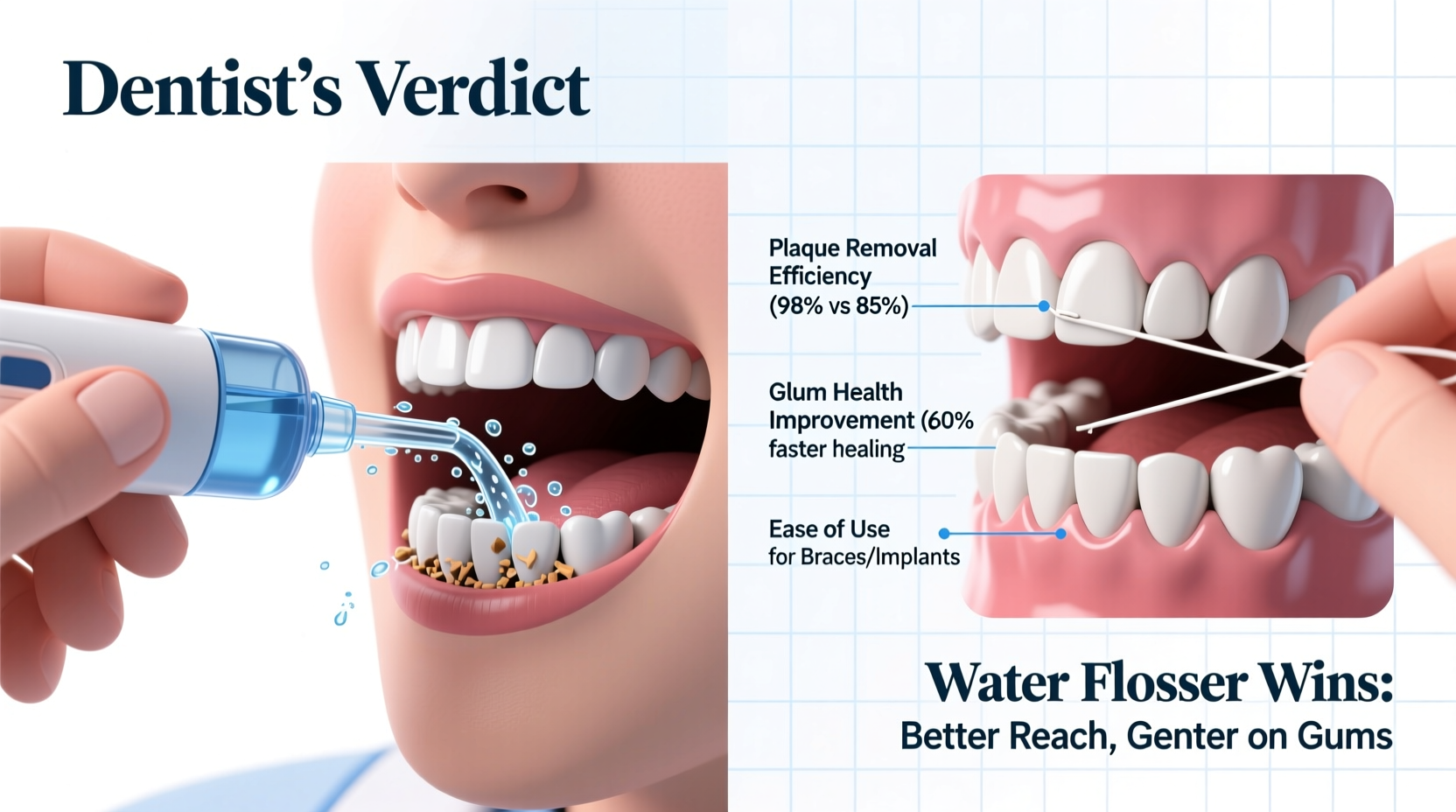
Multiple studies support the efficacy of water flossers. A meta-analysis published in the Journal of Clinical Dentistry found that water flossers were significantly more effective than string floss at reducing gingivitis and bleeding over a four-week period. Another study showed a 29% greater reduction in plaque when using a water flosser compared to traditional floss.
However, some dentists caution against viewing water flossers as a complete replacement. While they excel at flushing out loose debris and improving gum health, they may not remove tightly adhered biofilm as thoroughly as mechanical flossing.
“The water flosser doesn't 'scrape' plaque off like floss does. It's excellent for circulation and cleaning deep pockets, but I still recommend my patients use traditional floss if they can tolerate it.” — Dr. Marcus Rivera, General Dentist, Austin, TX
Comparing Effectiveness: Water Flosser vs. String Floss
To understand which method might suit you best, consider how they stack up across key categories.
| Factor | Water Flosser | String Floss |
|---|---|---|
| Gingivitis Reduction | High – clinically proven to reduce inflammation and bleeding | Moderate – effective with proper technique |
| Plaque Removal | Good – especially around braces and implants | Excellent – direct contact removes biofilm |
| Ease of Use | Very easy – ideal for those with arthritis or mobility issues | Requires coordination and practice |
| Time Required | ~60 seconds | ~2–3 minutes |
| Cost Over Time | Higher initial cost ($50–$100), low ongoing cost | Negligible – rolls last months |
| Best For | Braces, implants, sensitive gums, dexterity limitations | Those seeking maximum plaque control and willing to learn technique |
While both tools have merit, the choice often comes down to individual circumstances rather than universal superiority.
Real-World Example: Sarah’s Orthodontic Journey
Sarah, a 32-year-old graphic designer, started wearing traditional metal braces two years ago. Initially, she tried using waxed string floss daily but found it frustrating and painful. Despite her efforts, she developed mild gingivitis during her six-month checkup.
Her orthodontist recommended trying a water flosser. After purchasing a mid-range model, Sarah incorporated it into her nightly routine. Within three weeks, her gums stopped bleeding during brushing. At her next appointment, her hygienist noted a visible improvement in gum health and less plaque accumulation around brackets.
“I didn’t realize how much I was missing until I switched,” Sarah said. “Now I use the water flosser every night, and I even keep a travel version for weekends.”
Sarah’s experience reflects a common trend: patients with orthodontic devices or complex dental work often achieve better compliance and outcomes with water flossers.
Step-by-Step Guide to Using a Water Flosser Effectively
If you're considering making the switch—or adding a water flosser to your current routine—follow these steps for optimal results:
- Fill the reservoir with warm water. Some users add mouthwash (check device compatibility first).
- Select the appropriate tip (standard, orthodontic, periodontal, etc.) and attach it securely.
- Set the pressure control to low initially, especially if new to the device or have sensitive gums.
- Lean over the sink and place the tip in your mouth before turning it on to avoid splashing.
- Start at the back molars and slowly move the stream along the gumline, pausing briefly between each tooth.
- Aim slightly below the gumline at a 90-degree angle to maximize pocket penetration.
- Move systematically across all quadrants: upper right, upper left, lower left, lower right.
- Finish by turning off the device before removing the tip from your mouth.
- Clean the reservoir and tip after each use to prevent bacterial growth.
Consistency matters more than duration. Even 45 seconds daily can yield noticeable improvements in gum health within weeks.
Can You Use Both? Combining Methods for Maximum Benefit
Some dental professionals advocate for a hybrid approach—using both string floss and a water flosser. Here’s why:
- Mechanical disruption: String floss physically scrapes off plaque clinging to tooth surfaces.
- Hydraulic cleansing: Water flossers flush out residual debris and bacteria from deeper pockets.
- Synergistic effect: Together, they address different aspects of interdental cleaning.
In fact, a 2021 clinical trial found that participants who used both methods had significantly lower levels of subgingival pathogens compared to those using either alone.
Checklist: Choosing the Right Tool for You
Not sure which option fits your lifestyle and oral health needs? Ask yourself the following questions:
- Do I wear braces, implants, or have periodontal pockets? → Water flosser likely beneficial
- Do I have arthritis or difficulty gripping small objects? → Water flosser easier to handle
- Am I consistent with my current flossing routine? → Stick with string floss if working well
- Do my gums bleed frequently despite brushing? → Consider adding a water flosser for improved circulation
- Is cost a concern? → String floss is far cheaper long-term
- Do I travel often? → Compact floss picks or travel water flossers available
If multiple answers point toward convenience, comfort, or medical necessity, a water flosser may be worth the investment.
Frequently Asked Questions
Can a water flosser replace string floss completely?
The ADA states that water flossers can be an effective alternative for people unable to use string floss. However, they don’t remove plaque as mechanically as traditional floss. For optimal results, many dentists recommend combining both or sticking with string floss if technique is correct.
Are water flossers safe for people with gum disease?
Yes—and they’re often recommended. Studies show water flossers reduce bleeding and inflammation in patients with gingivitis and mild periodontitis. The pulsating action helps clean below the gumline where bacteria accumulate. Always consult your dentist for personalized advice.
Do I still need to visit the dentist if I use a water flosser?
Absolutely. No home care tool replaces professional cleanings. Tartar (calculus) can only be removed by a dental hygienist using ultrasonic scalers and hand instruments. Regular checkups every six months remain essential regardless of your flossing method.
Final Verdict: Is It Worth It?
So, is a water flosser worth it over traditional string floss? The answer depends on who you are and what you need.
For individuals with braces, implants, arthritis, or sensitivity, a water flosser isn’t just worth it—it can be transformative. It improves compliance, reduces gum bleeding, and makes daily care more manageable. Clinical evidence supports its benefits, and many dentists endorse it as a valuable tool.
But for those who already floss correctly and consistently, switching may offer minimal additional benefit. Traditional floss remains highly effective, inexpensive, and portable. In high-risk cases like aggressive plaque formers or tight contacts, mechanical removal via string floss may still be superior.
The bottom line: the best flossing method is the one you’ll actually use every day. If a water flosser increases your likelihood of cleaning between teeth regularly, then yes—it’s absolutely worth it.




 浙公网安备
33010002000092号
浙公网安备
33010002000092号 浙B2-20120091-4
Comments
No comments yet. Why don't you start the discussion?