
In recent years, interior spaces have shifted from rigid symmetry to more organic, expressive layouts. One of the most visible signs of this evolution is the rise of irregularly shaped rugs—ovals, ovals with scalloped edges, kidney shapes, and freeform silhouettes that defy traditional geometry. While rectangular rugs remain the default choice for many, irregular rugs are no longer confined to avant-garde lofts or bohemian studios. They’ve entered mainstream living rooms, bedrooms, and even minimalist homes. But is this shift just a fleeting aesthetic trend, or do irregular rugs offer tangible advantages over their rectangular counterparts?
The answer lies not in absolutes, but in context: how a space is used, the furniture layout, architectural features, and the emotional tone you want to create. Let’s break down the functional, aesthetic, and psychological dimensions of irregular rugs to determine whether they’re merely trendy—or genuinely better in certain scenarios.
Design Flexibility and Spatial Harmony
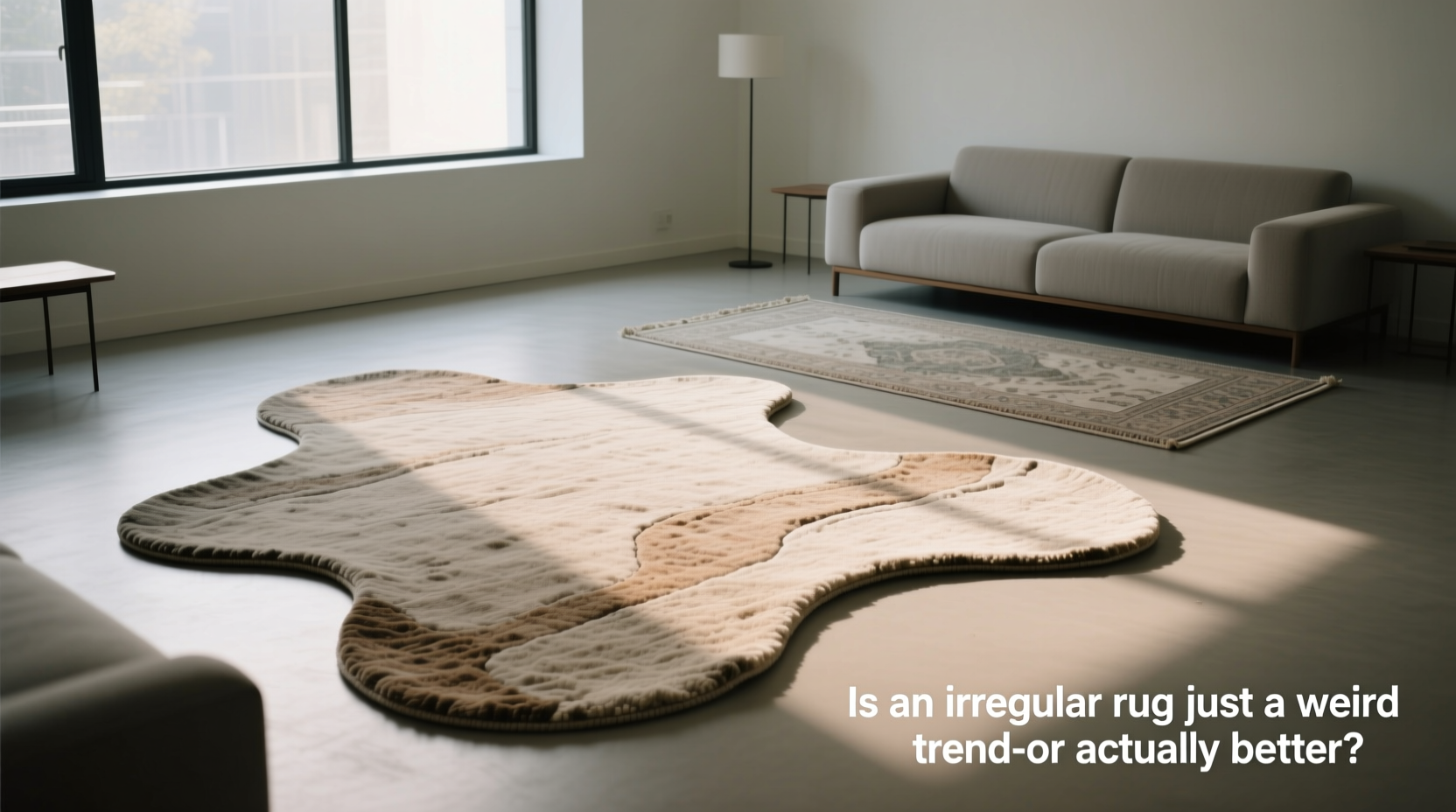
Rectangular rugs are predictable. They align neatly with walls, sofas, and dining tables, making them ideal for structured, symmetrical rooms. But not all spaces lend themselves to straight lines. Awkward corners, curved walls, or open-plan areas with asymmetrical furniture groupings often feel constrained by rectangular boundaries.
Irregular rugs, by contrast, can follow the natural flow of a room. An oval rug under a round dining table avoids the visual clash of mismatched shapes. A kidney-shaped rug can wrap around a conversation area without forcing furniture into unnatural positions. This adaptability makes irregular rugs particularly effective in older homes with non-standard layouts or modern spaces designed for fluid movement.
“An irregular rug isn’t about rejecting order—it’s about responding to the room’s rhythm. When done well, it feels less like decoration and more like part of the architecture.” — Lena Torres, Interior Designer & Author of *Organic Modernism*
Functional Advantages in Real-World Use
While aesthetics matter, function determines long-term satisfaction. Here’s where irregular rugs reveal strengths beyond trendiness:
- Better fit for circular furniture: Round coffee tables or dining sets look disjointed under rectangular rugs. An oval or circular rug creates cohesion.
- Reduced tripping hazards: In high-traffic areas, rounded edges eliminate the sharp corners of rectangular rugs that tend to curl or lift.
- Seamless integration in open-concept spaces: Irregular rugs can define zones without creating visual barriers. For example, a large amoeba-shaped rug under a lounge area separates it from a kitchen without blocking sightlines.
- Enhanced acoustics without rigidity: Like any rug, irregular ones absorb sound—but their ability to cover only key areas (e.g., under seating) means you get acoustic benefits without carpeting entire floors unnecessarily.
These functional perks aren’t trivial. They reflect a deeper shift toward human-centered design—where furniture and decor serve behavior, not convention.
Comparative Overview: Irregular vs. Rectangular Rugs
| Feature | Irregular Rug | Rectangular Rug |
|---|---|---|
| Furniture Compatibility | Best with round/organic shapes; excels in asymmetrical layouts | Ideal for linear arrangements; suits standard sofa-and-table setups |
| Room Shape Adaptability | Excellent in awkward, curved, or open spaces | Limited; works best in symmetrical, rectangular rooms |
| Visual Impact | Statement-making; adds movement and softness | Neutral; provides grounding without drawing attention |
| Practical Maintenance | Slightly harder to clean due to shape; may require custom padding | Easier to clean, rotate, and pair with standard pads |
| Versatility | Lower; often tied to specific room configurations | High; easily moved between rooms and repositioned |
A Real-World Example: The Brooklyn Loft Transformation
Consider a 2023 renovation in a converted Williamsburg warehouse loft. The client wanted a relaxed yet sophisticated space, but the central living area had an L-shaped sofa arrangement wrapping around a curved glass wall. A standard 9x12 rug would either leave one section exposed or bunch up against the curve.
The designer opted for a hand-knotted, ivory-toned oval rug measuring 10 feet at its longest point. It flowed naturally beneath both arms of the sofa, anchored the space without cutting off circulation, and echoed the curvature of the window. Guests consistently remarked on how “cozy” the area felt—a feedback rarely attributed to rectilinear layouts in such industrial settings.
This wasn’t about being trendy. It was about solving a spatial problem with a form-follows-function approach. The irregular rug didn’t dominate the room; it completed it.
When an Irregular Rug Is Actually Better
There are clear scenarios where an irregular rug outperforms a rectangular one:
- You have a round dining table: A rectangular rug forces chairs to hang off the edge when pulled out. An oval or circular rug keeps all legs on fabric, preventing scratches and improving comfort.
- Your room has an unconventional shape: Bay windows, sloped walls, or diagonal hallways disrupt symmetry. An irregular rug can mirror these lines rather than fight them.
- You want to create a focal point: In minimalist or monochromatic rooms, a uniquely shaped rug becomes art—a dynamic centerpiece that draws the eye and anchors the composition.
- You're defining zones in an open floor plan: Instead of placing a rectangle that cuts across pathways, a kidney-shaped or teardrop rug can cradle a seating area without obstructing flow.
Step-by-Step Guide to Choosing the Right Rug Shape
Follow this sequence to determine whether an irregular rug is right for your space:
- Map your furniture layout: Sketch or photograph the arrangement. Note whether pieces form straight lines or organic clusters.
- Assess traffic flow: Walk through the room. Do people move in straight paths or curve around objects? Curved movement favors irregular rugs.
- Identify architectural features: Are there curves, diagonals, or alcoves? If yes, consider mirroring those shapes.
- Determine maintenance priorities: If easy cleaning and rotation are top concerns, rectangular may still win.
- Test virtually: Use augmented reality apps (like IKEA Place or RoomScan) to overlay different rug shapes before buying.
FAQ
Are irregular rugs harder to clean?
Yes, slightly. Their unique shapes can complicate vacuuming edges, and professional cleaning services may charge more due to non-standard sizing. However, spot cleaning and regular maintenance are similar to rectangular rugs.
Can I use an irregular rug in a small room?
Absolutely—if proportionally sized. A small oval rug in a narrow bedroom can elongate the space visually. Just ensure at least 6–12 inches of floor remains visible around the edges to avoid crowding.
Do irregular rugs cost more?
Often, yes. Many are artisan-made or produced in smaller batches, increasing cost. Machine-woven options are becoming more available, narrowing the price gap.
Conclusion
An irregular rug is neither a mere trend nor a universal upgrade. It’s a design tool—one that excels when applied thoughtfully. In spaces defined by movement, asymmetry, or organic forms, it offers functional and aesthetic advantages that rectangular rugs simply can’t match. It softens hard edges, improves spatial flow, and introduces a subtle dynamism that elevates a room from staged to lived-in.
But like any powerful element, it demands intention. Choose an irregular rug not because it’s unconventional, but because it solves a problem, enhances comfort, or reflects your personal aesthetic in a way that rectangles cannot. When selected with purpose, it’s not weird at all—it’s wise.




 浙公网安备
33010002000092号
浙公网安备
33010002000092号 浙B2-20120091-4
Comments
No comments yet. Why don't you start the discussion?