
The decade-long legal conflict between Apple and Samsung is one of the most high-profile patent wars in modern technology history. What began as a fierce courtroom battle over smartphone design has evolved into a global symbol of intellectual property rights in the digital age. While headlines often claim Apple “won” or Samsung “lost,” the reality is far more nuanced. The outcomes have been mixed, appeals frequent, and financial stakes enormous. More importantly, the war never truly ended—it merely transformed.
The Origins: Design vs. Innovation
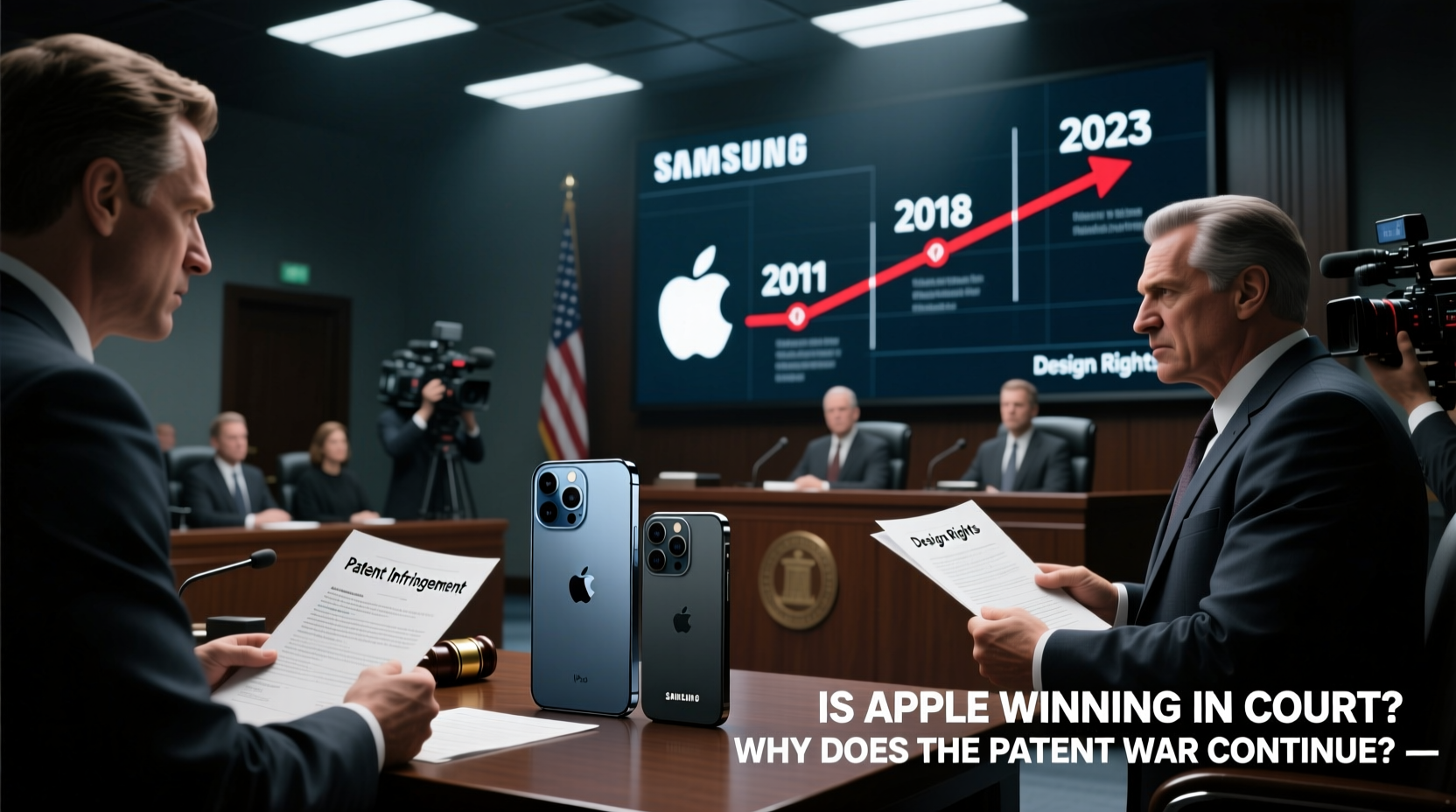
In 2011, Apple filed a lawsuit accusing Samsung of copying the iPhone’s design and user interface across multiple Galaxy devices. The core claims centered on trade dress infringement—specifically, the look and feel of the iPhone, including its rectangular shape with rounded corners, grid of colorful icons, and bezel-free front. Apple argued that Samsung didn’t just compete; it imitated.
Samsung countered by asserting that these features were functional, obvious, or already present in prior art. They also launched counter-suits alleging infringement of their own wireless communication patents. What followed was a series of trials across multiple countries, each with different legal standards and outcomes.
“Design matters. When you spend years refining a product’s simplicity and elegance, copying isn’t competition—it’s theft.” — Steve Jobs, as quoted in Walter Isaacson’s biography
Key Legal Battles and Outcomes
The U.S. trial in 2012 delivered a landmark verdict: a jury found Samsung had willfully infringed on Apple’s design and utility patents and awarded Apple over $1 billion in damages. This figure was later reduced but still marked a symbolic victory for Apple.
However, subsequent appeals diluted the impact. In 2016, the U.S. Supreme Court ruled unanimously that damages for design patent infringement should be based on the “article of manufacture” tied to the patented feature—not the entire device. This meant Samsung wouldn’t have to pay profits on the whole phone, only the component parts (like the casing) that infringed. The case was sent back for retrial, ultimately reducing Samsung’s liability significantly.
Outside the U.S., results varied:
| Country | Outcome | Notes |
|---|---|---|
| United States | Mixed | Initial win for Apple; later reduced awards and narrowed scope |
| South Korea | Tie | Both companies found to infringe minor patents |
| Germany | Samsung favored | Court invalidated some Apple patents |
| Australia | Apple blocked temporarily | Injunctions issued, later lifted on appeal |
| Japan | Narrow Apple win | Minor design infringement found, no major sales impact |
Why the Patent War Keeps Going
Despite settlements in recent years, the underlying tensions remain. The patent war persists not because of unresolved lawsuits alone, but due to deeper structural forces in the tech industry:
- Patent portfolios as strategic weapons: Companies like Apple and Samsung don’t just protect inventions—they use patents to delay competitors, extract licensing fees, or gain leverage in negotiations.
- Different innovation philosophies: Apple emphasizes vertical integration and proprietary design. Samsung operates across hardware, components, and software, often iterating on proven concepts. These models naturally clash.
- Global market overlap: Both dominate premium smartphones. Any perceived encroachment on design identity triggers legal responses.
- Legacy of mistrust: The initial accusations of copying left lasting scars. Even when products diverge, suspicion lingers.
Timeline of Major Events
- 2011: Apple sues Samsung in the U.S. for copying iPhone design.
- 2012: U.S. jury awards Apple $1.05 billion; Samsung ordered to pull devices.
- 2014: Appeals court upholds infringement but reduces damages to $548 million.
- 2015: Second trial determines $539 million in damages for design patents.
- 2016: U.S. Supreme Court rules on “article of manufacture,” reopening damages calculation.
- 2018: Final retrial sets Samsung’s payment at $539 million; full amount paid.
- 2023: Both companies settle remaining international disputes; no admission of guilt.
Mini Case Study: The Galaxy S II and the Ripple Effect
The Samsung Galaxy S II, released in 2011, became a central focus of Apple’s lawsuit. Its large touchscreen, minimalist front, and app layout bore a visual resemblance to the iPhone 4. Apple claimed consumers could confuse the two.
In Australia, a preliminary injunction briefly blocked the Galaxy S II’s sale. However, after expert testimony and public backlash, the court lifted the ban, citing insufficient evidence of consumer confusion. Sales surged afterward.
This case highlighted a key flaw in design-based litigation: similarity doesn’t always equal deception. Consumers recognized both brands distinctly. Yet, the legal maneuvering delayed Samsung’s rollout and generated negative PR—exactly what Apple may have intended beyond just winning in court.
Expert Insight: Patents as Business Tools
“Litigation isn’t just about justice—it’s about market positioning. Every lawsuit sends a message: ‘Stay out of our space.’ Whether Apple wins or loses, they’ve reinforced their brand as the originator.” — Dr. Karen Lee, IP Law Professor at Stanford University
This perspective explains why even partial victories matter. Apple didn’t need to bankrupt Samsung to succeed. It needed to establish a precedent: copying the iPhone’s essence comes at a cost.
Checklist: How Tech Companies Use Patents Strategically
- File broad design patents early—even for subtle UI elements
- Build massive patent portfolios to enable cross-licensing deals
- Use litigation to slow competitor product launches
- Target high-visibility markets (e.g., U.S., EU) for maximum impact
- Leverage media narratives to reinforce brand originality
- Settle selectively to avoid prolonged uncertainty
Frequently Asked Questions
Did Apple really win the patent war?
In the short term, yes—Apple won key rulings and received substantial damages. But in the long term, Samsung remained a dominant player, and the legal system limited how much Apple could enforce its design claims. The “win” was symbolic and financial, not existential.
Why didn’t the courts stop Samsung from selling phones?
Courts are cautious about removing popular products from the market. While infringement was found, judges determined that the copied features weren’t decisive enough to justify bans, especially given Samsung’s modifications over time.
Are design patents still powerful after this case?
Yes, but with limits. The Supreme Court’s “article of manufacture” decision made it harder to claim all profits from a device. Still, design patents remain valuable tools for protecting distinctive product identities, especially in consumer electronics.
Conclusion: A War Without End, But With Lessons
The Apple-Samsung patent war wasn’t just about rectangles and icons. It was a battle over who defines innovation in the smartphone era. Apple succeeded in framing the narrative: they were the creators, Samsung the imitators. Legally, the results were mixed, but culturally, Apple cemented its image as a design pioneer.
Yet Samsung adapted. It invested heavily in original design, software differentiation, and display technology—areas where it now leads. The rivalry shifted from courtroom fights to competitive innovation.
The patent war continues in spirit, if not in active litigation. As long as two giants occupy the same premium space, legal scrutiny will follow. But the real winner is the consumer: pushed forward by competition, today’s smartphones are more advanced, diverse, and refined than ever before.




 浙公网安备
33010002000092号
浙公网安备
33010002000092号 浙B2-20120091-4
Comments
No comments yet. Why don't you start the discussion?