
For years, high-performance gaming has required expensive hardware: powerful GPUs, multi-core CPUs, and fast storage. But as internet speeds improve and data centers expand globally, cloud gaming is emerging as a compelling alternative. Instead of relying on local processing power, players stream games from remote servers—much like watching a movie on Netflix. This shift promises to democratize access, especially for users with low-end devices. Yet questions remain: Is this a sustainable evolution in gaming, or merely a stopgap solution until affordable hardware catches up?
The answer lies somewhere between technological ambition and real-world limitations. While cloud gaming removes the barrier of upfront hardware costs, it introduces new dependencies—on bandwidth, latency, and corporate infrastructure. To understand its true trajectory, we must examine its mechanics, benefits, drawbacks, and the broader trends shaping digital entertainment.
How Cloud Gaming Works: A Technical Overview
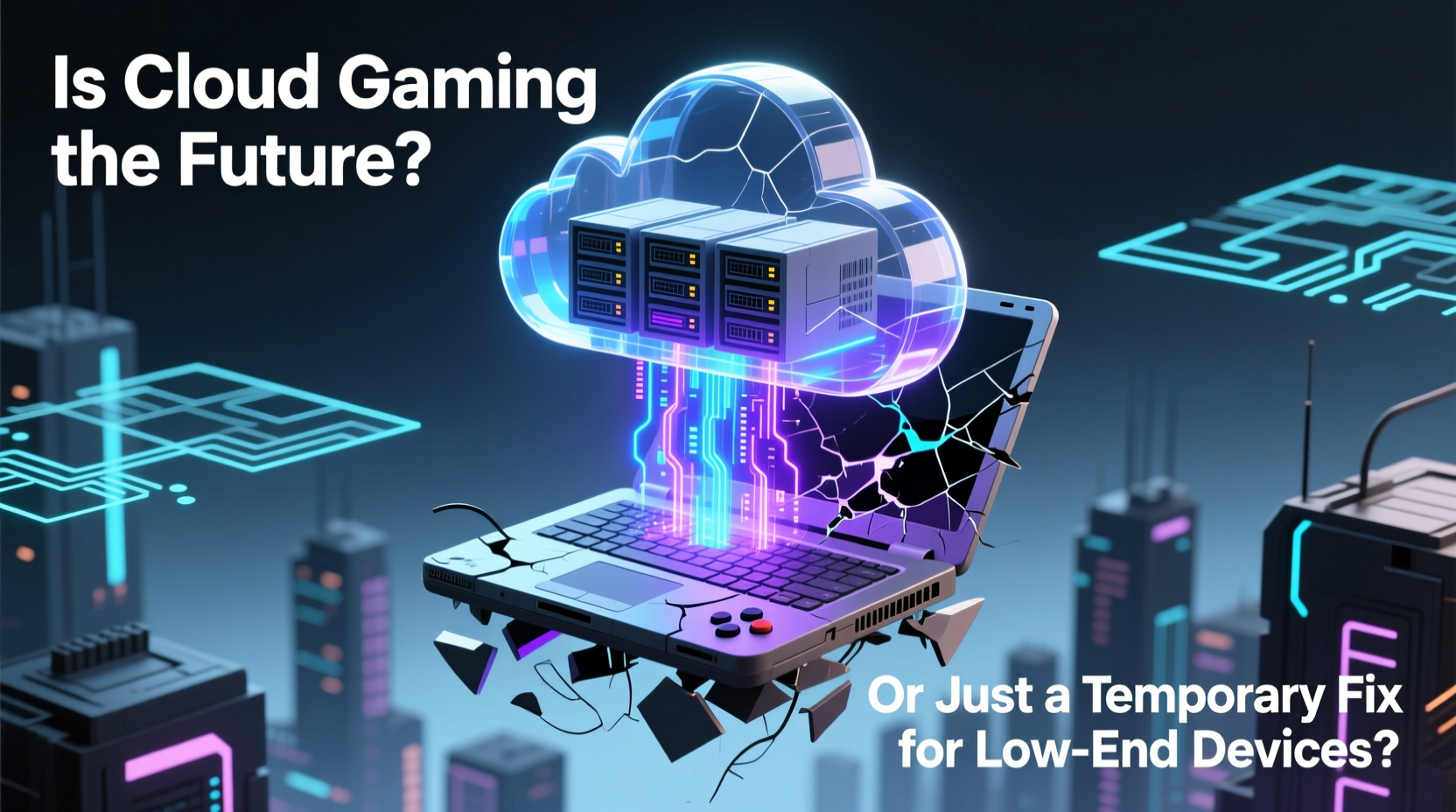
At its core, cloud gaming operates on a simple principle: computation happens in data centers, not on your device. When you press a button on your controller, that input is sent over the internet to a server running the game. The server renders the next frame, encodes it into a video stream, and sends it back to your screen. All of this occurs in milliseconds—if everything works perfectly.
This process relies on three key components:
- Data Centers: Equipped with high-end GPUs and optimized virtual machines, these facilities run games 24/7.
- Streaming Protocols: Technologies like Google’s Stadia, NVIDIA’s GeForce NOW, or Microsoft’s xCloud use proprietary compression (often based on WebRTC or HLS) to minimize latency and bandwidth usage.
- End Devices: Any screen with a compatible browser or app can become a gaming terminal—phones, tablets, smart TVs, or even Raspberry Pis.
The appeal is clear: a $200 Chromebook can play Cyberpunk 2077 if the heavy lifting is done remotely. But performance hinges on network quality. Even a 50ms spike in latency can make fast-paced shooters feel sluggish or unresponsive.
Advantages: Why Cloud Gaming Appeals to Millions
Cloud gaming isn’t just about convenience—it represents a fundamental shift in how we access software. Its strongest advantages include:
- Lower Entry Cost: No need to invest $1,000+ in a gaming PC. Subscription models (e.g., Xbox Game Pass Ultimate at $18/month) bundle access to hundreds of titles.
- Cross-Device Continuity: Start a game on your phone during a commute, resume on your TV at home—progress syncs seamlessly.
- No Downloads or Updates: Games launch instantly. Patches and updates are handled server-side, eliminating hours of waiting.
- Environmental Efficiency: Centralized computing can reduce e-waste by extending the life of older devices.
- Democratization of Access: Gamers in regions where consoles are prohibitively expensive can now participate.
In emerging markets like India or Southeast Asia, where smartphone penetration far exceeds PC ownership, cloud gaming offers a viable gateway to AAA experiences. Services like Boosteroid and Blacknut are already gaining traction in schools and households with limited hardware.
Challenges and Limitations: The Other Side of the Coin
Despite its promise, cloud gaming faces significant hurdles that prevent mass adoption—at least in the near term.
| Challenge | Description | Impact |
|---|---|---|
| Latency | Input delay due to round-trip data transmission | Makes competitive gaming difficult; noticeable lag in fast-response games |
| Broadband Requirements | Stable 15–25 Mbps for 1080p streaming | Excludes rural areas or regions with poor infrastructure |
| Data Caps | Streaming consumes ~3–7 GB per hour | Risks exceeding ISP limits, leading to throttling or extra fees |
| Service Longevity | Platforms like Google Stadia shut down despite investment | Users lose access to purchased games if service closes |
| Ownership Model | Games are licensed, not owned | Lack of resale rights, region locks, or delisting risks |
Moreover, not all games translate well to streaming. Titles requiring precise timing—racing sims, fighting games, or rhythm games—are particularly sensitive to micro-delays. Even with 5G and edge computing reducing latency, physics simulations and AI behaviors processed remotely may never match local fidelity.
“Cloud gaming shifts the bottleneck from hardware to connectivity. In theory, everyone wins. In practice, only those with fiber-grade internet do.” — Dr. Lena Torres, Network Optimization Researcher at MIT
Case Study: A Filipino Student’s Experience with Cloud Gaming
Rafael, a 19-year-old university student in Cebu City, Philippines, dreamed of playing modern RPGs but couldn’t afford a gaming laptop. His school issued him a basic Android tablet with 3GB RAM. After discovering GeForce NOW through a friend, he signed up using his existing Steam library.
With a Wi-Fi connection averaging 12 Mbps and moderate congestion during peak hours, Rafael could stream games at 720p with acceptable performance. He played *The Witcher 3* and *Hades* during late evenings when network traffic dropped. However, during daytime lectures, the same connection struggled to maintain stable streams.
Over six months, he logged 80+ hours of gameplay without upgrading his device. But he also faced frustrations: disconnections during storms, inability to play online multiplayer reliably, and concerns about long-term subscription costs. Still, he views cloud gaming as “a lifeline”—not a permanent replacement, but a bridge until he can save enough for better hardware.
Rafael’s story reflects a growing global trend: cloud gaming isn’t replacing consoles or PCs; it’s expanding the definition of who gets to play.
The Road Ahead: Is This the Future?
To assess whether cloud gaming is the future, consider three evolving forces: infrastructure, consumer behavior, and industry investment.
Infrastructure is improving. 5G networks, low-orbit satellites (like Starlink), and edge computing nodes are reducing latency and increasing coverage. Within five years, sub-20ms response times may become standard in urban areas. Rural access remains a challenge, but initiatives like Facebook’s Express Wi-Fi and government broadband subsidies are narrowing the gap.
Consumer behavior is shifting toward subscription models. Millennials and Gen Z are more comfortable renting software than owning physical copies. Music (Spotify), video (Netflix), and now games (Game Pass, PS Plus) follow this pattern. Ownership is becoming less important than access.
Industry investment signals confidence. Microsoft continues integrating xCloud into Xbox ecosystems. Sony’s PlayStation Plus Premium includes streaming for PS5 titles. Even Nintendo has filed patents related to cloud functionality. These aren’t side projects—they’re central to long-term strategies.
Yet, hardware innovation hasn’t stalled. Consoles like the PS5 and next-gen handhelds (e.g., Steam Deck, ASUS ROG Ally) offer portable power that rivals mid-tier PCs. As semiconductor efficiency improves, high-end gaming may become affordable enough to undercut cloud subscriptions.
The most likely outcome? A hybrid future. Cloud gaming won’t replace local rendering entirely but will coexist as one option among many—ideal for casual play, travel, or secondary devices. High-fidelity, competitive, and modded gaming will still favor local machines.
Actionable Checklist: Getting Started with Cloud Gaming
If you're considering cloud gaming, follow this checklist to maximize your experience:
- ✅ Test your internet speed (aim for 25 Mbps download and <30ms ping)
- ✅ Connect via Ethernet or 5 GHz Wi-Fi (avoid crowded bands)
- ✅ Choose a service compatible with your device (GeForce NOW for PC/mobile, xCloud for Xbox/Android)
- ✅ Start with single-player or turn-based games to assess performance
- ✅ Monitor data usage—set alerts if you have a cap
- ✅ Use a supported controller (Xbox, DualSense, or cloud-certified models)
- ✅ Try free tiers first (e.g., GeForce NOW Free tier, Xbox Cloud Gaming with Game Pass)
Frequently Asked Questions
Can I play cloud games on a smartphone?
Yes. Most major platforms support Android and iOS devices. You’ll need a compatible controller (Bluetooth recommended) and a strong Wi-Fi or 5G connection. Performance varies by network stability, but many users enjoy titles like *Control* or *Death Stranding* on phones.
Do I own the games I buy for cloud platforms?
Not always. Some services allow linking existing libraries (e.g., Steam to GeForce NOW), meaning you retain ownership. Others operate entirely within closed ecosystems (e.g., Stadia store, now defunct). Always check licensing terms before purchasing.
Will cloud gaming work without an internet connection?
No. Unlike downloaded games, cloud gaming requires constant connectivity. There is no offline mode. However, some hybrid systems (like Xbox Smart Delivery) let you download games locally after trying them via cloud.
Conclusion: A Step Forward, Not the Final Destination
Cloud gaming is neither a fleeting fad nor a complete replacement for traditional gaming. It is a transformative layer—one that expands access, reduces friction, and redefines what’s possible on low-end devices. For millions around the world, it’s already a lifeline to experiences once out of reach.
But it’s not without trade-offs. Latency, data demands, and uncertain service longevity mean it won’t dominate the landscape anytime soon. Instead, it complements local hardware, offering flexibility rather than supremacy.
The future of gaming isn’t purely in the cloud or solely on your desktop—it’s wherever you want to play. By embracing both models, gamers gain unprecedented freedom. Whether you’re on a budget tablet or a custom-built rig, the game goes on.




 浙公网安备
33010002000092号
浙公网安备
33010002000092号 浙B2-20120091-4
Comments
No comments yet. Why don't you start the discussion?