
It’s a familiar scene: clothes piled on chairs, countertops buried under mail and gadgets, and a constant sense of mental fog. Many people instinctively feel better after a good cleaning or organizing session, but is there actual scientific evidence behind the claim that decluttering reduces stress? The answer, backed by psychology, neuroscience, and behavioral studies, is a resounding yes. Physical clutter doesn’t just occupy space—it occupies your mind. Research consistently shows that disorganized environments increase cortisol levels, impair focus, and contribute to feelings of anxiety and helplessness. On the flip side, organized, minimal spaces are associated with improved mood, enhanced productivity, and greater emotional resilience.
This isn’t about achieving Instagram-worthy perfection. It’s about understanding how our surroundings shape our internal state. From brain function to hormonal balance, the science reveals a direct pathway between external order and internal calm. What you keep—and what you let go of—matters more than you might think.
The Science Behind Clutter and Stress
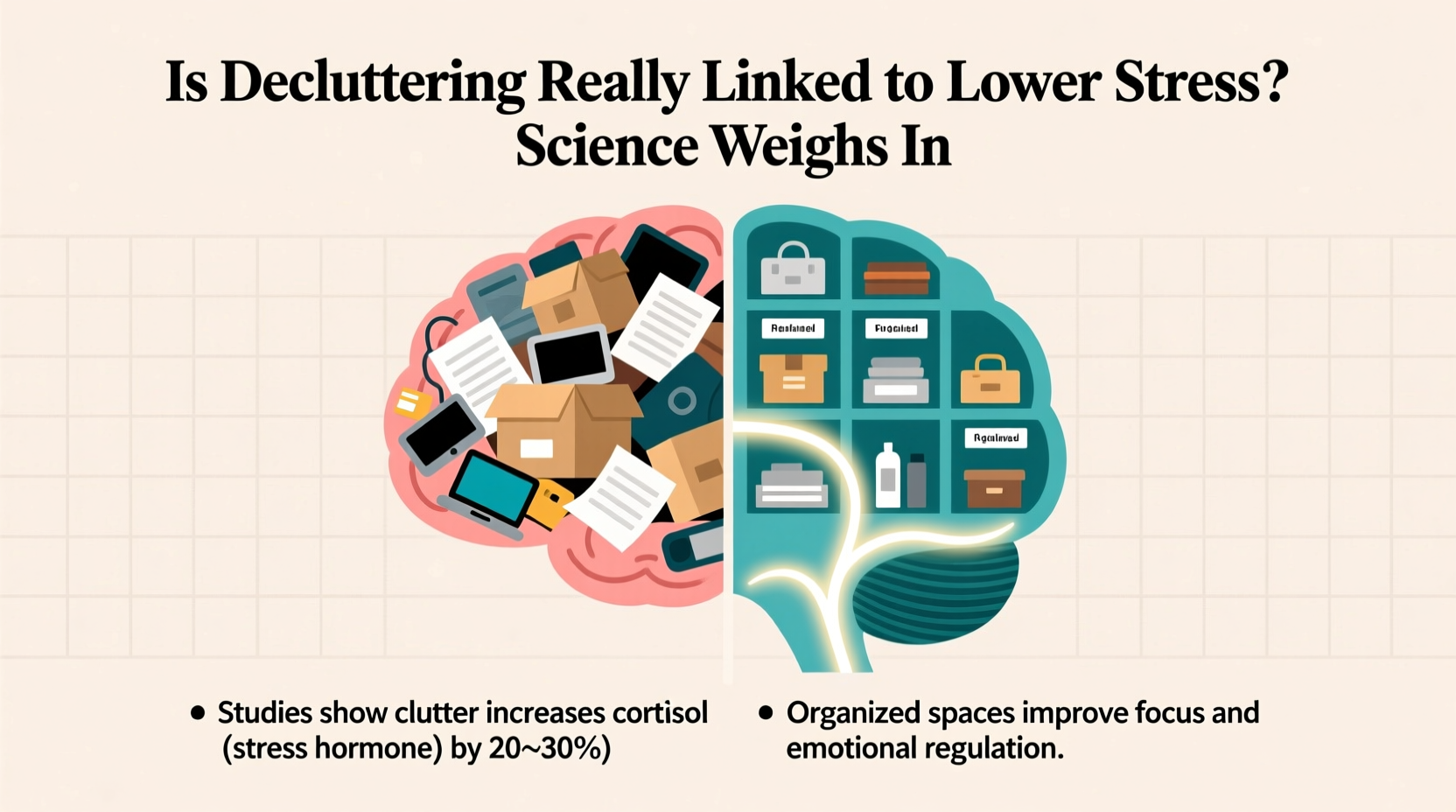
Multiple studies have explored the relationship between physical environments and psychological well-being. One landmark study from UCLA’s Center on Everyday Lives of Families (CELF) found that women who described their homes as cluttered had higher levels of cortisol, the primary stress hormone, especially later in the day. Researchers observed that visual clutter creates cognitive overload—our brains are constantly processing stimuli, and when surfaces are crowded with objects, attention becomes fragmented.
Neuroscientists refer to this phenomenon as “attentional fatigue.” Every item in your peripheral vision competes for neural resources. A kitchen counter stacked with appliances, a desk covered in papers, or a hallway filled with shoes all force your brain to work harder to filter irrelevant information. Over time, this low-grade cognitive strain accumulates, contributing to irritability, decision fatigue, and reduced problem-solving ability.
Dr. Sherrie Bourg Carter, a psychologist specializing in stress and burnout, explains:
“Clutter bombards our minds with excessive stimuli, causing our brains to work overtime processing multiple streams of information. This can lead to feeling overwhelmed, anxious, and unable to relax—even if we’re not consciously aware of it.”
Moreover, clutter often symbolizes unfinished tasks or unresolved decisions—unpaid bills, unworn clothes, unused gadgets. These items become silent reminders of obligations, triggering subconscious guilt or avoidance. The longer they remain, the heavier the psychological burden grows.
How Decluttering Rewires Your Brain
When you begin to remove physical clutter, you’re not just tidying up—you’re altering your brain’s chemistry and structure. Functional MRI studies show that organized environments activate the prefrontal cortex, the area responsible for focus, planning, and emotional regulation. In contrast, chaotic spaces tend to overstimulate the amygdala, which governs fear and threat responses.
A 2020 study published in the Journal of Environmental Psychology demonstrated that participants in minimalist rooms reported significantly lower anxiety and greater feelings of control compared to those in cluttered settings. Even brief exposure—just 15 minutes in a tidy room—was enough to improve mood and reduce subjective stress.
Decluttering also supports dopamine production. Completing small organizational tasks—like sorting a drawer or recycling old documents—triggers micro-rewards in the brain. This reinforces motivation and creates a positive feedback loop: the more you organize, the better you feel, and the more likely you are to continue.
Real-Life Impact: A Mini Case Study
Sarah, a 38-year-old project manager and mother of two, spent months feeling constantly drained. Despite getting enough sleep and exercising regularly, she struggled with evening anxiety and difficulty focusing. Her home office—a converted closet—was crammed with files, children’s artwork, and outdated electronics. After reading about the link between clutter and cortisol, she decided to dedicate one weekend to reorganizing the space.
She began by removing everything, sorting into four categories: keep, donate, recycle, discard. She installed shelves, labeled storage bins, and cleared her desk surface completely. Within 48 hours of finishing, Sarah noticed a shift. “I walked into the room and actually took a deep breath,” she said. “It felt like I could finally think again.”
Over the next three weeks, she tracked her mood using a journal. She reported fewer nighttime ruminations, improved concentration during work calls, and a 30% reduction in self-reported stress levels. While other lifestyle factors remained unchanged, Sarah attributed the difference primarily to her newly organized workspace.
Her experience aligns with broader research: environmental control enhances perceived personal control, a key factor in stress resilience.
Practical Steps to Declutter for Mental Well-Being
Knowing the science is one thing; applying it is another. Here’s a step-by-step approach grounded in behavioral psychology to make decluttering sustainable and effective.
- Start small. Choose a single drawer, shelf, or corner. Avoid overwhelming yourself with entire rooms at first.
- Set a timer for 20 minutes. Use the “Pomodoro” method: focused bursts prevent burnout and increase completion rates.
- Sort ruthlessly. Ask: Have I used this in the past year? Does it serve a purpose or bring joy? If not, let it go.
- Create designated zones. Assign specific places for keys, mail, devices. Clear zones reduce decision fatigue.
- Maintain daily. Spend 5–10 minutes each evening returning items to their homes. Consistency prevents buildup.
For digital clutter—emails, photos, apps—the same principles apply. Unsubscribe from newsletters you don’t read, delete duplicate files, and organize folders with clear labels. Digital chaos contributes just as much to mental load as physical mess.
Do’s and Don’ts of Effective Decluttering
| Do’s | Don’ts |
|---|---|
| Focus on functionality—keep what you use regularly. | Try to declutter while emotionally overwhelmed or tired. |
| Use containers with labels for easy access. | Hold onto items out of guilt or obligation (“my aunt gave this to me”). |
| Involve family members in shared spaces to maintain consistency. | Expect perfection—progress matters more than flawlessness. |
| Donate or sell usable items to reinforce positive behavior. | Store sentimental items in hard-to-reach places; rotate them seasonally instead. |
| Reassess every 3–6 months to prevent accumulation. | Keep “just in case” items unless truly essential (e.g., emergency supplies). |
Expert Insight: What Professionals Say
Dr. Sabine Kastner, a cognitive neuroscientist at Princeton University, led research showing that multiple objects in a visual field compete for neural representation. Her team concluded:
“A clean and organized environment allows the brain to focus efficiently on tasks without distraction. Clutter forces the brain to multitask even when you’re trying to do one thing.”
Lisa Woodruff, an occupational therapist and founder of OrganizeMe25.com, emphasizes habit formation:
“People fail not because they lack willpower, but because they lack systems. The goal isn’t a spotless home—it’s creating routines that make maintaining order effortless.”
These insights underscore a crucial point: decluttering isn’t a one-time event. It’s a lifestyle adjustment supported by neuroscience and behavioral design.
Frequently Asked Questions
Does minimalism work for everyone?
Minimalism, as a strict philosophy, may not suit every personality or household. However, the core principle—intentional ownership—benefits everyone. You don’t need to own 100 items to gain the mental benefits of decluttering. Even reducing clutter by 30–40% can significantly lower stress and improve focus.
What if I feel guilty throwing things away?
Guilt is common, especially with gifts or inherited items. Try reframing: keeping something out of obligation dishonors its purpose. If you’re not using it, it’s not serving you. Consider photographing sentimental items before letting them go, or repurpose them in meaningful ways (e.g., turning a sweater into a pillow). Donation also provides a positive narrative—someone else may benefit from what no longer serves you.
Can decluttering help with anxiety disorders?
While decluttering is not a substitute for therapy or medication, it can be a powerful complementary tool. For individuals with generalized anxiety or ADHD, structured environments reduce cognitive load and provide external cues for regulation. Therapists often recommend environmental modifications as part of treatment plans for anxiety, depression, and executive dysfunction.
Action Plan: Your 7-Day Decluttering Challenge
To harness the stress-reducing power of decluttering, follow this realistic weekly plan:
- Day 1: Clear your nightstand. Keep only essentials: lamp, book, glasses, water. Remove everything else.
- Day 2: Tackle one kitchen drawer or cabinet. Discard expired items, consolidate duplicates.
- Day 3: Organize your digital desktop and phone home screen. Delete unused apps and organize icons into folders.
- Day 4: Sort your entryway. Designate spots for keys, bags, and shoes. Remove anything that doesn’t belong.
- Day 5: Go through your wardrobe. Pull out clothes you haven’t worn in a year. Donate or recycle.
- Day 6: Address paper clutter—bills, receipts, school handouts. Shred unnecessary documents; file the rest.
- Day 7: Create a maintenance routine. Set a daily 5-minute tidy-up and schedule monthly check-ins.
Conclusion: Take Control of Your Space, Transform Your Mindset
The connection between clutter and stress is not anecdotal—it’s physiological. Scientific evidence clearly shows that disordered environments elevate stress hormones, disrupt focus, and undermine emotional well-being. Conversely, intentional organization fosters clarity, control, and calm. You don’t need a perfectly curated home to benefit. Even modest improvements in organization can yield measurable reductions in anxiety and mental fatigue.
Decluttering is an act of self-care. It’s about creating space—not just in your home, but in your mind. When your environment supports rather than competes with your goals, you reclaim energy, attention, and peace. Start small, stay consistent, and notice the shift. The path to lower stress begins with one drawer, one decision, one deep breath in a room that finally feels like yours.




 浙公网安备
33010002000092号
浙公网安备
33010002000092号 浙B2-20120091-4
Comments
No comments yet. Why don't you start the discussion?