
In an era where energy bills are climbing and environmental awareness is growing, many homeowners look to their air conditioners for relief — not just from heat, but from high electricity costs. One feature that’s become standard across modern AC units is “Eco Mode.” Promoted as a way to reduce energy consumption without sacrificing comfort, it sounds like the perfect compromise. But does it actually save money, or is it simply making your home cool more slowly while pretending to be efficient?
The truth lies somewhere in between. Eco Mode isn’t magic, but when used correctly, it can deliver meaningful savings. However, misunderstanding how it works often leads to frustration — especially on sweltering days when cooling seems sluggish. Let’s demystify what Eco Mode really does, how much it saves, and whether it's worth relying on during peak summer months.
What Exactly Is Eco Mode on an Air Conditioner?
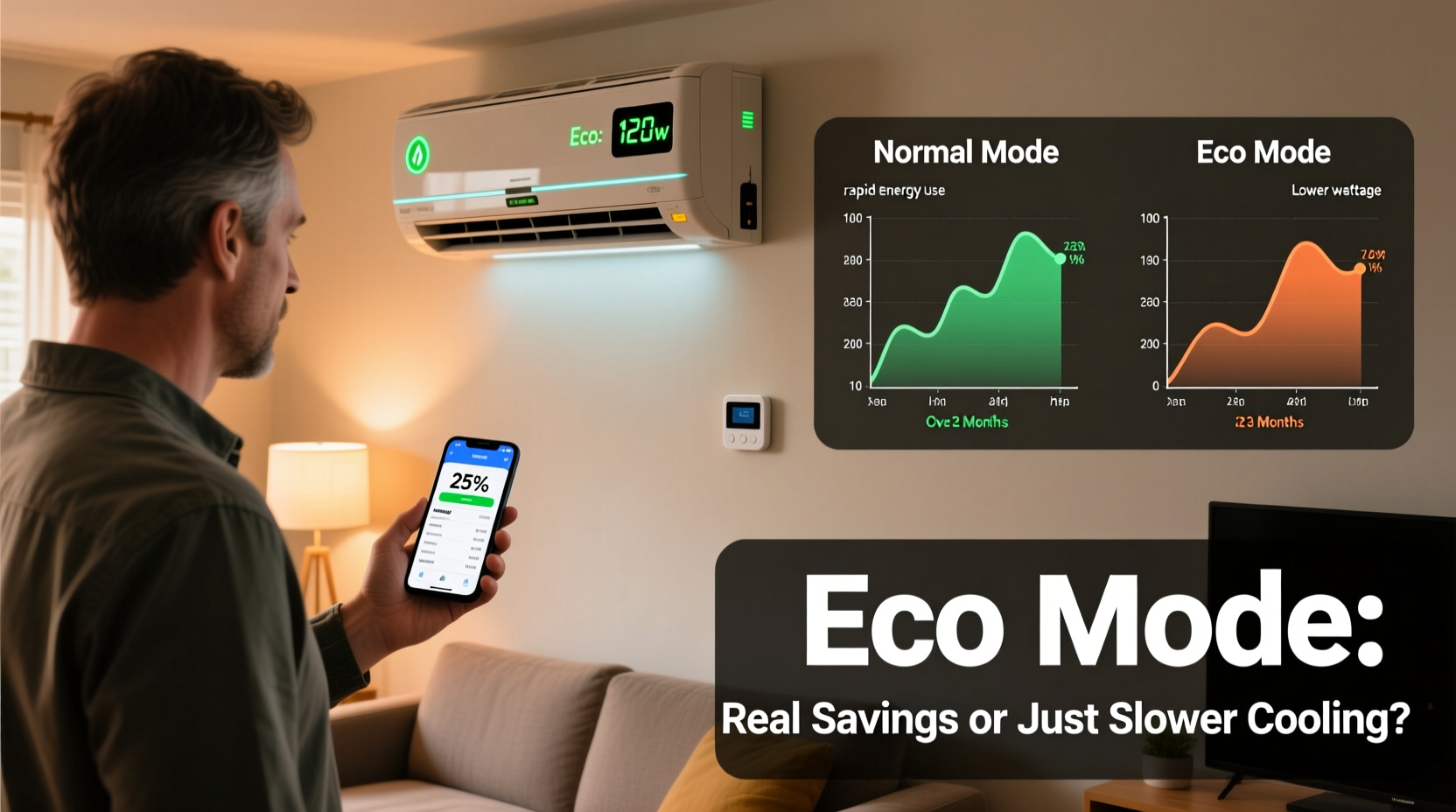
Eco Mode — sometimes labeled as “Energy Saver,” “Economy Mode,” or “Smart Cooling” — is a built-in function designed to optimize energy use. It doesn’t turn off your AC completely; instead, it adjusts its operation to minimize power consumption over time. The exact behavior varies by brand and model, but most implementations follow one of two primary strategies:
- Fan Cycling: Once the set temperature is reached, the compressor shuts off, but the fan continues to run intermittently to circulate air. This avoids constant compressor cycling, which consumes more energy.
- Temperature Adjustment: Some models automatically raise the thermostat setting by 1–2°F after reaching the desired temperature, reducing runtime and strain on the system.
Unlike standard cooling mode, where the AC runs at full power until the target temperature is hit and then restarts when the room warms slightly, Eco Mode introduces smarter pauses and recalibrations. Think of it as shifting from sprinting to steady jogging — less intense, but potentially more sustainable over long periods.
How Much Energy Does Eco Mode Actually Save?
Manufacturers often claim energy savings of up to 20–30% with Eco Mode enabled. While these figures aren't entirely misleading, they represent ideal conditions — moderate outdoor temperatures, well-insulated rooms, and consistent usage patterns.
Independent testing and consumer reports suggest a more realistic range of **10–15% energy reduction** under typical household conditions. For example, a 2023 study by the American Council for an Energy-Efficient Economy (ACEEE) analyzed 12 popular window and split-system AC units and found average savings of 12.7% over a two-week period using Eco Mode versus continuous cooling.
To put this into dollar terms: if your air conditioner uses about $50 worth of electricity per month during summer, switching to Eco Mode could save roughly $5–$7 monthly. Over a five-month cooling season, that adds up to **$25–$35 in savings per unit** — not life-changing, but far from negligible.
“Eco Mode won’t replace proper insulation or efficient equipment, but it’s a low-effort way to trim energy waste.” — Dr. Lena Patel, HVAC Efficiency Researcher at the National Renewable Energy Laboratory
Does Eco Mode Slow Down Cooling? (Spoiler: Yes, Sometimes)
This is where user frustration often sets in. On a 95°F afternoon, turning on your AC only to feel lukewarm air trickling through the vents can make Eco Mode seem like a scam. But here’s the reality: yes, Eco Mode typically slows the initial cooling process — intentionally.
Why? Because rapid cooling requires maximum compressor output, which draws peak power. Eco Mode limits this surge by moderating startup intensity or allowing slight temperature fluctuations before re-engaging. In technical terms, it prioritizes efficiency over speed.
Consider this real-world scenario:
Mini Case Study: Maria’s Weekend Dilemma
Maria lives in Phoenix, Arizona, where summer afternoons regularly exceed 105°F. She returned home one Saturday to a living room reading 88°F and immediately turned on her wall-mounted AC. With Eco Mode activated, she expected comfort within 15 minutes. Instead, it took nearly 40 minutes to drop to 78°F.
Frustrated, she switched to regular cooling mode. Within 20 minutes, the room was comfortably cool — but her next electricity bill showed a noticeable spike compared to previous weekends.
The lesson? Eco Mode excels at maintaining temperature, not recovering from heat buildup. Had Maria turned on the AC earlier — say, midday while she was out — Eco Mode would have kept the space stable with minimal energy use. But used reactively in extreme heat, it struggles to catch up.
When Eco Mode Works Best (And When It Doesn’t)
Like any tool, Eco Mode performs optimally under specific conditions. Understanding these helps you decide when to use it — and when to override it for better comfort.
| Situation | Recommended Mode | Reason |
|---|---|---|
| Overnight cooling | Eco Mode | Temperatures are milder; gradual cooling maintains comfort without noise or energy spikes. |
| Home during moderate weather (75–85°F) | Eco Mode | AC doesn’t need to work hard; efficiency gains are maximized. |
| Returning to a hot house (>85°F) | Regular Cooling | Eco Mode will take too long; use full power initially, then switch modes once cooled. |
| Leaving home for several hours | Eco Mode (if auto-scheduling available) | Some smart thermostats pair Eco Mode with occupancy sensing to avoid overcooling empty spaces. |
| High humidity environments | Cautious use of Eco Mode | Reduced runtime may limit dehumidification, leading to clammy air even at lower temps. |
Step-by-Step Guide to Maximizing Savings with Eco Mode
You don’t have to choose between comfort and savings. Follow this practical sequence to get the best of both worlds:
- Assess your daily schedule. Identify times when you’re away from home or sleeping — periods when immediate cooling isn’t essential.
- Pre-cool your space. Turn on the AC in regular mode 30–60 minutes before peak heat arrives (e.g., early afternoon), then switch to Eco Mode once the desired temperature is reached.
- Use programmable settings. If your AC has a timer or smart thermostat integration, program it to enter Eco Mode automatically during predictable low-demand periods.
- Pair with fans. Ceiling or portable fans allow you to set the thermostat higher without feeling warmer, enhancing Eco Mode’s effectiveness.
- Monitor your bill. Track monthly kWh usage before and after adopting Eco Mode. Small changes add up — but verify them with data.
Common Misconceptions About Eco Mode
Despite its prevalence, Eco Mode is widely misunderstood. Here are three myths that need debunking:
- Myth 1: “Eco Mode turns off the AC completely.”
Reality: It reduces activity, but rarely shuts down entirely. The fan may continue running to maintain airflow. - Myth 2: “It works the same on all brands.”
Reality: Implementation varies. LG’s Eco Mode disables the compressor above certain temperatures, while Daikin uses it to modulate fan speed. Always consult your manual. - Myth 3: “It replaces the need for maintenance.”
Reality: A dirty filter or clogged coil will negate any efficiency gain from Eco Mode. Regular upkeep is non-negotiable.
Checklist: Using Eco Mode Effectively
Before relying on Eco Mode, ensure you’ve covered the basics:
- ✅ Clean or replace air filters monthly during heavy use
- ✅ Seal windows and doors to prevent cooled air leakage
- ✅ Use curtains or blinds to block direct sunlight
- ✅ Set thermostat no lower than 75°F when using Eco Mode
- ✅ Test Eco Mode during mild weather first to gauge performance
- ✅ Pair with a ceiling fan for enhanced perceived cooling
- ✅ Avoid using Eco Mode during sudden heatwaves or high-humidity days unless pre-cooling has occurred
FAQ: Your Top Questions Answered
Does Eco Mode damage my AC over time?
No, Eco Mode does not harm your air conditioner. In fact, by reducing compressor runtime and minimizing frequent on/off cycles, it may extend the lifespan of key components. However, if the unit is already underperforming due to poor maintenance, Eco Mode might mask underlying issues rather than solve them.
Can I use Eco Mode with a smart thermostat?
Yes, and it’s often more effective. Smart thermostats like Nest or Ecobee can learn your habits and apply Eco Mode intelligently — for instance, switching to energy-saving mode when no one is home, then resuming normal cooling 30 minutes before arrival. This automation removes guesswork and improves results.
Is Eco Mode worth it for central air systems?
It depends. Central AC systems often have advanced zoning and variable-speed compressors that inherently operate efficiently. In such cases, dedicated “Eco” settings may offer marginal improvements. However, if your system includes a basic thermostat without adaptive recovery features, enabling Eco Mode (or programming setbacks manually) can still yield savings of 10% or more annually.
Final Verdict: Saving Money vs. Slower Cooling
Eco Mode on an air conditioner does save money — typically around 10–15% on cooling costs — but it achieves this by tempering performance, especially during initial cooldown phases. It’s not a flaw; it’s a trade-off. You’re exchanging instant, aggressive cooling for sustained, moderated operation that reduces energy waste.
The key to success lies in timing and expectations. Use Eco Mode proactively, not reactively. Let it maintain comfort in already-cooled spaces rather than rescue you from a heat-soaked room. Combine it with good insulation, shading, and supplemental fans, and you’ll maximize both comfort and savings.
For households looking to cut utility bills without upgrading equipment, Eco Mode is a simple, no-cost adjustment that delivers real benefits — as long as you understand its role. It’s not a shortcut to cold air; it’s a strategy for smarter cooling.




 浙公网安备
33010002000092号
浙公网安备
33010002000092号 浙B2-20120091-4
Comments
No comments yet. Why don't you start the discussion?