
For many households, the first weekend of December marks an unofficial holiday threshold: lights strung, ornaments unwrapped, and the scent of pine filling the air. Yet a quiet tension lingers — especially among churchgoers, tradition-minded families, or those raised with strict liturgical calendars. “Isn’t it too early?” “Doesn’t it jinx the season?” “My grandmother said it invites misfortune.” These aren’t just passing remarks. They echo centuries-old customs that intertwine faith, folklore, and agrarian memory. To ask whether putting up a Christmas tree before Advent is “bad luck” is to open a door into medieval devotion, Victorian reinvention, and the quiet resilience of regional belief systems — not superstition in the pejorative sense, but lived meaning shaped by time, scarcity, and sacred anticipation.
The Roots of the Belief: Advent as Sacred Threshold
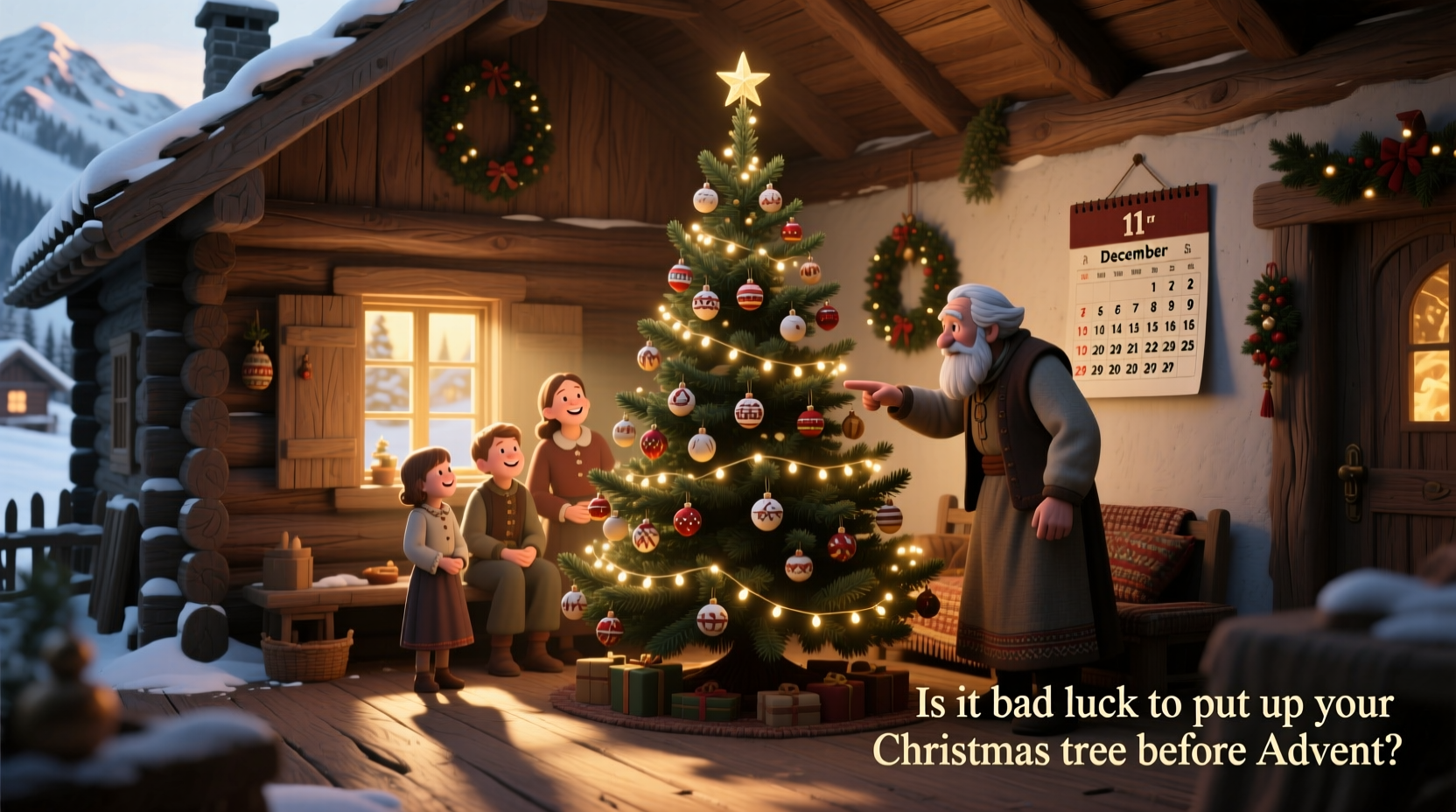
Advent — the four-week period preceding Christmas Day — originates in the 4th century as a season of preparation, penitence, and expectant waiting. Its Latin root adventus means “coming” or “arrival,” referring specifically to Christ’s coming in humility at Bethlehem and his promised return in glory. In early Western monastic practice, Advent began on St. Martin’s Day (November 11), a date still observed in parts of Germany and Austria as Martinstag, when children carry lanterns and sing carols — but no trees appear. The liturgical color violet (or sometimes blue) signals solemnity; the Advent wreath’s candles are lit progressively, each flame marking a deepening commitment to reflection over revelry.
Folklore surrounding early decoration grew organically from this theological framework. In rural England, Wales, and Ireland, the notion persisted that “decorating too soon invites the wrong kind of attention” — not from ghosts or goblins, but from spiritual forces that thrive where sacred boundaries blur. As historian Dr. Eleanor Voss notes in Ritual Time in Northern Europe, “The pre-Advent weeks weren’t considered empty space — they were charged with their own purpose: the quiet work of inner readiness. Introducing festive symbols prematurely wasn’t seen as frivolous; it was understood as a disruption of cosmic rhythm.” This view wasn’t codified in doctrine but transmitted through generations via proverbs, weather lore, and domestic ritual — for example, the widespread belief that holly gathered before St. Thomas’s Day (December 21) would wilt by Christmas Eve, its vitality sapped by untimely harvesting.
How the Tree Entered the Scene — and When It Didn’t
The Christmas tree as we know it is surprisingly young — a 19th-century convergence of German piety, British royal influence, and American commercial adaptation. While evergreen boughs were used across pre-Christian Europe for winter solstice rites — symbolizing endurance amid death — the upright, decorated fir tree gained Christian meaning only gradually. In 16th-century Alsace, records show guilds erecting trees in town squares on December 24, adorned with apples (echoing Eden), wafers (symbolizing the Eucharist), and candles (Christ as Light). Crucially, these trees were erected *on* Christmas Eve — the culmination of Advent, not its beginning.
It wasn’t until the 1840s that the custom crossed into mainstream British consciousness, thanks to Queen Victoria and Prince Albert’s widely published illustration in the Illustrated London News. Even then, etiquette manuals like Mrs. Beeton’s Book of Household Management (1861) advised setting up the tree “on the Saturday before Christmas Day,” aligning with the final days of Advent. In contrast, American practice evolved differently: department stores like Macy’s began promoting tree sales in late November by the 1920s, and radio broadcasts of carols from Rockefeller Center — inaugurated in 1933 — normalized public tree lighting in late November, decoupling the act from liturgical timing.
Folklore Across Regions: What ‘Bad Luck’ Actually Meant
“Bad luck” was never a monolithic concept — its definition shifted dramatically by geography, denomination, and social class. Below is a comparative summary of documented regional beliefs tied to early tree erection:
| Region / Tradition | Timing Considered Risky | Perceived Consequence | Historical Source / Record |
|---|---|---|---|
| German Lutheran villages (Black Forest) | Before December 13 (St. Lucy’s Day) | Unsettled weather through winter; livestock falling ill | Local parish chronicles, 1782–1845 |
| Rural County Kerry, Ireland | Before December 1 | “The blessing won’t settle” — family arguments, missed opportunities | Irish Folklore Commission field notes, 1937 |
| Northern England (Yorkshire dales) | Before St. Andrew’s Day (Nov 30) | Tree branches drooping or needles shedding prematurely | Oral history interviews, 1989, University of Leeds |
| Catholic communities in Quebec | Before First Sunday of Advent | Diminished spiritual fruitfulness in the coming year | Parish bulletins, 1950s–60s |
| Scandinavian Lutheran parishes | Before the start of the “Four Sundays of Waiting” | Loss of reverence for Christmas Day itself | Liturgical handbooks, Church of Sweden, 19th c. |
Note how consequences rarely involve catastrophe — no curses, no hauntings. Instead, they reflect a worldview in which time is sacramental: actions performed out of season disrupt harmony between human practice and divine order. The “bad luck” is less supernatural punishment and more ecological or relational imbalance — a subtle warning that rushing joy may dilute its depth.
A Modern Reality Check: Data, Psychology, and Practicality
Today, approximately 42% of U.S. households erect their tree before the first Sunday of Advent (which falls between November 27 and December 3), according to the National Retail Federation’s 2023 Holiday Pulse Survey. In the UK, the average setup date is November 29. Yet studies from the University of Exeter’s Centre for Wellbeing in Cultures reveal no statistical correlation between early tree decoration and increased household stress, financial strain, or interpersonal conflict — factors often culturally conflated with “bad luck.” What the research does find is a strong link between *intentionality* and satisfaction: respondents who consciously chose a date aligned with personal values (e.g., “We decorate the day after Thanksgiving so our college-aged kids can help”) reported higher seasonal wellbeing than those who followed external pressure (“Everyone else did it, so we did too”).
“The idea that timing alone brings misfortune misunderstands how meaning works. Ritual power lies not in the calendar square you check off, but in the coherence between action, belief, and community. A tree erected on November 20 with gratitude and shared labor carries more sacred weight than one set up December 1 in distracted haste.” — Rev. Dr. Miriam Chen, Liturgical Theologian and Director of the Anglican Centre for Liturgy & Culture
This insight reframes the question. It’s not whether early decoration is “bad luck,” but whether it serves your household’s emotional, spiritual, and practical needs — and whether it honors the people and traditions most meaningful to you.
Practical Guidance: Navigating Tradition and Modern Life
There is no universal rule — only thoughtful navigation. Below is a step-by-step timeline designed for families, faith communities, and individuals seeking balance between heritage and contemporary reality:
- Clarify your ‘why’ (by October 31): Ask: Is this about honoring family roots? Observing liturgical discipline? Accommodating travel schedules? Creating joyful momentum? Write it down.
- Consult your tradition (by November 10): If part of a religious community, review its Advent resources. Many Catholic, Anglican, Lutheran, and Orthodox parishes now offer flexible toolkits — including “Advent at Home” calendars that begin November 27 but include optional “preparatory” reflections for earlier dates.
- Choose your symbolic threshold (by November 15): Decide what date or event will mark your personal beginning — e.g., “the first frost,” “after parent-teacher conferences,” “the Sunday before Thanksgiving.” Anchor it in something tangible, not arbitrary.
- Set intentional boundaries (by November 20): Agree on practices that preserve Advent’s character — e.g., no Christmas music until December 1; tree lights remain off until Gaudete Sunday (Third Sunday of Advent); ornaments stay in boxes until the chosen date.
- Mark transition, not just arrival (December 1 or First Sunday of Advent): Hold a brief family ritual — lighting a candle, reading Isaiah 9:2, sharing one hope for the season — to distinguish preparation from celebration.
Mini Case Study: The O’Sullivan Family of Galway
For three generations, the O’Sullivans hung their tree on December 1 — a compromise between their Catholic parish’s Advent emphasis and their children’s school schedule. But in 2021, their eldest daughter returned from university in Berlin speaking passionately about Adventszeit, the German cultural practice of slow, sensory Advent — baking stollen weekly, using an Advent calendar with small acts of kindness, and keeping the tree undecorated until December 23. Her parents listened, then invited extended family to a “Threshold Evening” on November 27: mulled cider, readings from the Prophet Isaiah, and the quiet placing of an unlit, undecorated spruce in the corner — wrapped in burlap, with a single beeswax candle beside it. No ornaments. No lights. Just presence. By December 23, when they finally decorated together, the tree felt earned — not rushed. “We didn’t avoid ‘bad luck,’” says mother Maeve. “We made room for the waiting to mean something.”
FAQ
Does the Catholic Church prohibit putting up a tree before Advent?
No. The Vatican’s Directory on Popular Piety and the Liturgy (2001) affirms Christmas trees as “a sign of life amid winter’s death,” encouraging their use while urging that “they not obscure the centrality of the crib or the theological focus of Advent.” There is no canonical penalty or prohibition tied to timing.
Are there denominations that actively encourage early decoration?
Yes. Many evangelical and non-denominational churches in North America treat the entire November–December period as “Christmas outreach season,” using decorated trees in lobbies and homes as visible invitations to celebrate Christ’s birth. Their emphasis is on accessibility and evangelism rather than liturgical precision.
If I’m not religious, does the folklore still apply to me?
Folklore loses binding force outside its original context — but its wisdom remains relevant. The underlying insight — that rushing celebration can erode its resonance — applies universally. Psychologists call this “hedonic adaptation”: the faster we access pleasure, the less intensely we feel it. Delaying certain joys (like tree decorating) can renew our capacity for wonder — regardless of belief.
Conclusion
The question “Is it bad luck to put up your Christmas tree before Advent?” has never been about calendars — it’s about conscience, continuity, and care. Folklore doesn’t vanish because it’s old; it endures because it encodes hard-won human truths about rhythm, restraint, and reverence. Whether you choose November 27 or December 23, the real measure isn’t the date on your phone, but the attention you bring to the act: the laughter as tinsel catches light, the quiet awe when the first branch is placed, the shared breath before the first ornament hangs. That’s where meaning lives — not in the ticking clock, but in the beating heart.




 浙公网安备
33010002000092号
浙公网安备
33010002000092号 浙B2-20120091-4
Comments
No comments yet. Why don't you start the discussion?