
Keys are among the most frequently used personal items, yet their organization is often overlooked. Whether jingling in your pocket or tucked into a bag, how you manage your keys impacts daily efficiency, stress levels, and even security. The debate between using one consolidated keychain versus multiple separate ones isn’t just about preference—it’s about functionality, accessibility, and long-term habits. While some prioritize minimalism and simplicity, others value categorization and risk reduction. This article explores both approaches in depth, offering data-driven comparisons, real-world applications, and expert-backed strategies to help you make an informed decision.
The Single Keychain Approach: Simplicity and Efficiency
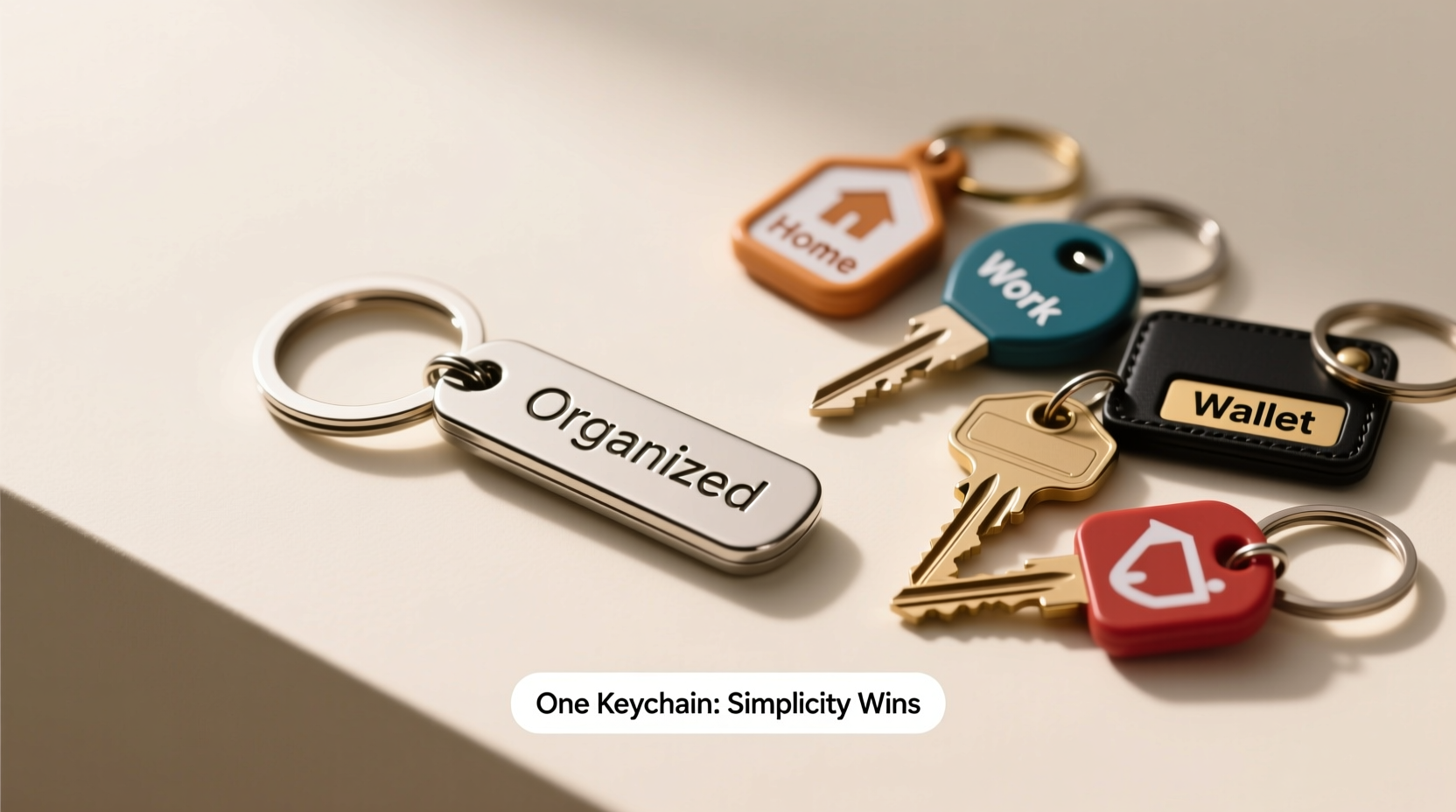
A single keychain consolidates all essential keys—house, car, office, mailbox—onto one ring or organizer. Advocates of this method emphasize ease of access and reduced clutter. With everything in one place, there’s no second-guessing which set you grabbed before leaving home. This system aligns well with minimalist lifestyles and routines where speed matters, such as morning commutes or emergency departures.
However, drawbacks emerge as the number of keys grows. A bulky chain can be uncomfortable in pockets, difficult to navigate when searching for a specific key, and prone to tangling. Over time, excessive weight may cause strain on key rings or even damage delicate key mechanisms.
The Multiple Keychains Strategy: Organization Through Separation
Using multiple keychains involves grouping keys by function, location, or frequency of use. For example, one chain might hold home-related keys (front door, garage, shed), another for work (office, supply closet), and a third for vehicle access. This method promotes intentional organization and reduces noise and bulk in everyday carry.
One major advantage is risk mitigation. Losing a single keychain doesn’t compromise every access point in your life. Additionally, sharing specific sets—like giving a partner only house keys without office access—becomes easier. Travelers also benefit; they can carry only what’s needed for a trip without lugging around irrelevant keys.
The trade-off lies in consistency. Without strict discipline, users may forget which chain holds certain keys, leading to confusion. It also requires more physical space—whether in bags, coat pockets, or at home storage—and introduces the possibility of misplacing an entire sub-set.
Comparative Analysis: Single vs. Multiple Keychains
| Factor | Single Keychain | Multiple Keychains |
|---|---|---|
| Convenience | High – one item to grab | Moderate – must choose correct set |
| Security Risk if Lost | High – all access compromised | Low – only subset exposed |
| Bulk & Comfort | Poor with many keys | Better distributed load |
| Organization Level | Low – mixed categories | High – grouped logically |
| Sharing Flexibility | Limited | High – selective distribution |
Expert Insight: What Professionals Recommend
“From a security and ergonomic standpoint, segmenting keys by environment significantly reduces vulnerability and wear. I recommend no more than five keys per carry chain.” — Daniel Reeves, Security Consultant and Access Systems Analyst
Reeves emphasizes that while convenience is important, overloading a single keychain increases both physical discomfort and exposure risk. He notes that businesses and institutions commonly use segmented key systems for precisely these reasons—why shouldn’t individuals?
Similarly, organizational psychologists point to cognitive load theory: having too many similar items in one cluster makes retrieval slower and more error-prone. Labeling or separating keys improves mental recall and reduces fumbling during high-pressure moments, such as arriving home late at night or rushing to unlock a car in bad weather.
Mini Case Study: Sarah’s Transition from Chaos to Control
Sarah, a project manager and mother of two, used to carry a massive keyring with over 12 keys—including spare house keys, gym lockers, old apartment entries, and tools. She frequently misplaced her keys or struggled to find the right one under stress. After locking herself out twice in one month, she consulted a productivity coach who recommended downsizing and segmentation.
She now uses three compact keychains: one for home (door, garage, shed), one for her car and work building, and a travel-specific set stored separately. Each contains labeled color-coded tags. Since the change, she reports faster access, fewer lost keys, and peace of mind knowing that losing one chain won’t leave her stranded everywhere.
Actionable Steps to Optimize Your Key System
- Inventory all your keys – Lay them out and identify active, duplicate, and obsolete ones.
- Categorize by usage – Group into themes: home, work, vehicle, seasonal, emergency.
- Limit each chain to 3–5 keys – Prioritize necessity and frequency.
- Use visual identifiers – Add colored caps, tags, or engraved labels.
- Store backups securely – Keep spare sets in a safe location, not attached to originals.
- Review quarterly – Remove keys no longer needed (e.g., past rentals, decommissioned locks).
Checklist: Building an Effective Key Organization System
- ✅ Audit current keys – eliminate unnecessary ones
- ✅ Choose primary carry method (single or multiple)
- ✅ Assign keys to logical groups
- ✅ Invest in quality organizers (split rings, rotating carriers, or smart trackers)
- ✅ Label each key clearly
- ✅ Designate secure storage spots at home
- ✅ Share only necessary sets with family or roommates
- ✅ Test the system for one week and adjust as needed
Frequently Asked Questions
Can having too many keys damage my pockets or bags?
Yes. Heavy or sharp keys can wear through fabric over time, especially in thin-lined pockets or delicate handbags. Distributing keys across smaller chains or using protective sleeves helps prevent material degradation.
Are smart key finders better with single or multiple setups?
Smart trackers like Tile or Apple AirTag work best when attached to individual keychains, making multiple setups ideal. You can locate the exact chain rather than just “the keys,” improving precision during searches.
What’s the optimal number of keys to carry daily?
Most experts suggest carrying only what you need for that day—typically 3 to 5 keys. Extra keys should be stored securely at home or in a trusted location to reduce weight and risk.
Final Recommendation: Balance Functionality and Lifestyle
There is no universal answer to whether a single or multiple keychains are better—the optimal choice depends on your lifestyle, responsibilities, and priorities. Urban commuters with few access points may thrive with a streamlined single chain. Parents, professionals with hybrid schedules, or frequent travelers will likely benefit from separation and categorization.
The key—pun intended—is intentionality. Mindlessly accumulating keys leads to clutter regardless of the system. By auditing regularly, labeling clearly, and designing a setup aligned with real-world needs, you transform a mundane object into a tool of efficiency.




 浙公网安备
33010002000092号
浙公网安备
33010002000092号 浙B2-20120091-4
Comments
No comments yet. Why don't you start the discussion?