
Every night, your brain cycles through complex stages of sleep, including rapid eye movement (REM) and non-REM phases, during which dreams form. Most people experience multiple dreams each night—some vivid, others fragmented—but very few remember them upon waking. If you consistently wake up with no recollection of your dreams, you're not alone. In fact, forgetting dreams is far more common than remembering them. This article explores the neuroscience behind dream amnesia, explains why most dreams vanish from memory, and offers practical insights into how memory functions during sleep.
The Science of Dreaming and Memory Formation
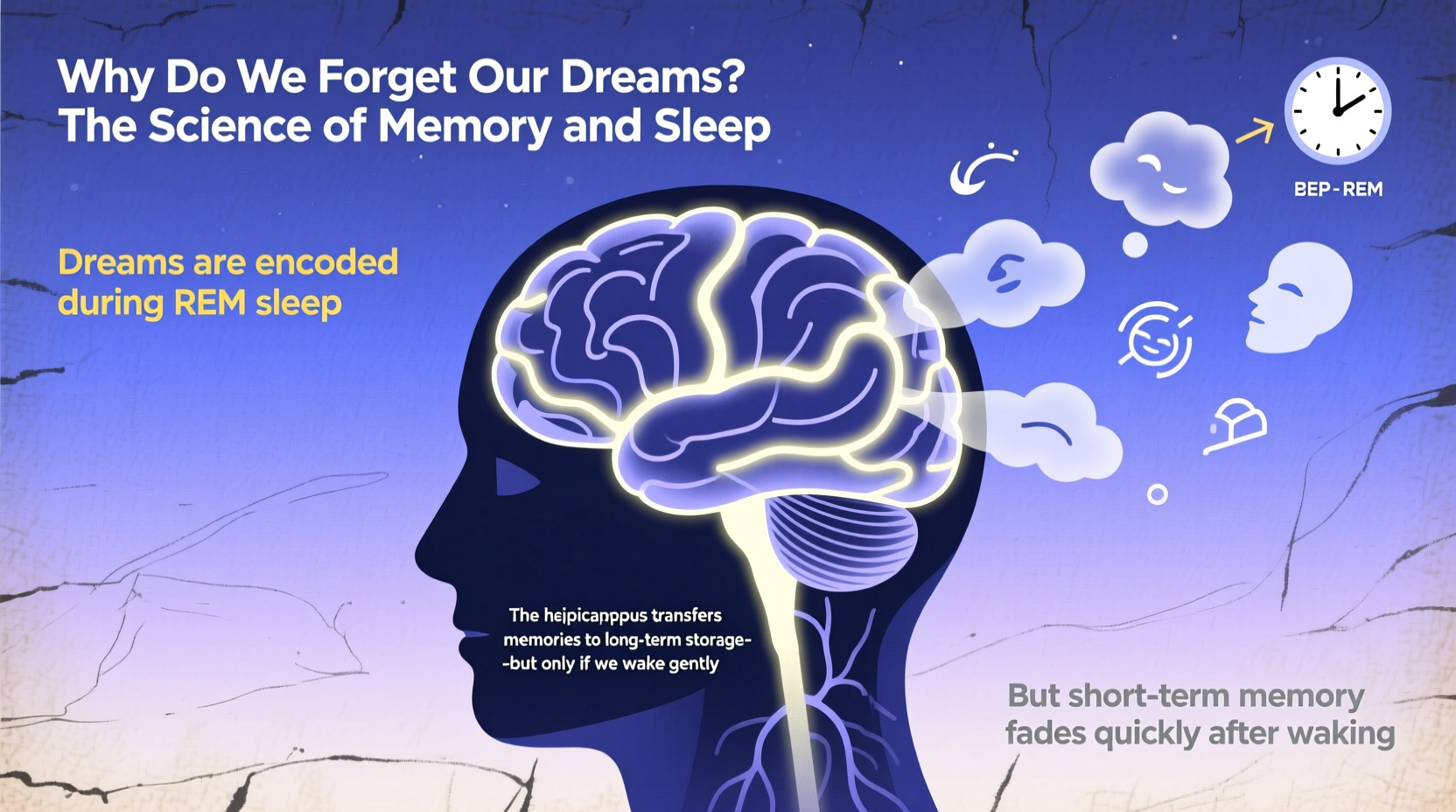
Dreams primarily occur during REM sleep, a stage characterized by heightened brain activity similar to wakefulness. During this phase, the visual, emotional, and sensory regions of the brain are highly active, creating rich, narrative-like experiences. However, despite this neural intensity, the brain’s ability to store these experiences in long-term memory is limited.
Memory consolidation—the process by which short-term memories become stable and retrievable long-term memories—depends heavily on the hippocampus and prefrontal cortex. These areas are less active during REM sleep compared to when we’re awake. As a result, even though dreams may feel intense at the moment, they often fail to transfer from short-term to long-term storage.
Neuroimaging studies show that during REM sleep, there is reduced connectivity between the hippocampus (responsible for memory encoding) and the neocortex (involved in higher cognition). This disconnect means that while a dream unfolds, the brain isn’t “tagging” it for future retrieval. Without this tagging mechanism, the memory trace dissipates quickly after awakening.
“Dreams are like writing notes on water. The experience happens, but unless you immediately capture it, it vanishes.” — Dr. Robert Stickgold, Cognitive Neuroscientist, Harvard Medical School
Why Forgetting Dreams Is Normal
Forgetting dreams is not a sign of poor memory or cognitive dysfunction—it’s a natural consequence of how the brain operates during sleep. Several factors contribute to this widespread phenomenon:
- Lack of rehearsal: Unlike waking experiences, dreams aren’t repeated or reflected upon, making them vulnerable to rapid decay.
- Neurochemical environment: Levels of norepinephrine, a neurotransmitter linked to attention and memory, are significantly lower during REM sleep, impairing memory encoding.
- Timing of awakening: People who wake naturally during or right after REM sleep are more likely to recall dreams. Those who wake during non-REM phases rarely remember anything.
- No external cues: Waking memories are anchored by sensory inputs (a sound, a smell), but dreams lack real-world anchors, making them harder to retrieve later.
A 2017 study published in Sleep Medicine Reviews found that over 95% of dreams are forgotten within five minutes of waking if not actively recorded. This rapid fading underscores how fragile dream memories are compared to waking ones.
Factors That Influence Dream Recall
While everyone forgets most of their dreams, some individuals report recalling them frequently. Differences in dream recall are influenced by both biological and behavioral factors.
Biological Influences
Research indicates that people with higher baseline activity in the temporo-parietal junction (TPJ)—a brain region involved in information processing and self-awareness—are more likely to remember dreams. This area appears to remain more responsive during sleep transitions, potentially allowing for better encoding of dream content.
Additionally, personality traits play a role. Individuals who score high on openness to experience or absorption (the tendency to become deeply immersed in mental imagery) tend to have greater dream recall. These traits may reflect a predisposition toward internal reflection and mental vividness.
Behavioral and Environmental Factors
Lifestyle choices significantly impact whether dreams are remembered. Key influences include:
- Sleep quality: Fragmented or insufficient sleep reduces time spent in REM, limiting dream opportunities and weakening memory traces.
- Alcohol and medication: Substances like alcohol suppress REM sleep early in the night, delaying or diminishing dreaming until later cycles.
- Morning routines: Jumping out of bed, checking phones, or engaging in immediate tasks shifts focus away from introspection, erasing fragile dream memories.
“People who practice mindfulness or meditation often report better dream recall. Their trained awareness helps them notice subtle mental content upon waking.” — Dr. Deirdre Barrett, Dream Researcher, Harvard Medical School
How to Improve Dream Recall: A Step-by-Step Guide
If you're interested in remembering more of your dreams—not because it's necessary, but because it can be insightful or creatively stimulating—there are evidence-based strategies to enhance recall. Follow this timeline over several weeks to build the habit:
- Set intention before sleep: Tell yourself, “I will remember my dreams when I wake up.” This simple cognitive priming has been shown to increase recall frequency.
- Optimize sleep duration: Aim for 7–9 hours per night to ensure full progression through multiple REM cycles, especially longer REM periods in the second half of the night.
- Wake up gradually: Avoid jarring alarms. Use a gentle wake-up light or soft tone to allow a smooth transition from sleep to wakefulness.
- Stay still upon waking: Keep your eyes closed and body relaxed. Try to replay any images, emotions, or sensations from the last thing you remember experiencing.
- Record immediately: Speak into a voice memo app or jot down keywords. Don’t wait—even a minute of distraction can erase the memory.
- Keep a consistent log: Maintain a dream journal for at least three weeks. Patterns may emerge, and recall tends to improve with practice.
| Do’s | Don’ts |
|---|---|
| Wake up slowly and lie still | Jump out of bed immediately |
| Use a dedicated dream journal | Rely on memory alone |
| Write fragmentary details (colors, emotions) | Disregard partial memories as “not real dreams” |
| Review past entries weekly | Expect perfect recall overnight |
Mini Case Study: Sarah’s Journey with Dream Journaling
Sarah, a 34-year-old graphic designer, had never remembered her dreams until she began experiencing recurring stress-related nightmares during a demanding project. Concerned, she started keeping a small notebook by her bed. At first, she recalled nothing. But after two weeks of setting an intention before sleep and lying still upon waking, she began capturing brief images—a dark hallway, a falling sensation, a familiar face without a name.
Over time, her recall improved. She noticed themes related to work pressure and unresolved conversations. By documenting and reflecting on these dreams, she identified subconscious anxieties affecting her mood. She shared some patterns with her therapist, who used them to guide cognitive restructuring exercises. While Sarah didn’t believe her dreams predicted the future, she found them valuable for self-awareness.
After three months, she stopped journaling nightly but maintained occasional recall, especially after emotionally intense days. Her experience illustrates that dream memory isn’t fixed—it can be cultivated with patience and structure.
Frequently Asked Questions
Is it bad if I never remember my dreams?
No, it’s not bad at all. Forgetting dreams is normal and doesn’t indicate poor sleep quality or memory problems. Many people live fulfilling lives without ever recalling a single dream. Unless you’re experiencing sleep disruptions or distressing dreams, there’s no need for concern.
Do people who remember dreams have better memory overall?
Not necessarily. High dream recall is associated with specific brain activity patterns and certain personality traits, but it doesn’t correlate with superior waking memory performance. Some frequent dream recallers have average memory function; others excel cognitively across domains. The link is nuanced and not causal.
Can medications or substances affect dream recall?
Yes. Antidepressants, particularly SSRIs, can suppress REM sleep and reduce dream vividness or recall. Alcohol decreases early-night REM, leading to fewer remembered dreams. Conversely, withdrawal from sedatives or sleep aids may cause REM rebound, resulting in unusually vivid or intense dreams that are more likely to be remembered.
Checklist: Boost Your Dream Recall (Printable Summary)
- ☑ Set a clear intention to remember dreams before sleeping
- ☑ Get 7–9 hours of uninterrupted sleep
- ☑ Place a notebook and pen (or voice recorder) next to your bed
- ☑ Wake up gently—avoid loud alarms
- ☑ Stay physically still upon waking and scan your mind for dream remnants
- ☑ Record anything you remember, no matter how vague
- ☑ Review your dream journal weekly to spot patterns
- ☑ Be patient—improvement takes 2–4 weeks of consistency
Conclusion: Embracing the Ephemeral Nature of Dreams
Forgetting dreams every morning is not only normal—it’s expected. The brain prioritizes survival-critical memories over nocturnal narratives. Yet, understanding the science behind dream amnesia empowers us to make informed choices. Whether you choose to explore your inner dream world or let it fade quietly each dawn, both approaches are valid.
If you’re curious about your subconscious mind, improving dream recall is achievable with deliberate practice. But if you never remember a single dream, rest assured: your brain is functioning exactly as nature intended. Sleep serves many purposes—memory consolidation, emotional regulation, physical restoration—and dream retention is just one small, optional layer.




 浙公网安备
33010002000092号
浙公网安备
33010002000092号 浙B2-20120091-4
Comments
No comments yet. Why don't you start the discussion?