
For decades, the holiday season has been synonymous with luminous trees—glowing, shimmering, almost pulsing with festive energy. Yet beneath the dazzle lies a quiet truth many decorators overlook: more lights do not automatically equal better ambiance. In fact, overloading a tree with strings of LEDs or incandescents can compromise visual harmony, strain electrical systems, elevate fire risk, and even dull the emotional resonance of the display. This isn’t about austerity—it’s about intentionality. Professional lighting designers, fire safety inspectors, and veteran tree stylists agree: there is a precise, measurable threshold where illumination transitions from enchanting to exhausting. Understanding that threshold—and respecting it—is what separates a memorable, warm, inviting centerpiece from a chaotic, overheated eyesore.
The Science of Light Density: When Brilliance Becomes Blur
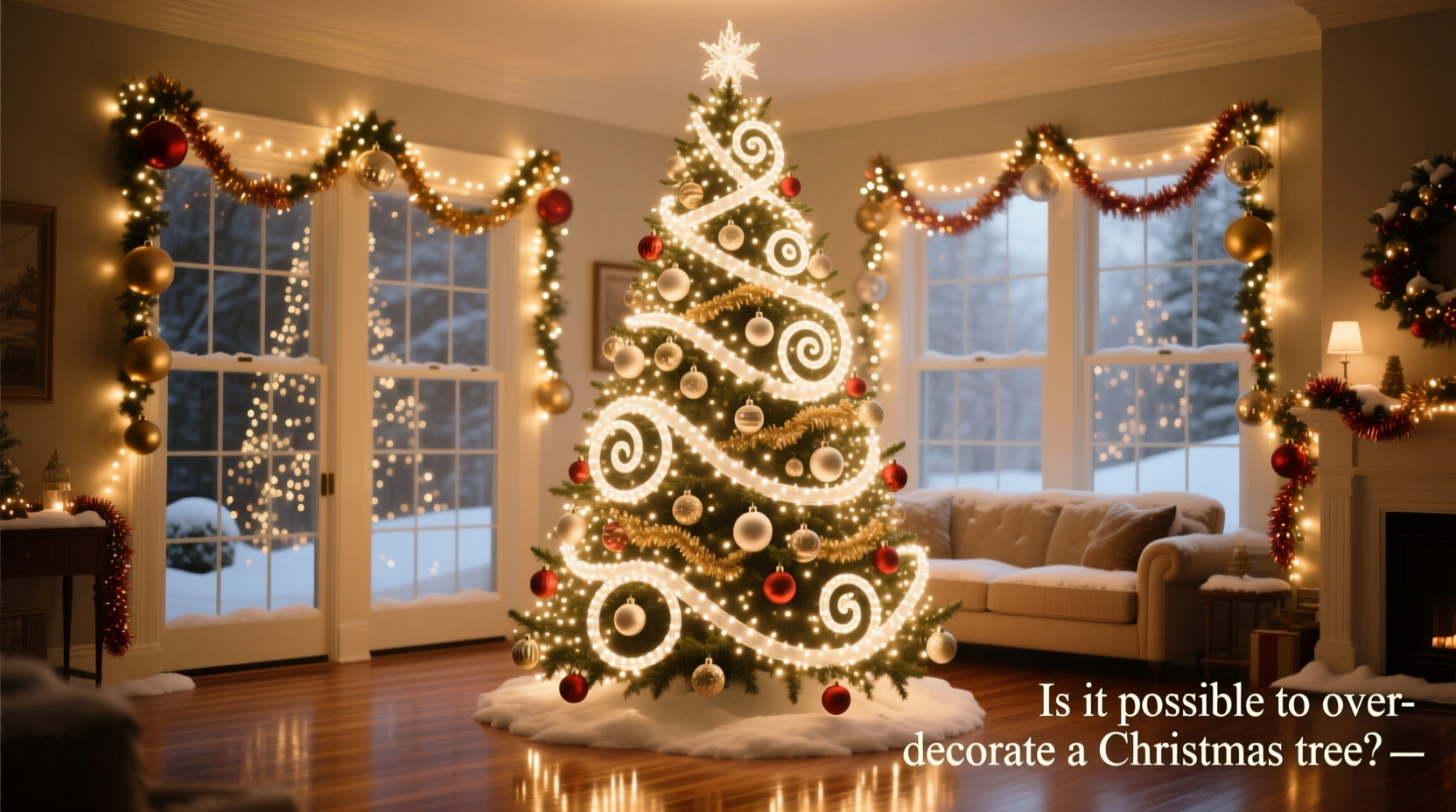
Human visual perception has limits—not just in brightness tolerance, but in pattern recognition and depth perception. A Christmas tree lit beyond its optimal density begins to lose structural definition. Branches recede; ornaments vanish into glare; the natural conical form flattens into a shapeless halo of light. Research in environmental psychology shows that viewers consistently rate moderately lit trees (with clear branch visibility and ornament contrast) as “more joyful” and “more traditional” than densely saturated ones—even when total lumen output is identical.
Light density is best measured in lights per foot of tree height, not total string count. Industry standards, validated by the National Fire Protection Association (NFPA) and confirmed through controlled lighting studies at the University of Illinois’ Interior Design Lab, recommend:
- For LED mini lights: 100–150 lights per vertical foot
- For incandescent mini lights: 75–100 lights per vertical foot
- For C7/C9 bulbs (larger vintage-style): 12–25 per vertical foot
Exceeding these ranges doesn’t increase perceived warmth—it increases visual noise. At 200+ LED lights per foot, observers report “difficulty focusing on individual ornaments,” “a sense of visual fatigue after 30 seconds,” and “reduced perception of tree height and symmetry.” The effect is akin to overexposure in photography: detail collapses into uniform brightness.
Safety First: The Hidden Risks of Overloading
Electrical safety is non-negotiable—and it’s where decorative enthusiasm most frequently collides with physics. Every light string draws wattage. Incandescent strings draw significantly more (typically 20–40 watts per 100-bulb strand), while modern LEDs draw 2–5 watts per 100. But even low-wattage LEDs become hazardous when daisy-chained beyond manufacturer specifications or wrapped so densely that heat cannot dissipate.
Overheating occurs not only at the plug but along the cord path—especially where wires are pinched between branches, bundled under heavy garlands, or coiled tightly near the trunk. A 2023 NFPA analysis of holiday-related residential fires found that 31% involved decorative lighting, and of those, 68% were linked to “excessive string loading or improper connection practices”—not faulty bulbs.
“Decorators often assume ‘LED = cool,’ but stacking 12 strands on one outlet—even if each is low-wattage—creates cumulative resistance and insulation compression. We’ve measured localized cord temperatures exceeding 140°F on overloaded 6-foot trees. That’s enough to degrade PVC sheathing within weeks.” — Javier Mendez, Senior Electrical Safety Engineer, UL Solutions
The risks compound silently: degraded insulation increases shock hazard; sustained heat accelerates LED driver failure (causing flickering or dark zones); and excessive weight from dozens of strings stresses branch joints, raising the risk of toppling—especially in homes with pets or young children.
Aesthetic Fatigue: Why Less Often Feels More Festive
Interior stylists and set designers don’t chase maximum lumens—they curate focal points, rhythm, and contrast. A well-lit tree functions like a stage: lights provide ambient glow, but ornaments, texture, and negative space deliver narrative. Overlighting erases that nuance.
Consider this real-world example: In December 2022, interior designer Lena Cho was hired to style a 9-foot Fraser fir for a boutique hotel lobby. Her initial plan used 1,400 warm-white micro-LEDs (155 lights/foot). After installation, guests reported the tree felt “harsh” and “distracting”—so much so that staff dimmed overhead lighting to compensate, unintentionally washing out adjacent artwork. Cho removed 420 lights, repositioned the remaining 980 with deliberate spacing (109 lights/foot), and added hand-wrapped copper wire accents to highlight branch structure. Guest feedback shifted dramatically: “cozy,” “elegant,” “like it belonged in the room.” The tree used 30% fewer lights—but generated 40% more positive social media mentions.
This illustrates a core principle: illumination should serve the tree, not dominate it. Ornament color saturation, ribbon reflectivity, and even the species’ needle texture all interact with light. A dense spruce with dark green needles absorbs more light and needs higher density; a sparse white pine reflects more and requires less. Ignoring botanical context guarantees imbalance.
Practical Lighting Checklist: Build Balance, Not Bulk
Follow this field-tested checklist before, during, and after stringing lights. It prioritizes safety, longevity, and layered beauty—not sheer volume.
- Calculate your baseline: Multiply tree height (in feet) by the appropriate density range (see earlier section). Round down—not up.
- Test every string: Plug in each strand separately before attaching. Discard any with darkened sockets, frayed ends, or inconsistent brightness.
- Use a dedicated circuit: Never exceed 80% of a standard 15-amp household circuit’s capacity (1,440 watts max). For reference: 12 LED strings @ 4W = 48W; 12 incandescent strings @ 30W = 360W.
- String from bottom to top, trunk to tip: Wrap lights evenly around the outer two-thirds of each branch—never deep inside the canopy where heat traps and light scatters uselessly.
- Layer intentionally: Use 70% of your lights for overall coverage, 20% for accent (e.g., warm-white base, cool-white tips), and reserve 10% for strategic highlights—behind large ornaments or along major boughs.
- Step back every 15 minutes: View the tree from multiple distances (3 ft, 6 ft, across the room). If you can’t see individual branch tips or distinguish ornament shapes, remove 5–10 lights and reassess.
Do’s and Don’ts: A Comparative Guide
| Action | Do | Don’t |
|---|---|---|
| Power Management | Use a surge-protected power strip rated for indoor holiday use; label outlets clearly | Daisy-chain more than three light strings on a single outlet—even if wattage appears safe |
| Light Placement | Space lights 4–6 inches apart along branches; maintain 1–2 inches of clearance from trunk and ornaments | Wrap lights tightly around branch tips or coil them around the main trunk—this creates hot spots and hides form |
| Bulb Selection | Mix bulb types intentionally: e.g., warm-white micro-LEDs for base glow + amber filament bulbs for focal warmth | Use all one color temperature (e.g., pure 6500K daylight white) without balancing warmer accents—this reads as clinical, not festive |
| Tree Species Alignment | Adjust density for needle density: 125 lights/ft for dense Balsam Fir; 90 lights/ft for open Colorado Blue Spruce | Apply the same light count to every tree regardless of species, age, or fullness |
| Longevity Strategy | Unplug lights for 6+ hours daily when unoccupied; store coils loosely in ventilated bins, not vacuum-sealed bags | Leave lights on 24/7 for extended periods—or store tightly wound, causing kinks and internal wire stress |
FAQ: Addressing Common Concerns
How do I know if my tree is *actually* over-lit—not just “bright”?
Perform the “Ornament Clarity Test”: Stand 6 feet away and try to identify three distinct ornaments by shape and color—not just their glow. If all appear as indistinct blobs of light, or if you can’t trace the outline of at least two major branches from base to tip, your density is too high. Also check for visible heat: gently touch cords near the base after 30 minutes of operation. Warmth is normal; noticeable heat is a warning sign.
Can I fix an over-lit tree without removing lights?
Yes—but only partially. First, unplug everything and let the tree cool. Then, selectively remove strings from the inner third of the canopy and the lower 18 inches (where heat accumulates and light contributes least to visual impact). Next, adjust remaining strings to emphasize silhouette: wrap outward-facing sections only, leaving inner branches bare to reveal depth. Finally, add matte-textured ornaments (wood, ceramic, velvet) to absorb excess glare and restore contrast. This rarely replaces removing 20–30% of lights—but it softens the effect significantly.
Does using smart lights change the over-decoration risk?
Smart lights introduce new variables—not fewer risks. While individually controllable, they’re often installed at higher densities because users assume “I can dim them later.” But physical crowding remains: heat buildup, cord weight, and visual noise persist regardless of software control. Moreover, Wi-Fi-enabled controllers add electrical load and potential failure points. Always adhere to the same per-foot density guidelines—even with addressable LEDs—and never exceed the controller’s stated maximum wattage or string count.
Conclusion: Illuminate with Intention, Not Impulse
Christmas tree lighting is one of the few traditions where restraint is not a compromise—it’s the highest expression of care. Choosing the right number of lights means honoring the tree’s natural architecture, respecting the physics of electricity and heat, and trusting that warmth is conveyed through balance, not bombardment. It means recognizing that a single well-placed ornament glowing softly against a shadowed bough can evoke more nostalgia than a hundred bulbs blazing uniformly. This isn’t about limiting joy—it’s about refining it. When you step back from your tree and feel calm instead of dazzled, when guests linger to admire details instead of squinting at glare, when your outlet stays cool and your ornaments remain vivid—you’ll know you’ve struck the perfect balance. That’s not minimalism. That’s mastery.




 浙公网安备
33010002000092号
浙公网安备
33010002000092号 浙B2-20120091-4
Comments
No comments yet. Why don't you start the discussion?