
In an age where smartphones are essential for communication, productivity, and entertainment, battery life remains a top concern. Many people plug in their phones before bed and leave them charging until morning—sometimes for eight or more hours. With newer models released each year, the question persists: is it still safe to charge your phone overnight in 2025? The short answer is yes—for most modern devices—but with important caveats. Understanding how today’s smartphones manage power, heat, and battery chemistry reveals a more nuanced picture than simple yes-or-no answers.
How Modern Phones Handle Overnight Charging
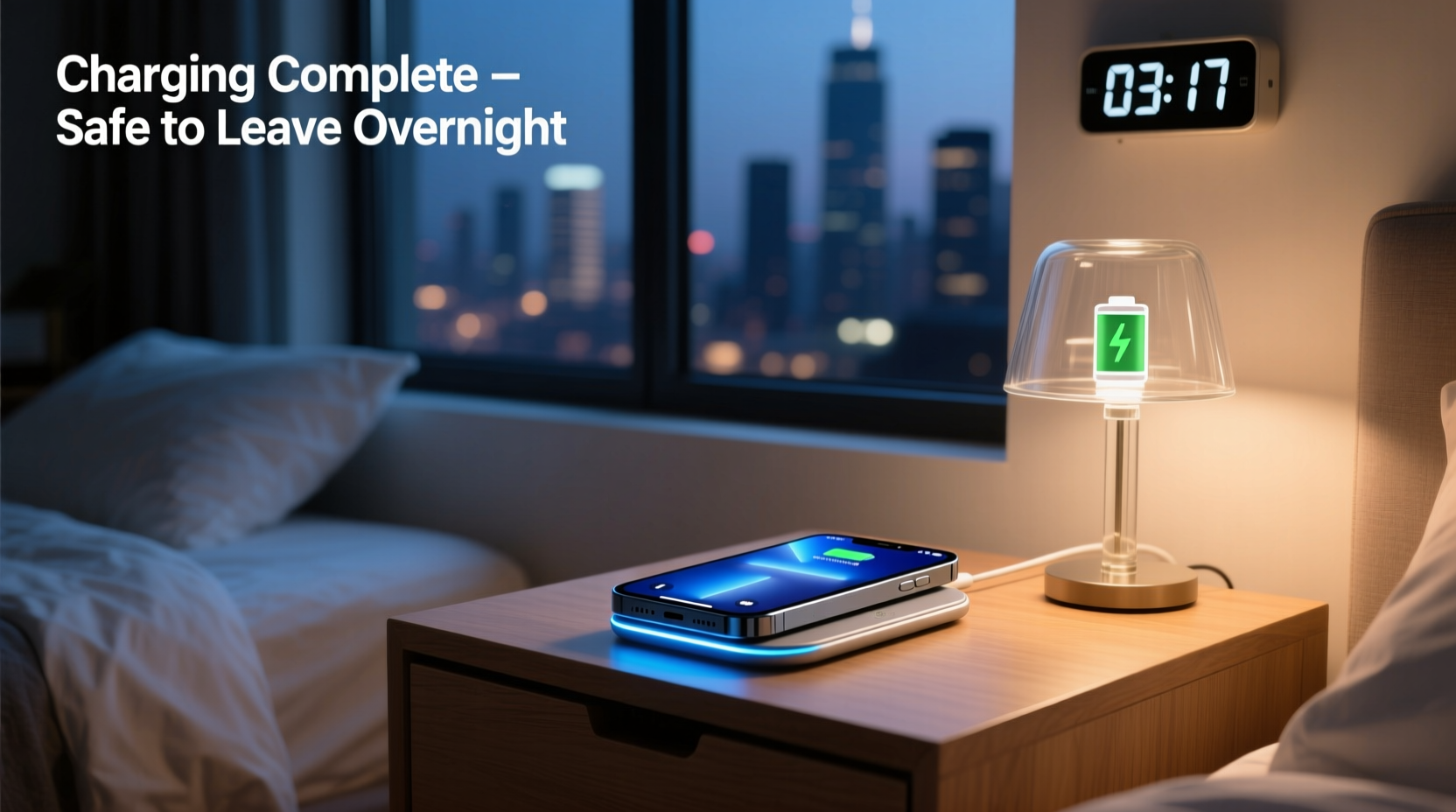
Today's smartphones are equipped with advanced battery management systems that make overnight charging far safer than it was a decade ago. Unlike older lithium-ion batteries that could overcharge and degrade quickly, current devices use intelligent charging algorithms designed to preserve battery longevity.
When you plug in your phone, it charges rapidly at first, then slows as it approaches full capacity. Once it hits 100%, the charger doesn’t continue pushing electricity into the battery. Instead, modern phones enter what’s known as “trickle mode” or “top-off charging,” where power delivery pauses and only resumes if the battery dips slightly due to background processes.
Apple introduced \"Optimized Battery Charging\" in iOS 13, which learns your daily routine and delays charging past 80% until just before you typically unplug. Google followed with a similar feature called “Adaptive Charging” on Pixel devices. Samsung and other Android manufacturers now include comparable tools under names like “Protect Battery” or “Battery Protection Mode.” These features are specifically engineered to reduce wear from prolonged time at 100% charge.
The Science Behind Lithium-Ion Degradation
Lithium-ion batteries, used in virtually all modern smartphones, degrade over time due to chemical aging. Two primary factors accelerate this process: high voltage (i.e., being fully charged) and elevated temperature.
When a battery sits at 100% charge for extended periods, the internal chemical stress increases. This is especially true when combined with heat generated during charging or from ambient sources like bedding or poorly ventilated nightstands. According to Dr. Isidor Buchmann, CEO of Cadex Electronics and a leading expert on battery technology:
“Keeping a lithium-ion battery at full charge, particularly in warm conditions, can significantly shorten its cycle life. Ideally, users should aim to keep batteries between 20% and 80% for optimal longevity.” — Dr. Isidor Buchmann, Battery Research Specialist
However, real-world usage rarely allows for such precision. Most people need their phones fully charged in the morning. That’s why manufacturers have developed software solutions to simulate ideal charging windows without sacrificing convenience.
Battery Longevity: What You Can Expect in 2025 Devices
Smartphone makers now design devices with longer lifespans in mind. Apple states that its iPhone batteries are engineered to retain up to 80% of original capacity after 500 complete charge cycles when properly maintained. Samsung and Google offer similar benchmarks. A charge cycle is defined as using 100% of the battery’s capacity—not necessarily in one go—so partial charges count cumulatively.
For context, charging from 50% to 100% twice equals one full cycle. If you charge nightly but only drain 30–40% per day, it may take well over a year to accumulate even 100 cycles. Under typical conditions, most users won’t see significant degradation until two to three years of regular use.
Still, certain behaviors can accelerate wear—even on 2025-era hardware:
- Using fast chargers every night instead of standard ones
- Charging under pillows or thick cases that trap heat
- Leaving the phone plugged in for days at a time when not in use
- Exposing the device to direct sunlight or hot environments while charging
Best Practices for Overnight Charging in 2025
While modern phones are built to handle overnight charging safely, maximizing battery health requires some user awareness. Below is a checklist of recommended actions to maintain peak performance over time.
✅ Charging Best Practices Checklist
- Enable Adaptive/Intelligent Charging (iOS or Android)
- Remove thick or non-breathable phone cases while charging
- Use manufacturer-approved chargers and cables
- Avoid covering the phone with blankets or placing it under pillows
- Keep the charging area cool and well-ventilated
- Unplug occasionally after full charge if not using smart charging
- Consider setting a charging schedule via smart plugs or automation apps
One often-overlooked factor is charger quality. Third-party or counterfeit chargers may lack proper voltage regulation, increasing the risk of overheating or inconsistent power delivery. Even if they work initially, poor-quality adapters can contribute to long-term battery stress.
Real-World Example: Maria’s Two-Year Phone Journey
Maria, a digital marketing consultant from Austin, Texas, uses her smartphone heavily for work and personal tasks. She charges her phone every night, typically from 10 p.m. to 7 a.m. In 2023, she purchased a flagship Android model with a 5,000mAh battery and enabled Adaptive Charging right away.
After two years of nightly charging, she ran a diagnostic test through the device’s built-in battery health tool. The result showed 83% remaining capacity—slightly above the expected 80%. When asked about her habits, Maria noted that she avoids fast charging unless necessary, removes her silicone case at night, and keeps her bedroom temperature around 68°F (20°C).
In contrast, her colleague James, who uses the same phone model but charges with a third-party fast charger, leaves his phone under a pillow, and disables all battery optimization features, reported only 72% capacity after 18 months. His phone also exhibited noticeable warmth upon waking.
This example illustrates how user behavior—even on identical hardware—can meaningfully impact long-term battery performance.
Do’s and Don’ts of Overnight Charging
| Do | Don’t |
|---|---|
| Use official or MFi-certified chargers | Use cheap, uncertified charging cables |
| Enable optimized charging features | Leave fast charging enabled all night |
| Charge in a cool, open space | Place the phone under bedding or cushions |
| Remove insulating cases during charging | Use wireless charging on flammable surfaces |
| Update your phone regularly for battery improvements | Ignore battery warnings or swelling signs |
Wireless charging, increasingly common in 2025, generates more heat than wired alternatives due to energy transfer inefficiencies. While convenient, leaving a phone on a wireless pad overnight without proper ventilation can increase thermal stress. Some newer wireless chargers include cooling fans or temperature sensors, but these aren't standard across all models.
What About Future Technologies?
Looking ahead, several emerging technologies may further reduce concerns around overnight charging. Solid-state batteries, expected to debut in consumer devices by 2026, promise higher energy density, faster charging, and improved safety profiles. Unlike traditional lithium-ion cells, they don’t rely on liquid electrolytes, reducing fire risk and enabling stable charging at full capacity.
Additionally, AI-driven battery management is becoming more sophisticated. Some 2025 flagships already use machine learning to predict not just wake times, but also usage patterns—adjusting charge rates dynamically based on whether you’ll be traveling, working remotely, or expecting heavy app usage the next day.
Manufacturers are also exploring “battery memory” modes, where users can set preferred charge caps—such as limiting maximum charge to 85% unless manually overridden. This gives power users greater control while maintaining ease of use for casual owners.
Frequently Asked Questions
Can charging my phone overnight damage the battery?
Not significantly, provided you’re using a modern smartphone with updated software and proper charging equipment. Features like Adaptive Charging and voltage regulation prevent overcharging and minimize degradation. However, consistently charging in hot environments or using low-quality accessories can accelerate wear over time.
Should I unplug my phone once it reaches 100%?
If your phone has intelligent charging enabled, there’s no need to unplug manually. The system will pause charging and resume only when needed. For older devices or those without optimization features, unplugging after full charge may help reduce long-term stress, though the benefit is marginal under normal conditions.
Is wireless charging safe for overnight use?
Yes, but with caution. Wireless charging produces more heat than wired methods, so ensure your phone and charger are on a hard, flat surface with good airflow. Avoid placing either on fabric, wood, or near flammable materials. Newer Qi2-certified chargers offer better alignment and efficiency, reducing heat buildup.
Step-by-Step Guide to Optimizing Overnight Charging
- Check Battery Health Settings: Navigate to your phone’s battery section and verify that adaptive or optimized charging is turned on.
- Inspect Your Charger: Confirm you're using a certified cable and adapter. Look for labels like “MFi” (Apple), “Made for Galaxy,” or official brand packaging.
- Clear the Charging Area: Place the phone on a nightstand or desk, away from bedding, curtains, or enclosed spaces.
- Remove the Case: Take off bulky or rubberized cases that trap heat during charging.
- Monitor Temperature: If the phone feels unusually warm within the first 30 minutes, investigate potential causes—background apps, poor ventilation, or faulty hardware.
- Schedule Heavy Tasks: Avoid running intensive apps (like video rendering or gaming) while charging overnight, as this increases power draw and heat.
- Reassess Monthly: Every few weeks, check your battery health percentage and adjust habits if degradation seems faster than expected.
Conclusion: Smart Habits for Lasting Performance
By 2025, technological advancements have made overnight phone charging generally safe for modern devices. Built-in safeguards, smarter software, and improved battery chemistry mean you no longer need to fear plugging in before bed. However, safety doesn’t eliminate the need for responsible usage.
Maximizing your phone’s lifespan comes down to small, consistent choices: enabling optimization features, avoiding extreme temperatures, and using quality charging gear. These habits compound over time, preserving both performance and resale value.
Your smartphone is designed to fit seamlessly into your life—not disrupt it. With the right approach, you can enjoy the convenience of overnight charging while keeping your battery healthy for years to come.




 浙公网安备
33010002000092号
浙公网安备
33010002000092号 浙B2-20120091-4
Comments
No comments yet. Why don't you start the discussion?