
For years, a common piece of advice has echoed through households: “Don’t charge your phone overnight—it’ll damage the battery.” This warning, once rooted in early lithium-ion battery behavior, persists despite significant advances in smartphone technology. Today’s devices are smarter, more efficient, and designed with long-term battery health in mind. So, is overnight charging still a risk, or has modern engineering made that fear obsolete?
This article separates fact from fiction by examining how today’s batteries work, what actually degrades them, and whether leaving your phone plugged in while you sleep is truly harmful. We’ll also provide practical steps to maximize your device’s lifespan—because even with advanced safeguards, not all habits are created equal.
The Evolution of Smartphone Batteries
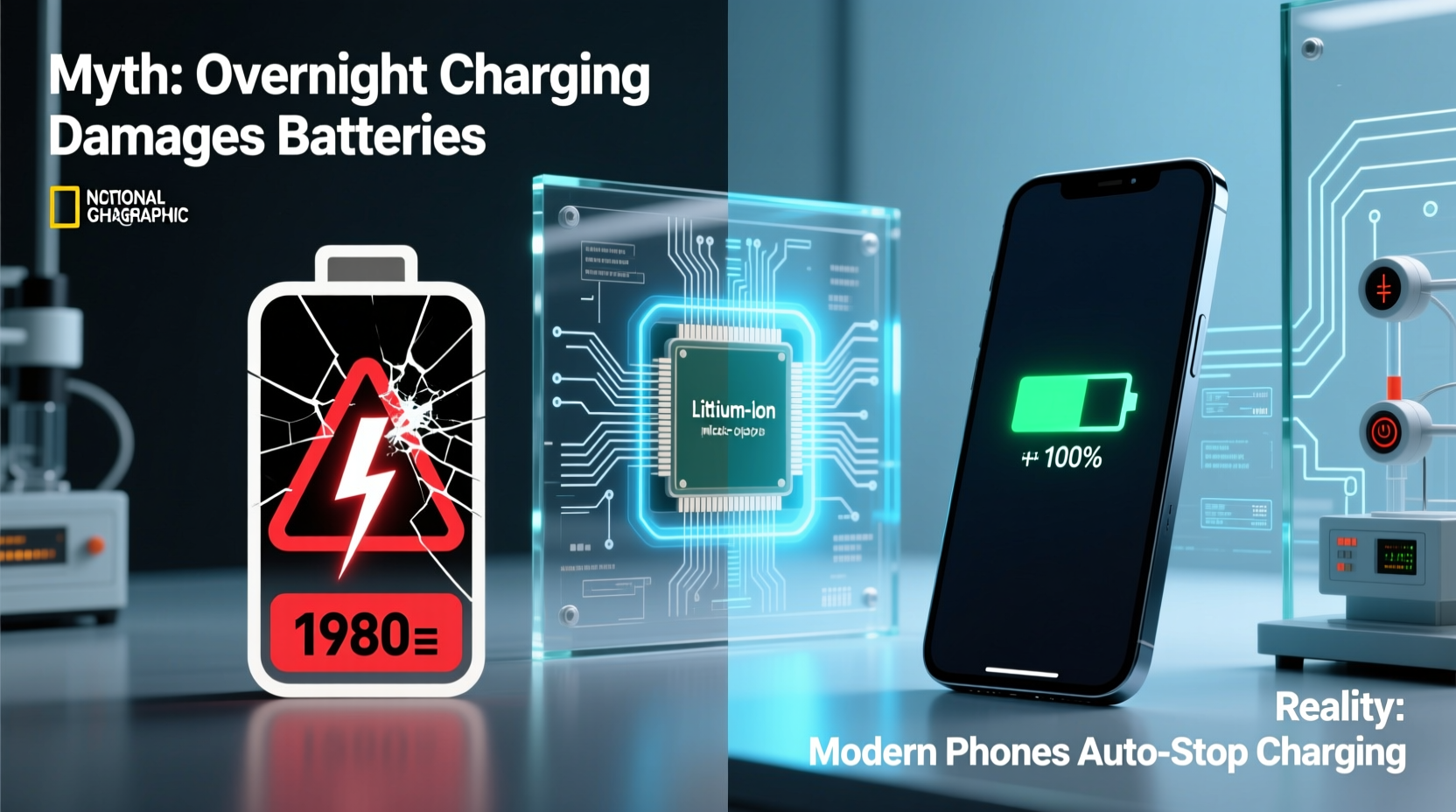
Early mobile phones used nickel-based batteries (NiCd and NiMH), which suffered from a \"memory effect\"—a phenomenon where partial discharges led to reduced capacity over time. These batteries also generated excess heat when overcharged, increasing the risk of swelling or failure. As a result, users were advised to unplug devices as soon as they reached 100%.
Modern smartphones, however, rely on lithium-ion (Li-ion) or lithium-polymer (Li-Po) batteries. These offer higher energy density, faster charging, and—critically—built-in protection circuits. Unlike their predecessors, they do not suffer from memory effects and are engineered to stop drawing current once fully charged.
Manufacturers like Apple, Samsung, and Google now integrate multiple layers of hardware and software intelligence into charging systems. For example, iOS features \"Optimized Battery Charging,\" while Android offers \"Adaptive Charging.\" Both learn your daily routine and delay full charging until just before you typically unplug the device.
“Today’s smartphones are designed to manage power intelligently. The idea that overnight charging inherently damages batteries is largely outdated.” — Dr. Lin Zhang, Battery Systems Engineer at MIT Energy Initiative
Debunking Common Overnight Charging Myths
Despite technological progress, several myths continue to circulate. Let’s examine the most persistent ones:
Myth 1: Charging past 100% destroys the battery
False. Once a modern phone reaches 100%, the charging circuit cuts off the flow of electricity. The battery enters a \"trickle mode,\" where it only draws small amounts of power if needed due to background drain. There is no continuous overcharging.
Myth 2: Heat buildup from overnight charging causes permanent damage
Partially true—but context matters. Excessive heat is indeed one of the top enemies of battery longevity. However, modern phones regulate temperature during charging. Issues arise primarily when the device is under heavy load (e.g., gaming or video calls) while charging, or when covered by thick cases or blankets. Simply charging overnight in normal conditions does not generate dangerous heat levels.
Myth 3: Keeping your phone at 100% for hours stresses the battery
Mildly true, but mitigated by design. Lithium-ion batteries experience slight stress when held at high voltage (i.e., near full charge). However, manufacturers counteract this by using algorithms that cap peak voltage or delay final charging stages. For instance, an iPhone might charge to 80% immediately, then wait until morning to reach 100%, reducing time spent at maximum charge.
Battery Degradation: What Actually Causes It?
While overnight charging gets blamed, the real culprits behind battery degradation are often overlooked. Understanding these factors gives you better control over your phone’s lifespan.
- Heat exposure: Operating or charging in hot environments (like direct sunlight or inside a car) accelerates chemical aging inside the battery.
- Deep discharges: Regularly letting your battery drop to 0% strains its chemistry. Lithium-ion prefers partial cycles between 20% and 80%.
- Fast charging frequency: While convenient, frequent use of high-wattage chargers generates more heat and increases wear over time.
- Long-term storage at full charge: Storing a phone at 100% for weeks or months leads to capacity loss. Manufacturers recommend ~50% charge for storage.
A battery’s lifespan is measured in charge cycles—typically around 500 full cycles before capacity drops to about 80% of original. A \"cycle\" means using 100% of the battery’s capacity, not necessarily charging from 0% to 100%. For example, two 50% charges equal one cycle.
Real Example: Sarah’s Two-Year Phone Test
Sarah, a digital marketer, used her smartphone heavily for work—emails, video meetings, social media. She charged it every night without fail. After two years, she checked her battery health: 88% capacity. Surprised, she compared notes with a colleague who avoided overnight charging but frequently let his phone die completely during the day. His battery was at 76%. The difference? Sarah’s consistent charging kept her battery in the optimal range, while her colleague’s deep discharges caused more wear.
This illustrates a key insight: consistency matters more than timing. Frequent shallow charges are gentler than infrequent deep ones.
Best Practices for Long-Term Battery Health
You don’t need to abandon overnight charging—but optimizing how you charge can extend your battery’s useful life. Here’s a practical guide:
Step-by-Step: Optimize Your Charging Routine
- Use manufacturer-approved chargers – Cheap third-party adapters may lack proper voltage regulation, increasing heat and instability.
- Remove thick cases during charging – Especially when using fast charging, cases trap heat and reduce cooling efficiency.
- Enable adaptive/optimized charging – Found in iOS Settings > Battery > Battery Health, or Android Settings > Battery > Adaptive Charging.
- Avoid extreme temperatures – Don’t leave your phone charging on a sunny windowsill or in freezing conditions.
- Keep charge between 20% and 80% when possible – This reduces electrochemical stress. Use battery percentage alerts to help manage this.
Checklist: Healthy Charging Habits
- ✅ Charge overnight if needed—modern phones handle it safely
- ✅ Enable adaptive charging features
- ✅ Avoid charging under pillows or blankets
- ✅ Unplug if the phone feels unusually hot
- ✅ Replace swollen or damaged batteries immediately
- ✅ Use wireless charging pads that support proper ventilation
Comparing Old vs. New: Charging Safety at a Glance
| Factor | Old Devices (Pre-2010) | Modern Smartphones (2020s) |
|---|---|---|
| Battery Type | NiCd / NiMH | Lithium-ion / Li-Po |
| Overcharge Protection | Limited or none | Standard (hardware + software) |
| Heat Management | Poor; prone to overheating | Advanced thermal sensors and throttling |
| Charging Intelligence | None | AI-driven scheduling (e.g., Optimized Charging) |
| Recommended Max Charge Time | Until full, then unplug | No strict limit; safe for 8–10 hours |
| Impact of Overnight Charging | High risk of degradation | Minimal impact with normal usage |
Frequently Asked Questions
Can I leave my phone charging all night every night?
Yes, it’s generally safe. Modern smartphones stop drawing power once fully charged and use intelligent systems to minimize battery stress. However, pairing this habit with good practices—like avoiding excessive heat and enabling adaptive charging—will yield the best long-term results.
Does wireless charging increase the risk of overheating overnight?
Wireless charging can generate more heat than wired charging due to energy transfer inefficiency. However, most premium phones include thermal monitoring that slows or pauses charging if temperatures rise. Using certified Qi-compatible chargers and ensuring proper airflow (don’t bury the phone under bedding) keeps risks low.
How long should a smartphone battery last before needing replacement?
Most manufacturers design batteries to retain at least 80% of their original capacity after 500 full charge cycles. With average use, this translates to about 2–3 years. After that, you may notice shorter battery life and slower performance, especially in cold conditions. Replacement is recommended when daily usability is significantly impacted.
Conclusion: Charge Smart, Not Fearful
The fear of overnight charging stems from outdated technology and incomplete information. Today’s smartphones are equipped with sophisticated systems that protect battery health far better than most users realize. While no battery lasts forever, modern charging practices have evolved to match our lifestyles—not force us to change them.
Rather than obsessing over unplugging at exactly 100%, focus on broader habits: avoid extreme temperatures, minimize fast charging when unnecessary, and take advantage of built-in optimization tools. These actions have a far greater impact than micromanaging your charging schedule.
Your phone is designed to be part of your routine—even while you sleep. Trust the engineering, follow simple best practices, and charge with confidence.




 浙公网安备
33010002000092号
浙公网安备
33010002000092号 浙B2-20120091-4
Comments
No comments yet. Why don't you start the discussion?