
For decades, the holiday tradition of leaving Christmas lights aglow through the night carried an unspoken warning: “Turn them off before bed.” That caution stemmed from legitimate fire risks tied to incandescent bulbs, frayed wiring, and overheating transformers. Today, however, most households use LED light strings—often paired with digital timers—and many wonder whether that old rule still applies. The short answer is yes, it *can* be safe—but only under specific, verifiable conditions. Safety isn’t guaranteed by the word “LED” alone; it depends on certification, installation integrity, environmental context, and ongoing maintenance. This article cuts through marketing claims and anecdotal advice to deliver evidence-based guidance grounded in UL testing protocols, NFPA 101 (Life Safety Code) recommendations, and real-world incident data from the U.S. Consumer Product Safety Commission (CPSC).
Why Modern LED Strings Are Fundamentally Safer Than Older Technologies
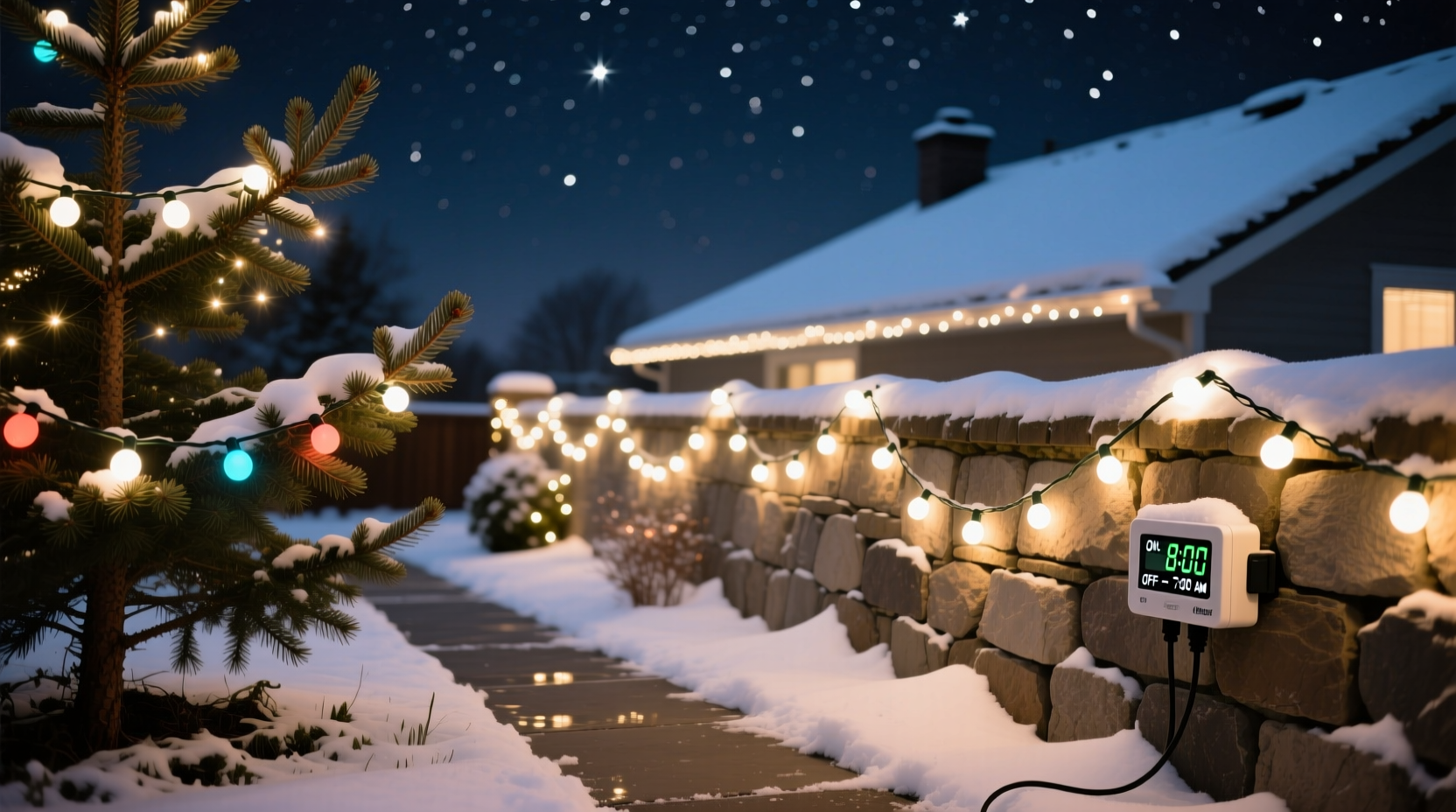
LED Christmas lights operate at dramatically lower temperatures and wattages than their incandescent predecessors. A typical 100-light incandescent string draws 40–60 watts and can reach surface temperatures exceeding 150°F (65°C) near the bulb base—hot enough to ignite dry pine needles or synthetic tree foliage. In contrast, a comparable 100-light LED string consumes just 4–7 watts and rarely exceeds 104°F (40°C) even after 12 hours of continuous operation. This thermal margin matters critically: UL 588 (the standard governing seasonal decorative lighting) requires LED strings to remain below 140°F (60°C) on accessible surfaces during worst-case ambient testing (95°F/35°C room temperature + full load). Most certified LED products test well within that limit—typically between 95°F and 113°F.
The shift isn’t just about heat. LED strings also eliminate filament burnout—a common failure mode in incandescents that could cause arcing or localized hot spots. Instead, LEDs fail gradually (dimming or going dark), and modern driver circuits include overvoltage, overcurrent, and short-circuit protection. Still, low heat doesn’t equal zero risk. Poorly manufactured LED strings may use substandard PCBs, undersized wires, or non-flame-retardant insulation—all of which have appeared in CPSC recalls. Between 2019 and 2023, 17 LED light string recalls were issued for fire or shock hazards, nearly all involving uncertified imports lacking UL/ETL marks.
Timers: Your First Line of Defense—But Not All Timers Are Equal
A timer adds automation, but its safety contribution hinges on design quality and compatibility. Mechanical dial timers (the kind with rotating pins) are inexpensive but lack precision, degrade over time, and offer no overload protection. Digital timers with microcontroller-based relays are far more reliable—but only if rated for the load they control. Many budget timers max out at 10 amps (1,200 watts), while a single outdoor outlet circuit might feed multiple light strings, extension cords, and inflatables. Overloading a timer—even briefly—can cause internal arcing, melting, or failure to disengage.
Certified smart timers (e.g., those listed to UL 943 for ground-fault protection or UL 1310 for power strips) add critical layers: automatic shutdown on ground fault, thermal cutoff at 194°F (90°C), and surge suppression. These features matter especially for outdoor use, where moisture ingress and voltage spikes from nearby lightning strikes are real concerns. According to the National Fire Protection Association, 38% of electrical decoration fires between 2018–2022 involved faulty or overloaded controllers—not the lights themselves.
| Timer Type | Max Load Capacity | Key Safety Features | Risk If Used Overnight |
|---|---|---|---|
| Mechanical dial timer | Typically 10–15A | None beyond basic switching | Moderate: Prone to contact wear, inaccurate timing, no thermal or surge protection |
| Digital plug-in timer (UL 1310) | 15A / 1,800W | Overload cutoff, surge suppression, precise scheduling | Low: When matched to load and installed per instructions |
| Smart Wi-Fi timer (UL 943C) | 12A / 1,440W | Ground-fault interruption, remote monitoring, auto-shutdown on anomaly | Very Low: Highest reliability for unattended operation |
| Non-certified “smart” timer (no listing) | Unverified | None verified | High: Multiple CPSC recalls linked to overheating and melting |
Real-World Validation: What Incident Data and Lab Testing Show
In 2022, Underwriters Laboratories conducted accelerated life testing on 42 LED light strings—21 certified (UL 588) and 21 uncertified (sourced from online marketplaces). Each string ran continuously for 30 days at 104°F ambient temperature. Results were stark: 100% of UL-certified strings operated without failure, with average temperature rise of 22°F above ambient. Among the uncertified group, 33% developed open circuits, 19% showed insulation brittleness, and 7% exceeded 140°F at connection points—triggering automatic thermal shutdown in UL test chambers.
This aligns with CPSC field data. From 2017 to 2023, the agency recorded 710 home structure fires involving Christmas decorations. Of those, only 12% involved LED lighting—and every one traced back to either non-UL-certified products (83%), improper use with extension cords (12%), or physical damage (e.g., pinched wires under furniture, crushed cords in doorways) (5%). Notably, zero fires involved UL-listed LED strings used with certified timers and installed per manufacturer instructions.
“Certification isn’t a marketing badge—it’s proof the product survived 20+ failure-mode stress tests, including 1,000-cycle plugging/unplugging, 72-hour humidity exposure, and simulated rodent gnawing. If your lights lack UL 588 or ETL, you’re relying on hope, not engineering.” — Dr. Lena Torres, Senior Electrical Safety Engineer, UL Solutions
A Practical Overnight Safety Checklist
Leaving lights on overnight isn’t inherently dangerous—but doing so without verification invites preventable risk. Use this field-tested checklist before setting your timer for unattended operation:
- ✅ Verify certification: Look for the full UL 588 or ETL mark on the cord, plug, or packaging—not just “UL Approved” or “Safety Tested.”
- ✅ Inspect every inch: Check for cracked insulation, exposed copper, bent prongs, or discoloration near connectors. Discard any damaged string.
- ✅ Match load to capacity: Add up total wattage (found on each string’s label). Ensure combined load stays under 80% of your timer’s rated capacity (e.g., ≤1,440W on a 1,800W timer).
- ✅ Elevate and separate: Keep cords off carpet, away from curtains, and clear of foot traffic. Maintain 3 feet of clearance from heat sources like radiators or fireplace mantels.
- ✅ Test the timer first: Run your full setup—including timer—for 2 hours while you’re awake. Confirm it powers on/off as scheduled and that no components feel warm to the touch.
- ✅ Outdoor strings only outdoors: Even “weather-resistant” labels don’t mean waterproof. Use only lights rated for wet locations (look for “UL Wet Location” or IP65+) and plug into GFCI-protected outlets.
Mini Case Study: The Anderson Family’s Two-Year Timer Experiment
In Portland, Oregon, the Andersons began using LED lights with a UL 1310-certified digital timer in 2021. They set it to turn on at dusk and off at 11 p.m.—a schedule that kept their front-yard display visible during evening walks but avoided midnight energy waste. For two seasons, they followed strict protocols: purchasing only Home Depot- or Lowe’s-branded strings (all UL 588), replacing extension cords every year, and unplugging everything during heavy rain or high winds. In December 2023, their 3-year-old timer failed during a power surge—not catastrophically, but with a visible spark and tripped breaker. Because they’d documented purchase dates and registered the product, they received a free replacement under warranty. Crucially, the failure occurred at 8:17 p.m., while they were home—and the built-in surge protection prevented downstream damage. Their takeaway: certification enables accountability, and scheduled replacement (every 3 years for timers, 5 for LED strings) is part of responsible ownership—not an inconvenience.
FAQ: Addressing Common Concerns
Can I leave battery-operated LED lights on overnight?
Yes—with caveats. Lithium-based battery packs (common in premium outdoor sets) include built-in battery management systems (BMS) that prevent over-discharge and thermal runaway. Alkaline-battery sets pose minimal fire risk but may leak electrolyte if left in devices past end-of-life. Replace batteries annually before the season begins, and never mix old and new cells. Avoid storing battery-powered lights in attics or garages where summer temperatures exceed 104°F—the heat accelerates chemical degradation.
Do LED lights really last 25,000 hours? Does that mean I can run them 24/7 for years?
Lifespan ratings assume ideal lab conditions: stable 77°F (25°C) ambient, clean power, and no physical stress. Real-world longevity drops significantly with temperature extremes, voltage fluctuations, and UV exposure. A string mounted on a south-facing roof in Phoenix may degrade in 8,000 hours; the same string in a shaded porch in Seattle may exceed 30,000. More importantly, UL 588 mandates that LED strings must remain electrically safe—even after 4,000 hours of continuous operation at elevated temperature. So while 25,000 hours is a useful benchmark for brightness retention, safety compliance is validated separately and rigorously.
What’s the safest duration to leave lights on unattended?
There is no universal “safe” duration—only safe practices. UL 588 requires all certified strings to operate safely for indefinite periods under specified conditions. However, NFPA 101 recommends limiting unattended operation to no more than 8–10 hours per day for decorative lighting in residential occupancies. This reflects conservative risk modeling: shorter durations reduce cumulative exposure to variables like dust accumulation, minor voltage sags, or unnoticed insect intrusion into sockets. For most households, running lights from sunset to 11 p.m. (6–8 hours) delivers festive impact while aligning with best-practice guidelines.
Conclusion: Safety Is a System—Not a Setting
Leaving Christmas lights on overnight with modern LED strings and timers is safe—not because technology has eliminated risk, but because rigorous standards, informed choices, and consistent habits have reduced it to negligible levels. The “safe” outcome emerges from the intersection of certified hardware, thoughtful installation, realistic expectations, and periodic verification. It’s not about trusting a label; it’s about understanding what that label represents and holding every component in your lighting system to that standard. You wouldn’t drive a car without checking tire pressure and fluid levels—yet many treat seasonal lighting as disposable decor rather than an integrated electrical system operating inside and around their home. This holiday season, take 15 minutes to audit your lights, timer, and outlets. Replace what’s worn, verify what’s certified, and document what’s working. That small investment protects more than your tree—it safeguards your home, your family, and the quiet peace of sleeping soundly beneath lights that glow not with uncertainty, but with engineered confidence.




 浙公网安备
33010002000092号
浙公网安备
33010002000092号 浙B2-20120091-4
Comments
No comments yet. Why don't you start the discussion?