
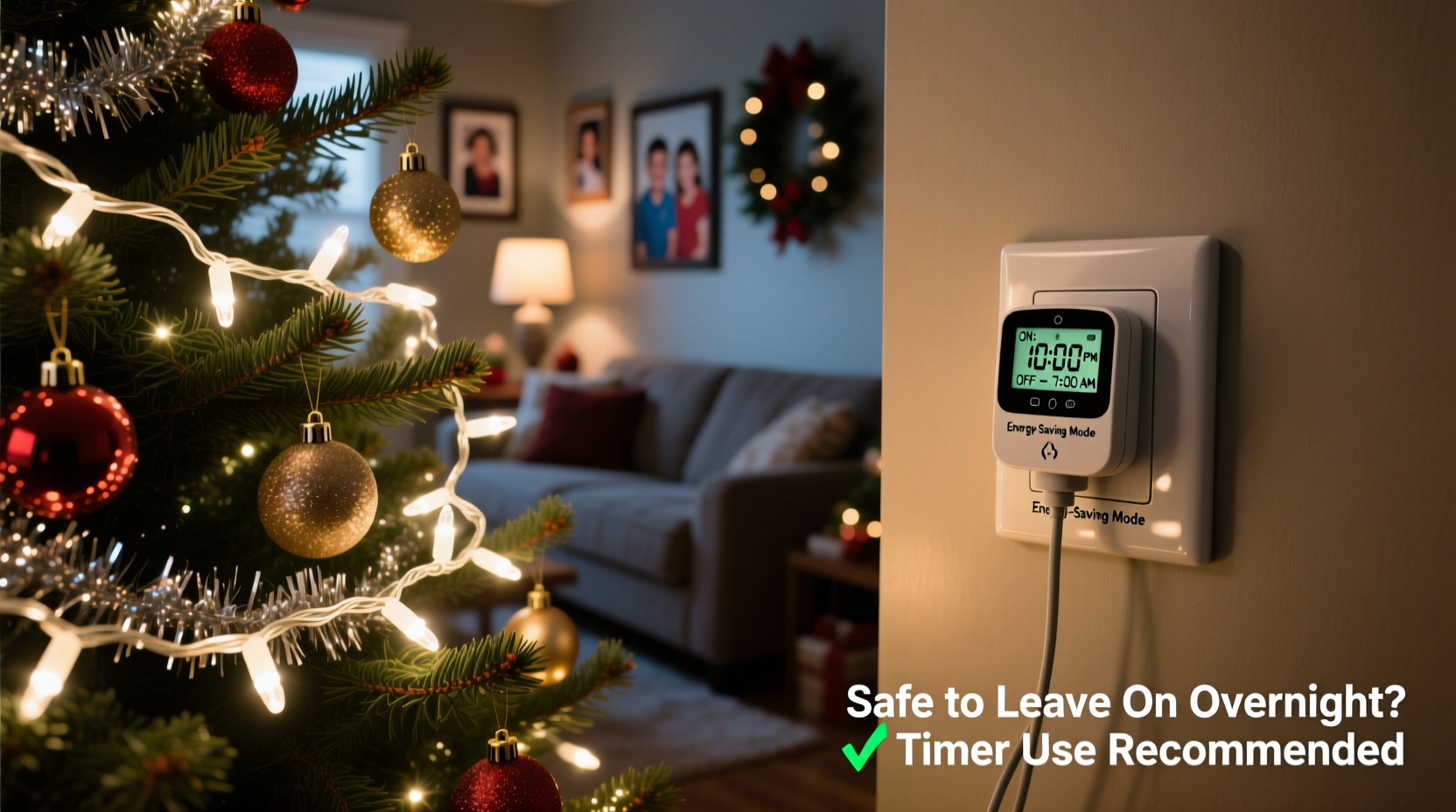
Every December, millions of households face the same quiet dilemma: Should the twinkling glow of the Christmas tree stay lit while everyone sleeps? Many rely on plug-in or smart timers to automate the lights—turning them on at dusk and off at midnight or 2 a.m. It feels convenient, festive, and energy-conscious. But convenience shouldn’t come at the cost of safety. The question isn’t just “Can I?”—it’s “Should I, and under what conditions?” This article cuts through holiday myths and marketing claims to deliver grounded, evidence-based guidance from electrical safety experts, fire investigators, and lighting engineers. We’ll examine real-world risks, clarify regulatory standards, and give you a clear, actionable framework—not just for surviving the season, but for doing it safely, year after year.
Understanding the Real Risks: Why Lights + Sleep = A Calculated Decision
Christmas tree fires are rare—but when they occur, consequences are severe. According to the National Fire Protection Association (NFPA), between 2017 and 2021, U.S. fire departments responded to an average of 150 home structure fires per year started by Christmas trees. Of those, roughly 25% involved decorative lighting as the ignition source or contributing factor. Crucially, over 40% of these lighting-related fires occurred between 11 p.m. and 7 a.m.—the exact window many timers activate or sustain operation.
The risk isn’t inherent to timers themselves. Rather, it’s the intersection of three variables: heat buildup, material degradation, and undetected failure. Incandescent bulbs can reach surface temperatures exceeding 200°F—hot enough to scorch dry pine needles or ignite nearby curtains. Even modern LEDs generate heat at the transformer, wiring junctions, and dimmer circuits—especially when bundled tightly behind ornaments or under heavy tinsel. Add aging insulation, loose connections, or voltage spikes from faulty outlets, and a timer that keeps power flowing becomes an unintentional enabler.
Importantly, UL (Underwriters Laboratories) does not certify timers *for continuous unattended operation* unless explicitly rated for “industrial” or “commercial duty.” Most consumer-grade plug-in timers—particularly those under $15—are tested only for intermittent residential use (e.g., turning lamps on/off daily), not for sustained 8–10 hour nightly cycles over weeks.
LED vs. Incandescent: A Critical Safety Comparison
The shift to LED lights has dramatically improved seasonal lighting safety—but not all LEDs are equal. Below is a comparison of key safety metrics across common lighting types used on residential trees:
| Feature | Incandescent Mini-Lights | Standard LED String Lights | UL-Listed Commercial-Grade LED |
|---|---|---|---|
| Avg. bulb surface temp | 180–220°F | 85–110°F | 70–95°F |
| Wattage per 100 bulbs | 40–60 W | 4–7 W | 3–5 W |
| Max recommended run time (unattended) | Not advised > 4 hrs | Up to 8 hrs with verified timer | Up to 12 hrs with UL-listed timer |
| Insulation rating (common) | PVC (degrades at ~140°F) | PVC or PET (rated to 105°C) | Thermoplastic elastomer (TPE), 125°C rated |
| Fail-safe behavior on short circuit | Fuse blows; entire string fails | Individual bulb shunts; rest remain lit | Auto-shutoff + thermal cutoff at 140°F |
Note: “Commercial-grade” doesn’t mean “for businesses only.” It refers to construction standards—including thicker gauge wire (22 AWG minimum), reinforced strain relief at plugs, and integrated thermal fuses—that significantly reduce fire risk during extended operation.
What Makes a Timer Actually Safe for Overnight Use?
A timer is only as safe as its weakest link—so choosing one requires scrutiny beyond aesthetics or app connectivity. Here’s what matters:
- UL 943 Certification: Look for this specific standard, which covers ground-fault circuit interrupters (GFCIs) with timing functions. UL 943-certified timers include built-in overload protection, thermal cutoffs, and automatic reset prevention after fault detection.
- Load Rating Margin: If your light string draws 48 watts, select a timer rated for at least 150 watts (3× headroom). Undersized timers overheat at their internal relays—even if the label says “works with LEDs.”
- No “Smart Plug” Reliance Alone: Wi-Fi-enabled smart plugs often lack thermal monitoring and may reboot silently during firmware updates—leaving lights on indefinitely. Pair them only with physical timers or dedicated lighting controllers with fail-closed relays.
- Outlet Placement Matters: Timers should never be buried under rugs, tucked behind furniture, or stacked with other adapters. Heat dissipation is critical. A timer operating at 90°F ambient temperature can exceed safe internal temps if airflow is restricted.
“Timers aren’t passive switches—they’re active electronic devices with finite lifespans. After 3–4 seasons, relay contacts wear, thermal sensors drift, and plastic housings become brittle. Replacing your timer annually isn’t excessive; it’s preventative maintenance.” — Michael Torres, Senior Electrical Safety Engineer, UL Solutions
A Real-World Scenario: How One Family Avoided Disaster
In December 2022, the Chen family in Portland, Oregon, used the same timer-and-LED setup for four consecutive years. Their 7-foot Fraser fir was strung with two 300-bulb UL-listed LED sets (total draw: 36W), controlled by a popular $22 smart timer. On Christmas Eve, the timer malfunctioned—not by failing open, but by entering a “stuck-on” state due to corrupted memory from a brief power surge during a thunderstorm. The lights remained on for 38 hours straight. By morning, the lower third of the tree was noticeably drier than usual, and the PVC coating on one wire segment near the trunk had developed subtle micro-cracks visible only on close inspection.
What saved them wasn’t luck—it was habit. Two nights earlier, Mr. Chen had rechecked all connections using a non-contact voltage tester and noticed slight warmth near the timer’s outlet prongs. He swapped it for a UL 943–certified mechanical timer rated at 300W. When the smart timer failed, the backup was already live—and cut power at 11:45 p.m. as programmed. Later, an electrician confirmed the original timer’s internal relay had welded shut—a known failure mode in budget units lacking arc-fault suppression.
This case underscores a vital principle: redundancy isn’t overkill for seasonal lighting. It’s resilience.
Your Overnight Safety Checklist
Before setting any timer for overnight use, complete this verified checklist. Do not skip steps—even if your setup worked fine last year.
- ✅ Verify UL 588 listing on every light string (look for the mark etched into the plug or printed on the tag).
- ✅ Confirm total wattage of all connected strings (add labels or use a Kill-A-Watt meter) and ensure it’s ≤ 50% of the timer’s rated load.
- ✅ Inspect every inch of wiring for cracks, fraying, exposed copper, or melted insulation—especially near plugs, branches, and base wraps.
- ✅ Test the timer manually at least twice: once before decorating, once after full installation. Use a stopwatch to confirm on/off accuracy within ±90 seconds.
- ✅ Ensure 3 feet of clearance around the tree base—from walls, furniture, drapes, and heating vents—to prevent heat accumulation.
- ✅ Water your tree daily. A well-hydrated tree (water level above stand base) resists ignition up to 3× longer than a dry one, according to NFPA fire lab testing.
- ✅ Install a working smoke alarm within 10 feet of the tree—and test it the same day you install lights.
Step-by-Step: Setting Up a Truly Safe Overnight Lighting System
Follow this sequence precisely. Skipping or reordering steps introduces avoidable risk.
- Day 1 – Audit & Prep: Unbox all lights. Discard any with cracked sockets, bent pins, or discoloration. Label each string with wattage and year purchased.
- Day 2 – Tree Hydration: Make a fresh ½-inch diagonal cut on the trunk. Place in water immediately. Maintain water level above the cut for 72 hours before lighting.
- Day 3 – Wiring Layout: Start at the bottom and work upward. Avoid wrapping wires tightly around branches—leave gentle loops. Never staple, nail, or tape lights to the trunk.
- Day 4 – Timer Integration: Plug lights into timer. Plug timer into a GFCI-protected outlet (required by NEC Article 410.104 for indoor holiday lighting). Do not use extension cords unless rated for indoor use and 16 AWG or thicker.
- Day 5 – Load Test: Turn on for 2 hours. Feel plugs, timers, and wire segments. Any warmth beyond body temperature warrants investigation.
- Day 6 – Final Validation: Set timer for 6-hour cycle (e.g., 5 p.m.–11 p.m.). Monitor via phone alert or physical check at 10:55 p.m. Confirm shutdown. Repeat for two nights.
- Ongoing: Every 48 hours, inspect water level and visually scan for hot spots or flickering. Replace timer after 3 seasons—or immediately if it emits buzzing, smells like ozone, or fails to switch reliably.
FAQ: Your Top Overnight Lighting Questions, Answered
Can I use an old incandescent string with a new timer?
No—unless the string is less than 2 years old, has intact insulation, and carries a current UL 588 listing. Pre-2015 incandescent sets often use thinner wire and lack thermal fuses. Even with a perfect timer, their operating temperature exceeds safe thresholds for unattended use. Retire them. LED replacements cost less than $20 per 200-bulb set and pay for themselves in energy savings within one season.
Do battery-operated lights solve the problem?
They eliminate electrical hazards—but introduce others. Lithium coin-cell batteries (common in mini LED sets) can overheat if shorted by metal ornament hooks or foil garlands. Alkaline batteries leak corrosive potassium hydroxide if left in fixtures past expiration. For overnight use, only choose battery lights with built-in low-voltage cutoffs and replace batteries every 45 days—even if they “still work.”
What’s the safest time window for overnight lighting?
Data from the U.S. Fire Administration shows the lowest risk period is 10 p.m. to 5 a.m. Why? Most household fires during sleep hours start between midnight–4 a.m., when ambient humidity drops and tree moisture loss peaks. Shutting lights off by 11 p.m. reduces exposure during the highest-risk thermal window. If you prefer later hours, limit runtime to ≤6 hours and ensure your tree receives ≥1 quart of water daily.
Conclusion: Safety Isn’t Seasonal—It’s Habitual
Leaving Christmas tree lights on overnight with a timer isn’t inherently unsafe—but treating it as routine without verification is. Modern LEDs and certified timers have made seasonal lighting dramatically safer than decades past, yet complacency remains the leading cause of preventable holiday incidents. Safety isn’t achieved by buying the most expensive gear or downloading the trendiest app. It’s built through deliberate habits: checking certifications, measuring actual loads, inspecting physical condition, and respecting the physics of heat and electricity. This season, don’t just set a timer—validate it. Don’t just admire the glow—protect the space around it. And remember: the most beautiful tree is the one still standing, unscathed, on New Year’s Day.




 浙公网安备
33010002000092号
浙公网安备
33010002000092号 浙B2-20120091-4
Comments
No comments yet. Why don't you start the discussion?