
Birds possess one of the most efficient respiratory systems in the animal kingdom, allowing them to extract oxygen at high altitudes and sustain prolonged flight. However, this same biological advantage makes them extremely vulnerable to airborne toxins—including those released by essential oils. While diffusing essential oils may seem harmless or even beneficial in a human household, for pet birds such as parrots, canaries, and finches, exposure can lead to serious illness or sudden death. Understanding the risks and knowing which scents to avoid is not just responsible pet ownership—it’s a matter of survival.
Why Birds Are So Sensitive to Airborne Substances
Birds have a unique respiratory anatomy that differs drastically from mammals. Unlike humans, who rely on lungs that expand and contract, birds have a system of air sacs and rigid lungs that allow for continuous airflow during both inhalation and exhalation. This unidirectional flow maximizes oxygen absorption but also means that inhaled particles—especially volatile organic compounds (VOCs) like those found in essential oils—are processed more efficiently and rapidly.
Additionally, birds lack a diaphragm and instead depend on their entire body cavity to assist with breathing. Their air sacs extend into bones and internal organs, increasing surface area for gas exchange but also making contamination more widespread. Because they breathe faster than humans—up to 25–40 breaths per minute depending on species—they inhale pollutants at a much higher rate relative to their size.
This sensitivity extends beyond essential oils. Non-stick cookware fumes, aerosol sprays, cigarette smoke, and even overheated Teflon can be fatal. But essential oils, often marketed as “natural” and “safe,” present a deceptive danger because their perceived safety leads owners to underestimate the risk.
“Birds are essentially living on the edge when it comes to air quality. What might be a mild irritation for us can cause acute respiratory distress in them.” — Dr. Laura Spano, Avian Veterinarian and Respiratory Specialist
The Dangers of Essential Oil Diffusion Around Birds
Diffracting essential oils disperses microscopic oil particles into the air, where they remain suspended and easily inhaled. These oils contain concentrated plant compounds such as phenols, terpenes, and ketones, many of which are toxic when inhaled in concentrated form—even by humans, let alone birds.
Symptoms of essential oil toxicity in birds include:
- Rapid or labored breathing
- Panting or tail bobbing (a sign of respiratory effort)
- Lethargy or loss of balance
- Vomiting or regurgitation
- Weakness or collapse
- Sudden death without prior symptoms
Because birds are prey animals, they instinctively hide signs of illness until they are critically unwell. By the time symptoms become visible, significant organ damage may have already occurred.
Common Methods of Exposure
Owners may unknowingly expose their birds through:
- Ultrasonic diffusers: Release fine mists containing oil particles directly into the air.
- Nebulizing diffusers: Produce even smaller particles that linger longer and penetrate deeper into lung tissue.
- Scented candles or wax melts: Often contain essential oils and release toxins when heated.
- Cleaning products: Many \"natural\" cleaners use essential oils; residue can volatilize over time.
- Clothing or skin: Applying oils and then handling birds transfers oils through contact or off-gassing.
Essential Oils That Are Toxic to Birds
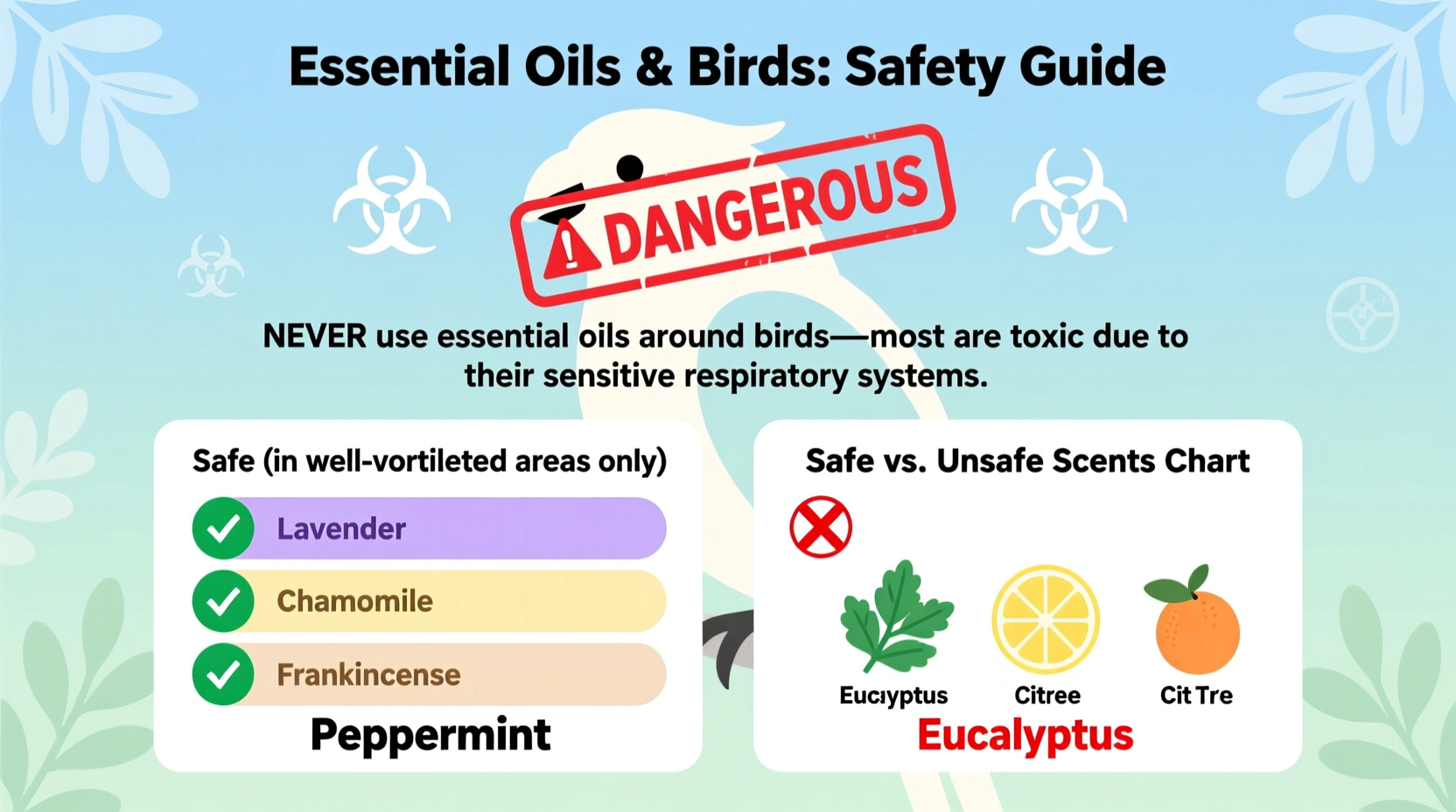
While no essential oil is considered completely safe around birds due to the method of dispersion, certain oils are particularly hazardous. The following list includes some of the most commonly used but dangerous oils for avian companions.
| Essential Oil | Primary Toxins | Known Effects on Birds |
|---|---|---|
| Tea Tree (Melaleuca) | Terpinen-4-ol, Cineole | Neurological depression, liver damage, respiratory failure |
| Eucalyptus | 1,8-Cineole | Airway irritation, bronchoconstriction, suffocation |
| Pine | Alpha-pinene, beta-pinene | Lung inflammation, chemical pneumonia |
| Cinnamon | Cinnamaldehyde | Mucous membrane burns, severe respiratory distress |
| Peppermint | Menthol, Menthone | Respiratory paralysis, cardiac arrhythmia |
| Clove | Eugenol | Hepatotoxicity, central nervous system suppression |
| Lemon/Lime (Citrus) | Limonene, Citral | Respiratory irritation, photosensitivity, liver stress |
| Thyme | Thymol | Severe mucosal damage, pulmonary edema |
Even oils labeled as “gentle” or “safe for children,” such as lavender or chamomile, should be avoided around birds. Inhaling these via diffusion still poses a risk due to concentration levels and delivery method. There are no peer-reviewed studies proving the safety of any essential oil in avian environments.
Real-Life Case: A Canary’s Sudden Decline
In 2022, a bird owner in Portland reported that her canary began gasping and became unresponsive within hours of using a eucalyptus diffuser in the adjacent room. Though the door was closed, the house had an open-concept layout with shared HVAC. Despite immediate veterinary care, the bird died within 12 hours. Necropsy results revealed severe pulmonary congestion consistent with chemical inhalation injury. The veterinarian confirmed that airborne eucalyptus oil was the likely culprit, emphasizing that even indirect exposure through air circulation can be lethal.
This case highlights how quickly things can go wrong—even with precautions. Birds don’t need direct contact to be affected; air currents carry microdroplets throughout a home.
Safe Alternatives and Precautions for Bird Owners
If you’re seeking natural ways to freshen your home or support wellness while sharing space with birds, safer alternatives exist. The key is avoiding anything airborne or aerosolized.
Non-Toxic Home Freshening Options
- Ventilation: Open windows regularly to refresh indoor air naturally.
- Baking soda: Place bowls around the house to absorb odors safely.
- Vinegar solutions: Use diluted vinegar for cleaning; ensure full drying before birds re-enter the area.
- Fresh herbs: Display dried rosemary or lavender in sachets—only if kept out of reach and never heated.
Checklist: Essential Oil Safety for Bird Owners
- ✅ Avoid all forms of essential oil diffusion near birds.
- ✅ Store essential oils securely away from cages and play areas.
- ✅ Wash hands thoroughly after applying oils before handling birds.
- ✅ Choose fragrance-free or bird-safe cleaning products.
- ✅ Educate family members and visitors about the risks.
- ✅ Monitor HVAC systems to prevent cross-airflow between rooms.
- ✅ Consult an avian vet before introducing any new scent or product.
What to Do If Your Bird Is Exposed
Immediate action can make the difference between recovery and fatality.
Step-by-Step Response Guide
- Remove the source: Turn off diffusers, extinguish candles, or eliminate the contaminant immediately.
- Remove the bird from the environment: Gently place them in a clean, quiet, well-ventilated area with fresh air.
- Do not induce vomiting or administer anything orally.
- Contact an avian veterinarian immediately: Describe the oil used and duration of exposure.
- Transport carefully: Cover the carrier partially to reduce stress and keep warm.
- Follow professional guidance: Treatment may include oxygen therapy, nebulization with saline, or supportive care.
Even if the bird appears normal, observation for 24–48 hours is critical. Delayed onset of respiratory distress is common.
“Time is tissue when it comes to inhalation injuries. The sooner we can get oxygen support and reduce inflammation, the better the prognosis.” — Dr. Rajiv Mehta, Board-Certified Avian Veterinarian
Frequently Asked Questions
Can I use essential oils if my bird is in another room?
No. Most homes have interconnected air systems through HVAC, fans, or open doorways. Microscopic oil particles travel easily and can accumulate in enclosed spaces. Even low-level exposure over time can weaken a bird’s respiratory system. It’s safest to avoid use entirely if you own birds.
Are “bird-safe” essential oil blends really safe?
There is no regulated standard for “bird-safe” essential oil blends. Any product containing concentrated plant extracts poses a risk when diffused. Marketing terms are not backed by veterinary research. True safety means eliminating airborne oils altogether.
Is topical application on humans dangerous for birds?
Yes, if you apply essential oils to your skin or clothing and then handle your bird, transfer can occur through touch or off-gassing. Birds preen and may ingest toxins from your hands or clothes. Wait several hours after use—or better yet, avoid using oils altogether if you interact closely with your bird.
Conclusion: Prioritizing Avian Health Over Aromatherapy Trends
Living with birds requires a heightened awareness of environmental hazards. What feels like a small indulgence—lighting a lavender diffuser or using a citrus-scented cleaner—can have devastating consequences for a creature whose biology magnifies every breath. Essential oils are not inherently evil, but their use in homes with birds crosses a line of acceptable risk.
Choosing to forgo aromatic convenience is not a sacrifice; it’s an act of love and responsibility. Your bird depends on you to create a safe, breathable world—one free from invisible threats. By understanding their vulnerability, avoiding toxic scents, and adopting bird-friendly alternatives, you ensure a longer, healthier life for your feathered companion.




 浙公网安备
33010002000092号
浙公网安备
33010002000092号 浙B2-20120091-4
Comments
No comments yet. Why don't you start the discussion?