
The holiday season brings warmth, connection, and—inevitably—decorative decisions. One of the most delicate social questions that arises in homes where Christmas trees are displayed is whether it’s appropriate to ask guests not to touch or add ornaments. While some households welcome spontaneous decoration as part of the festive spirit, others treat their trees as curated displays. So where does one draw the line? Can you politely request that visitors refrain from altering your tree’s arrangement without offending them?
The answer isn’t a simple yes or no—it depends on context, relationship dynamics, communication style, and cultural expectations. What may seem like a minor boundary to one person can feel like an overreaction to another. Navigating this requires emotional intelligence, clarity, and a bit of etiquette finesse.
Understanding the Emotional Weight of Holiday Decor
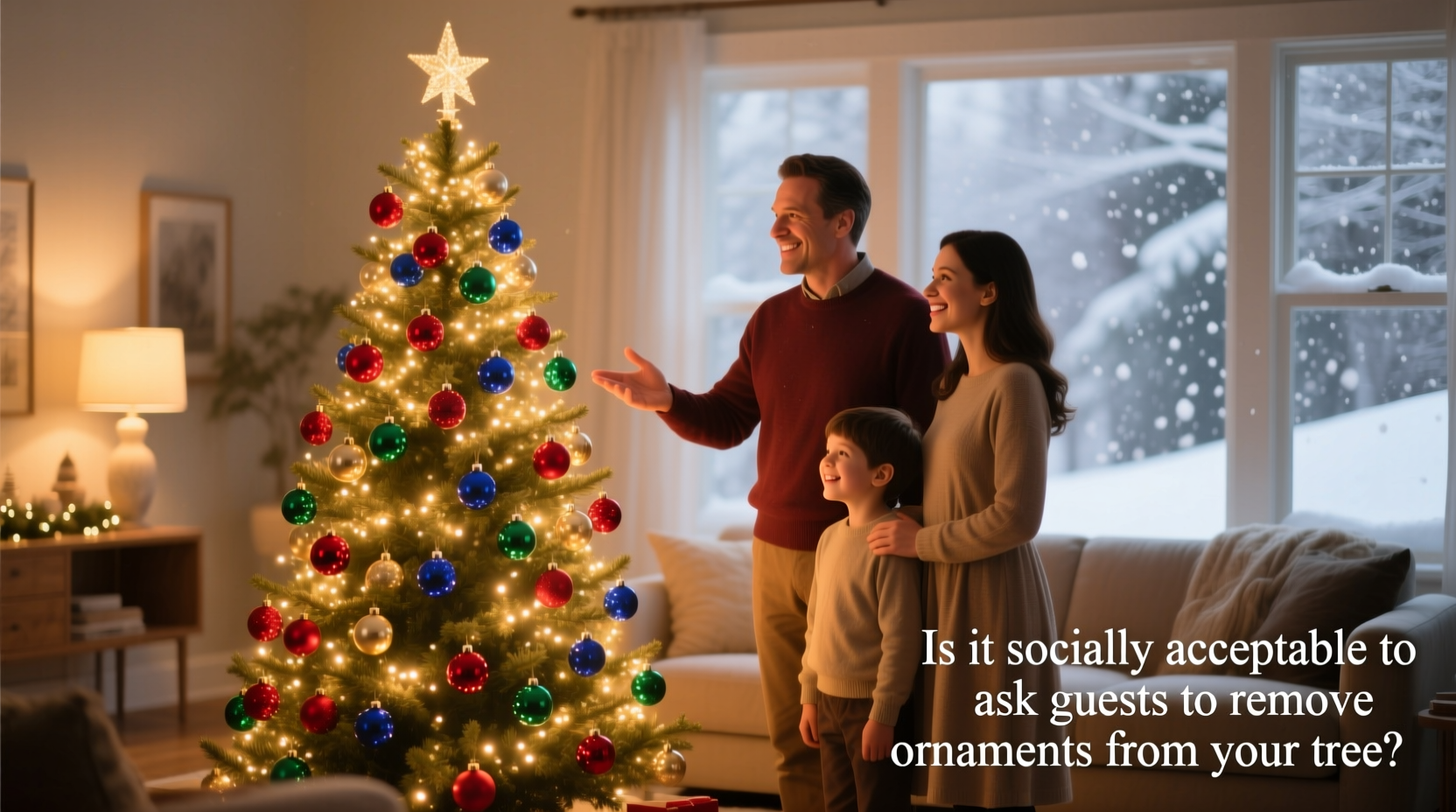
Holiday decorations often carry deep sentimental value. Ornaments might commemorate milestones—a first Christmas together, a child’s birth, a lost loved one. The tree itself can be more than just seasonal decor; it’s a living archive of memory and tradition. For many, rearranging or adding to it without permission feels like altering a personal narrative.
At the same time, for others, the joy of the holidays lies in shared participation. Guests—especially children—might see the tree as a communal project, a canvas for collective celebration. This creates a tension between preservation and participation.
“Holiday traditions are deeply personal, but they also exist within a social framework. The key is balancing respect for individual space with inclusive warmth.” — Dr. Lila Monroe, Cultural Anthropologist & Author of *Seasons of Belonging*
This duality explains why seemingly small actions—like hanging a handmade ornament—can spark strong reactions. It's not about the object itself, but what it represents: autonomy, inclusion, memory, or disruption.
When It’s Reasonable to Set Boundaries
There are several scenarios in which asking guests to refrain from touching your tree is not only acceptable but necessary:
- Sentimental or fragile ornaments: If your tree includes heirlooms, antiques, or items irreplaceable due to emotional significance, protecting them is both practical and understandable.
- Structural concerns: Overloading branches can cause breakage, especially with real trees or older artificial ones. Safety matters.
- Design integrity: Some people invest significant time in color schemes, themes (e.g., rustic farmhouse, vintage gold, monochrome), or spatial balance. Random additions can disrupt the aesthetic intentionally created.
- Allergies or pet safety: Certain ornaments contain materials that could trigger allergies or pose choking hazards if pets or young children knock them down.
How to Communicate the Request Without Offense
The way you frame the request makes all the difference. A blunt “Don’t touch the tree” can sound harsh, even if well-intentioned. Instead, use empathetic language that emphasizes care rather than restriction.
Here are several effective phrasing strategies:
- Frame it around preservation: “We’d love for everyone to enjoy the tree—many of these ornaments have been in the family for decades, so we keep them hands-off to protect the memories.”
- Make it playful: “This tree has a strict ‘no unsupervised decorating’ policy! All new ornaments go through an approval process by the Chief Elf.”
- Redirect participation: “We’re saving space for our annual ornament craft night next week—if you’d like to make one, we’d love to include it!”
- Use humor with warmth: “That snowman is technically my nephew’s emotional support ornament—he gets nervous if anyone moves him.”
The goal is to convey the boundary while preserving goodwill. When done with kindness, most guests will understand and appreciate the sentiment behind the rule.
Case Study: The Tree That Sparked a Family Talk
Last winter, Sarah hosted her extended family for Christmas Eve. She had spent weeks curating a minimalist silver-and-blue theme, incorporating glass orbs passed down from her grandmother. Midway through dinner, her niece, age six, excitedly ran to the tree and hung a glittery reindeer she’d made at school.
Sarah froze. The ornament clashed dramatically with the palette, and the weight caused a branch to sag. But scolding the child felt wrong—her enthusiasm was genuine.
Instead, Sarah knelt beside her and said, “I love what you made! It’s so full of sparkle and joy. Our tree tonight is telling a quiet story, but would you help me start a new tradition? We’ll hang your reindeer on the ‘Kid’s Tree’ in the sunroom tomorrow morning, and every year, we’ll add one more.”
The solution preserved the original display, validated the child’s creativity, and created a new ritual. By the end of the night, the entire family was brainstorming ideas for the second tree.
This example shows that boundaries don’t have to shut down joy—they can redirect it into new, inclusive forms.
Do’s and Don’ts: Managing Tree Etiquette Gracefully
| Do | Don’t |
|---|---|
| Explain the reason behind your request with warmth | Assume guests know your rules without communicating them |
| Offer alternative ways for guests to participate in decorating | React with visible frustration if someone touches an ornament |
| Use humor or storytelling to soften the message | Shame children or make them cry over a simple mistake |
| Place delicate ornaments higher up or behind barriers | Leave fragile items within easy reach of toddlers without supervision |
| Acknowledge gifts of ornaments—even if not hung immediately | Discard or ignore homemade ornaments given with affection |
Alternatives to Saying “No”: Inclusive Solutions
If you're concerned about seeming unwelcoming, consider these alternatives that honor both your boundaries and your guests’ desire to contribute:
- Create a secondary tree: A smaller “community tree” allows guests to hang ornaments freely. Label it playfully: “The Free-For-All Fir” or “Guest Galaxy of Glitter.”
- Host a designated decorating event: Invite guests to a pre-holiday session where everyone adds their pieces together under supervision.
- Display a guest ornament station: Set up a table with blank tags, markers, and plain bulbs. Invite people to create their own, then store them to be added later—or photograph them as keepsakes.
- Rotate ornaments annually: Tell guests, “We rotate special ornaments each year—yours will have its moment in the spotlight soon!”
These approaches transform potential conflict into collaboration. They acknowledge the human need to belong and contribute, while still protecting your primary display.
FAQ: Common Questions About Tree Boundaries
Can I refuse to let someone hang an ornament they brought as a gift?
You can choose when and how to display gifts, but outright refusal should be handled with care. Accept the ornament graciously, express gratitude, and say something like, “We’ll find the perfect spot for it in next year’s setup,” or “It means so much—we’ll treasure it always, even if it doesn’t fit this year’s theme.”
What if a guest hangs an ornament without asking?
Respond calmly. If it’s safe and fits aesthetically, you might leave it as a gesture of goodwill. If not, remove it discreetly later and say, “We rotated some pieces this year to make room for old favorites.” Avoid public correction, especially with children.
Is it rude to have a “no touch” policy during open-house events?
Not if it’s communicated respectfully. Use signage, lighting, or furniture placement to subtly discourage close interaction. Most guests understand that not everything is meant to be handled—just like in a gallery.
Step-by-Step Guide: Setting Tree Boundaries With Grace
- Assess your priorities: Determine whether your tree is decorative, interactive, or memorial in nature.
- Anticipate interactions: Consider who will visit—children, elderly relatives, friends unfamiliar with your customs.
- Choose your method of communication: Decide whether to use verbal cues, signage, or environmental design (e.g., placing the tree out of reach).
- Prepare a kind explanation: Have a short, warm script ready for when questions arise.
- Offer an alternative: Provide another way for guests to engage with the holiday spirit—crafting, caroling, cookie decorating.
- Follow through consistently: Apply the rule to everyone to avoid perceptions of favoritism or unfairness.
- Reflect afterward: Did the approach work? Would you adjust anything next year?
Checklist: Preparing Your Home for Holiday Guests
- ✅ Identify which ornaments are fragile or sentimental
- ✅ Relocate high-risk items out of reach of children and pets
- ✅ Decide whether to allow guest contributions
- ✅ Prepare a polite phrase to explain any restrictions
- ✅ Consider setting up a secondary tree or decoration station
- ✅ Place subtle visual cues (e.g., ribbon barrier, low lighting)
- ✅ Plan a backup response if a boundary is accidentally crossed
Conclusion: Balancing Respect and Warmth
Yes, it is socially acceptable to ask guests to remove or refrain from adding ornaments to your tree—provided it’s done with empathy and clarity. Personal space, even in the form of holiday decor, deserves respect. At the same time, hospitality thrives on inclusion and generosity.
The most successful homes aren’t those without boundaries, but those where boundaries are set kindly and clearly. You can protect your traditions without shutting out joy. You can honor memory while making room for new moments.
This holiday season, consider not just how your tree looks—but how it makes people feel. With thoughtful communication and creative solutions, you can maintain your vision while welcoming others into the spirit of the season.




 浙公网安备
33010002000092号
浙公网安备
33010002000092号 浙B2-20120091-4
Comments
No comments yet. Why don't you start the discussion?