
Every holiday season, millions of households bring home a fresh-cut or artificial Christmas tree, only to face the same familiar challenge: getting it to stand straight. A slight lean might seem like a minor issue at first—something you can adjust with a few tugs on the trunk or some creative positioning in the corner. But over time, that tilt can become more than just cosmetic. It affects ornament balance, light distribution from string lights, and even safety, especially in homes with pets or small children.
This is where the idea of a rotating Christmas tree stand comes in. Marketed as a solution for both convenience and alignment, these stands promise effortless 360-degree viewing and automatic centering. But are they truly effective for correcting a leaning tree? And more importantly, is the investment justified for what may appear to be a small problem?
The answer isn’t straightforward. While rotation offers undeniable convenience, its ability to correct or compensate for an existing lean depends on several factors—including the type of tree, the quality of the stand, and how the tree was initially secured. Let’s examine whether upgrading to a rotating model makes sense when your tree already tilts slightly.
Understanding Why Trees Lean in the First Place
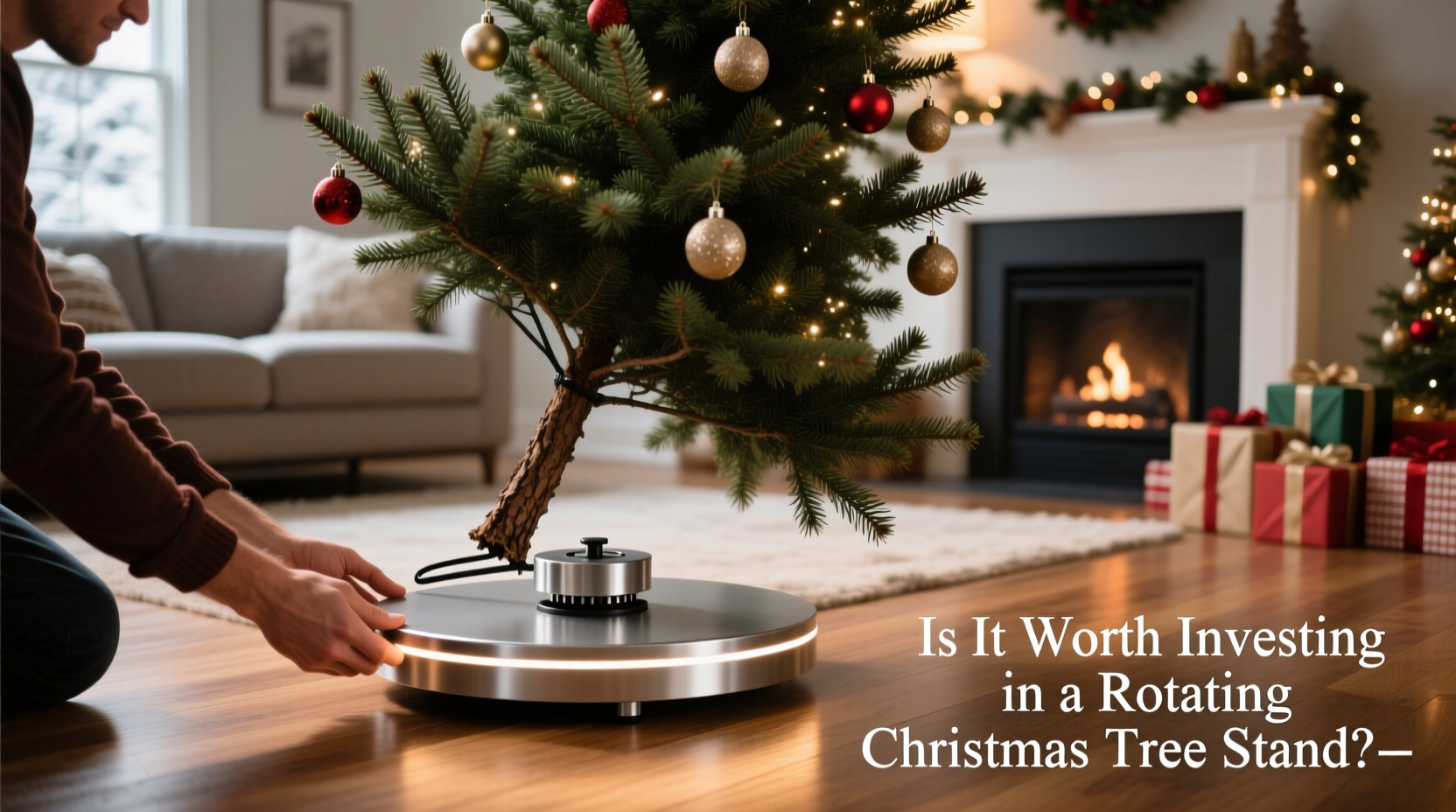
A Christmas tree that leans isn’t necessarily defective—it’s often the result of natural asymmetry or improper setup. Most trees, especially real ones, grow outdoors where wind, sunlight exposure, and terrain influence their shape. Even artificial trees can have uneven branch distribution due to folding patterns or manufacturing variances.
The most common causes of leaning include:
- Trunk curvature: The base of the trunk may not be perfectly straight, making it difficult to seat evenly in a standard stand.
- Uneven weight distribution: Heavier branches on one side pull the tree off-center.
- Poor water reservoir fit: If the stand’s clamp mechanism doesn’t grip the trunk securely, shifting is inevitable.
- Carpet or flooring inconsistencies: Soft carpet padding or uneven hardwood joints can cause instability.
In many cases, a slight lean develops shortly after setup and worsens as the tree dries out or absorbs water and expands. While traditional stands allow manual adjustments using screws or braces, they require constant monitoring. This is where rotating stands claim to offer a better solution—not by fixing the lean directly, but by minimizing its impact through design and functionality.
How Rotating Stands Work—and Where They Fall Short
A rotating Christmas tree stand uses a motorized or manual turntable system that allows the entire tree to spin smoothly. High-end models feature slow, continuous rotation powered by a small electric motor, while budget versions rely on hand-spinning mechanisms. The primary benefit advertised is ease of decoration and viewing—no need to walk around the tree to hang ornaments or plug in lights.
But do these stands actually correct a lean?
The short answer: not inherently. Rotation does not stabilize a wobbly tree or re-center a misaligned trunk. However, higher-quality rotating models often come with additional features that indirectly improve stability:
- Enhanced gripping systems (e.g., multi-point screw clamps)
- Built-in leveling feet or adjustable bases
- Wider footprint for improved balance
- Integrated water reservoirs with capacity gauges
These upgrades mean that while the rotation itself won’t fix a lean, the overall engineering of premium rotating stands tends to be superior to basic fixed models. In this way, switching to a rotating stand might solve the symptom—not because of rotation, but because of better construction.
“Rotating stands don’t magically straighten crooked trees, but the best ones combine rotation with advanced stabilization tech that reduces movement by up to 70% compared to economy stands.” — Daniel Reeves, Holiday Home Engineer and Product Tester at Seasonal Living Labs
When a Rotating Stand Is Worth the Investment
Not every household will benefit equally from a rotating stand. The decision should be based on practical needs, tree type, and long-term usage. Consider investing in one if you meet any of the following criteria:
- You decorate the tree annually with intricate detail and want uniform visibility.
- Your living space limits access to certain sides of the tree (e.g., against a wall).
- You have mobility challenges that make walking around the tree difficult.
- You own a tall tree (over 7 feet), which is harder to stabilize manually.
- You plan to reuse the stand for multiple years, justifying the upfront cost.
For those dealing with a slightly leaning tree, a high-end rotating model with self-leveling capabilities and reinforced clamps can provide noticeable improvement. These stands often include independent leg adjustments that compensate for uneven floors—a major contributor to leaning.
Conversely, if your tree leans due to a severely curved trunk or structural imbalance, no amount of rotation or leveling will fully correct it. In such cases, trimming the base at a slight angle to match the floor’s pitch may be necessary—an option available only with real trees.
Real Example: The Johnson Family’s Fix
The Johnsons had struggled for three years with their 8-foot Fraser fir leaning toward the fireplace. Each year, they used bungee cords and furniture braces to hold it upright, which worked temporarily but damaged the branches during removal.
Last season, they invested in a mid-range electric rotating stand with adjustable legs and a four-screw locking mechanism. After trimming the trunk base flat, they mounted the tree and used the stand’s leveling guide to ensure even contact with the floor. Once secured, the rotation function allowed them to decorate without stepping behind the tree.
The result? No visible lean, consistent water intake, and zero need for external supports. While the $120 price tag gave them pause, they estimate saving at least five hours in setup and maintenance over the holidays—time they now spend with family instead.
Comparison: Standard vs. Rotating Tree Stands
| Feature | Standard Stand | Rotating Stand |
|---|---|---|
| Average Price | $15–$30 | $60–$180 |
| Stability Features | Single or dual screw clamp | Multi-point clamp + leveling legs |
| Ease of Decoration | Requires full rotation by hand | Motorized or smooth manual spin |
| Water Capacity | 0.5–1 gallon | 1–2 gallons (larger reservoirs) |
| Fixes Leaning? | Only if adjusted properly | Indirectly, via better engineering |
| Best For | Occasional use, small trees | Frequent users, large or problematic trees |
Step-by-Step: Can You Fix a Lean Without a New Stand?
Before purchasing a rotating stand, try these proven methods to correct a slight lean using your current equipment:
- Re-trim the trunk base: Cut ½ to 1 inch off the bottom to create a fresh, flat surface. This improves water absorption and seating.
- Empty and reposition the stand: Remove the tree, place the stand on a hard surface, and verify all legs make contact.
- Use shims under the stand: Thin wooden or plastic wedges can level the base on carpet or sloped floors.
- Tighten clamps incrementally: Alternate between each screw to apply even pressure and avoid splitting the trunk.
- Test stability: Gently push the top of the tree; if it moves more than 2 inches, reinforce with hidden guy wires anchored to furniture.
If these steps eliminate the lean, a rotating stand may be unnecessary unless you value the rotational convenience. But if the tree continues to shift or droop, upgrading becomes a more compelling option.
FAQ: Common Questions About Rotating Stands and Leaning Trees
Will a rotating stand prevent my tree from falling over?
Not automatically. While many rotating stands offer better stability than basic models, they still require proper assembly and placement. Always position the tree away from foot traffic and secure it in high-risk environments. Rotation adds convenience, not fail-safe protection.
Can I use a rotating stand with an artificial tree?
Yes, and many are designed specifically for artificial trunks. Just ensure the pole diameter matches the stand’s clamp range. Some rotating stands include adapters for metal poles, so check compatibility before buying.
Do rotating stands work on carpet?
Most do, especially those with wide, non-slip feet. However, thick plush carpet can compress unevenly. Look for models with adjustable legs or add a rigid board underneath the stand for consistent support.
Action Plan: Decide Whether to Upgrade
To determine if a rotating Christmas tree stand is worth the investment for your slightly leaning tree, follow this checklist:
- ✅ Assess the cause of the lean—is it floor-related, trunk-related, or balance-related?
- ✅ Attempt DIY fixes (trimming, shimming, re-clamping) before buying new equipment.
- ✅ Measure your tree’s trunk diameter and height to ensure stand compatibility.
- ✅ Evaluate your decorating habits—do you struggle to reach the backside?
- ✅ Calculate long-term value—if you’ll use it for 5+ years, even a $100 stand costs less than $20/year.
- ✅ Read reviews focused on stability, not just rotation speed.
If most answers point toward recurring difficulty and long-term use, then yes—a rotating stand is likely worth the investment. It won’t erase physics, but it can significantly reduce the hassle of managing a stubborn tree.
Final Thoughts: Convenience Meets Practicality
A slightly leaning Christmas tree isn’t just a visual flaw—it’s a sign of instability that can compromise safety and enjoyment. While rotating stands don’t directly correct leans, the best models combine rotation with superior engineering that addresses the root causes: poor leveling, weak clamping, and uneven weight distribution.
For families who prioritize ease of decoration, consistent presentation, and long-term durability, upgrading to a quality rotating stand makes practical sense. The initial cost is offset by reduced setup time, better water retention, and fewer emergency corrections during the holidays.
Ultimately, the decision comes down to how much you value peace of mind during one of the busiest times of the year. If straightening your tree currently eats into precious holiday moments, then a rotating stand isn’t just a luxury—it’s a meaningful upgrade that pays back in time, effort, and festive joy.




 浙公网安备
33010002000092号
浙公网安备
33010002000092号 浙B2-20120091-4
Comments
No comments yet. Why don't you start the discussion?