
For many, the Christmas tree is the centerpiece of holiday decor. Its glow sets the tone for warmth, nostalgia, and celebration. But as lighting technology evolves and design trends shift, more people are experimenting with combining multiple types of Christmas lights—twinkling LEDs, steady incandescents, warm whites, cool blues, icicle strands, and even color-changing bulbs—all on a single tree. The question arises: does this layered approach enhance the magic, or does it cross into visual chaos?
The answer isn’t a simple yes or no. Layering different types of Christmas lights can be stunning when done with intention, balance, and an understanding of light dynamics. When executed poorly, however, it risks overwhelming the eye, creating a cluttered effect that distracts from the tree’s natural beauty. This article explores the art and science behind multi-light layering, offering practical guidance for achieving elegance without excess.
Understanding Light Types and Their Visual Impact
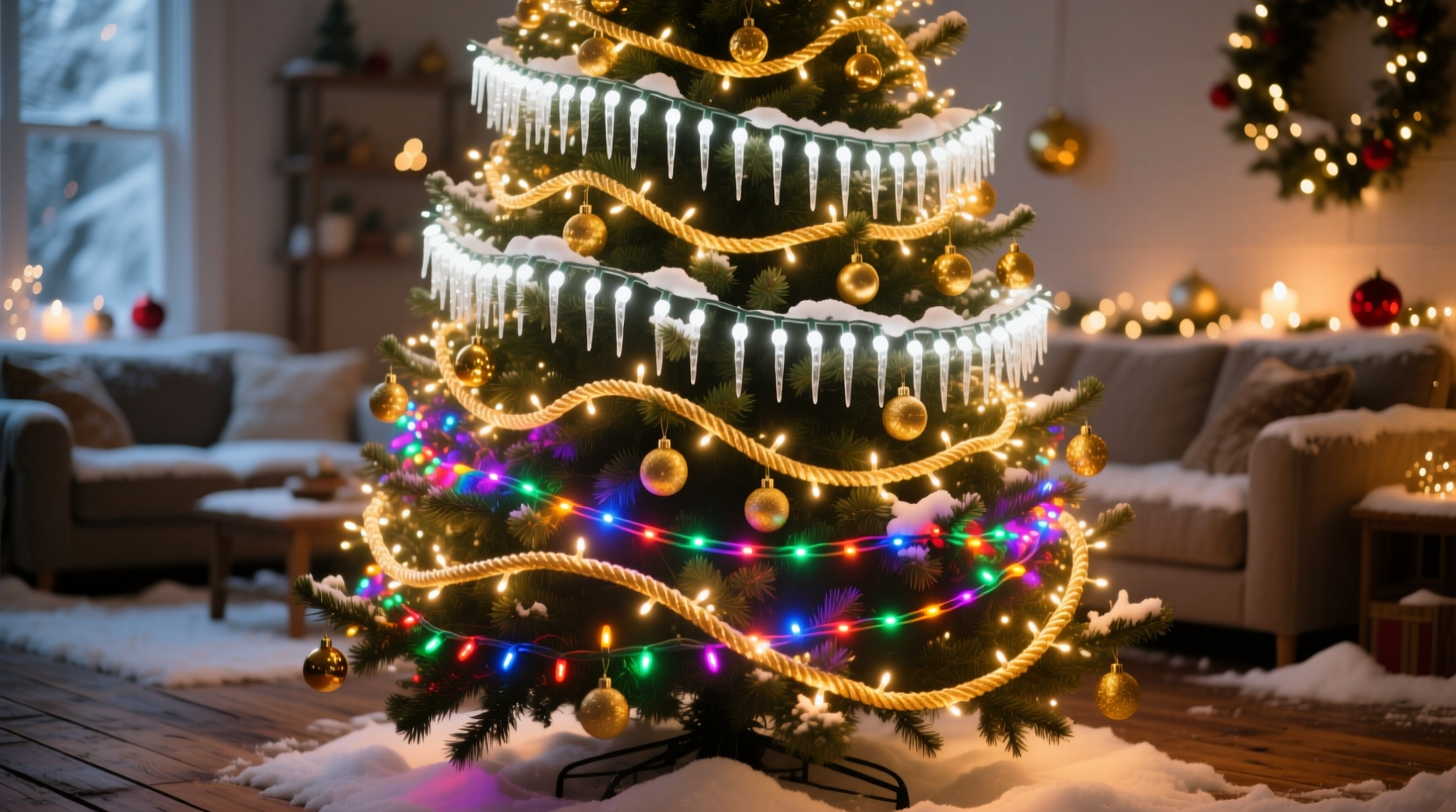
Before combining lights, it’s essential to understand what each type contributes to the overall aesthetic. Not all lights behave the same way in terms of brightness, color temperature, movement, and beam spread. Recognizing these differences helps prevent clashing effects.
- Incandescent Lights: Warm, soft glow with a slightly yellow hue. They emit a nostalgic, vintage feel but consume more energy and generate heat.
- LED Lights: Energy-efficient and long-lasting. Available in a wide range of colors and temperatures—from warm white (2700K) to daylight (6500K). Some offer dimming or color-shifting features.
- Twinkle/Flicker Lights: Simulate candlelight or fireflies. Best used sparingly to add dimension, not as the primary light source.
- Steady-Burn Lights: Provide consistent illumination. Ideal for base coverage and depth.
- Icicle Lights: Designed to hang vertically, often used on rooflines but sometimes draped down trees. Can add drama if integrated thoughtfully.
- Color-Changing RGB Lights: Programmable via remote or app. Offer versatility but require careful coordination to avoid a carnival-like appearance.
Mixing these types isn’t inherently problematic—but doing so without a unifying vision increases the risk of sensory overload.
The Design Principle of Layered Lighting
In interior design, layered lighting refers to using ambient, task, and accent lighting to create depth and functionality. The same principle applies to Christmas trees. A well-lit tree uses layers to achieve balance:
- Base Layer (Ambient): Uniform, steady lights that cover the tree densely. This forms the foundation, ensuring no dark spots.
- Accent Layer (Sparkle & Texture): Twinkling, flickering, or specialty lights placed strategically to catch attention—near the outer branches or around focal ornaments.
- Feature Layer (Drama): Icicle strands, rope lights along the trunk, or color accents that highlight specific zones.
When all three layers work in harmony, the result feels rich and intentional. But stacking too many competing features—such as blinking multicolor LEDs over warm-white steady lights with random twinkle strands—can fracture focus and diminish elegance.
“Lighting should guide the eye, not chase it. A Christmas tree should feel inviting, not jarring.” — Clara Bennett, Holiday Interior Designer and Author of *Seasonal Spaces*
Do’s and Don’ts: Combining Light Types Without Overdoing It
The key to successful layering lies in restraint and cohesion. Use the following table as a guide to make informed choices.
| Scenario | Do | Don’t |
|---|---|---|
| Using LED + Incandescent | Stick to similar color temperatures (e.g., both warm white). Ensure voltage compatibility. | Mix warm white LEDs with cool blue incandescents—they clash visually. |
| Adding Twinkle Lights | Use only 1–2 strands per large tree, nestled near reflective ornaments. | Wrap every branch in twinkling lights—creates visual noise. |
| Incorporating Color-Changing Lights | Program them to match a single palette (e.g., gold/white/red) and avoid rapid cycling. | Let them run in rainbow mode across the entire tree—it distracts from other decor. |
| Using Icicle Lights | Drape vertically from top to bottom on one side for subtle texture. | Weave them randomly through inner branches—they get lost and look messy. |
Step-by-Step Guide: How to Layer Lights Successfully
Follow this timeline to install layered lighting that enhances rather than overwhelms.
- Plan Your Palette (Day 1): Decide on a color scheme—traditional (warm white/gold), modern (cool white/silver), or themed (red/green, blue/silver). Stick to no more than two dominant light colors.
- Install Base Lights (Day 2): Begin with 100–150 lights per foot of tree height. For a 7-foot tree, use at least 700 steady-burn lights in your primary color. Weave them from trunk outward, maintaining even spacing.
- Add Accent Lights (Day 3): Introduce secondary lighting—such as warm twinkle LEDs or vintage-style filament bulbs—in small quantities. Focus on high-visibility areas like the front face and upper third of the tree.
- Incorporate Specialty Features (Day 4): Add one dramatic element—like a single strand of color-shifting lights set to pulse slowly, or a few vertical icicle drops. Avoid symmetry; asymmetry adds interest.
- Final Evaluation (Day 5): Turn off room lights and observe the tree from multiple angles. Adjust any overly bright or distracting zones. Remove anything that competes for attention unnecessarily.
A Real Example: From Overdone to Elegant
Sarah M., a homeowner in Portland, Oregon, once layered five different light types on her 8-foot Fraser fir: warm white LEDs, cool white incandescents, red-and-green twinkle lights, blue icicle strands, and a color-changing spiral bulb set. “It looked like a department store exploded,” she admitted. After consulting a local decorator, she simplified her approach.
She kept the warm white LEDs as her base (800 bulbs), removed all colored lights except a single strand of amber twinkle LEDs wrapped around the lower front quadrant, and added battery-powered fairy lights inside a few glass ornaments for internal glow. The transformation was immediate. “People comment on how peaceful it feels now,” Sarah said. “It still sparkles, but it doesn’t scream at you.”
This case illustrates a common pitfall: equating variety with festivity. In reality, sophistication often comes from editing, not adding.
Checklist: Is Your Tree Light Layering Working?
Use this checklist to evaluate your tree before finalizing decorations:
- ☑ All lights share a cohesive color temperature (e.g., warm white throughout).
- ☑ No more than two types of motion effects (e.g., one twinkle strand, one slow-fade RGB strip).
- ☑ Base lighting covers at least 80% of the tree uniformly.
- ☑ Accent lights are used sparingly and placed intentionally, not randomly.
- ☑ The tree remains visually balanced when viewed from the main living area.
- ☑ You can see ornaments clearly without glare or distraction from flashing lights.
- ☑ The overall mood is warm and inviting, not chaotic or electric.
Frequently Asked Questions
Can I mix LED and incandescent lights safely?
Yes, but only if they’re on separate circuits or connected through compatible adapters. Never daisy-chain different types unless the packaging confirms compatibility. Mismatched voltages can cause overheating or premature burnout.
How many light strands are too many on one tree?
There’s no fixed number, but a good rule is 100 lights per foot of tree height as a baseline. Beyond that, additional strands should serve a clear purpose—not just fill space. If adding another strand doesn’t improve depth or sparkle, it’s likely excess.
Will mixing light types damage my tree or outlets?
Physically, no—if wiring is sound and circuits aren’t overloaded. However, poor quality connectors or excessive load can pose fire risks. Always check wattage limits and use UL-listed products. More importantly, visual “damage” is real: poor coordination can ruin the tree’s aesthetic coherence.
Conclusion: Less Can Be More—But More Can Also Be Magical
Layering different types of Christmas lights isn’t inherently too much. It becomes excessive only when done without purpose. The most memorable trees aren’t those with the most lights, but those that evoke emotion—calm, joy, wonder—through thoughtful design.
Whether you prefer the simplicity of a single string of vintage bulbs or the dynamic interplay of modern LEDs and subtle twinkle effects, the goal remains the same: to create a focal point that draws people in, not pushes them away. With planning, restraint, and a clear vision, layering can elevate your tree from ordinary to extraordinary.




 浙公网安备
33010002000092号
浙公网安备
33010002000092号 浙B2-20120091-4
Comments
No comments yet. Why don't you start the discussion?