
The release of the Marvel vs. Capcom Fighting Collection: Arcade Classics sparked immediate excitement among retro fighting game fans. With its announcement, many assumed it would be little more than a remaster of the beloved Marvel vs. Capcom 2: New Age of Heroes. After all, that title remains one of the most iconic entries in the franchise. But is this new collection truly just a repackage of MvC2 with a fresh coat of paint? The answer is both simpler and more nuanced than it appears.
This compilation includes nine titles spanning the arcade era of crossover brawling, from early entries like Marvel Super Heroes to Captain Commando, and yes—Marvel vs. Capcom 2 is indeed one of them. However, reducing the entire collection to “MvC2 remastered” overlooks its broader historical significance and curated preservation effort. Let’s examine exactly what’s included, how it’s been updated, and whether this release brings anything genuinely new to the table.
What’s Actually Included in the Collection?
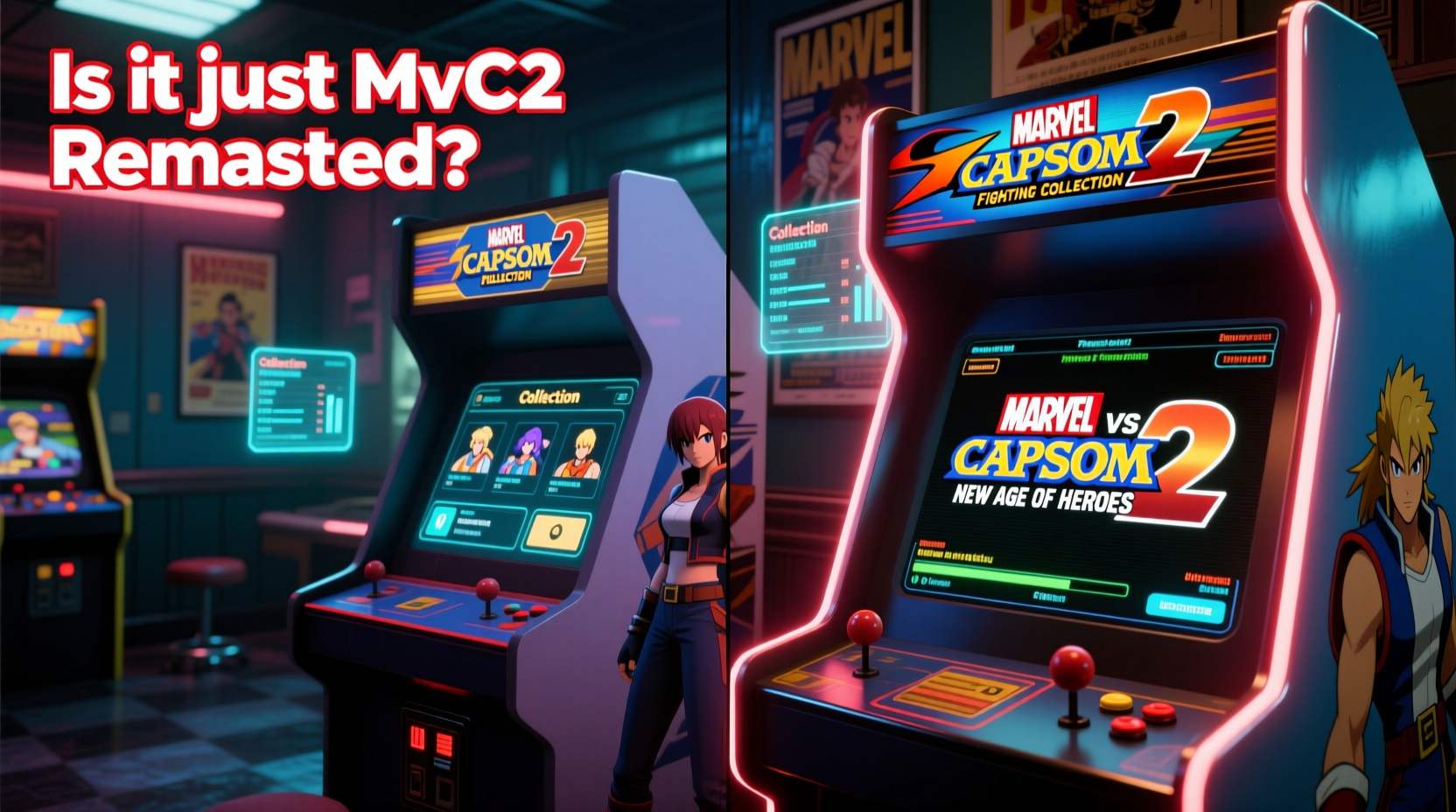
The Fighting Collection isn’t built around a single game. Instead, it serves as a digital museum of Capcom’s arcade-era superhero and character crossover titles. Here are the nine games featured:
- Marvel Super Heroes (1995)
- X-Men: Children of the Atom (1994)
- Marvel Super Heroes vs. Street Fighter (1997)
- X-Men vs. Street Fighter (1996)
- Marvel vs. Capcom: Clash of Super Heroes (1998)
- Marvel vs. Capcom 2: New Age of Heroes (2000)
- Captain Commando (1991)
- Dungeons & Dragons: Tower of Doom (1993)
- Dungeons & Dragons: Shadow over Mystara (1996)
Of these, only three are direct Marvel vs. Capcom crossover titles. The rest are either Marvel-licensed Capcom fighters or classic co-op beat ‘em ups. This breadth suggests an intent to celebrate Capcom’s broader legacy with licensed and original characters during the golden age of arcades.
How Has MvC2 Been Updated?
Yes, Marvel vs. Capcom 2 is part of the package—and it’s the most modern title in the lineup. But calling it a “remaster” might be overstating the changes. Unlike full visual overhauls seen in titles like Sonic Origins or Street Fighter 30th Anniversary Collection, MvC2 here runs on emulation rather than being rebuilt from the ground up.
Capcom has applied several quality-of-life improvements:
- Online multiplayer with rollback netcode (a major upgrade, especially for a game once limited to local play)
- HD display options and screen filters
- Save states and rewind functionality
- Training mode enhancements
- Leaderboards and match history tracking
These updates make MvC2 more accessible and competitive in 2024, but the core assets—sprites, music, voice lines—are unchanged. There’s no 4K redrawn art, no re-recorded audio, and no gameplay rebalancing. In that sense, it’s not a remaster in the traditional sense; it’s a well-presented emulated version with modern networking.
“Preservation doesn’t require reinvention. Sometimes, the best way to honor a classic is to present it faithfully—with tools that let it thrive today.” — Jason Liang, Retro Game Archivist & Developer
Comparing the Collection to a Standalone MvC2 Remaster
To assess whether this is “just” MvC2 in disguise, consider what a true standalone remaster would entail:
| Feature | Standalone MvC2 Remaster (Hypothetical) | MvC Fighting Collection (Actual) |
|---|---|---|
| Visual Upgrade | Redrawn sprites, HD UI, widescreen support | Emulated original visuals with filters |
| Audio Quality | Remastered soundtrack, optional high-bitrate audio | Original CD-quality tracks preserved |
| Gameplay Changes | Balancing patches, new movesets, quality-of-life tweaks | No balance changes; faithful emulation |
| Online Play | Modern matchmaking, ranked ladders, tournaments | Rollback netcode, casual/online rooms |
| Content Scope | MvC2 only, possibly with DLC characters | Nine full games, including MvC2 |
The table makes it clear: if fans were hoping for a ground-up remake akin to Resident Evil or Demon’s Souls, this isn’t it. But the collection offers something different—historical context. You can now trace how team mechanics evolved from X-Men vs. Street Fighter to MvC2, seeing incremental design shifts in assists, air combos, and character synergy.
A Mini Case Study: Learning Mechanics Across Generations
Consider Alex, a 25-year-old fighting game enthusiast who grew up playing Super Smash Bros. and only recently discovered tag-team fighters. He bought the Fighting Collection expecting MvC2 to be the main attraction. After struggling with MvC2’s fast pace and complex inputs, he decided to start with X-Men vs. Street Fighter.
Playing the earlier title, he noticed simpler combo structures, fewer aerial cancels, and a slower overall tempo. As he progressed through Marvel Super Heroes vs. SF and then MvC: Clash of Super Heroes, he began recognizing the design lineage—how hyper combos evolved, how assists became more integral, and how stage design changed.
By the time he returned to MvC2, his performance improved dramatically. What initially felt chaotic now had structure. The collection didn’t just give him access to MvC2—it gave him the tools to understand it.
Step-by-Step Guide: Getting the Most Out of the Collection
To fully appreciate what the Fighting Collection offers beyond MvC2, follow this timeline:
- Begin with Captain Commando or Dungeons & Dragons – These co-op beat ‘em ups offer accessible entry points and showcase Capcom’s character design roots.
- Move to X-Men: Children of the Atom – The first Marvel-Capcom crossover. Learn basic super mechanics and special moves.
- Play X-Men vs. Street Fighter – Introduces tag teams and assists. Practice basic team combos.
- Try Marvel Super Heroes vs. SF – More characters, deeper mechanics. Experiment with morph meters and variable counters.
- Advance to MvC: Clash of Super Heroes – First true MvC title. Note the three-on-three format debut.
- Finally, tackle MvC2 – Now equipped with context, enjoy the peak of the series’ arcade evolution.
- Explore online play – Use training mode and replay features to refine techniques across all titles.
Frequently Asked Questions
Is MvC2 the only worthwhile game in the collection?
No. While MvC2 is the most technically advanced and popular, earlier titles like X-Men vs. Street Fighter have dedicated communities and are still played competitively. Additionally, the D&D games offer unique co-op experiences not found elsewhere.
Does the collection include any unreleased content or bonus features?
There are no previously unreleased games or secret characters. However, the inclusion of rollback netcode, save states, and online leaderboards adds significant modern functionality not available in original arcade or console releases.
Can I play this collection offline?
Yes. All games can be played offline in single-player or local multiplayer modes. Online features require an internet connection, but they’re optional.
Final Verdict: More Than Just a Rebranded MvC2
The Marvel vs. Capcom Fighting Collection is not merely a disguised remaster of Marvel vs. Capcom 2. It is a carefully assembled anthology that preserves a pivotal era in fighting game history. While MvC2 is the crown jewel, the surrounding titles provide essential context, variety, and depth.
For casual players, it’s a chance to experience legendary games that were previously hard to access legally. For veterans, it’s a nostalgic trip with modern conveniences. And for newcomers, it’s a masterclass in how tag-team fighters evolved over seven years of innovation.
Calling this release “just MvC2” undersells its ambition. Capcom hasn’t remade the past—they’ve preserved it, enhanced it, and made it playable for a new generation. That’s not deception. It’s respect.




 浙公网安备
33010002000092号
浙公网安备
33010002000092号 浙B2-20120091-4
Comments
No comments yet. Why don't you start the discussion?